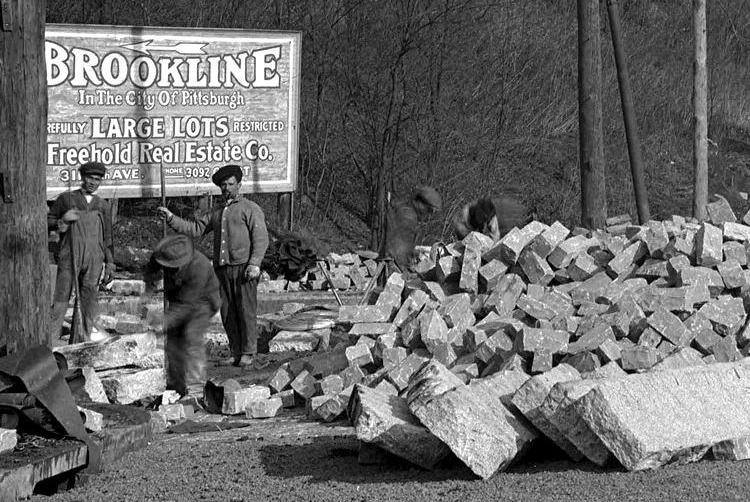
|

Reconstruction of the intersection of
Brookline Boulevard and Pioneer Avenue in 1935.
The Brookline community, one of the
many residential neighborhoods that make up the City of Pittsburgh, was
developed in the early 1900s. Prior to that, the region known as West
Liberty Borough, or Lower Saint Clair Township, was mainly populated by
scattered family farms. Mining enterprises also dotted the landscape.
The first formal housing plan, begun in
1891 along the hillside above Saw Mill Run, along Timberland Avenue, was called
the Boggs Place Plan. It was built to house some of the workers employed in the
mining operations that dominated the region at that time.
Starting in 1902, a the Fleming Place,
Hughey Farms and Paul Place plans appeared along West Liberty Avenue.
The sale of ten farms in 1905, along with the arrival of the Pittsburgh Railways
Company's high-speed electric traction line, was the catalyst to large-scale
development in Brookline.
* Last Modified: March 17, 2025 *

Engineers gather on Plainview Avenue in 1906
discussing designs for the construction of the King Place Plan, which
would consist of new homes along Plainview and Woodward Avenues, between Pioneer
and West Liberty Avenue.
The large white home below still stands along Woodward Avenue next to
the city steps at Ray Avenue.
Real Estate Advertisements
By 1908, the community had grown
to a point where it was annexed into the City of Pittsburgh. From then
on, commercial and residential development accelerated.
There were four distinct phases
of residential construction: the early development period from 1900 to
1910, the housing boom of the 1920s, the post-war era of the 1940s and
the Renaissance I migration in the 1950s.

♦ Fleming Place/Hughey Farms Real
Estate Ads (1902) ♦
♦ Freehold Real
Estate Ads (1904-1916) ♦
♦ Freehold Real
Estate Ads (1921-1926) ♦
♦ Freehold Real
Estate Ads (1930) ♦
♦ Pitt Manor Plan
(1942-1945) ♦
♦ London Towne Townhomes
(1979-1986) ♦
♦ Beechview/Dormont Real Estate Ads
(1901-1917) ♦


<><><><> <><><><>
<><><><> <><><><>
<><><><> <><><><>
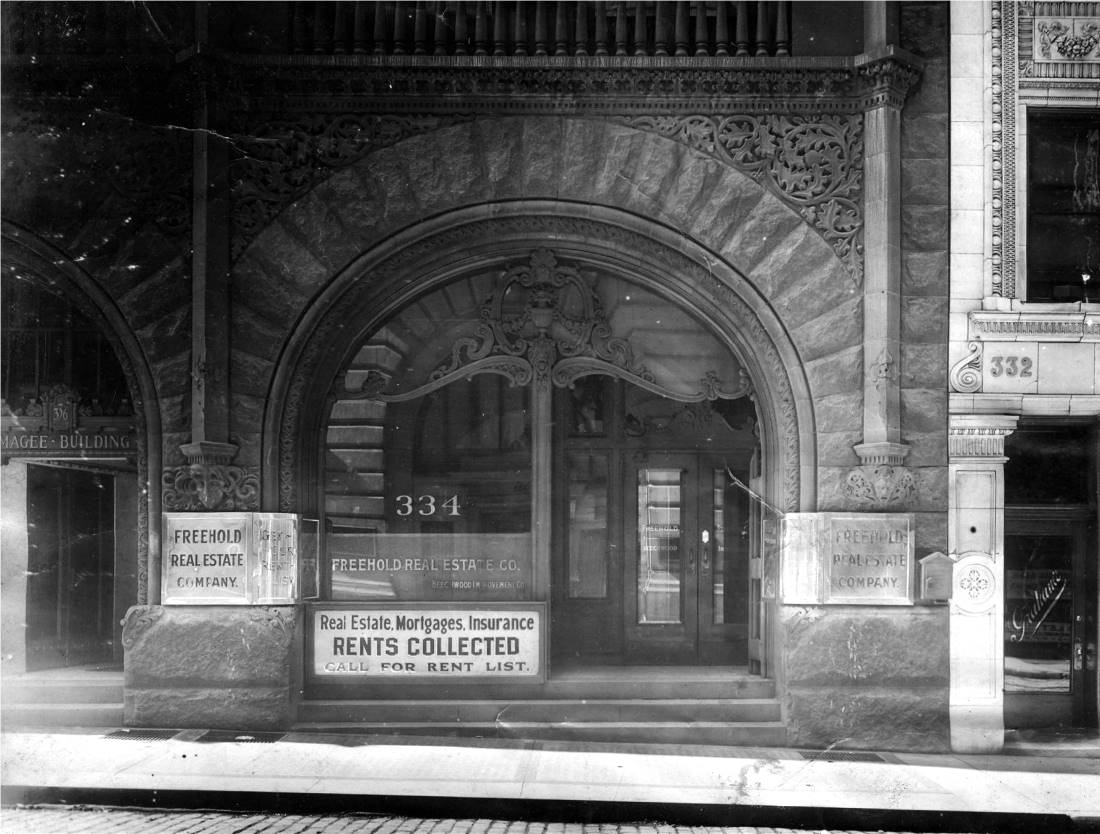 
Downtown Freehold Real Estate offices at
334 (left), in 1907, and later 311 Fourth Avenue, in 1915. These offices
handled many of the investment and home buying transactions for
Brookliners in the early days.
Brookline Subdivisions
Up until 1950, the growth of Brookline
can be charted in an illustration of the various subdivisions that
make up the neighborhood. Beginning with the original six Brookline wards and
continuing throughout the years, these individual tracts of land were built upon
when the original landowners made them available to developers. Piece by piece,
these distinct housing plans make up the puzzle board that is
Brookline.

<The 72 Brookline Subdivisions As
Of 1950>
<Map Showing Incremental Growth Of
Brookline>

Early development was done by
the West Liberty Improvement Company, the Freehold Real Estate Company,
the City of Pittsburgh, and the various parochial institutions. Infrastructure
installation was handled mainly by the city, the railway company and
the various utility companies.

In the decades that followed the 1950s,
new home construction was limited to a few houses here or there. The main
changes were civic infrastructure improvements, the expansion of the public
and parochial institutions, the addition of two high-rise senior apartment
complexes and the development of the 20-acre land tract known as the
Anderson Farm into Brookline Memorial Park.

Sewer line being repaired at the intersection
of Queensboro and Berkshire Avenues in 1933.
Sears Honorbilt Catalog Homes
For many years, a home buyer could
purchase a lot, then select the home of their choice through the Sears
Catalog. All of the necessary building materials would be shipped to the
construction site and the home built by local contractors.
One example of these Catalog homes
was The Fullerton. Sears homes were so popular and made up such a large portion
of the local housing stock erected during the 1920s that they came up with
a design known as The Pittsburgh.

HonorBilt Sears Catalog
Models Available For Purchase:
1908-1914 1915-1920 1921-1926
1927-1932 1933-1940

Altmar Street extension, looking north
towards Whited Street, during construction in 1946.
Below are links to some interesting
photos from the various stages of Brookline's development. They give a small
glimpse of how the community as seen today came into being. |