|
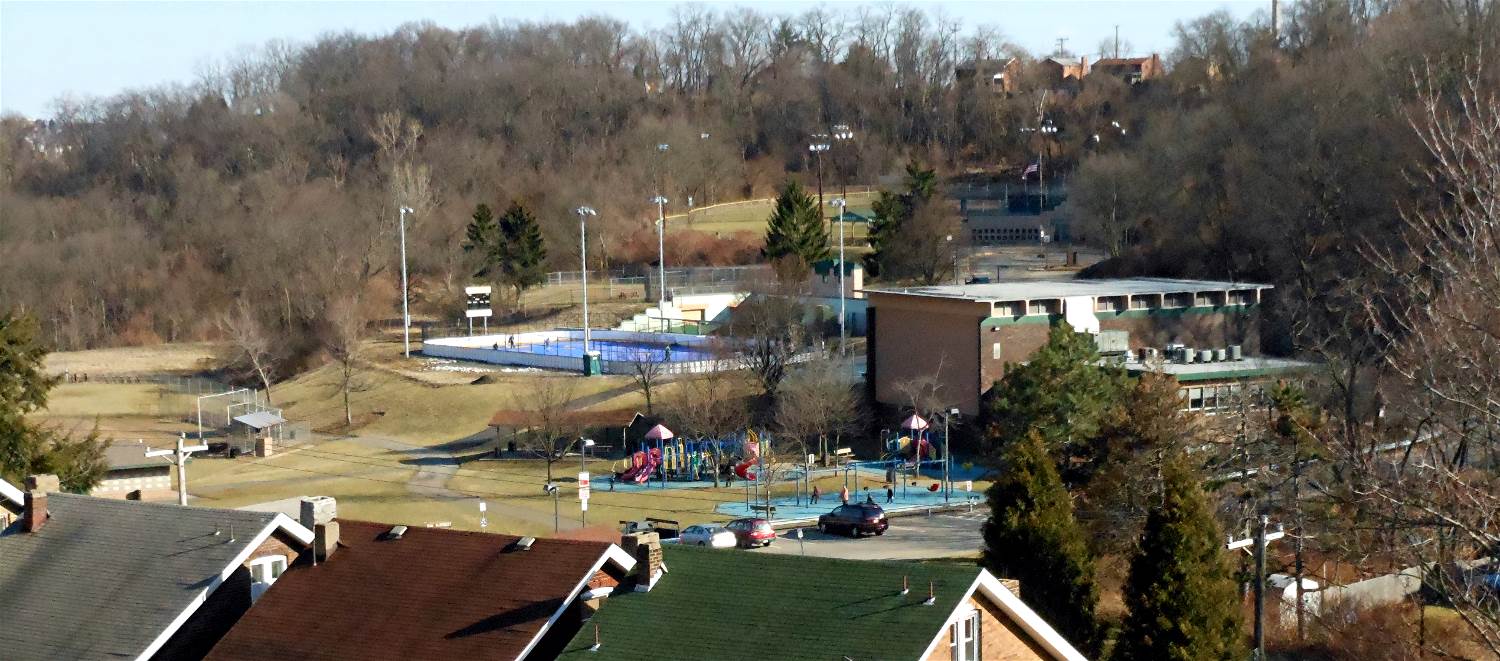
Brookline Memorial Community Center Park
in March 2014
From Farmland to Park Land
Evolution Of Brookline Park
Brookline Memorial Community Center Park,
established in 1947, is a finely landscaped recreational facility consisting
of four ballfields, multi-purpose recreation building, outdoor basketball court,
DEK Hockey rink, children's playground, picnic pavilion and much more.
As the march of time goes on, it becomes
ever more difficult to imagine how this land once looked in the early 1900s.
This once lush farmland, which produced a variety of fruits and vegetables,
and the adjacent wooded valley, has gone through a continual evolution over the
past century.
How did this farm and wooded landscape
become the annual gathering place that Brookliners utilize today? The evolution
of the Brookline Memorial Community Center Park provides an interesting look back
at the development of not only the park itself, but the growth of the Brookline
community.
* Click on images for
larger pictures *

Brookline Park, shown in 2010, covers nearly
sixty acres, including a 22-acre developed park and a
38-acre greenway.
The
Anderson Farm
Dating back to the dawn of the
19th century, the area that is now Brookline Memorial Park was mainly
rural farmland. The land was originally deeded in 1787 to Joseph McDowell
and David Kennedy. It passed to the Hayes estate, which farmed and mined
the land. In 1875, the the Anderson Family purchased twenty-two acres of Hayes property,
situated between present-day Brookline Boulevard and Breining Street.
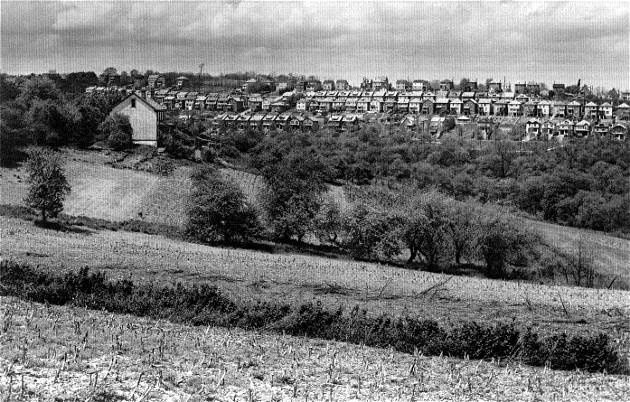
The Anderson Farm began operation
in 1875. The land was sold in 1947.
In 1895, James Anderson built a
large, stately home on the hillside below Breining. The farm operated as
a family business for nearly seventy years, supplying much of the fresh
produce and fruit for local merchants. As the community of Brookline
evolved around them, several generations of Anderson's continued to
cultivate their little corner of the neighborhood. By the 1930s, most
of the other large tracts of real estate had been sold to developers.
Only the Anderson Farm remained as a reminder of Brookline's rural
heritage.
Brookline
Development
Prior to the 1900s, Brookline consisted
mostly of sunny farms and wooded hillsides. Streams and brooks criss-crossed the
landscape. The main roads were sparsely populated with homes and merchants. The
area was then part of rural St. Clair Township, known officially as West Liberty
Borough. Despite the close proximity to the city of Pittsburgh, the South Hills
was cut off geographically from the urban population. The hilly nature of the
terrain kept it isolated from the region's industrial center.

The Mount Washington Transit Tunnel,
built in 1904.
The construction of the Mount Washington
Transit Tunnel through the
heart of Coal Hill was the catalyst that brought real change to the South
Hills. Streetcar service was established in Brookline. With a direct link to
the city, travel times were slashed and the urban population began to migrate
south.
Annexed into the city of Pittsburgh in
1908, Brookline development began to boom. Subsequent improvements in the
streetcar service made Brookline a popular place to live. The Liberty Tunnels,
opened in 1924, were the next big transportation improvement that spurred local
development. By 1930, the landscape of Brookline had evolved into a sprawling
residential community, a process that continued well into the 1950s.
Early Recreational
Facilities
The first playground that
Brookline ever had was located between Berkshire and Woodbourne Avenues,
below Castlegate Avenue. Later, three more playgrounds were established.
They were located between Gallion and Rossmore Avenues, Fordham and
Norwich Avenues, and at the corner of Aidly and Pioneer Avenues. The
residents were permitted to use these plots for playgrounds through the
kindness of the owners.
There was also a field between
Whited Street and Milan Avenue (where the current Roswin Drive homes
are located) that used to be a recreation park in the summer for the kids.
There was a big sand box, swings and slides, as well as volley ball, with
teachers in attendance to monitor the activities. Eventually these plots
of land were sold and the kids were left without any space to play.

A model of Brookline Elementary
in 1919 showing a proposed playground.
At Brookline School, the adjacent ground
was leased from the Knowlson family in 1919 and then purchased outright by the
school district in 1923. This land was to be used as a playground, but in 1929
much of this property was used for a much-needed school expansion. Because of
this, Professor Joseph F. Moore, in order to further the recreational activities of the youth in the Brookline district, and as chairman of the
Playground Committee of the Brookline Board of Trade, acquired a ten acre plot along Pioneer Avenue for the sole purpose of being developed into
a community park.

Moore Park swimming pool and bath house
under construction in June 1940.
The project, which was approved by the
city, stalled during the Depression years. Then, in 1939, with the assistance
of the Works Project Administration, this dream became a reality. The Council
of the City of Pittsburgh passed an ordinance which acquired and developed this
land as a playground which is now known as the Moore
Recreation Center. The new park opened in August 1940 and was named in honor of
Professor Moore, the man who worked so hard to bring a permanent recreation
facility to the community of Brookline.
As the years passed and the community
of Brookline continued to grow and develop, the need for further recreational
facilities arose.
Brookline Memorial
Community Center Association
The Brookline Memorial Community
Center, or the seeds of what exists today, were sowed in the mid-war
years. The Brookline Kiwanis Club opened a teenage canteen for dancing and
other limited activities. This was a temporary measure. The club researched
better ideas for providing a suitable recreational facility for the community.
It was decided to construct a recreation building ... but where, and
how?
The Community Center Committee was
formed in early 1945. It consisted of members from all of the local Civic
and Church organizations, and of residents from around the area. A mass
meeting was held in September 1945, at Brookline Elementary School. The idea
of building a new recreation building was approved. The Brookline Memorial
Community Center Association was chartered, with John L. Boyle as President
and Louis Beinhauer as Vice-President.

An aerial view of the Anderson Farm
in 1939.
The Association immediately went
to work investigating possible locations, and obtaining financing. In
February 1946 it was announced that a fundraising drive was underway to
build the park, a pool, a community building and a stadium. The goal was
to collect $120,000.
Some creative ideas were presented
to raise the desired capital. One was a "$30-Easy-Pay" plan wherein every
Brookline family would pledge to contribute thirty dollars. The plan would
meet the overall goal in one campaign. A house-to house drive was scheduled
to begin in March. This pledge would be payable with $5 down and the
remainder over a period of thirty months.
Another idea was a "Mile of Pennies"
drive for the community's 2400 school children. Banks would be placed on the
front desk of each classroom in the nearby elementary schools. Classes
would compete to travel the greatest distance "in pennies." This campaign
was expected to raise over $800.
By February 1946, civic and
business groups had already contributed $4000. Initial donations of $500 were
made by the Kiwanis Club, Brookline Business Mens Association and the
Resurrection Holy Name Society. Every business on Brookline Boulevard also
contributed $100 each.
Farm Purchased
Also in February that year, it was
discovered that the 22-acre Anderson Farm was being placed on the market. Two
acres on the extreme northerly section of the original Anderson property had
already been purchased by the Pittsburgh and Birmingham Traction Company in
1910 for use as a trolley loop.

This image of the proposed new
park first appeared in
the Pittsburgh Press on February 17, 1946.
Twenty-acres remained. A plot of land this
size, within the confines of a major city, was becoming a rarity, and with
it's location virtually in the geographic center of the Brookline/Overbrook
area, the site was a perfect choice. A buy option was immediately placed on
the property by the Community Center Association.

The Brookline Memorial Community Center
Association
purchased the Anderson Farm on May 3, 1947.
The farm was
purchased in May of
1947 for $19,000 dollars, with all arrangements handled by Paul N. Smith,
a local realtor, at no charge. Eighth grade students from around the area
canvassed the community for pledges, and Brookline residents were eager
to help. The necessary funding was procured, and Brookline Memorial
Community Center Park was born. However, through years of neglect, the landscape was
in a state of disrepair. A large ravine dominated the northern section of
the property and the remainder was overgrown with dense brush.
The Community Goes
To Work
Much work needed to be done to
make the land suitable for use as a recreational area. The Association's
charter stated that its purpose was to "develop the park for outdoor
recreation, and provide picnic sites and playground facilities, and to
preserve a country-like atmosphere within the city limits." The
Community Center Association went to work fast. With volunteer help and
further financing from residents and businesses, the park's evolution
began.

Proposed Brookline Memorial Community
Center Park Design
Pittsburgh Press - May 4, 1947.
The first order of business
was to draw up a plan for how to develop the land. Much thought went into
this design. An artist's conception of the future Brookline Memorial Community
Center Park that appeared in May 1947 envisioned a baseball field,
football field, large swimming pool, croquet courts, ski tower and toboggan
trail, tennis courts, picnic groves, outdoor amphitheatre and a recreation
building. It was a grand plan.
The flag
raising and dedication of
the park was held on June 29, 1947 at the old Anderson home, now serving as
a temporary recreation center. The park was dedicated to all of the local
citizens who served in World War II. It was christened in memory of those
who never returned. After the dedication, the hard work began.

A soldier, sailor and Marine salute as the
flag is raised in ceremonies
dedicating Brookline's new community center - PG Photo.
Tragedy Strikes
Once the park opened, one man took
a lead role in taking on the task of transforming the old farm into a
family park. Bernard "Barney" Diehl oversaw much of the initial excavation, leveling
and dumping of landfill. A resident of Breining Street, Diehl worked
tirelessly to construct the playground, and was beginning work on the
old Anderson farmhouse.
On September 27, 1951, while laying a
concrete foundation for an enlarged porch, Barney Diehl was stricken with a
heart attack and passed away on the scene.
Brookline Little
League
When first purchased, the farm land
was sloped. Extensive excavating and grading was necessary. With volunteer
help from men like Barney Diehl and Sam Bryen , tons of donated landfill and back-breaking labor, an area was
cleared on the lower plateau large enough for a parking area, two baseball
fields and a concession
stand. The Little League
field was built in time for the 1952 season. Major League style dugouts were added in 1955. The Pony League
field, with the help of Morris Grummet and the entire
Brookline community, was ready by the 1962 season.

The Community Center Little League field in
1956.
The year 1959 was a big year for
the fledgling Brookline Little League Association and the Brookline Community
Center. That was the season that Brookline hosted the Pennsylvania
Little League State Finals.
Improvements were made to the baseball field and thousands of visitors
from across the state came to watch the games. Brookline Park had hit the
bigtime.

The Community Center was filled to
capacity for the state finals.
During the winter months, when the
temperature cooperated, residents constructed a make-shift ice
skating rink on the
little league field. As shown in the Post-Gazette article below from
January 22, 1960, the frozen wonderland was quite a popular attraction
as long as the cold weather prevailed.

While the Little League complex
dominated the lower plateau, the upper section of Brookline Memorial Community
Center Park consisted of a large open field surrounded by thick woods. A
large open space was excavated from the hillside. This plateau was
envisioned to include an ice-skating rink, basketball courts, tennis
courts, playground equipment, picnic areas, and a modern
recreation building.

The upper plateau of Brookline Memorial
Community Center Park. The farmhouse
stands to the left, while orchard trees still dot the hillside below
Breining Street. Much work was planned to improve the
open field adjacent to the farmhouse.
Proposed Recreation
Center Building
By 1962, work on the ballfields
was completed. Preparations now began on the construction of a Community Center
Recreation Building.
The structure would be built next to the old Anderson farmhouse, which
served for over a decade as a temporary Recreation Center.

Construction of the original
Recreation Center - 1962.
Construction of the new building began
with volunteer help, supervised by R. H. Eberhart, and financed with local
contributions. When the first phase of the project was completed, the
building was just a one floor, 20' by 53' concrete block structure.

Artist's conception of the
new Recreation Center - 1962.
This was to be the foundation of
a much larger structure, which would be built into the hillside and be large enough to
house receptions and other large-scale activities. Due to a lack of finances,
phase two of the project never began.
Beehive Of
Activity
In the mid-1960's, the Community
Center became a beehive of activity. While efforts were made to obtain
further financing and materials to proceed with the second phase of
building construction, the partially completed Recreation Center was
extensively used. Basketball courts were built outside the structure.
The courts doubled as an ice-skating rink in the
winter.

Ice Skating at the Recreation
Center - January 1964.
Many local civic groups used the
building and surrounding picnic area for summer activities. The Women's
Civic Club hosted Day Camps for the kids, and carnivals
were held yearly, beginning in 1954, attracting young and old alike. The
Brookline Little League participation had grown to over 400
kids. In July 1965, a large parade preceded the carnival. The event
focused on the new building. Enthusiasm was high. The hard work and
dedication of the Brookline Memorial Community Center Association was
beginning to pay off.

Fund-raising carnival in the
Summer of 1965.
An Unprecedented
Move
Despite the generosity of the
entire neighborhood, the financial burden associated with the proposed
structure proved to be too much. The Community Center Association decided
that the best way to expand and modernize the existing park was to
involve the federal and city governments. With their aid, and the
availability of state and federal funding, the dream of a first class
community showpiece, complete with a state-of-the-art recreational
building, could become a reality.
In October 1966, in an unprecedented move, the Association
sold the remaining sixteen acres (two had been sold as individual housing lots
along Breining Street to raise money) to the City of Pittsburgh for $1. In
return for that one dollar, the city promised to develop the land into an
expanded, more accessible park, one that they predicted would serve over
11,000 people, including 3500 school age children living in the
Brookline-Overbrook area.
A successful presentation by Moore Park
Recreation Director Chuck Senft was given detailing the activities and programs
planned for the new facility. It was pivotal in convincing the Parks Department
and the Brookline residents to accept the city offer.

The Port Authority, having recently
ceased trolley operations in Brookline, donated the four acres of
the 39-Brookline trolley loop. The city also designated the adjacent thirty-eight wooded acres,
all tax deliquent properties, as part of the new Brookline Memorial
Park.
Brookline Memorial Community Center Park
now spanned nearly sixty acres. Plans for improvements included a swimming pool,
modern recreation building, lighted baseball/softball complex, regulation sized
baseball field, football/soccer field, basketball courts, tennis facilities,
nature trails, campgrounds, ice-skating rink and more.

A corner marker placed in the woods
denoting
one of the Brookline Park boundaries.
The park was to be
completed in five years, by the spring of 1972. The offer sounded too good to
be true, but there were no other choices. The land was turned over and residents
prayed that the city would follow through with their promises.
Brookline
Recreation Center
The first priority was the building of
a recreation building. Groundbreaking for the new Brookline Memorial Recreation Center was held on July 25,
1969. Construction
took two years. The building was completed in the spring of
1971. The 10,500 square
foot building housed a 50' by 70' gymnasium, including a basketball court
and folding stage, two 22' by 20' activity rooms, weight room, kitchen,
warming hut for skaters, restrooms and locker facilities, all at a cost of
$430,000.
The general contractor was J.J. McGaffin.
The building was positioned about twenty feet from the left field fence of the
Little League diamond. It made an excellent target for the long ball. Local
homerun king Eddie Beveridge, in 1972, hit several truly Ruthian shots over the building. He
was only eleven years old at the time.

Access to the building and park
area were slightly improved. A dirt roadway led from Breining Street to
the upper plateau. Parking there was expanded. Wooden steps were built
to allow people to get down the steep hill to the Little League fields.
On the lower plateau, near the building, parking was also expanded and
the walkways around the fields were paved.

More Fun on Ice behind the new Recreation
Center,
shown here on January 29, 1973.
Even with these improvements,
it was still difficult to get to the park. Vehicle access was limited to
the upper dirt road, or via Oakridge Street, with its dangerous intersection
at Breining Street. For the kids, there were always the improvised paths
either through the woods to Carmalt, up the sandy hill to Breining Street,
or down into the ravine, over "the pipe", and up the hill to Brookline
Boulevard.
Further improvements included the
addition of lights to the Little League field. It was quite a thrill for
the Little Leaguers to play night games under the lights. Playground equipment was erected behind the
new building, and picnic tables were placed in spots.

Lights were added to the Little
League field in 1971.
Tennis courts and a portable
four-foot pool were
added in 1973 to the upper park level. An unfortunate change was the loss
of the century old Anderson house, which burned to the ground in the summer
of 1971.
Aside from these improvements, no
further work was done by the city in the park. Impatience within the community
began to grow. In addition to the unfulfilled promises, the old Community Center
building on the upper level was in a sad state of disrepair and
unusable.
The land behind the lower ballfields had
become a cratered moonscape. Erosion along the Senior League outfield fence forced the placement of telephone pole sections in spots to keep balls, and kids, from falling through. Residents
began to complain.
 
By the mid-1970s the ballfields
were in a state of disrepair.
Local organizations, led by the
Brookline Little League Association and the Brookline
Area Community Council,
came together and applied pressure to the city agencies responsible for
developing the land. Through the perseverance of people like Little League
President Angelo Masullo and Community Council President Elva
McGibbeny, the city
finally acted.
Park Expansion
In the spring of 1975, three years
after park construction was to be completed, the second phase of development
began. The ravine bordering Brookline Boulevard was to be filled, extending
in a half moon all the way up and around to join with the upper
plateau.
This filled land would become a new
roadway, parking area, baseball field, football field, and open greenspace for
picnicking. The Master Plan, submitted in May 1975 was an impressive
architectural design.
 
The wooded ravine is leveled with
dirt from the Port Authority East Busway project.
Half a million
cubic yards of landfill were shipped in. This fill came from the construction of the Port
Authority East Busway. The trucks came, one-by-one, for months. City cleaning crews
hosed the streets daily
to keep down the dirt.
By the Winter of 1975, the valley had
been leveled approximately to its present position. Plans to fill further
were postponed, and eventually discontinued due to utility lines that ran along
the construction perimeter. Diverting these obstacles proved too costly for city
developers, and the present boundaries of the developed park were set. The new
baseball-only field was designated a multi-purpose baseball/football/soccer
field.
Ballfield Delays
Due to landslide concerns, the
hillsides were sloped from the old fields down to the fill zone, where a
new field was to be built. The aging outfield fences were removed, leaving
no effective baseball fields. Without fields to play on, the 1976 Little
League season was threatened.

Parents and children look
at unfinished ballfield - 1976.
Angry parents, with help from the
Pittsburgh Post-Gazette, pressured the Parks Department for a remedy to save the season.
Temporary fences and lights were erected. The city promised to have a new
Senior League field completed by the spring of 1977. As the springtime
approached, the city again stalled.
 
Construction of Danny McGibbeny
Field - 1977.
Relentlessly pressured once again
by community organizations, the leveling and
developing of the
ballfield area resumed. In July 1977, the first
game was played on
the new Senior League field. The girl's softball league moved onto the
vacated Pony field. The remaining landfill area was converted into a park
roadway, vehicle parking, two large grassy fields and an expanded children's
playground, with landscaping and tree planting throughout.

On October 8,
1977, the new ballfield
was named Danny McGibbeny Memorial Field, in memory of a young Brookline man who dedicated
much of his twenty-six short years to community service. On this rainy October day,
the park itself also received it's new official designation, Brookline Memorial
Park.
Major Park Reconstruction
In the Fall of 1980, with renewed
pressure from the Brookline Little League Association and the Brookline Area
Community Council, the city began work on the third
and final phase of
park development. This required extensive excavating, and the transformation would be
dramatic.

Phase Three of the park construction
required extensive excavation.
Gone would be the old Little League
and Senior League baseball fields, the concession stand, the old basketball
courts and the blockhouse. In place of this would be a new swimming
pool, tennis
courts, an expanded
roadway with additional parking, and a lighted multi-field baseball
complex.

The playground next to the Recreation
Building in 1981.
Work began in the fall of 1980 and
was completed by June 1981. The field was officially christened in June of
the following year. The Brookline Little League called its new baseball
complex Sam Bryen Fields, in honor of the man many call the Father
of the Brookline Little League.

Special guests at the June 1982 dedication
of Brookline's Sam Bryen Fields were:
Pittsburgh Parks Director Louise Brown, BACC President Elva McGibbeny, State
Representative Mike Dawida, Sam Bryen and BLLA President Ed Motznik.
In mid-June, coinciding with the dedication
of the new ballfields and swimming pool, the Brookline Area Community
Council sponsored the first Junefest, a community carnival to celebrate the grand opening of the
new Brookline Memorial Park. The Junefests celebrations were a big hit
with the community and continued from 1982 through 1985.

The Brookline Junefest in 1982 was
a huge success.
In addition to Moore Park, built in 1940,
Brookline now had another top-notch recreational park that it could truly be
proud of. Facilities were on hand for year-round use, and the Community Center
expansion was complete.
True Community
Center
Since completion of construction in 1982,
Brookline Park has been one of the unchallenged centers of the Brookline
neighborhood, a true Community Center. For seventeen years, from 1982-1998,
the Brookline Youth Soccer Association made their home on the lower fields.

Brookline Youth Soccer action - Fall
1998.
The Brookline Little League Association, sixty years young in 2010, expanded to
eight leagues serving over 600 children, and the Brookline
Knights Football Association teams, expanded to six teams, now had a permanent home
field.

The Knights 1980 Twerp team
celebrates a home victory at McGibbeny Field.
The Recreation
Center thrived, offering a
variety of activities, including basketball leagues, soccer camps, championship
boxing teams, track clubs, and ceramics classes, to mention just a few. Annual
events, like the Brookline Breeze, the Talent
Shows and the Chamber
of Commerce Easter Egg Hunts added to the excitement. There were abundant opportunities for the
neighborhood children to engage in recreational activities.
Additional Park
Improvements
In the final years of the 20th Century,
the park underwent additional improvements. In 1995, the Little League Association,
with local donations and volunteer labor led by Tony Colangelo, constructed
a new
concession stand and restroom
facility inside the baseball complex. The stand was dedicated to three
city firemen who had
perished earlier that year.

Mayor Tom Murphy dedicates new
playground - 1997.
In 1997, Mayor Tom Murphy dedicated a modern
playground facility, and
the outdoor basketball court was resurfaced. In 1999, a picnic pavilion was
constructed next to the playground. Sidewalks and light standards were repaired
or replaced.
21st Century Brings
More Changes
The dawn of the 21st Century brought
more subtle changes to Brookline Park. In 2001, the facades on both the baseball
Wall of Fame Archway and
the pool area were refurbished with new brick facing and trim. The tennis courts,
which had fallen into disrepair, were replaced by a small T-Ball field,
later named Stephen Mayhle Memorial Field. Tons of fresh landfill were dumped and leveled behind McGibbeny
Field, enlarging the area for future expansion.
In May of 2002, Citiparks Director
Duane Ashley and the Recreation Center Staff had the pleasure of re-dedicating the Brookline Recreation Center after
a six-month, $400,000 remodeling effort. The gymnasium was completely refurbished,
including the installation of a hardwood basketball floor, new lighting, upgraded
fixtures and a large electronic scoreboard. To christen the new gymnasium, the
staff started the Summer Youth Basketball Leagues.

Little League storage building and
pavilion - Spring 2008.
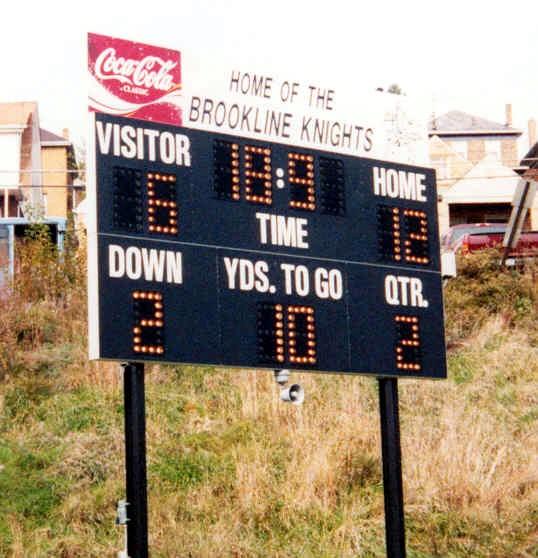
The year 2003 saw the construction of
a concession
and storage building and the
installation of a lighted scoreboard for McGibbeny Field and the Brookline Knights
football program. Five years later, a two-level storage building and
pavilion was constructed
between the ballfields in the upper Sam Bryen complex. It was ready for the opening
of the 2008 Little League season. A smaller pavilion overlooking the T-Ball field
was built the following year. Also in 2008, upgrades were made
to McGibbeny Field, including
a new infield, resurfaced outfield, new fencing and goal posts.
The second decade of the new millenium
began with a major improvement to the Recreation Center Building. In December
of 2010, the Brookline community celebrated the dedication of a new fitness facility, with a weight lifting gym and
a cardio room complete with all new equipment. The $400,000 investment included
a commercial HVAC system and a complete remodeling of the lower level.

The DEK Hockey Rink is a vibrant
addition to the park - December 2013.
In the Fall of 2013, the Pittsburgh
Penguins Foundation chose Brookline Park as one of twelve locations in Allegheny
County for the installation of a state-of-the-art lighted, outdoor DEK Hockey Rink. Built by the city and funded by the Penguins, the rink replaced the
swimming pool, which was decommissioned in September 2004 and had stood idle for
nine years.
The DEK rink, which cost $200,000, opened
in December 2013 and was officially christened by the Penguins on July 16, 2014,
when they hosted Youth Hockey Day. Available for public and private use, the rink has become the new home
of the Brookline Youth Hockey League, which was chartered in 2005.
 
The Sam Bryen Little League fields were
refurbished in the Fall of 2016.
The Brookline Little League Association,
in the Fall of 2016, invested nearly $50,000 to refurbish the Sam Bryen Little
League fields. Specially formulated dirt and clay was trucked in from North
Carolina for the infields. The hump where the infield met the outfield was
removed and the outfield grass sodded in the many worn spots. The fields were
properly leveled and ready for the start of the 2017 season.
The results were so stunning that in the
spring of 2017 the Little League Association followed up by repairing
the infield of Danny McGibbeny Field on the lower level of the park.
The ballfield renovations were, to date,
the last in a long series of improvements that have helped maintain Brookline
Memorial Community Center Park as one of the finest neighborhood recreational
facilities in the City of Pittsburgh.
A Wise
Investment
Brookline
Memorial Park, as we
know it today, serves thousands of youths and adults alike. Who would have
thought that in return for one dollar in 1966, the community of Brookline
would be rewarded with such a wonderful recreational facility? Just one look
around the park and the Recreation Center, which are buzzing with activity
year-round, says it all.

One of the Car
Cruises held yearly at
Brookline Memorial Park - May, 2010
It took some aggressive action, but
in the end the City of Pittsburgh came through. Several millions of dollars
have been invested to complete the transformation of the privately-owned
Brookline Memorial Community Center Park into a showcase family recreational
facility.
This could not have been done without the
dedication, perseverance, and leadership of the residents, organizations, and city
authorities that worked tirelessly throughout the years. Their efforts helped
turn one of the last of Brookline's old farms into a first class neighborhood
park, one that the Brookline community and the City of Pittsburgh can be
proud of.

Thursdays during summer - Comcast
Cinema In The Park - August, 2010
Articles reprinted from "The Brookline Journal" and
"The Pittsburgh Post Gazette". |