|
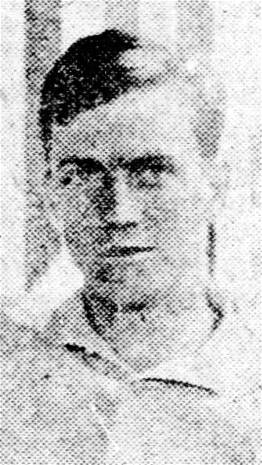
Pfc. Edward J. Napier
United States Army (1943-1944)
Edward J. Napier (Napierkowski) was born
on November 25, to parents Julia and Peter Napierkowski, a steel worker. Both of
Edward's parents were Polish emigrants living on 30th Street in the South Side.
He had three brothers, Stanley, Walter and John, and two sisters, Jennie and
Stella. Edward never finished high school and was employed as a Truck Driver in
the Strip District. He had a troubled past and, in 1931, at age twenty-one was
sent to Western Penitentiary after his third arrest for Auto Theft.
After his release, he met and married Mary
Tutchko on August 16, 1939. It was at this time that Edward shortened his name
to Napier. The newlyweds settled at 1228 Brookline Boulevard. Edward enlisted in
the U.S. Army in 1943 and, in February 1944, was assigned to Company L, 3rd
Battalion, 329th Infantry Regiment, 83rd Infantry Division, nicknamed
"The Thunderbolt."
After training in the United States, Pvt.
Napier and the 329th Regiment sailed for England from New York Harbor on the
British transport HMS Samaria. After twelve days at sea the ship docked in
Liverpool on April 16, 1944. The Regiment moved to a tent city in Wrexham,
Wales to begin training for war on the European continent.
The 83rd Division was originally assigned
to the U.S. First Army and scheduled to be part of the initial D-Day Omaha Beach
landings. However, weapons shortages forced them to be scratched from that list.
The Division was reassigned to Third Army and held back in England as the Allies
stormed the beaches of Normandy on June 6, 1944.
  
SAILING FOR FRANCE
After a two week respite, the Regiment
boarded the British liner Cheshire on June 19 and pulled out of port in the
darkness of evening. A bad storm at sea forced the ship to return to England.
The men remained aboard the cramped and crowded ship for two days. Finally,
on the evening of June 22 the ship sailed again and reached Omaha Beach the
following morning.
The 83rd Division, now temporarily back
with the VII Corps of the First Army, was given the mission of relieving the
101st Airborne Division in Carentan. They marched down some dirt and hardtop
roads through the villages of Formigny, Trevieres, and Bricqueville to an
assembly area at Colombieres, a total of about nine miles. The Regiment spent
nearly four days there before receiving orders to move about twelve miles west
through the towns of Isigny and Carentan to assume their front line
assignments.
By June 28 the Division was in place and
ready to begin maneuvering out of the Cotentin Peninsula, which had just been
secured with the surrender of Cherbourg. The next four days were spent patrolling
the vacant areas between units, looking for German patrols and
snipers.
Despite their intense training in England,
nothing could compare to the reality of being in the war zone. The green troops
often jumped at the sound of artillery fire, even if it was from friendly units.
Each day the soldiers became a little more accustomed to the noises of the
battlefield, but nothing could prepare them for the hell to come.
FIGHTING IN THE HEDGEROWS
For Pfc. Edward Napier and the 329th
Regiment, the drive south towards St. Lo began at 0400 on July 4. What followed
was the grim and frustrating story of the Battle of the Bocage. The hedgerows of
Normandy would prove to be the most difficult terrain of the war in which to
attack. These obstacles were defended by crack German SS Panzergrenadiers and
Parachute Infantry who had created a network of strong defensive
positions.
 
German Parachute Infantry put up a ferocious
defense in the Normandy hedgerows.
After the first day of fighting in the
rain, marshes and intimidating landscape of the hedgerows, the division had
advanced only one thousand yards and suffered tremendous casualties. They were
smothered by steady machine gun fire, mortars and hand grenades, and well
coordinated panzer and artillery fire. It was a slaughter.
The battle was not all one-sided. The
enemy was also taking heavy casualties. The carnage was such that, at 1600 hours,
a German medic raised a white flag and a short truce was called. The fighting
ceased in that sector and the medics from both sides came out to gather their
wounded. The Germans even helped with the American casualties. Once the medics
had done their duty, the fighting resumed in all its fury. It was a Fourth of
July that none of the soldiers of the 329th Regiment would ever
forget.
 
Fierce fighting in the Bocage took a
severe toll on the men of the 329th Regiment.
Just before dawn on July 5 the Germans
fired flares and the whole sky was illuminated. They opened up with artillery,
mortars, machine guns, and panzers. It sounded like the enemy was everywhere.
The Germans had launched a strong counterattack, but were fought off after
making only minor gains. After the first two days of combat, the 2nd Battalion
alone had taken well over 350 casualties. Private Napier's 3rd Battalion fared
little better.
For the next three days this was how
the battle unfolded. Each day was a life and death struggle as fierce fighting
continued in the bocage. The 329th Regiment pushed forward, one hedgerow at a
time, against determined German resistance. It had gotten to the point where
morale was beginning to suffer among the men in the regiment. Still, they
fought on.
 
The Americans cleared one hedgerow after
another and measured their gains in yards.
A GRIM TOLL
On July 8 the Regiment withdrew to a
line about 800 yards to the rear and reverted to Division reserve. This was
a much-needed break from the carnage at the front line, but there was still
the persistent artillery fire and threat of counterattack that kept everyone
on edge mentally. Even the exhausted had trouble eating and
sleeping.
The Regiment was back at the tip of the
sword on July 10, when ordered to attack near the town of Saint Eny. Again they
were met with dogged resistance and casualties were high. Little did they know
that during the past couple days the German lines had been reinforced with
elements of the elite Panzer Lehr Division.
The following day, July 11, the German's
launched another major counterattack against the American lines. The Panzer Lehr
advance was halted by a coordinated effort between the Infantry, Artillery and
Air Corps. Casualties were once again high. This time, the grim toll of those
who fell in the heat of battle included Brookline's Private Edward J.
Napier.
BACK HOME IN BROOKLINE
It was some time before word of Private
Edward J. Napier's death was received in Brookline. Perhaps the delay was due
to the enormous amount of casualties incurred by the Americans since D-Day and
the incredible amount of paperwork involved.
News of Pvt. Napier's fate was
released to the media and published in the Pittsburgh Press on October 21,
1944. The Napier family, of 1228 Brookline Boulevard, became another of many
to post a Gold Star on the window of their home.

THE THUNDERBOLT STRIKES
For the next two weeks, the 83rd
"Thunderbolt" Division fought on until reaching the St. Lo-Periers Road on
July 25. This was the date for the beginning of Operation Cobra, the Allied
Breakout from Normandy. The division was transfered to the Third Army and
participated in the sweeping drive through Brittany and on through France
to the Siegfried Line.
The Division fought in the Huertgen
Forest and attacked the Germans during the Battle of the Bulge. The 329th
Regiment crossed the Rhine and moved into the heart of Germany on March 29.
From there they made a mad dash east towards Berlin.
It was during this eastward rush that the
Division was refered to as the "Rag-Tag Circus" by war correspondents. Commanding
General Robert Macon ordered the Division to continue its drive forward with
anything that moved, "no questions asked."

The 83rd Division confiscated a wide
assortment of German vehicles, including Kubelwagons, staff cars, trucks, buses,
panzers, motor bikes and two fire engines. Each vehicle was painted olive green
and fitted with an American star before joining the Division motor poll. The
Division even seized and flew a German ME109 fighter plane.
At war's end, the 329th Regiment was the
closest U.S. unit to the German Capital of Berlin, being ordered to halt its
advance at the Elbe River, just thirty miles short of the city. Third Army
Commanding General George S. Patton, upon reviewing the Thunderbolt's Rag-Tag
Circus, proclaimed "that's the finest body of soldiers I have ever seen in the
field."
FINAL RESTING PLACE

Private First Class Edward J. Napier's body
was not returned to the United States for burial. He was permanently interred at
the Normandy American Cemetery and Memorial in Plot B, Row 15, Grave 45. Napier's sacrifice is
honored at this hallowed location along with that of another Brookline
soldier, Sgt. Alfred M. Reeves.

* Written by Clint Burton:
April 12, 2018 *
The Brookline
War Memorial

Listed below are
many of the sons of Brookline who gave their
lives to preserve freedom and contain aggression during
World War I, World War II, Korea and Vietnam.
“It is foolish and wrong to mourn the men who died.
Rather, we should thank God that such men lived.”
General George S. Patton
  

World War I
(1917-1919)

The World War I Memorial -
Washington D.C.
<> <>
<> <> <> <> <> <> <> <>
<> <> <> <> <> <> <> <>
<> <> <> <> <> <> <> <>
<> <> <> <> <> <>
World War II
(1941-1945)
|
Alm, William H.
Pioneer Avenue
Army
Details |
Arensberg, Roy T.
Fernhill Avenue
Army
Details |
|
Bracey, Bruce H.
Plainview Avenue
Army
Details |
Brickley, Edward G.
Woodward Avenue
Army
Details |
|
Capogreca, James J.
Merrick Avenue
Navy
Details |
Copeland, Clarence R.
Creedmoor Avenue
Navy
Details |
|
Cullison, Thomas J.
Birtley Avenue
Army
Details |
Dempsey, Howard F.
Berkshire Avenue
Army
Details |
|
Dempsey, Walter F.
Milan Avenue
Navy
Details |
Diegelman, Edward R. Jr
Norwich Avenue
Army
Details |
|
Dornetto, Frank P.
Jacob Street
Navy
Details |
Doyle, John F Jr.
Eben Street
Navy
Details |
|
Fagan, Gerald B.
Woodbourne Avenue
Army
Details |
Falk, Harold E.
Pioneer Avenue
Army
Details |
|
Fehring, Robert M.
Fernhill Avenue
Army
Details |
Gmuca, Joseph J.
Brookline Boulevard
Army
Details |
|
Heil, Robert F.
Bayridge Avenue
Army
Details |
Hynes, Richard E.
Waddington Avenue
Army
Details |
|
Kestler, Paul C.
Creedmoor Avenue
Navy
Details |
Ketters, Robert C.
Berkshire Avenue
Army
Details |
|
Mahoney, Michael J.
Oakridge Street
Army
Details |
Majestic, Arthur B.
Starkamp Avenue
Army
Details |
|
Mayberry, Alexander G.
Breining Street
Army
Details |
Mazza, John
Alwyn Street
Army
Details |
|
McCann, Robert F.
Edgebrook Avenue
Navy
Details |
McFarland, Hugh R.
McNeilly Road
Army
Details |
|
Meisner, Walter F.
Berwin Avenue
Merchant Marine
Details |
Miller, William J.
Norwich Avenue
Army
Details |
|
Napier, Edward J.
Brookline Boulevard
Army
Details |
Nicholson, John D.
Woodbourne Avenue
Army
Details |
|
O'Day, John R.
Creedmoor Avenue
Navy
Details |
Orient, Andrew D.
Fordham Avenue
Army
Details |
|
Pisiecki, Raymond A.
Wolford Avenue
Army
Details |
Reeves, Alfred M.
Brookline Boulevard
Army
Details |
|
Reitmeyer, John P.
Bellaire Avenue
Navy
Details |
Rhing, Vern M.
Norwich Avenue
Army
Details |
|
Ruane, Roy J.
Berkshire Avenue
USMC
Details |
Shannon, Harry C.
Midland Street
Army
Details |
|
Shannon, Jack E.
Midland Street
USMC
Details |
Simpson, James D.
Woodbourne Avenue
Army
Details |
|
Spack, Harry
Linial Avenue
Army
Details |
Tobin, Paul M.
Woodbourne Avenue
Army
Details |
|
Vierling, Howard F.
Fordham Avenue
Army
Details |
Wagner, Ralph G.
Shawhan Avenue
Army
Details |
|
Wentz, Walter L. Jr
Woodbourne Avenue
Army
Details |
Zeiler, Harold V.
West Liberty Avenue
Army
Details |

The World War II Memorial -
Washington D.C.
<> <>
<> <> <> <> <> <> <> <>
<> <> <> <> <> <> <> <>
<> <> <> <> <> <> <> <>
<> <> <> <> <> <>
Korean War
(1950-1953)

Korean War Memorial -
Washington D.C.
<> <>
<> <> <> <> <> <> <> <>
<> <> <> <> <> <> <> <>
<> <> <> <> <> <> <> <>
<> <> <> <> <> <>
Vietnam War
(1965-1973)

Vietnam War Memorial -
Washington D.C.
The Brookline
Monument - The Cannon

<Brookline
War Memorial> <> <Brookline
History> |