|

In researching the history of
Brookline soldiers in the First World War, old editions of the Pittsburgh Press
revealed the following special feature on the contributions of Pittsburgh
and Western Pennsylvania soldiers in that Great War. It is a revealing
documentary detailing the role that our local men and women played in bringing
an end to that global conflict. It is a part of Pittsburgh history that has
been buried in the newspaper archive for nearly a century. It has been
recreated here after so many years in hiding.
The documentary covers the work of
the Pennsylvania National Guard's 28th Keystone Division and the infantry regiments and artillery
battalion comprised of Pittsburgh men. It also follows the 80th Blue Ridge Division, made up of men drafted into service from
the Western Pennsylvania area, the 15th Engineer Battalion, raised and trained in Pittsburgh,
and Base Hospital No. 27, comprised in large part of students and faculty
from the University of Pittsburgh.
The story takes the reader from the
early days at training camps in the United States to the battlefields of France
and on to the armistice. Pittsburgh soldiers were instrumental in several
campaigns, including the Second Battle of the Marne, the Battle of Soissons and the Argonne-Meuse Offensive.
At the time of America's entry into World
War I, Pittsburgh was the eighth largest city in the United States. It was
an unrivaled industrial giant. From factory output at home, to the foot
soldiers in the field and the medical staff in the Army hospitals,
Pittsburgh did as much as any other city or state in helping to bring the
Great War to a successful conclusion for the Allies.

The Carnegie Steel Homestead Works.
When the guns ceased firing and the
doughboys from Pittsburgh came home, 508 did not
return, and many thousands
had suffered wounds. Many of our Pittsburgh boys remained in France, buried
in military cemeteries that will forever be hallowed ground, and a reminder
to future generations of the costly toll paid by the young men and women of
the United States of America to help preserve freedom and rid the world of
tyranny.
This story, written by John V. Hanlon
of the Pittsburgh Press, documents these achievements and is presented below
as it was printed in the Sunday Press a century ago. There were four missing
editions in this thirty-edition chronicle. The gaps in the text are unfortunate,
but do not take away from the gripping history of the soldiers from
Pittsburgh and Western Pennsylvania.
There are some additions and images
included at the end that substantiate and enhance the original text, including
some personal remembrances from a Mount Washington nurse that served in
France and a Somerset native that spent four months in German captivity.
Finally, there are additional links to online, readable Google Books that
detail the wartime experiences of individual regiments, complete with maps
and plenty of photos.
  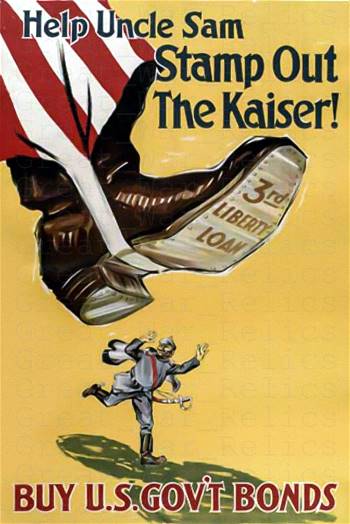 
A History
of Pittsburgh and
Western PA Troops in the War
by John V.
Hanlon
Illustrations from paintings by F.C. Yohn
(Copyright, 1919, by the Pittsburgh Press)
 The Saga Of The WWI
Veterans Bonus Army - 1932/36 The Saga Of The WWI
Veterans Bonus Army - 1932/36
Brookline Veteran's Memorial
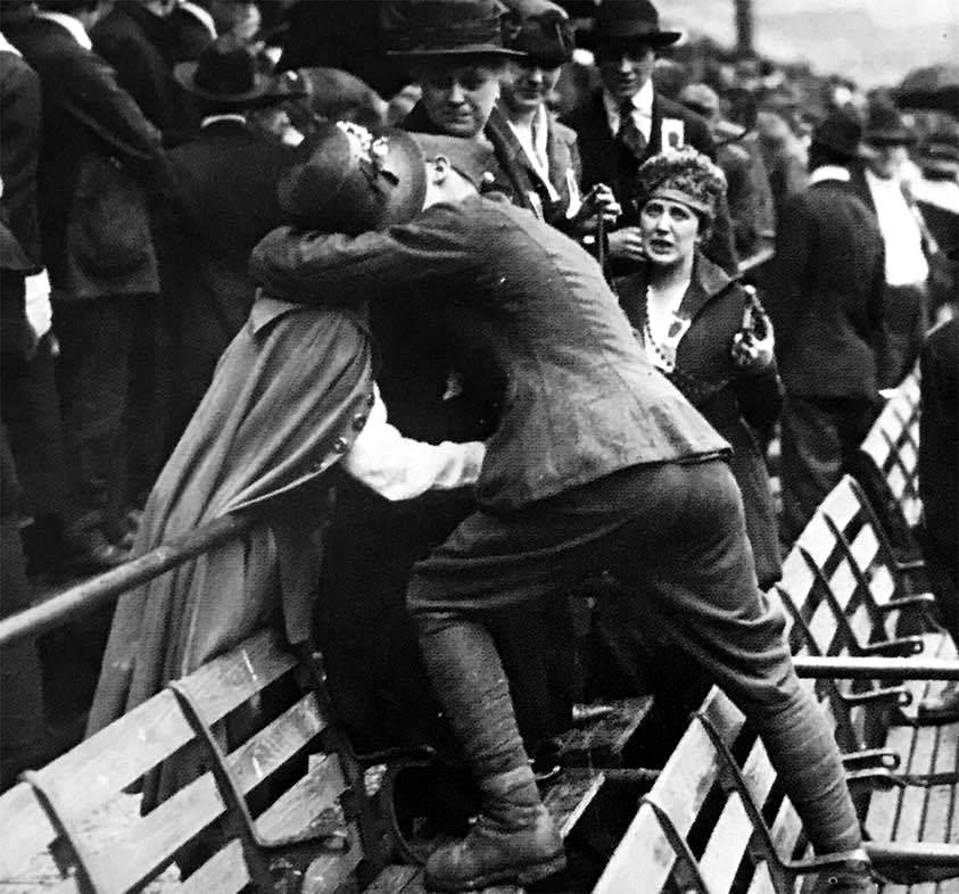 
The men of the 15th Engineers say goodbye to
family and friends on May 22, 1917 at Forbes Field (left)
and return to a triumphal parade through downtown Pittsburgh on May 7,
1919.
Additional Reading on Western
PA Troops during the War
"The 110th Infantry in the World War"
Google Online Books
- By Francis Earle Lutz
"History of the 110th Infantry (10th PA) of the
28th Division (1917-1919)"
Google Online Books
- By The Association of the 110th Infantry, Pennsylvania
"Illustrated Roster of the 110th Infantry (10th PA) of the
28th Division (1917)"
Google Online Books
- By The Association of the 110th Infantry, Pennsylvania
"The Iron Division, National Guard of Pennsylvania"
Google Online Books
- By Harry George Proctor
"The Accurate and Authentic History of the Second Battalion, 111th Infantry"
Google Online Books
- By George W. Cooper
"Company F History, 319th Infantry, 80th Division"
Google Online Books
- By Charles Ryman
"History of the 18th Regiment, the Duquesne Greys"
Google Online Books
- By The National Guard of Pennsylvania
"History of Hampton's Battery, the Pennsylvania Light Artillery"
Google Online Books
- By William Clark
"C Company, 15th Engineer Battalion History"
Independent Document - 107 pages - Author Unknown
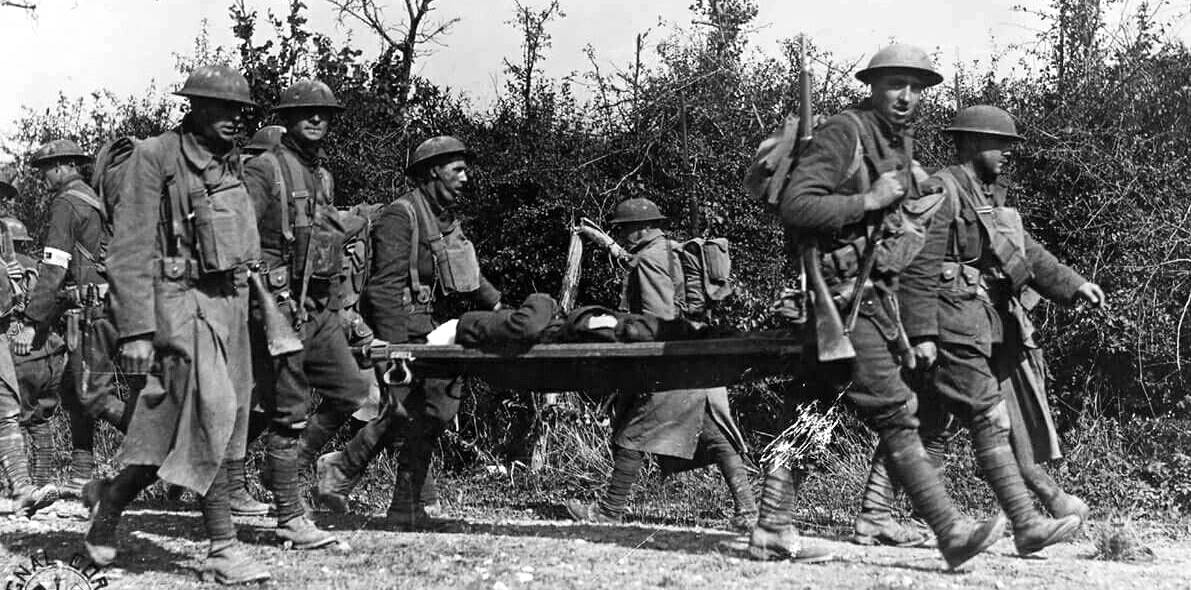
Men of the Pennsylvania's 28th Infantry Division
bringing in a wounded soldier on September 26, 1918.
INTRODUCTION
THE SPIRIT THAT WINS
To chronicle all the activities
and achievements of the sons and daughters of Pittsburgh and Western
Pennsylvania in the Great War would be to compile a complete history of
the mighty struggle itself. Such a history would have its opening
chapters dating from the day when he who was Emperor of the Germans
summoned his militaristic hordes and sent them forth on an orgy of
murder, pillage and terrorism to satiate his unholy greed for power
and to realize his ambition of a fettered world.
Long before the United States
entered the war and indeed from its very first days, adventurous sons
of Pittsburgh and Western Pennsylvania were bleeding and dying on the
battlefields where the allies were striving to stop the ravages of the
Hun.
Turn where you would in stricken
Belgium and bleeding, torn France; in the plague-ridden Balkans; along
the cold, barren wastes of Russia or on the hot sands of far-off Egypt,
wherever the crimson tides of war surged back and forth in the struggle
for humanity, they could be found performing acts of charity or mercy
or of war itself.
They
pressed the cup of water to the fevered lips of Serb and Cossack and
Poilu and Tommy. The men from India and Australia and Canada hailed
them from beds of pain as ministering angels and the sons of sunny
Italy were familiar with their work.
The Hun, too, had tasted of
their prowess with the cold steel on land and sea, under the waves and
in the air. When sudden death and destruction would pour from the
heavens at the enemy lines the steady skillful hand of a Pittsburgh
man was frequently at the helm of that battleship or in the
air.
UNTOLD DEEDS OF HEROISM
It is very likely that some of
the most notable deeds performed in this war will never be set down to
enrich the pages of the history or the advance of mankind towards that
goal where shines the radiant lights of equality and justice. Many of
these deeds were unobserved and those who performed them made the
supreme sacrifice. Their lips are forever sealed in the silence of
the grave. Perhaps had they lived the stories would have remained
locked close in their hearts, for brave men are not prone to boast
of valor.
And although many of these sons
of Pittsburgh and Western Pennsylvania had fought and died, winning for
themselves the deathless crown of victory under foreign flags, before
Columbia unloosed the mighty hurricane of her wrath, nevertheless they
contributed their all to the final determination of the great cause.
And as the story of their deeds is cherished in the archives of other
nations it is not possible at this time to include in this narrative
more than acknowledgement of their contribution to humanity. Anything
further would not be right for it could not give them that measure of
exact justice which is their due.
For this reason this resume of
the part played by Pittsburgh and Western Pennsylvania soldiers in the
war must begin with the entry of the United States into the conflict
and even then it is only possible to follow the activities of certain
designated units in which the personnel was made up largely of men
from this section.
When the United States declared
that a state of war existed with the Imperial German Government there
were hundreds of men from Pittsburgh and Western Pennsylvania serving
in the regular army establishment. There was hardly a unit of any size
which did not carry their names upon its roster of commissioned or
enlisted personnel.
ONE OF THE FIRST THREE
One of the first three men to
make the supreme sacrifice in the first actual clash between the
soldiers of Uncle Sam and the enemy was a Pittsburgh lad, Private
Thomas Enright, of 6641 Premo Street. He, together with Privates
James B. Gresham, of Evansville, Indiana, and Merle D. Hay of Glidden,
Iowa, headed the first honor roll of casualties which came home to
America from overseas.

Thomas Enright, James Gresham
and Merle Hay.
Private Enright had enlisted
in the Regular Army eight years before and had been assigned to
Company F, Sixteenth United States Infantry. He was therefore a
trained and seasoned man and when he met his death he was in a
training sector securing the actual combat knowledge necessary to
effectively instruct his less experienced comrades back of the
lines.
It was on Saturday, November
3, 1917, that the little band of about forty Americans to which
Private Enright was attached was cut off by artillery fire which
literally ripped their trench to pieces. The Germans had learned,
in some manner or other, that Americans were holding this salient,
and desired to capture prisoners in order to ascertain, if possible,
the strength of Pershing’s forces then in France.
It is recorded
in the data on that first fight that 210 Germans rushed the forty
Americans after the artillery preparation and in the hand-to-hand
combat which followed the Americans gave a good account of
themselves, fighting in a manner which would have delighted their
revolutionary ancestors. It was a fight worthy of the best
traditions of their country and flag.

American troops manning the
trenches.
The American casualties were
three dead, five wounded and twelve missing. The German casualties
are known to have been extremely heavy and although they secured
prisoners the cost to them in lives was out of all proportion to
the numbers they engaged.
When the story of this first
clash and the casualty list reached Washington and was made public
it sent a thrill throughout the nation and the war department was
besieged with inquiries from many anxious homes. The news brought
to America the first distinct appreciation that her part in the
great world struggle was not to be a bloodless one.
BURIAL OF PITTSBURGH HERO
And this appreciation of
the heartaches and suffering which war was to bring to many
firesides was especially felt in Pittsburgh, the home of one of
those three patriots who went to their deaths on that bleak
November day.
They buried the three heroes
close to the place where they fell; while the shells screeching
overhead sang the only requiem. American troops and French
veterans were massed in the form of a hollow square and the three
caskets, draped in the flag of the country they had loved so well
were carried upon the field by comrades.
From the lines there
stepped a soldier of France wearing the insignia of a general.
He walked to the caskets. With tears streaming down his
war-seamed face he removed his cap and bowing before each bier he
called the names of Private Enright, Private Gresham and Private
Hay, and then in a voice husky and choked with emotion
said:
“In the name of France I
bid you farewell. In the name of France I thank you. May God
receive your souls. Farewell.”
Then he asked in the name
of France that the mortal remains of these three young men be left
with that nation forever* and that upon their tombs would be the
words:
“Here lie the First United
States Soldiers to Fall on French Soil for Liberty and
Justice.”

Thomas Francis
Enright
Pittsburgh
As he finished there was a
terrific roar, the salute for the dead, and it was not fired with
blank cartridges, but by batteries of the great French 75s,
manned by American artillerymen who sent a salvo of shells
hurling into the German lines and with every shell there went a
prayer that it would find an avenging mark.
And the names of Privates
Enright, Gresham and Hay will have a special and distinguished
niche in history. The French will see to that for they already
have erected a monument to the memory of these brave soldiers
where all the world and generations yet unborn may read of the
day when the Hun first met the men of that nation which was
destined to wreck his vain ambition.
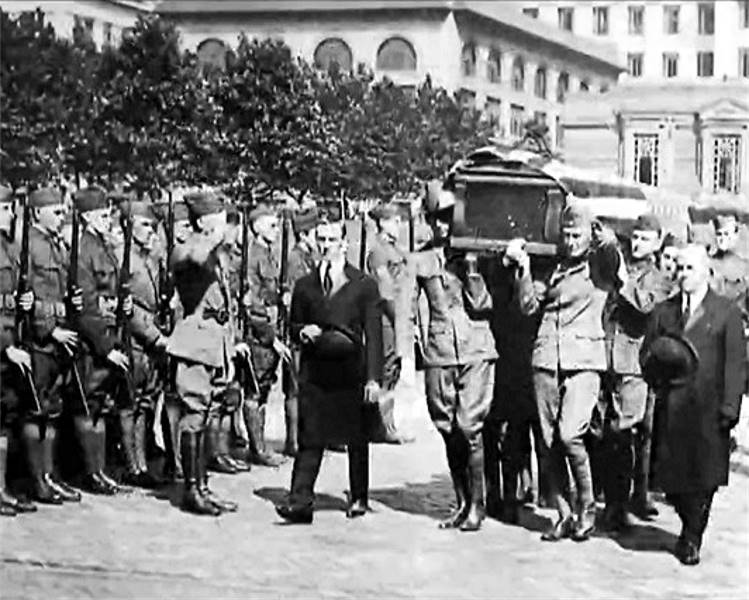 
The remains of Private Thomas
Enright were brought back to the United States in 1921.
Upon his return to Pittsburgh, his casket laid in state at Soldiers and
Sailors Hall
in Oakland. He is buried in Saint Mary's Catholic
Cemetery, Lawrenceville.
A WAR OF METAL AND METTLE
And this is where
Pittsburgh and Western Pennsylvania was first brought to a true
realization of the sacrifices necessary to the conduct of this
war and the truths brought home did not go unheeded. The story
of Private Enright and his comrades but strengthened that grim
determination to go on to a victorious end, let the cost in
blood and treasure be what it might.
As there was scarcely a
unit of any size in the Regular Army which did not carry the
names of Pittsburgh and Western Pennsylvania men upon its
roster, even from the earliest days of the Republic, so it is
today in the mighty and unconquered host which Uncle Sam has
created, for Pittsburgh brains and brawn and bravery were found
necessary wherever the War or Navy departments carried on their
activities.
Thousands of the most
skilled men in the military establishment were summoned from
the industries of Pittsburgh and Western Pennsylvania to do for
the government what they had been doing for private employers.
Pittsburgh and the surrounding industrial districts furnished
many of the very best mechanics and men trained in the various
metal crafts and trades.
This was a war of metal
and where else in the world could men be found so eminently
fitted for keeping the combatant branches supplied with the
weapons they used so effectively against the Hun!
And so to write the story of
their achievements would be to write of the work of every unit and
branch of the military service - ordnance, quartermaster, motor
transport, tank, chemical warfare and many other and special and new
sections necessary to the modern army.
For instance, it was
Pittsburgh chemists who strove night and day in gas research work
and contributed much towards making our gas defense and gas assault
sections so effective that even the Germans with all their boasted
expertness in chemical warfare were both outguessed and
out-gassed.
MAN LOCAL MEN COMMISSIONED
Through every ramification of
the service, in every rank and station the men of Pittsburgh and
Western Pennsylvania toiled through all the weary months when our
stupendous military establishment was building, to weld it into a
solid whole and which even in its infancy turned the tide of battle
and strewed the Central Empires with fear, internal dissensions and
empty thrones.
Hundreds of highly trained
executives from this section of the country were commissioned and
ordered to the nation’s capital to help direct the activities of the
war. They were searched out and summoned to the most important tasks
by both the military and civil authorities of the Federal government
and although many were restless because they could not secure
assignments overseas where the actual fighting was being done,
nevertheless they did not flinch from their work and contributed much
to the success of their brothers “over there.”
But it was not alone in
the military service of the nation that the sons of Pittsburgh
and Western Pennsylvania helped to make the world safe for
democracy. It was necessary that many should remain at home to
tend the mines, and mills, and factories. The Pittsburgh
district became the Arsenal of America in many respects.
To this great manufacturing
section where steel is king the nation looked for the implements and
machines of modern warfare. Here was planned the huge ordnance plant
which was to have furnished the heavy engines of destruction with
which our fighting men proposed to blast a way through the enemy lines,
and then on to Berlin.
To those who served in the
mines and the mills, the furnace and the forge, acknowledgement of
the part they played in the victorious outcome is justly due.
They will never be accorded the place in history that will go to
those who stood on the far-flung battle line, but, nevertheless,
they wrought efficiently and effectively back of that
line.

The German Kaiser bit off
more than
he could chew when he drew
America into the war.
ARSENAL OF THE WORLD
And thus it came about
that what was known as the “Workshop of the World” in times of
peace turned in the passing of a day into an arsenal of the
world. The thousand glares which light the skies of night
marking the abode of a wealth of peaceful industry and a world
a-building became the demon eyes of an outraged and determined
people flashing ominous warnings of swift and terrible
retribution for those who dared to taunt the Giant of the
Occident.
Then it was that Pittsburgh
and Western Pennsylvania resolved to drain the blood of manhood to
the dregs with the same determination with which the precious
metal is drained from the melting pots in order to make sure the
triumph of our arms. The lids of the treasure chests and strong
boxes were thrown open and gold was literally poured into
Columbia’s coffers.
Then it was that the call went
forth from Washington for men as well as munitions and money, and our
people saw those famous regiments from the western slopes of the
Pennsylvania Alleghenies depart for their training stations to secure
that military instruction which together with their traditional
bravery later enabled them to throw back the Hun from the very gates
of Paris; to confound and demoralize and annihilate the very flower
of German Soldiery; to break the armies of the Kaiser in twain at the
Argonne, and force an early ending of the Great War.
Later came the selective
service calls which summoned thousands more of the very cream of our
manhood to take up the rigors of military training; a training which
eventually made the Pittsburgh and Western Pennsylvania draftees the
superiors of any Hun who ever wore the uniform of his
overlord.
And the accomplishments of the
selective service men who left the plow and the forge, the store and
the factory, to do battle on the blood-stained soil of Europe; who left
peaceful homes for trenches reeking with all that chills the heart
- demonstrates that they were of a type beyond compare.
They were men
with iron in their blood and the advance of their legions was irresistible.
The German horde fell back withered and palsied before those living walls
of valor as if stricken with the most dreaded arrow in the quiver of the
Grim Destroyer.
PRAISE FOR PITTSBURGH MEN
It has always been the policy of
the War Department since Columbia threw down the gage of battle to
refrain from making public the standards of proficiency attained by the
various army divisions. This policy, no doubt, is a commendable one,
preventing, as it does, any feeling between the men from various sections
of this country.
Nevertheless, it has recently come
to notice and from the highest authoritative sources that the soldiers of
Pennsylvania were among the very best taken overseas. A great military
leader of a foreign power recently remarked in private conversation that
they proved themselves to be among the foremost soldiers of the
world.
The 28th Division (Pennsylvania
National Guard) and the 80th Division (selective service men mostly
from Western Pennsylvania) both became “Red” divisions - divisions
designated as “shock troops” of the highest known type and only so
honored after being thoroughly tested in actual combat with the
enemy.
The 28th Division is known to have
been the most proficient National Guard division in the United States.
That is why this division was among the first to be sent to Europe and
also why it was used so continuously and successfully, bringing upon
itself the record of so many glorious achievements.
The casualties of
this division and especially of some of the Western Pennsylvania regiments
which are a part of this unit demonstrated it was regarded so highly by
the supreme command that it was always used in the most difficult places
and where failure to hold or obtain objectives was not to be even thought
of, regardless of the resistance offered.
Likewise, the 80th Division became
one of the most proficient of the draft divisions because the records
show that even before departing for overseas it was held in high regard
by military leaders. But these facts will not surprise Western
Pennsylvanians, for their section of the state has given to our armies
of the past many skilled and notable men-at-arms.
Although ordinarily
following peaceful pursuits they are primarily of fighting stock and can
readily be transformed into soldiers capable of successfully meeting the
choicest of what William the Murderer was proud to boast of as his
unconquerable and matchless legions.

The Gunners of an American
Battery, though reduced to two wounded men,
keep their gun in action through a gas attack.
UNSURPASSABLE MORALE
The spirit and morale of the
Western Pennsylvania soldiery in this war was characterized by the
military authorities as unsurpassable. The traditions of their
state coupled with a free-born love of justice, together with a
natural aptitude to face and solve the serious problems of life,
made of these men antagonists to all tyranny.
They were accustomed
to laugh under the strain of the most arduous labors, for theirs was
the life of the mines and the mills where only the fittest survive
and thus they furnished some of the most desirable military material
obtainable in America.
They went to their training
camps with a song and a smile upon their lips just as they later
sang and laughed while a hurricane of German machine gun bullets was
cutting wide swaths of death in their ranks. They knew no such word
as failure and they also knew that no man from the Keystone state had
ever turned his back upon his flag. In their creed to die was one
thing and to die bravely was another and that is why they were
always found with their faces toward the enemy.
The folks at home already
know how true they kept to these teachings for in the accounts of
their battles cabled by the war correspondents it has been a matter
of frequent comment that the men of the Pennsylvania regiments
always fell with their faces in the direction from which came the
steel and leaden hail of the Hun.
This statement does not mean,
of course, that there were any Americans who refused to face the
enemy and go forward where sudden death was stalking beside them at
every step. It does show, however, that those from Pittsburgh and
Western Pennsylvania lived up to every cherished tradition of their
home district; that they were men unafraid.
In addition to the two
divisions mentioned above, Pittsburgh and Western Pennsylvania sent
many men to other fighting organizations. The Marines claimed
hundreds and everybody knows how the “Soldiers of the Sea”
accounted for themselves when they met the enemy. The Navy and
Merchant Marine claimed other hundreds while the dangers of the
Tanks and Aviation tempted many more to forsake the ways of peace
even before the draft calls were made.
A GLORIOUS CONTRIBUTION
And hundreds of men from this
section flocked to the officer's training camps very early in the war
there to learn how to lead and train other men. Most of them passed
their period of intensive military instruction successfully and they
were scattered throughout every arm of the Army, Navy and Marine
Corps.
The 79th Division which
trained at Camp Meade carried the names of about 3,000 Pittsburgh
and Western Pennsylvania men on it's muster rolls and the 83rd Division
which trained at Camp Sherman, Ohio, also received men from the
counties of Butler, Beaver, Lawrence and Washington.
The Fifth (now the Fifteenth)
Engineers which trained at Oakmont and which were one of the first
units to go overseas was recruited from in and about Pittsburgh, and
Pittsburgh likewise contributed the University of Pittsburgh Base
Hospital No. 27, which included an Allegheny Hospital Unit, known as
Unit L.
Taken all-in-all it was a
glorious contribution to the cause given by Pittsburgh and Western
Pennsylvania in stalwart manhood and it is predicted that when it
is possible to secure the final total of those who donned the
uniform of Uncle Sam from this section the percentage of men
directly serving the nation, either as soldiers or civilians, will
be the highest of any section of the country.
Many of the boys will never
come home again, they will not participate in the last grand review
and many a mother’s heart is aching because she will never see her
son again. They sleep under the soil of a people who gave us
Lafayette and freely shed their blood that our Republic might live.
Their graves are tended by loving hands and will be kept green and
flower-bedecked until such time as our government will bring the
bodies home.
The women of France do not forget.
The hero dead will come home either to find eternal rest beside loved
ones in some quiet country churchyard or maybe in Arlington, that
magnificent city of the nation’s soldier and sailor dead where one
may trace the history of Columbia’s greatness in the carven words
upon the marble monuments pointing to the last abode of those whose
memory our people delight to honor.
Some have died in the very
forefront of the battle while others were the victims of accident
or disease, but one and all gave the last full measure of sacrifice
and devotion. It matters not where they fell, nor under what soil
they repose either now or in the years to come. They have built
for themselves tombs which are indestructible, which even the ever
shifting hands of time shall only serve to polish and make more
brilliant the records of their deeds. Their names shall go ringing
down the centuries alongside those heroes of the world who have
gone before.
Others will return maimed
and torn by shot and shell - some to go through a living death of
perpetual darkness or mad from the shock of the close-bursting bomb
or crippled beyond human skill to repair. They want no charity and
none will be offered for they belong to the nation and it is not
likely that our people will allow the Congress to forget.
And those who return from the
conflict well and hearty will have treasures beyond the wildest
dream of the youth; treasures which they would not exchange for all
the gold in the universe and for which many men would today give
everything on earth which they hold dear. These treasures are the
knowledge of having been “over there,” of having participated in
the greatest military struggle in the history of the world, of
having gained the victor’s wreath.
They will have ever before
them the memory of what they did for mankind and wondrous stories
to tell until their dying days. Then when the dark night comes and
they pass ever to the comrades who have been gathered to their
fathers they will have a heritage to leave their offspring as
lasting and substantial as the rock of ages.
When on April 6, 1917, at
1:13pm, President Wilson signed the memorable Joint Resolution of
the Congress declaring the existence of a state of war and five
minutes later issued a call for volunteers to fill up to war
strength the regular military establishments, Pittsburgh and
Western Pennsylvania commenced to change the habiliments of peace
for the panoply of war. The transition was accomplished swiftly,
smoothly and thoroughly.
The great army of toilers
in the mines and mills and factories only paused long enough to
utter a defiant word to the Hun, to clench their fists and set
their jaws in determination. Then they turned to their work again
and with increased production began literally to jam the avenues
of transportation with the implements of war.
They knew that they
must gird Uncle Sam with armor against which the Hun might launch
his thunderbolts in vain and that the requirements of our gallant
allies must not be forgotten or neglected. Without the Pittsburgh
industrial district to turn to in the emergency there might have
been a different story to tell.
In Washington and London,
Paris and Rome, the contribution of Pittsburgh and Western
Pennsylvania to the winning of the victory is well known by those
who directed our civil and military enterprises. Foch and
Pershing, Haig and Petain can tell, and so can the former German
warlord and all his Prussian brood, for the enemy was unable to
withstand those avalanches of steel which rolled out of Pittsburgh,
tagged for Berlin.
And while every drop of
energy was being expended to turn out those products so necessary
to the prosecution of the war, Pittsburgh and Western Pennsylvania
did not forget that men must also go forth to make effective the
use of the material in the areas where despots sought to dispute
with free men in the future conduct of the world.
THE EIGHTEENTH ORDERED OUT!
Even before Congress had
finally passed the law to determine whether the military policy of
the nation should be volunteer or selective service, Pittsburgh
experienced an early realization of the cruel part of war, that
part which summons the sons and the husbands and the fathers from
the firesides and company of their loved ones and sends them forth
with the prospect that they may never return.
Death is hard at any time
but to go forth to face the end far away from kinfolk or even
kindly neighbors oftentimes makes even a brave man shudder. And
when men are destined to days of suffering from disease or wounds
there is something in the gently loving touch of mother or wife,
daughter or sister, which seems to possess the magic of transmitting
power to endure pain. This is the part of war which tears and rends
the heartstrings, but it is a part of the toll civilization has
ever been forced to pay. The progress of the world is but an
escalade of battles.
So to many anxious homes in
Pittsburgh there came the first real stir of war’s alarms when on
April 12, 1917 the old Eighteenth Regiment of the Pennsylvania
National Guard was ordered to mobilize and proceed to patrol the
great avenues of transportation which radiate from this
city.
The officials at the head of
our government knew only too well that the country was enmeshed in a
network of enemy espionage directed by agents who would not hesitate
to order any crime which might retard the stupendous preparations
Uncle Sam was making. There were few more likely places to commit
such outrages than in the Pittsburgh district. The railroad bridges
spanning the rivers and valleys and the tunnels piercing the mountains
offered especially excellent objectives.

Soldiers of the Eighteenth Regiment
guard the Radebaugh and Gallitzin Tunnels in May, 1917.
THE VOLUNTEERS DEPART
The presence of the
Eighteenth regiment on this important duty was first revealed May
18, but even before that date a Pittsburgher at the head of a
little band of intrepid Americans with the flag of the country
above them was marching through Paris for the front and being
acclaimed amid that greatest demonstration that city had witnessed
in years.
This event occurred on May 9,
1917, and the man was R.T. Scully, who was one of the officers in
charge of this unit of sixty Americans clad in khaki and armed with
rifles. They comprised the first detachment of the then newly
created munitions transport branch of the American Ambulance corps.
This was the first American armed force to pass through
France.
And while the Eighteenth
continued to guard the strategic points along the railways leading
out of Pittsburgh, thus assuring the speedy transportation of the
material for war, martial events began developing quickly throughout
this section of Pittsburgh more and more as each day passed by
realization of the stern requirements of the nation.
Soon the rhythmic tread of
marching feet echoed through Pittsburgh’s streets as the early
squads of volunteers departed from recruiting offices of the Army,
Navy and Marine Corps for the various training stations. Tented
cities began to appear in and about Pittsburgh and armories were
made ready for the mobilization of the units of the National Guard
which had not been placed upon patrol duty.

The order for the
mobilization of the National Guard of Pennsylvania was sent from
Washington to Governor Brumbaugh on the night of May 17, 1917 and
was immediately transmitted by the Adjutant General of the state
to all commands. The mobilization was set for July 15 at the
armories of the various units, there to be mustered into the
Federal service and await the order to proceed to the training
camp. The guard was drafted into the Army of the United States,
August 5, 1917, by proclamation of the President.
Meanwhile, Colonel Edgar
Jadwin, formerly in charge of the United States Engineers office
in the Pittsburgh district, had received permission from Washington
to go ahead with his pet scheme of recruiting a regiment of
engineers in Pittsburgh. He worked fast and aroused such
enthusiasm over the prospect of an early journey to France that he
organized and trained a splendid body of men within a short time.
At Oakmont, Colonel Jadwin established Camp Gaillard and the
regiment mobilized there for training May 23, 1917.
Then came the news of June
6, 1917. It was a day which will always be remembered for those
who were to comprise the principal part of the great draft army
registered for service. Ten days later the first Liberty Loan
campaign was launched and Pittsburgh and Western Pennsylvania went
into the business of beating the Kaiser with renewed vim.
THE ENGINEERS DEPART
The first troop movement of
consequence out of Pittsburgh occurred on July 4, 1917, when the
Fifth Engineers (now the Fifteenth Engineers) finally departed
from this section for a port of embarkation to take ship for
overseas, there to build railroads and wagon roads for the legions
Uncle Sam was preparing to hurl against the Hun.
From that time on until the
signing of the armistice hardly a day passed in which men from
Pittsburgh and Western Pennsylvania did not depart, either singly
or in squads, companies or regiments, with their objective as the
battlefields of France. The uniform became a familiar sight upon
the streets for many officers and enlisted men were assigned to
this district to supervise in the various industries performing war
work and to inspect the finished products.

Fourth Avenue in downtown
Pittsburgh was alive with the Spirit of America on July 19,
1917.
Many Pittsburghers had just left for war and many more were being
mobilized.
July 15, 1917, the National
Guard units not already on patrol duty mobilized. The Tenth and
Sixteenth Regiments of infantry assembled by companies at their
home armories throughout Western Pennsylvania and the First Field
Artillery took up quarters in Motor Square Garden.
Troop H, First Pennsylvania
cavalry, camped on Bayard Street, opposite the Schenley Riding Academy
and Duquesne Garden was used to house Truck Companies No. 5 and 6. The
First Field Battalion Signal Corps, Field Hospital No. 1 and Ambulance
No. 1 were stationed at the Armory, Penn Avenue and Station Street.
Ambulance No. 4 remained at its armory in Coraopolis and Field Hospital
No. 4 departed for camp at Mt. Gretna.
EIGHTEENTH CAMPS HERE
The Eighteenth Regiment of
infantry was relieved from patrol duty along the railroads and after
a parade through the downtown section of Pittsburgh went into camp
at Schenley Park. During all this time the Guard units were busy
recruiting up to war strength and close to 4,000 soldiers were
stationed in Pittsburgh and another 4,000 scattered throughout the
cities and towns in Western Pennsylvania where the various companies
maintained their headquarters.
In the meantime, the great
draft lottery had been held at Washington and the various local and
district draft boards in Pittsburgh and Western Pennsylvania were
busy selecting the men who were desired by the Federal government
to make up the personnel of the 80th Division of the new National
Army to be organized at Camp Lee, near Petersburg, Virginia and the
83rd Division at Camp Sherman, near Chillicothe, Ohio. The draftees
from the counties of Beaver, Lawrence, Butler and Washington were
sent to Sherman and those from all other sections of Western
Pennsylvania to Lee.
August 24, 1917, witnessed
the departure for Fort Oglethorpe, Georgia, of 600 officer candidates
who had assembled in Pittsburgh from every section of Western
Pennsylvania preparatory to entraining for the southern camp. They
departed in three squads over the P & L E, Pennsylvania and B & O
railroads and were cheered on their way by hundreds of friends and
well wishers who had gathered at the depots.
GUARDSMEN GO SOUTH
The first of the guardsmen
began to move towards Camp Hancock August 17, 1917, when Field
Hospital No. 1 and Ambulance Company No. 1 of the Eighteenth regiment
entrained. Then on August 30 the Western Pennsylvania contingent of
the First Field Artillery Battery, a sanitation detachment and
regimental band numbering 622 men and 18 officers entrained at East
Liberty station. Colonel W.S. McKee was in command and the local
units were joined later by Battery A, of South Bethlehem, Battery D,
of Williamsport and Battery C, of Phoenixville.
The units marched from their
armory to the station in a steady downpour of rain but this did not
deter thousands of relatives and friends together with city and
county officials from braving the elements to give the men a rousing
farewell. The same scenes were re-enacted when the Eighteenth
regiment “pulled stakes” at it's camp in Schenley oval and entrained
for Camp Hancock September 7, 1917.
September 11, 1917, the last
guardsmen in this section departed for the south; Troop H, First
Cavalry of Pittsburgh, which was later joined by Troop F, First
Cavalry of New Castle. During this period of the guard movement
the Tenth regiment and the Sixteenth regiment, both with companies
scattered all over Western Pennsylvania, entrained for Camp
Hancock.

Americans driving the Germans out
of a French farmyard. The enemy held thesefarmhouses and buildings
until the
last moment in order that he might harass the Allied troops. The
fighting was hand-to-hand and company work.
CHAPTER I
DEPARTURE OF PITTSBURGH AND WESTERN PA TROOPS
The night of September 4, 1917,
in Pittsburgh and in practically every city, town and village in this
section of the state, was a somber night for many Western Pennsylvania
families. The draftees received notice from their draft boards
to hold themselves in readiness to go to war.
The demonstrations of
farewell that took place in the thousands of Western Pennsylvania
homes were of the type that create fond memories for both the soldier
and his proud yet anxious family. The memories of these cherished
moments, for families and friends and soldiers alike, would be their
last together for many months or years, however long it took to push
the German aggressors back to the gates of Berlin.
THE DRAFTEES DEPART
The large crowds gathered at
the railway stations of Pittsburgh and other towns around Western
Pennsylvania on September 23, 1917, to bid farewell to those assembled,
were filled with pride and anxiety. The somber reality that many of
the thousands of draftees departing for military training would never
return could not dull the excitement of family and friend, but the
morbid anxiety was real.
The population of the United
States knew the bloody strife that awaited our soldiers and only too
well the terrible toll to be exacted by this war for they had received
first-hand information from our nearby neighbor Canada, where there
remained hardly a home that had not been touched with sorrow for
lost sons. Canada had paid a horrible price thus far on the European
battlefields by reason of the dash and daring of her unconquerable
legions.
But with all the sadness and
the bitter thoughts of what the future might have in store for the
boys who were going away, nevertheless there was a brave attempt at
cheerfulness, and many a mother went through the ordeal with Spartan
spirit as she gave her only son to Uncle Sam.
No one will ever know
the heartaches and the torture which the mother suffered during the
days when all these Western Pennsylvanians were leaving for the armed
camps, and then on through the long days and nights until the armistice
was signed and the casualty lists finally were completed.
First disease invaded the camps
and death claimed many of the lads even before they had completed their
training, and then when they were safely overseas the cables would
commence to bring stirring accounts of battles and tell of the brilliant
fighting of the Pennsylvanians. And after the news of the battles would
always come those lists of sorrow for many homes.
There would be a rap at the door
and a messenger would quietly hand out a telegram from the War Department
at Washington. That was all, and it was oftentimes the sudden end of the
hope and joy of a lifetime. But there was always the consolation in
knowing that he died with the bravest of the brave and for a cause in
which millions of other men cheerfully gave up their lives.

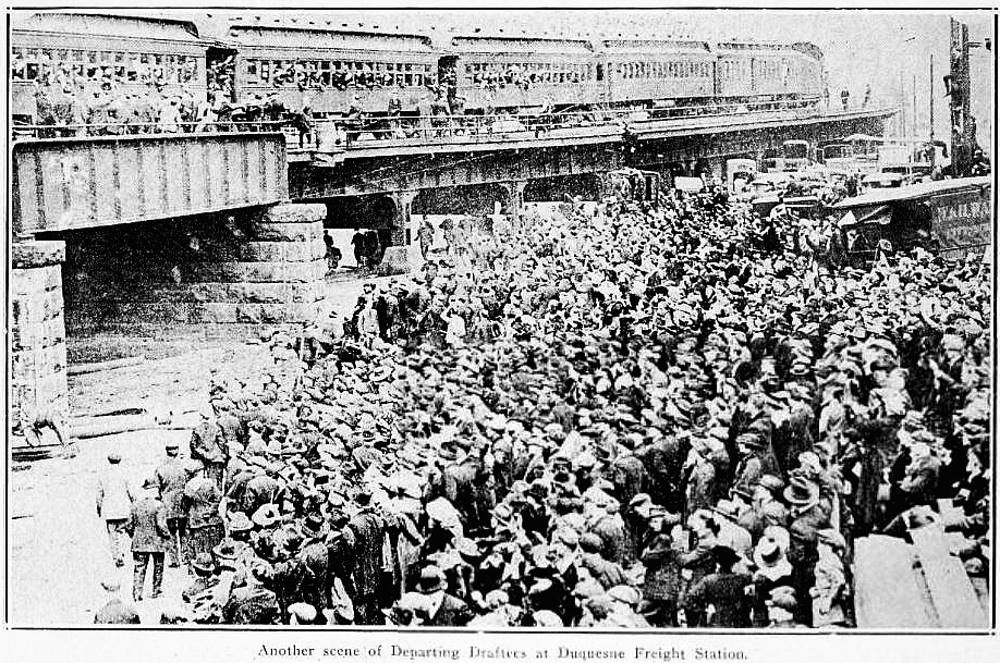
Drafted men from the First,
Third and Twelfth Wards at the B & O Station,
Pittsburgh, on Sunday, September 23, 1917.
LOCAL BOYS GOOD FIGHTERS
And, many a home in Pittsburgh
and Western Pennsylvania had good and sufficient reason to know the
casualties among the troops from this section were especially heavy.
Our families suffered this toll due to the fact that our soldiers were
efficient and dependable forces.
Wherever the vitally important work
was, where it was necessary to use soldiers who would not fail in the
tasks assigned them, our boys were sent. And such work was usually
found where the fighting was thickest and hottest and the enemy
offering desperate resistance with picked regiments.
During September, 1917, the
University of Pittsburgh Base Hospital No. 27, the female personnel
of which had been encamped at Ellis Island, embarked for France. The
unit numbered about 300 persons and was in command of Lieutenant
Colonel Robert Miller. This base hospital was recruited in Pittsburgh
and was originally financed by a contribution of $25,000 made by Mrs.
Henry S. Collins from the funds of the Pittsburgh Chapter of the
American Red Cross.
The Allegheny Hospital Unit,
known as Unit L, was mobilized early in September and departed for
France early in December 1917, under the command of Major Victor
King.
In addition, there were hundreds
of men leaving this section of the country almost daily under orders
inducting them into certain special branches of the military
establishment where their particular skill, along mechanical and other
lines, made their services greatly desired.
Some received commissions
while others were inducted as privates or in various non-commissioned
grades. It was this gradual filtration of the skilled men in and about
the Pittsburgh industrial district which eventually helped make the new
Army of the United States so proficient in almost every line of it's
endeavor.
MANY PITTSBURGH AVIATORS
No matter where one would turn,
either in this country or overseas, in aviation, quartermaster, ordnance,
signal corps or in any of the many different and exacting branches of
the service, Pittsburgh and Western Pennsylvania men could be found
performing the most difficult work and gaining lasting reputations for
energy, close attention to duty and as master craftsmen.
The aviation service, offering as
it did exceptionally hazardous opportunities, was a favorite with many
of the young men of Pittsburgh and Western Pennsylvania and hundreds of
them later won the right to wear on their uniforms the wings of the
graduate flying man.
Many thousands of others who offered
were unable to get into the aviation camps because of the great popularity
of this branch of the service and were forced to seek some other arm. But
those who did gave a good account of themselves both in the air as pilots
and observers or on the ground as engineers and mechanics.
The tank service was another
branch which was attractive for the men from this section and many
hundreds were accepted and became highly proficient in manipulating
these monsters of modern warfare. Chemical warfare, too, was
attractive to many Pittsburghers and Western Pennsylvanians, because in
this section there were many men skilled in chemistry and Uncle Sam had
crying need for these experts in order to make ineffective the
avalanches of gas so frequently sent over by the Hun.
TERRIBLE GASES READY
If the war would have gone on
much longer the Germans would have had occasion to learn even more of
the work of these chemists from Pittsburgh and Western Pennsylvania, for
they had devised gases so devilish and deadly that even the worst the
enemy had to offer were mild in comparison.
To enumerate all the special
branches of the service in which men from Pittsburgh and Western
Pennsylvania were engaged both at home and abroad would require a book
itself. They were everywhere and doing every imaginable sort of work
and in every rank and station in that great army.
Pittsburgh and Western
Pennsylvania physicians and nurses were at the front in large numbers
administering to the soldier boys, and the work of men and women from
this section of the country in connection with the various religious,
athletic and other activities must not be forgotten. Pittsburgh and
Western Pennsylvania furnished many men and women who voluntarily left
peaceful and happy homes to undergo the hardships of life on the
battlefield so that they might assist our fighting men.
Many such were striving by
night and by day in connection with the YMCA, Knights of Columbus,
Jewish Welfare Board, Salvation Army and the other agencies, and they
helped materially to lighten the load of the soldier boy billeted on
a foreign shore away from home and kinfolk.
General Pershing says:
"The fact that our soldiers, in
a land of different customs and languages, have borne themselves in a
manner in keeping with the cause for which they fought, is due not
only to the efforts on their behalf, but much more to other high ideals,
their discipline and their innate sense of self-respect."
"It should be
recorded, however, that the members of these welfare societies have
been untiring in their desire to be of real service to our officers
and men. The patriotic devotion of these representative men and women
has given a new significance to the Golden Rule, and we owe to them a
debt of gratitude that can never be repaid."
330,000 FROM PENNSYLVANIA
In the Red Cross, too, were
many men and women from the western section of Pennsylvania, and
wherever there were works of mercy or relief to be performed, either
among the soldiers or the civilians of devastated towns and villages,
their kindly ministrations will be long remembered.
Pennsylvania furnished the
stupendous total of 330,000 men to the World War, according to figures
obtained from the draft headquarters at Harrisburg, and estimates made
from the state totals indicate that Pittsburgh and Western Pennsylvania
alone furnished almost half this number.

Hundreds of Pittsburghers and Western
Pennsylvanians are sworn in to the service at Memorial Hall.
Draft boards throughout the entire
state furnished 195,203 men, and of this number 77,514 were supplied by
this section of the Commonwealth. The Harrisburg draft officials estimate
that in reality the state supplied 250,000 men through the draft, because
there were individual inductions amounting to 7,528 men sent to the student
army training camps and 219 to the navy. The balance of the estimate is
made up by adding delinquents and deserters and replacements for rejected
men at camps.
The State National Guard furnished
approximately 30,000 men, and in the neighborhood of 50,000 men volunteered
in the various branches of the Army, Navy and Marine Corps.
Recruiting officers in charge of
the Pittsburgh stations of the Army, Navy and Marine Corps, and who have
charge of all enlistments in Western Pennsylvania, estimate that they
received into the service more than 10,000 men. Of this number the Army
had about 3,000, the Marine Corps 2,200 and the Navy approximately 5,500.
Aviation and other special branches also obtained relatively large quotas
here.
Here are the draft figures for
Pittsburgh and the various counties of Western Pennsylvania:
Allegheny County 14,198; Beaver 2,850;
Blair 1,261; Butler 1,827; Bedford 568; Clarion 830; Clearfield 2,239;
Crawford 1,130; Cambria 4,726; Elk 981; Erie 3,207; Pittsburgh 18,467; Fayette
4,202; Forest 182; Greene 622; Huntingdon 701; Lawrence 1,648; Mercer
2,425; McKean 1,050; Somerset 1,372; Venango 2,381; Warren 806; Washington
4,565; Westmoreland 5,276.
When the National Guardsmen from
Pittsburgh and Western Pennsylvania arrived at Camp Hancock and the drafted
men at Camp Lee, those who had never participated in military affairs before
received their first taste of the hardships which often accompany Army life.
Especially was this so at Camp Lee, because there was a scarcity of bed
clothing, no heat and the weather was anything by comfortable.
The National Guardsmen had
considerable equipment before they departed for the South and so were
more fortunate in this respect than the selective service men, but even
then there were other inconveniences with which the boys had to put up
until such time as the camp was thoroughly organized and equipped. Many
were the complaints of unnecessary hardships which filtered back from
Camp Lee to the folks at home, and what was true of Lee was true of most
every camp in the country.

A section of the trenchworks at
Camp Hancock, where the 28th Division prepared for war.
AT THE CANTONMENTS
In undertaking to create so large
an Army, Uncle Sam had many obstacles to meet and overcome, and it was no
small task to provide the necessary equipment for so large a body of men
in so short a time between the declaration of a State of War and the
calling of the men to camp. In addition to bedding being scarce
considerable time elapsed before all the men were equipped with uniforms
and other articles of clothing required to withstand the rigors of an
Army camp in winter.
There were instances of
carelessness on the part of officers in exposing the new men to the
elements, and no doubt much sickness was caused as a result. This
carelessness most generally took the form of forcing the men to stand
in line in unheated buildings to await their turn for medical
examination or for various inspections, but such conditions were soon
corrected by the chief military authorities.
There were also some
cases of neglect in properly caring for men who were ill, but these,
too, were incidents due to the inexperience of the officers in
handling large bodies of troops and they did not happen after the camp
became thoroughly organized and in smooth running order.
But these experiences only served
to give the men an idea of what might be expected in the way of hardships
under war conditions, and on the whole they bore up bravely, accepted
their lot with a highly commendable spirit of patience and prepared to
acquire everything offered in the school of the soldier.
They later gave ample and sufficient
demonstration on the battlefield that, although they learned the arts of
war quickly, nevertheless they had learned their lessons thoroughly and
well. And some of the former Kaiser’s best well knew the truth of this
statement.
At the two camps, Hancock and Lee,
where the large majority of the Pittsburgh and Western Pennsylvania boys
were stationed, the usual courses of intensive training were commenced
shortly after their arrival and continued without interruption until the
divisions were declared fit to go overseas to complete their
studies.
LEARNING THE ART OF WAR
Of course, the guardsmen were for
the most part familiar with military discipline and the major field
maneuvers, so that it was possible to start them in the advanced studies
of the most modern forms of warfare within a few weeks after they went
into camp.

Maj. Gen. Adelbert
Cronkhite
But the selected men at Camp Lee
were, with few exceptions, entirely without any previous military
experience, so it was necessary to teach them the very rudiments of the
camp. From the start the men at Camp Lee had one of the most successful
soldiers in the Regular Army as camp commander, Major General Adelbert
Cronkhite, and it was freely predicted in high Army circles in Washington
that if the Pittsburghers and Western Pennsylvanians had the stuff in
them to make soldiers that he would turn out one of the best divisions
in the new Army.
How well this prediction held out
is known to the General Staff, for the 80th Division was noted as one of
the most highly trained and proficient divisions of the National Army when
it finally received orders to move to France.
And while the selected men at Camp
Lee were going along steadily and developing into first-class soldiers,
the guardsmen down at Camp Hancock were commencing to have troubles in
the shape of an order for the entire reorganization of the Pennsylvania
National Guard Division to conform to the new Army standards. General
Pershing, after making a study of the British and French army
organization standards, had worked out a plan taken from the best points
of both, and the carrying into effect of this plan played havoc with the
various guard units.
SCHEME CAUSES BIG PROTEST
The strength of an infantry
regiment under the new standards called for many more men and officers
than under the old scheme of organization. Thus some regiments were
broken up to bring others up to the new strength, and it was at this
time that the stir was caused when it became known that the Old
Eighteenth, of Pittsburgh, was to lose it's identity entirely by being
broken up, with part of the regiment to be used as a depot
brigade.
Major General Charles M. Clements,
then division commander, had arranged the scheme of reorganization and
some ugly stories were circulated at the time relative to an attempt by
Philadelphia politicians to save the identity of a Philadelphia regiment
at the expense of the Pittsburgh unit. The citizens of Pittsburgh were
indignant that the historic Duquesne Greys, upon which the regiment was
founded, should be thus relegated into oblivion, and a mighty protest
went up.
Delegations composed of the
Pittsburgh representatives in Congress, together with Colonel E.L.
Kearns, the commander of the regiment, hastily appealed in person to
Secretary of War Baker and to General Tasker H. Bliss, then Chief of
Staff of the Army, to save the Eighteenth. The information was given
that the reorganization was purely a matter for Major General Clements
to decide. The Governor, Martin G. Brumbaugh, was asked to exert himself
on behalf of the Eighteenth, and he even made a trip to Washington to
consult with the Secretary of War.
The tide of dissatisfaction was
running uncurbed for a time over this controversy. As the result of
some alleged irregularities, including a telegram bearing the signature
of the governor, which he declared he never signed, an investigation by
the War Department into the whole affair was threatened. Congress also
began to hear of the row and rumors of an investigation by the House
Military Affairs Committee were rife.
THE OLD EIGHTEENTH IS SAVED
Later, however, and much to the
relief of the citizens of Pittsburgh and the men of the Eighteenth, the
plans were changed so as to allow this regiment to retain it's identity,
but it had a narrow escape from not being able to add more glorious
chapters to it's long history.
All fair men in or out of the
Pennsylvania National Guard will admit that, although considered
excellent as a state militia division, this organization had much to
learn about the brand of warfare being waged in Europe when it entered
camp. Politics, both internal and external, had left imprints in spots,
and such imprints were considered as retarding the efficiency of the
men and the units.
The General Staff in Washington
was well aware of these conditions and did not hesitate to clean up
these spots, although taking full cognizance of the fact that such
renovation would undoubtedly cause much talk and dissatisfaction in
the quarters attacked. Nevertheless, to have left matters as they
were would have been to needlessly jeopardize the interest of the
soldiers in the division, both as regards training and
leadership.
The first and foremost consideration
was capable officers throughout every branch of the organization, and today
none know better than the men themselves how important, and for their
interests, were the changes made at Camp Hancock.
The weeding-out process removed
many officers either for physical defects, age or for other reasons
deemed in the interests of the service. Many of the officers so removed
were patriotic, sincere men, who had given a lifetime of service to the
guard and were loved and respected by the men of their commands, but in
this war there was no room for sentiment and so some had to
suffer.
GENERAL MUIR TAKES CHARGE
Major General Clements, the
guard’s division commander when it went to camp, was early separated
from direct contact with his command by being sent overseas on an
observation trip, and upon his return was retired and replaced by Major
General Charles E. Muir. Before being relieved of his command, Major
General Clements had also removed and shifted a number of officers,
including Colonel E.L. Kearns, commander of the Eighteenth Regiment,
of Pittsburgh. And Major General Muir did not hesitate to carry out
this policy of swinging the ax whenever he became convinced the service
could be benefited.

Maj. Gen. Charles
Muir
A lifelong and thorough soldier,
Major General Muir had not been long in command of the division before
improvement was noticeable in the discipline and morale of the troops.
“Regulations” Muir they called him. He demanded promptness and
efficiency on the part of officers and men and he did not hesitate to
speak his mind when things were not to his liking.
He won the
admiration and confidence of the men by demanding respect for them on
the part of officers as well as absolute obedience by the men. And
from that time on there was a new spirit of service, a new atmosphere
about the camp reflected in every activity. Thus was the 28th
Division re-made, and thus was it brought up to the new standard of
proficiency where it stood first on the list of all the National Guard
divisions of the United States.
LOCAL GUARD REGIMENTS
Before proceeding further with
the story of the activities of Pittsburgh and Western Pennsylvania
units in the Great War, it would be well to examine somewhat the
history of the guard regiments from this section of the state and also
to set forth the results of the reorganization whereby these regiments
may be identified in the Army of the United States. This history will
deal chiefly with the 28th and 80th Divisions, because it was in these
divisions where a large majority of these men served.
The 319th and 320th Regiments
of infantry, 160th Brigade, 80th Division, were the units comprised for
the most part of the selected men from Pittsburgh and the western end of
the state, although many were scattered throughout this organization in
the various arms of the service.
The guard regiments were the 10th
Infantry (now the 110th Infantry), 55th Brigade, 28th Division; 18th
Infantry (now the 111th Infantry) and 16th Infantry (now the 112th
Infantry), 56th Brigade, 28th Division; 1st Artillery (now the 107th
Artillery), 53rd Artillery Brigade, 28th Division; 1st Field Battalion,
Signal Corps (now the 103rd Field Signal Battalion), 28th Division;
Ambulance Companies (now the 103rd Sanitary Train), and Field Hospitals
No. 111 and 112, 28th Division; Truck Companies No. 5 and 6 became the
103rd Supply Train of the 28th Division.
THE “FIGHTING TENTH”
The 110th Infantry, formerly the
Tenth Regiment of the National Guard, was mustered into the state service
in December, 1873. Its military district comprises the counties of
Westmoreland, Washington, Somerset, Blair, Fayette, Indiana, Beaver and
Greene. The respective company headquarters are located at Greensburg,
Latrobe, Mount Pleasant, Connellsville, Somerset, Holidaysburg,
Blairsville, Indiana, New Brighton, Monongahela, Washington and
Waynesburg.
Colonel John A. Black, of Greensburg,
was it's first commanding officer, and he was succeeded by Colonel Alexander
L. Hawkins, who had been Captain of Company H, at Washington. The regiment
served during the Spanish-American war in the Philippines, where it obtained
the sobriquet of the “Fighting Tenth.” It's tour of duty there was from July
17, 1898, until July 1, 1899, when it embarked for home. The regiment suffered
casualties in the Philippines of: killed in action 6; wounded 70; died
of wounds 9; died of disease 6; and missing 1.
The death of Colonel Hawkins occurred
on shipboard July 18, while on the journey home. The regiment was
re-organized in 1900, with Colonel James E. Barnett as Commander who
served in that capacity until 1907. He was succeeded by Colonel Richard
Coulter Jr., of Greensburg. The regiment served on the Mexican border
during the Mexican aggressions from July 8, 1916, until October 4 of the
same year.
In August 1917, Colonel Coulter was
promoted to be Brigadier General and he was succeeded in command of the
regiment by Lieutenant Colonel Henry W. Coulter. In the reorganization for
service overseas as part of the 28th Division the table of organization
called for 3,750 officers and men, and to effect this change the Third
Infantry was directed to transfer the enlisted personnel of that organization,
less 346 men to the Tenth (now 110th) Regiment. Orders also assigned some
officers of the third regiment to the 110th and Colonel George E. Kemp
was named as regimental commander, with Lieutenant Colonel Coulter the
second in command.
“PITTSBURGH’S OWN”
The Eighteenth regiment was
“Pittsburgh’s Own” and perhaps the most historic military organization
in the state and one of the oldest in the nation. It was known as the
Duquesne Greys and was organized August 5, 1831. In the Mexican War it
served as Company K, First Pennsylvania Volunteers. In the Civil War it
served as Company B, Twelfth Pennsylvania Volunteers and gave 69 officers
to the Union Army, including Major General James S. Negley and seven
colonels.
The Duquesne Greys was organized
as a regiment of the National Guard of Pennsylvania in September 1869.
The organization in the early days of it's existence was given certain
special privileges, vested rights and immunities, and all military codes
of the Commonwealth since 1832 have contained clauses recognizing these
grants made by the Legislature.
During the Spanish-American War
the regiment became the Eighteenth Pennsylvania Volunteers. It was on
Mexican border service during the Mexican aggressions in 1916, was
called to do patrol duty in the state April 12, 1917, and drafted into
the Federal service August 5, 1917, by proclamation of the President.
Upon reorganization of the 28th Division it became the 111th Infantry,
56th Brigade. Sufficient of the enlisted and commissioned personnel of
the Sixth Infantry were transferred to the Eighteenth to being it up to
the new standards.
Since the organization of the
Duquesne Greys as a regiment in the National Guard of Pennsylvania, it
has been commanded by Colonel David Campbell, 1869-1870; Colonel
Presley N. Guthrie, 1870-1883; Colonel Chambers McKibben, 1883-1884;
Colonel Norman M. Smith, 1884-1899; Colonel Frank I. Rutledge,
1899-1909; Colonel Albert J. Logan, 1909-1912; Colonel James H. Bigger,
1912-1916. Colonel Edward L. Kearns was in command of the regiment
on the Mexican border and also when it went into training at Camp
Hancock.
THE SIXTEENTH REGIMENT
The Sixteenth Regiment, used
as a nucleus around which to build the 112th Regiment, hails from the
thriving oil and manufacturing cities and counties of Western
Pennsylvania north of Pittsburgh. It was organized in 1878 with
General John A. Wiley, a veteran of the Civil War, as its first
colonel.
From the time of it's organization
until it's entry into the service of the United States during the Great
War, it had but three commanders; General Wiley, General Willis J. Hulings
and Colonel George C. Richards. During the Spanish-American War the
regiment saw active service in Puerto Rico and was frequently mentioned in
official dispatches for its excellent work. At the close of the
Spanish-American War the regiment was reorganized by bringing in five
companies of the old Fifteenth infantry which then went out of
existence.
The respective company
headquarters are located at Oil City, Corry, Bradford, Kane, Franklin,
Erie, Ridgeway, Warren, Kittanning, Butler and Grove City.
In the new reorganization at
Camp Hancock sufficient commissioned and enlisted personnel to make
up the new standard were drawn from the Eighth infantry, which formerly
had headquarters at Harrisburg and was recruited from the central
portion of the state.
FIRST FIELD ARTILLERY
The First Field Artillery, which
became the 107th Field Artillery of the new Army, dates back to Civil
War days for it was formed around Battery B from the Allegheny Valley,
known as Hampton’s Battery. Hampton’s Battery was organized October
8, 1861 and served in the Civil War from 1861 to 1865. It was in some
of the greatest battles of the Rebellion including Bull Run, Antietam,
Chancellorsville, Gettysburg and others.
As a regimental unit the First
Artillery was officially organized November 30, 1915. The headquarters
are in Pittsburgh, but it's batteries are drawn from all sections of
the state. The regiment was in service during the Spanish-American
War but did not leave the country. During the Mexican aggression, the
regiment was stationed on the Mexican border. Colonel William S.
McKee was the commander at the time the regiment went into training
at Camp Hancock.
The First Field Battalion,
Signal Corps, which became the 103rd Field Signal Battalion of the
28th Division, was recruited in and around Pittsburgh a number of
years ago and was composed of experts in all branches of signal work.
The battalion was considered one of the very best in the United
States by reason of it's skilled enlisted and commissioned
personnel.
It saw service on the Mexican
border during the Mexican aggressions. How well this battalion accounted
for itself in the Great War will be apparent to all who read of it's
exploits in the chapters to follow. The battalion was in command of Major
Frederick T. Miller when it went into training at Camp
Hancock.
OFF FOR FRANCE!
The Truck Companies which
became the 103rd Supply Train, the Ambulance Companies which became
part of the 103rd Sanitary Train, and the Field Hospitals which took
the numbers 110, 111 and 112 were all recruited for the most part
in Allegheny County and had been part of the state guard organization
with headquarters in Pittsburgh.
Late in April 1918, the 28th
Division completed it's training and was declared ready for preliminary
work close to the scene of actual fighting. Overseas orders were
received by General Muir. The division embarked May 3 and was in France
by June 1, 1918.
The 80th Division was
transported to France during the latter part of June and the forepart
of July 1918.
It was almost impossible to
obtain an accurate record of the many shifts in the commissioned
personnel of the 28th Division during the time which elapsed between
its arrival at Camp Hancock and departure for overseas. There were
many changes and additions due to the reorganization as well as in
the career officers who were found unfit physically and
otherwise.
The following officers were in
command of the principal units from Pittsburgh and Western Pennsylvania
when the 28th Division embarked for France: 110th Infantry, Colonel
George E. Kemp; 111th Infantry, Colonel Edward C. Shannon; 112th
Infantry, Lieutenant Colonel Albert C. Crookston; 103rd Field Signal
Battalion, Major Frederick G. Miller.

Curious Frenchmen watch as the
doughboys of the 28th Division arrive in France, June 1918.

BATTLE CHRONOLOGY OF THE 28TH DIVISION
July 6 - Under shell fire in
rear of the line below the Marne.
July 15 to July 21 - Stopped last German offensive and participated in
the counter attack which started the German retreat.
July 24 to August 4 - The drive from the Marne to the Vesle.
August 4 to September 4 - Battle of Fismes and Fismettes.
September 10 to September 25 - In rest billets in St. Mihiel sector under
constant artillery fird while being incorporated as part of First American
Army.
September 26 to October 10 - Participated in The Battle of the Meuse,
better known as the Argonne-Meuse Offensive.
Towns and positions freed of
invaders by division, alone of with other troops: St. Agnan,
La-Chapelle-Monthodon, Boise de Conde, Epieds, Trugny, Courpoil,
La Charmel, Fresnes, Roncheres, Courmont, Boise de Grimpettes, Sergy,
Fismes, Fismette, Blanzy-les-Fismes, Barbonval, Glennes, Neuvilly,
Boureuiles, Varennes, Montblainville, Baulby, Apremont, Chatel-Cheherry,
Fleville.
CHAPTER II
AMERICANS ARRIVE JUST IN TIME
When the 28th Division arrived in
France our allies were facing the most critical period of the war. All
during the previous winter and early spring the Germans had prepared for
a series of drives which they expected to break the backbone of the
British and French armies before the Americans could arrive in
force.
The German expectations were
heralded to the world, so confident was the enemy high command that
nothing could go wrong with the carefully worked-out plans. The
Russian fiasco had released to them many thousands of seasoned veterans
and, with these added to the armies already on the West Front, the order
to advance was given on March 21, 1918. Then on a 50-mile front,
stretching from La Fere to Arras, the Germans went “over the
top.”
The French and British lines
joined in and around St. Quentin, and the objective was to force a
break and separate the forces of the two allies. This plan did not
succeed, but the enemy was able to drive a great wedge, and Amiens,
the important British distributing point, was seriously
menaced.
The second phase of the German
offensive was launched April 9 against the British in the Ypres sector,
and with such fury and persistence that Marshal Haig’s troops were
thrown back for a considerable distance before they were able finally
to stem the assault. But the British line did not break and the
French sent reinforcements whereby it was possible to counterattack
and regain a portion of the territory lost.
Raids and local actions then
constituted the principal activities for several weeks while the
Germans were preparing for their third effort. It began May 27
when the Crown Prince’s army was hurled forth from Chemin des Dames,
in Champagne. The Allied armies were forced back until the enemy
had reached the Marne and Chateau-Thierry by June 1.
The French capital Paris was
directly threatened. It was at this juncture of the German offensive
that American troops were rushed to the front and so successfully
helped the French stem the oncoming hordes of the Kaiser. Every
American knows the story of Chateau-Thierry and Cantigny.

Situation on the Western Front,
July 1918, when the 28th Division arrived to help stop the German
advance.
The Spring Offensive had gained much territory, but the Hun lacked
the strength for a push to Paris.
The fresh American troops provided the manpower needed to bolster
the Allied defense.
WHAT THE AMERICANS DID
Here are the words of the Commander
in Chief, General Pershing:
"The Allies faced a crisis
equally as grave as that of the Picardy offensive in March. Again
every available man was placed at Marshal Foch’s disposal, and the
Third Division, which had just come from it's preliminary training
in the trenches, was hurried to the Marne. It's motorized machine-gun
battalion preceded the other units and successfully held the
bridgehead at the Marne, opposite Chateau-Thierry."
"The Second
Division, in reserve near Montdidier, was sent by motor trucks and
other available transport to check the progress of the enemy towards
Paris. The division attacked and retook the town and railroad
station at Bouresches and sturdily held it's ground against the enemy’s
best guard divisions."
"In the Battle of Belleau Wood,
which followed, our men proved their superiority and gained a strong
tactical position, with far greater loss to the enemy than ourselves.
On July 1, before the Second was relieved, it captured the village of
Vaux with most splendid precision."

United States Marines drive the
Germans from Belleau Wood.
Thus the enemy began to secure
demonstration of the fighting ability of the Americans, and to meet lines
of adamant resistance that would neither bend nor break. The enemy was
stopped at the Marne, but one week later opened another offensive between
Montdidier and Novon in a new thrust for Paris.
The allied supreme command had
advance information and this blow was readily checked. This was the
situation during the last days of June, the darkest hour of the Allied
cause when it was feared that Paris was doomed and such a catastrophe
would literally take the heart out of the French.
It was during these stirring
times in June that the Pittsburgh and Western Pennsylvania infantrymen
were billeted within sight of Paris and hearing of the wonderful work
of their countrymen who were privileged to be taking part in the mighty
struggle.
They heard of Chateau-Thierry,
Bois de Belleau, Bouresches, Cantigny, those milestones already recorded
in the history of the American arms and they fretted and strained at the
leash which held them far from where there were deeds of valor to be
performed and glory to be won.
NOTE: Brookline's Sgt. Raymond P.
Cronin was a member of the 1st Battalion, 5th Regiment, 4th Marine Brigade,
assigned to the U.S. 2nd Divsion during the Battle of Belleau Wood. He
was killed during the Battle of Hill 142. For his bravery during that
engagement, Sgt. Cronin was awarded the Distinguished Service Cross, the
Navy Cross and the Silver Star Citation. Learn more about Sgt. Raymond
P. Cronin,
Brookline's most decorated soldier.

It was during this Battle of
Belleau Woods that the United States Marine Corps Leathernecks earned
the nickname "Devil Dogs." The German soldiers were so shocked by the
fierce grit and determination showed by the Marines under the most horrific
of conditions that they began calling them "Teufel Hunden." They name stuck
and to this day a U.S. Marine is refered to as a "Devil Dog."
BRIGADED WITH THE BRITISH
When the division arrived in
France it was split up into small units and brigaded with the British
troops to receive it's final instruction before going to the front. At
times the men became discouraged as the result of what they deemed an
exceptionally long training period for they felt fit to meet any Boche
that ever lived. Some of the men even began to wonder if they were ever
to see any of the real fighting.
The Supreme Command had worked
out a special system for training new troops whereby they were gradually
brought to that state of steadiness and perfection required for the line
by a series of movements ever nearer the front and thus closer and closer
to the sound of the guns. Then the artillery fire where through
experience gained, at times as the result of casualties, their nerves
were steeled to withstand the din of battle.
Next there was a period in the
front line under the watchful eye of experienced officers. But the
Americans “made good.”
During the course of training with
the British, the Pittsburgh and Western Pennsylvania troops were stationed
near Lumbres and later at French training centers near Gonesse and
Rebais.
The Division was partly
reassembled a few miles northwest of Paris with headquarters at
Gonesse. This town is about ten miles from the heart of the French
capital. The four infantry regiments together with the engineers were
scattered throughout the surrounding towns and countryside wherever
billets were available.
UNITS ARE SEPARATED
At the time of arrival in France,
the artillery brigade of the division, which included the 107th
Regiment, was separated from the other units and sent to an artillery
training camp many miles away. Other units had been sent to other
places for specialized training.
The infantry and engineer regiments
assembled first and then awaited the arrival of other units at the
divisional center, and it was during this wait that the Pennsylvania
doughboys began to long for a nearer approach to that direction from
which came the low rumbling sound like continuous thunder. To the
southeast on clear days they could see the great Eiffel Tower in
Paris.
But the men did not get much
time to ponder over the reasons for the delay in keeping them out of
the conflict. They were busy those warm July days in going through
that maze of work incidental to their final graduation from the school
of the soldier. It was a trying period but it was soon forgotten in the
days which followed.
The Germans were preparing for
another thrust at the Marne. The bald, naked truth is that the British
and French were fearful that they did not have sufficient men to stop
the Hun. Even during the last rush the lines were but thinly held and
would probably have given away had not the few American troops which
were ready been rushed up in the night in motor trucks and thrown into
the battle.
As appeal had gone forth for
more Americans, and casting aside all thoughts of a distinct American
Army for the time being, General Pershing offered all the troops
available to be brigaded with the French and British armies in a
supreme effort to save the world.
The American Army at that time
was merely an army on paper because it had not yet been assembled.
Divisions were the largest unit then working as a whole and by
brigading these divisions with the British and French the gaps would
be stopped up and their forces strengthened by all the available
American forces. Their army units were functioning with the
experience of the long years of war and it was an easy task to
assimilate the American divisions. Time was short, too, in which
to work effectively.

A convoy of trucks carrying soldiers
to the front line.
It was at this juncture in
the fortunes of our Allies that the order came down the line for the
28th Division to prepare for a journey. The artillery brigade had
not yet come up to join the division, so the infantry and engineers
were to go away without it.
When the time came to depart
for their new destination the men noticed that long lines of motor
trucks awaited them and there was much jubilation, for here indeed
was evidence of a respite from the wearisome hikes. They were to
ride in state, for the motor trucks looked to them like the best to
be had in the way of transportation.
There was expectancy in the
very air, for to be accorded the luxury of a motor ride was unusual
up to that time for the men of the 28th. However, they were
disappointed when the direction taken was not to the northeastward
or to the northward from whence came that rumbling sound, but
eastward from Paris.
They journeyed on through pretty
French villages where the townspeople greeted them as saviors when it
was discovered they were Americans. The Pennsylvanians sang and cheered
until they were hoarse. Soon they came to a little river, the
Petit Morin, and down along it's beautiful winding valley the great
trucks lumbered carrying their happy and cheerful burdens.
Suddenly the men discovered
that the distant thunder was gradually getting louder, and they
commenced to realize that they were approaching that zone where
the guns were continuously belching forth their messengers of death.
They knew, too, from the people along the way that they were nearer
the battle lines, and then finally they stopped in a little town
beside the river.

AT MONTMIRAIL
This town was Montmirail and
the distant guns could be heard distinctly. Part of the division
passed through Montmirail and stopped at another town a few miles
to the eastward. This town was Vauchamps. The rear of the column
turned off and stopped at Verdelot, to the westward a few miles from
Montmirail. The surrounding countryside was dotted with villages
and in the three towns and these villages the local doughboys and
engineers were billeted.
The pause here was but
another step in the advanced training of the men so that they
could become more familiar with the sound of the guns, and it was
only a few days before they ceased to notice that ever rising and
falling rumble which made the earth tremble under foot even at
that distance.
Now the soldiers from
Pittsburgh and Western Pennsylvania began to grow serious and
to buckle down to their training work with even more
determination to approach nearer perfection, for they realized
that the day would soon come when they would have an opportunity
to let the folks at home, and the world, know that the men of the
28th were not afraid of anything the Hun had to offer.
Within a few days they
commenced to grow restless, however, because they had not moved
nearer to the guns so that they might at least obtain a distant
view of the activities which were going on just to the north of
them; activities among the most important in the long war and
with Paris as the stake. They were not more than ten to fourteen
miles from the front lines along the Marne and could not
understand why they were not up there helping the French to hold
back the enemy from any further advances.
This was the situation as
it pertained to the Pittsburgh and Western Pennsylvania regiments
during the last days in June. Little did the men dream that
before the end of another month they would have decisively
demonstrated their mastery over the pick of the Prussian soldiery
and had written large on the pages of history that state of valor
and achievement which sent a thrill throughout America, and the
Kaiser reeling with disappointment and chagrin.
And little did they realize
that there were many there in those last days which would never
be with them again; many whom would be found, after the tide of
battle passed, with cold set features and with the light gone from
their eyes, the victims of the Hun; others cruelly shattered in
mind and body and facing a lifetime of helplessness and
misery.
But even if these soldiers
from Pittsburgh and Western Pennsylvania could have known in
advance the bloody days directly ahead of them they would not
have been less keen for the carnage; to have known would have
only whetted their desire to rise to even greater heights of
bravery and daring if such were possible. There were folks at
home who in other days had spoken of the guardsmen as “tin”
soldiers.
And there were officers of the
regular military establishment who had scoffed at them and questioned
their usefulness in a crisis. Both these insults were to be wiped out
forever; wiped out in such a sea of blood by men who were to prove
themselves the peers of any men-at-arms the world had ever known that
a blush of shame would mount to the cheek of every person who ever
uttered an unkind remark against the old Pennsylvania National
Guard.
ON THE FOURTH OF JULY
Came July 1, 1918, and the
Pittsburgh and Western Pennsylvania boys were still billeted in and
around the vicinity of Montmirail, from ten to fourteen miles from
the front lines on the Marne. They were planning for some sort of
celebration for the Fourth in order to help while away the tedious
hours of waiting for a shot at the Boche.
Something extra in the way of
food to be topped off with concerts, sports, etc., was on the program.
There was some comfort in the prospect of getting away from the
tiresome and heavy routine, too, because they expected to be allowed
to rest at least part of Independence Day.
Midnight, Wednesday, July 3,
1918, there was a stir in camp when the 109th Regiment, from
Philadelphia and the eastern part of the state, was rousted out
and formed into companies in heavy marching order. Here at last
was a prospect of action! Wild rumors flew up and down the line
to the effect that the Hun had broken through and that the
Pennsylvanians were going out to stop him. Some of the
Pittsburghers and Western Pennsylvanians in the 110th, 111th and
112th Regiments heard of the sudden movement and were wondering
why it had not been their luck to be called.
The night rang with the
hastily snapped out commands as officers prepared the 109th
Regiment to move forward. Then when the order to march at double
time was given the men were sure that something was happening.
It was a long, weary hike with the sound of the guns ever getting
closer. Then, just before the dawn, the head of the column was
stopped by a staff officer who arrived in the sidecar of a
motorcycle, and Colonel Millard D. Brown, of Philadelphia, in
command of the regiment, was ordered to return to
billets.
This was a disappointment
indeed, and when the order for a short rest was given the men just
dropped down in their tracks, equipment and all. They were dead
tired after the long, hurried journey. But while there were
prospects of real work to do they were willing to bear without
flinching the rigors of that wearisome march in the dark.
The night had been cool, but
when they were ready to trudge back towards their billets the sun
was well up and beating down in all its July fury upon their heads.
They thought of the celebration they had missed back in camp, and
they wondered what the loved ones back in America were doing to
while away the holiday.
CHUCKLES OVER “FALSE ALARM”
It was night before all the
companies were finally back in camp, and so all thought of any Fourth
festivities was gone. They were mighty glad to crawl into bed.
As to the celebration conducted by the other regiments, it is said
by officers, that, when it became generally known that the 109th
had gone forward in the night, the men considered themselves so
out of luck that they didn’t care whether they extracted any joy
out of the Fourth’s festivities or not. However, the men of the
other regiments surely did chuckle the next day when they learned
of what the 109th had been through.
But during this period the
Pennsylvanians were wondering as to the experiences of certain of
their number who were actually on the front line receiving advanced
instruction under the French. Several platoons had been picked
from the Division and sent in with the French just west of
Chateau-Thierry. This sector was not a quiet one, nor was it a
really active just at that time.
Two of these platoons were
from the old Eighteenth, under the command of Lieutenants
Cedric H. Benz, of Company B, and John H. Shenkel, of Company A, both
of Pittsburgh. Then the sector in which they were stationed
commenced to grow hotter as each hour passed. On July 1 the French
decided to launch attacks against the nearby village of Vaux and
Hill 204.
The Americans carefully
watched the French go about the preparations for this attack, with
that skill which is only obtained after long and arduous campaigning.
The Americans were invited to take position where they could easily
view the whole operation.
The platoons from Pittsburgh had
made such an impression on the French that the French Commander informed
them they might participate in the attack if they so desired, but
that such action would be entirely voluntary. Those who elected to
go were invited to step out of the ranks and every man of the two
platoons came forward with a snap that demonstrated how eager they
were to get into some actual fighting.
They went into the battle
with the French, and under French command and they were the first
troops of the 28th Division to engage in important fighting. Here is
the story of that attack told by the French general
commanding:
AMERICANS ROUT THE ENEMY
“On the morning of July 1 a
platoon of the 111th Infantry, in command of Lieutenant Shenkel,
participated with several platoons of French infantry in the attack
on Hill 204. The battle opened with sharp machine gun fire from
the German forces, concealed in trees, underbrush and trenches.
Immediately, on gaining the heights of Hill 204, Lieutenant Shenkel
deployed his troops to the right and left of him for the purpose
of making flank movements.”
“As the Pittsburghers and
the French commenced to close in on the German troops an avalanche
of machine gun fire greeted them. The soldiers refused to give
ground and continued their advance. Seeing that the machine gun
fire could not check the advance, the German officer in command
called for a barrage artillery fire. But before this could be
laid down the Americans had routed the enemy from his first line of
trenches.”
Lieutenant Benz went in on
the left of Hill 204 with his platoon and together with the French
completely routed the German forces. He succeeded in bringing
thirty-nine prisoners back to his lines.
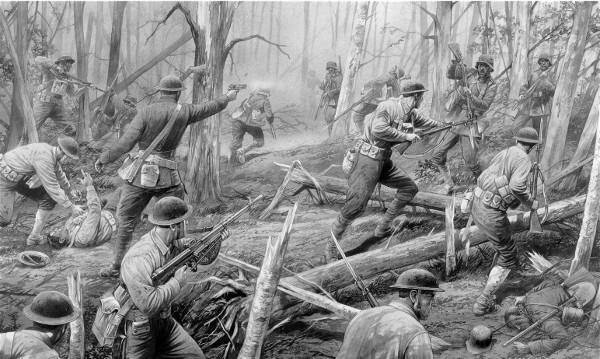
American soldiers attacking a
German position near Chateau-Thierry, July 1918.
The French general in his
report on the work of Lieutenant Benz said:
“Lieutenant Benz and his
platoon of American and French soldiers, in spite of the firing
of the enemy’s heavy and light machine guns, trench mortars and
riflemen placed in trees, bravely threw themselves on their
adversaries in a fierce hand-to-hand contest. In a thick and almost
impregnable wood, they not only routed the German forces but took
thirty-nine prisoners back to the allied lines.”
The sector where Lieutenant
Benz operated was of the utmost importance. The enemy had
concentrated large forces, and a menacing shrapnel fire was
continually harassing our troops located at Vaux directly within
the range. The lieutenant and his men started towards the crest
of the hill. They soon gained its heights and were forcing their
way through the heavy underbrush when a burst of machine gun
bullets was sprayed on them.
FOUGHT LIKE DEMONS
Taking position as skirmishers
the men pressed forward even under this heavy fire, while the enemy
troops quickly retired to second line trenches. The lieutenant saw
a chance for a rush before the enemy could set up his machine guns
in the new position and his men were quickly upon them, forcing them
back to the their line and then finally out of the woods.
It was then that a number of
the Germans became panic-stricken and beat a hasty retreat, leaving
Benz with his thirty-nine prisoners.
Lieutenant Shenkel was also
busy on the other side of the hill during all this, for by a flanking
movement a detachment of German soldiers had succeeded in trapping
Shenkel and a squad of his men. This crisis was quickly broken up by a
counterattack.
The lieutenant and his seven men
fought like veritable demons, cutting and hacking their way through the
Germans with bayonets and the butts of their rifles. Lieutenant Shenkel
flirted with death more than once that day, for three times he was
targeted by a German sniper who was concealed in a tree. Each time
the bullet pierced part of his uniform.
In commending Lieutenant
Shenkel for his part in this battle the French high command, after
telling of his ardor and bravery in the taking of the hill, declared
that “the American people should be proud of the wonderful soldiers
that are now fighting with the allies.”
“The odds were ten-to-one
against you,” said the General, “but this great disadvantage did not
dampen the ardor and bravery of your men. You troops today did what
I thought was the impossible. You have taken a position which is of
the utmost importance.”

American soldiers engaging
the Germans in close combat.
Thus with the taking of Hill
204 one of the most important gains of the Marne sector was made.
The Germans, prior to the engagement with the French and Americans,
had concentrated more than 1,000 soldiers and an exceptionally large
amount of ammunition.
They were preparing for an attack
on Vaux, which had been previously wrested from their grasp by the Marines.
Had not the Pittsburghers taken Hill 204 the Germans would have had
a commanding position whereby they could have readily shelled the
Americans out of the town.
The battle opened at 6:00am,
July 1, and raged all that day, Before dawn of the next day there
was not a single Boche remaining on Hill 204.
GLORY FOR OLD EIGHTEENTH
Both the Pittsburgh lieutenants
were cited by the French for their part in this glorious victory
and both received the coveted Croix de Guerre. In speaking later
of the work of the men who were in his platoon, Lieutenant Shenkel
said that the boys showed wonderful courage and ability and that
the people of Pittsburgh and Pennsylvania should be proud of every
one of them. Lieutenant Benz says that too much credit cannot be
given the boys of the Old Eighteenth for the wonderful work they did
in chasing the Boche from Hill 204.
Before many hours had passed
the news of this action filtered back to the regiment, and also
stories of the wonderful work of their comrades, with the result
that each man pledged himself, in his own heart, to live up to the
standards established by the men of the two platoons from Pittsburgh.
Now more than ever before were the men chafing under the restraint
which held them back from the front lines, for they were absolutely
confident that they could outfight any Boche that ever
lived.
But the regiments kept up
that dayly routine of drill, bayonet work and rifle practice,
together with frequent hikes and all the other activities of
intensive training. The men at times began to feel they were
“going stale” from overtraining, but the real trouble was their
anxiety to get into action.

The work of the airplane in
attacking, at low altitudes, the ammunition and transport wagons of
the enemy has been very successful in cutting off huge quantities of
supplies for the front lines.
CHAPTER III
THE BATTLE OF THE MARNE
During the first days of July,
1918, Marshal Foch had been gradually working the Germans into a
position where there was only one loophole towards which to launch the
forthcoming drive, and the Supreme Commander wanted the enemy to make
just that move. The direction was straight south at the tip of the
Soissons-Rheims salient and in the direction where the Pittsburgh and
Western Pennsylvania troops were stationed.
Here Marshal Foch set a
trap, for although the lines were only thinly held by the French, he
had the Americans in reserve. He had already tested the valor of some
of the Pennsylvanians and the other American forces assembled in that
section, and he was supremely confident that the great moment had
arrived.
The Germans would cross the
Marne, but they wouldn’t go far until they met those unyielding lines
of doughboys. There would be a violent clash as the Americans
unloosed their pent up energy, and then the Germans would find
themselves on the defensive and making a hurried effort to get back
on the other side of the Marne.
That was the way Marshal Foch
expected the affair to work out. He was banking on the Americans, and
the Americans did not fail him. Then it was that the German military
leaders realized for the first time that the war was lost to them.
General Pershing said it was the turning point of the war, and the
ex-Crown Prince has since admitted that he knew it was the beginning
of the end for Germany. The Boche had never met an “Iron”
division.
July 5, 1918, there was a
noticeable stir at brigade headquarters. Then messengers began to
hurry to the various regimental headquarters and soon the word was
passed along that the regiments were to move up in closer support
of the French lines. This was cheering news indeed. At last the
Pittsburghers and Western Pennsylvanians were actually going up
into the zone of fire where the great shells would go screeching
overhead and fall menacingly near at times.
Early on the morning of
July 6, 1918, the 110th, 111th, and the engineers shouldered their
equipment and moved forward to the positions assigned them. The
112th was held in reserve.
During the journey one of
the soldiers was seen to reach up and pull a branch from a tree
alongside the road. He stuck a leaf-covered twig in his cap with
the remark that “now I am camouflaged.” The flies were
troublesome and his comrades soon perceived that the soldier with
the “camouflage” was not bothered.
Then there was a rush for
head decorations until the regiments looked like the famous
Italian Bersaglieri. The Bersaglieri wear plumed hats.
The 110th, 111th and the engineers arrived at their positions
without incident, except an occasional reminder from the Boche in
the shape of a shell which passed overhead and exploded in the
distance. The cannonading also became ever louder and increased
in volume as the troops advanced.
DODGING THE GERMAN SHELLS
The 109th Regiment did not
fare so well, for it encountered an area in it's march northward
which was being vigorously shelled by the Boche. The regiment had
passed the little village of Artonges, where the Dhuys creek joins
the road and then follows along the valley towards Pargny-la-Dhuys.
The latter town was almost in sight when a shell burst in a field
a few hundred yards away.
Then an officer came rushing
from brigade headquarters with orders for the regiment immediately
to seek cover in the woods nearby. The Germans were raking the
countryside in an attempt to locate French batteries. The
shelling kept the regiment in the woods until July 10, 1918.
Then came orders to advance, and after going through what was left
of Pargny, after that terrific shelling, the regiment was ordered
off the road into a long ravine.
Then the bombardment
started again and the men realized that it was much safer to have
the protection of the ravine than to be caught on the shell-swept
open road. For three days the enemy kept up the fire. July 13, 1918,
when the hour for “taps” arrived, and no orders for the night had
been given, the men realized that something was going to happen.
At midnight the regiment was formed in light marching order - no
heavy packs, no heavy clothes, nothing but fighting equipment and
two day’s rations.
Then the column moved
northward through the night; up toward the Marne while star shells
shed a glow from the sky and shrapnel and high explosives were
being showered in all directions. When the column reached the
designated position to the left of the engineer regiment of the
division the men were told to “dig in!”
The next day was July 14,
“Bastille Day,” France’s equivalent of our Independence Day, and
from all indications the Pennsylvanians believed it was to be a real
celebration.
The Pennsylvania regiments
spent Bastille Day in their hastily constructed trenches about two
miles from the front line, which was directly along the valley of the
Marne. Their line stretched out over quite a distance, with French
regiments between each of the regiments of the 28th Division. The
engineers were operating as infantry.

The line extended from
near Chezy, on the east, to the region of Vaux, beyond
Chateau-Thierry, on the west. The 103rd Engineers held the eastern
end, and then came the 109th, 110th and 111th. The 112th was back in
reserve.
All day long the Pennsylvanians
waited patiently for something to happen, but the only excitement was
the screech of the shells overhead. Towards evening on Bastille Day
runners arrived from brigade headquarters with orders for Colonel
Brown of the 109th and Colonel Kemp of the 110th to dispatch two
companies from each regiment to fill little gaps in the French lines
on the front.
Colonel Kemp forwarded the message
to Major Joseph H. Thompson, of Beaver Falls, commanding the first battalion
of the 110th. Major Thompson selected Company B, of New Brighton, and
Company C, of Somerset. Company B was commanded by Captain William
Fish and Company C by Captain William C. Truxel.
Company L and Company M of the
109th were also selected, commanded by Captain James B. Cousart, of
Philadelphia, and Captain Edward P. Mackey, of Williamsport,
respectively.
The two companies of the old
“Fighting Tenth” were placed in the line back of Fossoy and Mezy,
directly in the great bend of the river, with the 113th French
regiment. The two companies of the eastern Pennsylvania regiment
were placed near Passy-sur-Marne and Courtemont-Varennes. It is near
this point that the Dhuys River flows into the Marne, and the Dhuys
separated the companies of the two regiments. Fossoy, the farthest
town to the west, is only four miles from Chateau-Thierry, and Passy
is about four miles further east.
The reasons for thus plugging
the holes in the French line were many. Marshal Foch had been giving
the Germans a jolt here and there until he had them in such a
position that the next outbreak was almost sure to occur directly
southwest of Chateau-Thierry. The heavy concentration of French
troops around Chateau-Thierry had depleted the French front line at
this point.
NO SLEEP FOR 48 HOURS
Here it was expected that the
Pennsylvania troops would receive their baptism of fire, for they would
be directly in the zone of operation. French staff officers accompanied
the Americans to the front line and so distributed them that there was
alternately a French regiment and a Pennsylvania company. The
Pennsylvanians were now operating directly with the French troops and
under French higher command.
Between the advanced companies
and the Pennsylvania regiments there was an open country with many
well-tilled fields stretching away in all directions. Towards the
enemy there were dense woods which extended to the Marne, known as the
Bois-de-Conde. These woods were to be the scene of some of the most
strenuous fighting of the war.
French liaison officers, who came
back from the front to consult with the officers of the Pennsylvania
regiments, declared that they had made it almost next to impossible for
the Germans to get across the Marne. Acres of wire had been strung and
machine guns had been massed at every possible point.
Before midnight July 14, 1918,
the Pennsylvania companies were in position, and although not a man had
been able to secure a minutes sleep for over 48 hours nevertheless they
were wide awake. They tried to pierce the gloom of No-Man’s land, for
they were anxious to get a sight of the Hun lines. Occasionally a star
shell would light up the countryside and they would catch a glimpse of
the river but none of the enemy was in sight. The flash of a gun across
the river, however, told them that the Hun was not sleeping.
Two miles back in the trenches,
where their comrades waited eagerly discussing the adventure which fell
to the lot of the four companies, envious eyes were turned in the
direction of the front and they sat about in little groups talking of
possibilities in the hours to come.
THE BOMBARDMENT STARTS
At 11:30pm that night the very
heavens were shaken with a roar which sounded as though all the cannon
in the world had broken forth at once. The men looked up in amazement
as the shells from the French batteries in the rear went screeching
over into the enemy lines.
This was something new for the
Pennsylvanians, for it was their first experience under intensive
artillery fire. Later they learned that this activity was designed to
break up enemy concentrations of men and munitions and to harass his
artillery concentrations.
The Germans paid little
attention to the French cannonade, for the German adheres to a system
and the “zero hour” had not yet arrived. Midnight came and went, and
the French artillery continued to hurl tons of shrapnel and high
explosive shells to the north of the Marne.
But the hour was fast
approaching when it was expected there would be some retort from
Fritz, for it was known that he had concentrated all his resources
for a last stupendous effort. The German Supreme Command was
staking everything on this attempt to break through to Paris. To
the German mind such a success would mean victory and an early end
to the war.
THE BATTLE BEGINS
At 12:30am the German front,
for a distance of sixty-five miles, belched forth a stream of fire
the like of which had never been witnessed before. It has since been
described by the French as the most terrific bombardment of the
war.
It was the opening salvo
announcing that the last German offensive was on and that it was
to be the mightiest of man’s mighty efforts to force slavery upon
the world.
The Second Battle of the
Marne had opened and the Allies waited nervously to learn of the
result. All the free men on the earth knew that civilization was
hanging in the balance.
Documents taken from prisoners
who were captured later show that the French did not exaggerate when
they declared the bombardment to be the heaviest of the war. On one
prisoner was found a copy of a General Order to the troops assuring
them of victory.
It informed the Germans that this
was the great offensive which was to force the Allies to make peace and
that when the time came to advance they would find themselves
unopposed.
The reason for this, according
to the order, was that the attack was to be preceded by artillery
preparation that would destroy completely all troops for twenty miles
in front of the German lines. It has since been learned that shells
fell twenty-five miles back of the Allied lines.
It was the opening of this
offensive that the Kaiser witnessed, and Karl Rosner, his favorite
correspondent, wrote to the Berlin Lokal Anzeiger:

The German Emperor, Kaiser Wilhelm
II, inspects his Prussian Guards.
“The Emperor listened to the
terrible orchestra of our surprise fire attack and looked on the
unparalleled picture of the projectiles raging towards the enemy’s
positions.”
Thus the lads from Pittsburgh
and Western Pennsylvania also had the privilege of sharing with the
then Prussian warlord all the wonders of this “surprise fire
attack.”
CROUCHED IN TRENCHES
But how were our lads in the
very front line of trenches faring under this terrific hail of steel?
The Emperor’s correspondent described the din as a “terrible
orchestra” but most of the Western Pennsylvanians, when writing home
about their experience on that night, gave to it the short
four-lettered word that Sherman used.
The soldiers crouched in their
trenches powerless to do anything for themselves or each other. This
most pretentious effort of the Hun was entirely different from the
low rumbling sound like thunder to which they had become accustomed
during the past few weeks. This was deafening and ear-splitting, and the
earth fairly rocked under their feet.
It was one continuous roar and
was heard in Paris, fifty miles away, where people resting after
their day of celebrating were wakened from the sound sleep of
exhaustion while windows cracked and pictures were jolted from the
walls. The people of Paris heard and wondered and breathed a prayer for
the boys out there who were charged with the mission of withstanding
that avalanche of death and destruction.
The nerves of some of the
Pennsylvanians were apparently giving way under the terrible strain
and there were men who had to be forcibly restrained from rushing
madly out of the trenches - anywhere to get away from that awful
noise and suspense. French and American officers went up and down
the line encouraging the men and speaking a word here and there where
needed.
The other Pittsburghers and
Western Pennsylvanians back in the support trenches two miles away
fared little better than did their comrades of the four companies in
front. The Hun shells raked the back areas and the men had to clench
their fists and bite their lips to withstand the tension on their
nerves. Nevertheless, our boys fought grimly against that madness
which often comes to green troops serving for the first time under
such conditions, and they were amazingly determined and courageous
through it all.
A SLAUGHTER OF PRUSSIANS
The knowledge that eventually
the Boche would come forth, and that they must be in condition to meet
and stop him, helped to steady the nerves of many a doughboy during
the seemingly endless hours of that cannonade. The artillery preparation
of the Germans was for a longer time than usual. This was because
something had gone wrong with the German schedule.
The Boche is methodical and has
a schedule for everything, and with this schedule goes the supreme
confidence that it always will be carried out. His schedule was upset
at the very start that night by the early bombardment of his lines and
back areas. It was revealed later that after one solid hour of artillery
preparation the Germans were to swing pontoon bridges across the Marne.
This should have occurred at 1:30am.
The anticipatory fire of the
French had harassed the Germans in their preparations to such an extent
that the bridges were not swung across the Marne until 3:00am. The
original schedule also called for advance guards to be in Montmirail
at 8:30am that morning. It will be remembered that it was in and around
Montmirail that the Pittsburgh and Western Pennsylvania men were
billeted previous to moving northwards to support the French
lines.
The German infantry advance
began immediately after the pontoon bridges were across the Marne.
The famous Prussian guards led. They literally swarmed upon the
bridges. The French and four companies of Americans poured into
this living mass such a rain of bullets that their rifles became
hot and their arms tired from the repeated loading and
firing.
They worked fast and saw
their concentrated fire tear great gaps in the oncoming hordes, but
these gaps were quickly filled by Germans pushed forward from the
rear. The Huns were herded onto these bridges like so many cattle
being driven into slaughter pens, and slaughter pens they were for
the river was soon choked with the bodies of the dead, and it
remained so for several days afterwards.
WHAT THE “GREEN” TROOPS DID
Officers, in describing the
behavior of the Pennsylvania boys on this memorable occasion, said
that immediately when the Hun appeared their nervousness and excitement
dropped from them like the cloak from the body of a gladiator just
stepping into the arena.
Their steadiness was magnificent
and they gave assurance that they would live up to every tradition of
their nation and their state. French officers afterwards said they were
amazed at the way in which these Pennsylvanians met their baptism
of fire.
It had always been the
custom to have new troops going to France “blooded” gradually in
minor engagements and in frequent contact with the enemy before
being sent into major operations. It was the intention that the
Pennsylvania troops should have this experience, but a change in
the Boche plans, and the necessity for haste, decreed otherwise.
It was thus that Pennsylvania troops were hurled into the greatest
battle of the war without going through the usual easy stages of
approach.
The maximum German effort
of the thrust was made along their front and it seemed almost as
if the enemy knew he faced green troops and, by pitting against them
his crack regiments, he counted on having an easy
breakthrough.
The Hun with his perfected
military machine could not understand how it would be possible for
“green” troops to withstand an attack by the Prussian Guards. There
was no known rule by which such an eventuality could be even
suspected, much less given the most fleeting thought or consideration.
The Guards were expected to brush those new troops aside as a man
brushes a fly from his hand - and then on to Paris and
victory!

Elite German storm troopers
of the Crown Prince on the attack during the Second Battle of the
Marne.
THE KEYSTONE HOLDS!
Some idea of the tremendous
feat accomplished by these Pennsylvanians may be gleaned from the
fact that the Germans used no less than fourteen divisions,
approximately 170,000 men, in the first line on this part of the
battlefield. Behind these in support were an additional fourteen
divisions.
Some of the Boche support
divisions were used to fill gaps in the front lines, so there were
actually more than 170,000 Germans engaged. No figures are available
as to the French, but their lines were so thinly held that Americans
had to stop up the gaps and there were fewer than 15,000 Pennsylvanians
in the four regiments.
But the Keystone held. The
German offensive smashed against those living, breathing walls
which could not be swayed or moved. They were “green” troops, but
the Kaiser had none to withstand their withering fire or the cold,
sharp points of their bayonets.
The Pennsylvanians wrote one
of the most brilliant pages in the military annals of the world, and
the story of that stand will go down in history alongside that of
the Old Guard at Waterloo. But the door to glory and to death swung
wide for many a Pittsburgh and Western Pennsylvania lad that
night.
The terrible slaughter at
the bridges which the Boche had thrown across the Marne failed to
stop those green-gray waves and, after sufficient of the Prussian
Guards were on the south side of the river, they charged up the
wooded slope.
The masses were so dense that
the hurricane of machine gun and rifle bullets pouring into them failed
to make any appreciable impression. They swept onward and then over the
first line of trenches in which were positioned the companies of the old
Tenth.
HAND-TO-HAND FIGHTING
The Pennsylvanians, finding
themselves surrounded on all sides and split into little groups by
the rush of the enemy were determined to forfeit their lives as
dearly as possible. It became a hand-to-hand combat in which the
Pennsylvanians were seen to rise to heroic heights.
They forgot
for the moment the lessons of warfare so carefully learned in the
camps, and with bayonet and rifle butt, and even with their bare
hands, they savagely attacked the Huns. Men were locked breast to
breast in combat, from which the only escape was death to one of
them.
There was one lad in the
melee that had his rifle knocked from his hands and with blazing
eyes and clenched fists he went at an antagonist. The American
managed to get in a hard punch on the point of his opponent’s chin
and just as he delivered the blow a bullet hit him in the
back.
The German, staggering under
the blow on his chin, threw up his arms and his rifle dropped. The
American grabbed it up and plunged the bayonet through the breast of
his enemy, at the same time not forgetting to gurgle out the ferocious
“yah!” which he had learned at bayonet practice in the camps. Then
he toppled over on the German.
The little groups of
Americans fought back-to-back, and fired and hacked and hewed at the
enemy masses. No group knew how the others were doing, and many
said afterwards that they felt certain that it was the end of all
things for them. It was only a question of accounting for
as many Huns as possible before it came their turn to cross the
Great Divide.
It was then that there
occurred the great tragedy for those valiant Pennsylvanians. One
of their officers noticed that they were no longer supported by the
French on their flanks. Something had failed or someone had
blundered. Either the liaison service between the French and
Americans had been broken or the runners had been killed, or perhaps
an officer who had received the orders to fall back had died before
he could give the command.
ALONE IN THE BATTLE
Soon the officers and men
of all four companies realized that they were alone on the field
and that the French forces had moved backwards. It was the famous
“yielding defense” of the French in action, but for some reason the
Americans had not been informed of the execution of this movement.
The four companies of Pennsylvanians faced the army of the German
Crown Prince, but even then they were undaunted and
undefeated.
No man of the four companies
who went through that Gehenna of fighting has any clear idea fixed
in his mind as to just what happened during these crucial moments.
Thousands of Prussians were between them and the French by that
time and there was only one thing to do. Either die where they were
or take a chance at hacking their way through the Germans and thus
regain the lines where the French were now making a stand.
This was
a difficult feat to attempt, especially when the companies were all
split up into little groups, nevertheless, it was the only way out.
To have stayed and died in their tracks would have been a useless
sacrifice, and civilization needed every man that day.
The groups frequently formed
into fan-shaped circles and moved backward, fighting the enemy from
all sides. Then one group would meet up with another and these little
forces, thus combined, were able to make more headway. Company B, of
the 110th, was surrounded and split, and after hours of fighting,
during which it was necessary, time after time, to charge the Huns
with bayonets and rally the group repeatedly to keep it from
disintegrating.
Captain Fish, of New Brighton, with
Lieutenant Claude Smith, of New Castle, and Lieutenant Gilmore Hayman, of
Berwyn, fought their way back with 123 men. They brought with them several
prisoners and carried twenty-six of their own wounded.
The other members of Company
B were surrounded in the woods. They made a running fight of it but
were scattered badly and drifted back to the lines in little groups.
They were forced to leave many comrades behind, dead or wounded. Some
were taken prisoner.

Two companies of the “Fighting
Tenth” boldly battle and refuse to give way before crack Prussian
divisions.
Companies B and C were caught in the center of the rush and, although
surrounded, fought their way out.
CHAPTER IV
AMERICANS BEAT BACK THE BOCHE
Company C of the 110th had about
the same experience as Company B of the same regiment when the four
Pennsylvania companies were cut off and surrounded at the opening of
the Battle of the Marne. Only about half the men returned to the
regiment.
Captain Truxal and Lieutenants Wilbur
Schell and Samuel S. Crouse were surrounded by greatly superior forces and
taken prisoner with a small group of their men. But they did not give up
until they were convinced that it was utterly impossible to fight their way
out; that to continue the struggle meant death for all of them and nothing
substantial to be gained by the sacrifice.
Corporal Alva Martz, of Glencoe,
was standing on the south bank of the Marne in charge of a working
party of five privates who were engaged in stringing wire entanglements
when the German offensive was launched. Martz quickly called to his
men to take cover and they dropped into shell holes. The wire had not
been broken by the German cannonade at the point where they were
concealed and the Kaiser’s hordes swept around and past them. Then
they were completely cut off from their comrades.
They carefully crept from shell
hole to shell hole until they approached a tree line. Then Martz
ordered bayonets fixed and with a hearty yell the squad charged the
Germans between them and the woods. The enemy, believing they were
attacked in force on their flank, gave way and the little group was
able to make the cover of the woods in safety.
For more than two hours Martz
and his companions worked their way through the forest. At times they
had to fight desperately when they met groups of the enemy. They were
hunting for the place where they believed their company had been
stationed, but the company was not there. Suddenly they glimpsed
American uniforms through the foliage and thought they had rejoined
the company. However, it was only Sergeant Robert Floto, of
Meyersdale, a member of their company, with half a dozen men.
Sergeant Floto assumed
command of the entire group and they pressed on. They met up with
another American who was fighting mad and on the verge of tears
because the six other lads who had been with him were suddenly cut
off by a party of Germans and taken prisoner. He had seen his
comrades led off towards the river by two Hun officers.
TO THE RESCUE!
Martz thought they ought
to try to do something to release the six prisoners so, with the
permission of Sergeant Floto, he selected John J. Mullen, of
Philadelphia, to go along and set out on the dangerous rescue mission.
All of the men wanted to go, but Martz insisted it was a job for
only two men. Mullen was a former guardsman, but was now a selected
man who had been sent from Camp Meade several months before to help
fill up the ranks of the Company.
Corporal Martz and Mullen
then set out to locate their comrades who were being marched to the
rear by the Huns. Although surrounded by a goodly part of the
Crown Prince’s crack troops they never faltered, being sustained
in their undertaking by the firm conviction that they could turn
the trick. They half crawled through the thick woods and finally
came upon the party marching single file on a path between the
trees.
One German officer was in
the lead of the convoy and another was bringing up the rear. Martz
and Mullen decided the best plan would be to ambush the party, and
so they circled around until they were close to a point where the
officers and their prisoners would have to pass.
Martz told Mullen to take
the officer in the lead while he would look after the one in the
rear. Both Martz and Mullen were rated as marksmen. They took
careful aim and, at a nod from Martz, their rifles cracked
simultaneously. Both Hun officers dropped dead in their
tracks.
The little band of prisoners
were almost stunned with surprise to find that they were no longer
guarded and peered anxiously into the foliage from whence came the
shots. Martz and Mullen stepped forward and motioned for them to get
under cover. There was no time for thanks or
congratulations.
A THRILLING EXPERIENCE
Then the little party
hurried back the way they had come, the rescued men arming
themselves with rifles and ammunition from the dead lying in the
woods. Martz and his men soon rejoined Sergeant Floto and the
party. Now being of more formidable size, the group started to march
back towards the American and French lines.
The Germans were broken
up into little groups by this time so the Americans didn’t bother
about trying to hide. They marched boldly as a belligerent force,
not hunting fight, but moving not a step to avoid one.
A few hours later the party
met up with another group under the command of Captain Charles L.
McClain, of Indiana, who took command. Captain McLain put a stop
to the rush through the Hun-infested wood by daylight and ordered
the men to hide until nightfall. Captain McLain said that a rear
guard was necessary, so Corporal Martz and Mullen promptly
volunteered for this dangerous duty.
After nightfall the party
was able to make the regimental lines without further adventure.
The men had been out for thirty-six hours in that caldron of gas
and machine gun and artillery fire.
The two companies from the
eastern part of the state fared little better than the Western
Pennsylvanians, for they went through practically the same
experiences. Separated into little groups by the sudden rush of
the Germans, and not having been apprised of the withdrawal of the
French were soon surrounded. They also began to battle their way
back towards the new line of defense.
Many of the officers of
these two companies were either killed or taken prisoner, as well
as many of the enlisted men, and they endured all that their
fellows in the two western companies did.
CAPTAIN McLAIN DECORATED
The easterners gradually
drifted back to the regimental lines in small squads under the
shadow of night. The four companies were so depleted that it
was decided to form them into one company until replacements were
received.
Captain McLain was later
cited in official orders and decorated for his part in the affair.
In awarding the Distinguished Service Medal, the official
communication of the war department set forth:
“Captain Charles L. McLain,
110th Infantry, for repeated acts of extraordinary heroism in
action on the Marne River, France, July 15, 1918, and at Apremont,
France, September 29, 1918. Captain McLain was an observer with
the French when the enemy attack on the Marne River was started
July 15, 1918. All the officers of an infantry company having
been killed or wounded, he voluntarily reorganized the remainder
of the company and successfully fought his way through the enemy,
upon two occasions being surrounded.
In this operation he was
badly gassed. At Apremont, September 29, when his own company
had reached its objective, Captain McLain, finding that another
company was without officers, voluntarily assumed command of it
and led the first wave. In so doing, Captain McLain was wounded,
but he continued in action until the objective was
reached.”
During those long weary
hours of carnage while the Pittsburghers and Western Pennsylvanians,
belonging to the companies which were out in front, were bravely
standing off the German hordes and fighting their way back to the
lines, the other Pennsylvania regiments continued to endure the storm
of shells. The men were under a terrible nerve strain and longed
for an opportunity to experience the excitement of combat in order
to relieve the tension.
Finally, they saw the French
come filtering through the woods before them and looked
eagerly for sight of their comrades who were out there. As the
French continued to pass and they did not see any of the members
of the four companies, it was realized that they must be having a
hard time. It was at this stage of the battle that Colonel Kemp,
of the 110th exclaimed: “I wonder what is happening to my poor boys
out there.”
Shortly before daybreak the
vanguard of the Prussians reached the edge of the woods, and when
the men on watch saw the gray-clad figures slinking around among
the trees they immediately opened fire. This was the first sight
of the enemy for most of the soldiers from Pittsburgh and Western
Pennsylvania. Within a few hours sufficient of the enemy had
assembled along the fringe of wood to form a line and soon the
waves came forward in an effort to take our trenches.
MADE THE GERMANS RUN
Our boys poured into those
advancing lines such a concentration of rifle, machine gun, and
artillery fire that the first wave just seemed to wither away. No
force could withstand that terrific storm of steel for long. The
following waves slackened their pace, hesitated and finally broke
and ran for the cover of the woods.
It was then that the
Pennsylvanians discovered that the Germans were not invincible; that
despite the boasted perfection of his military machine the Hun could
not stand the resistance if it were given to him with sufficient force.
The breaking up of this attack gave to the men that degree of
confidence and self-reliance which they later exemplified on many a
bloody field. They knew they were unbeatable, for they had just
broken up a charge by the crack Prussian Guards.
But the Germans returned to
the assault, and time and time again attempted to rush the trenches.
Numbers of the enemy, having gained the wheat fields out in front
between the trenches and the wood, attempted to use the waving wheat
as a protection whereby they could crawl up to the trenches. Our
boys saw the move and whole platoons volunteered to meet them at
their own game.

American soldiers beat back the
Germans at the Second Battle of the Marne.
BATTLE IN WHEAT FIELD
The Pennsylvanians who were
permitted to go crawled out into the wheat and began a deadly game of
hide and seek, with the Americans and Germans stalking each other
like big game is stalked, flat on their faces in the growing
grain.
It was just such fighting as the
American loves, for there is something he has inherited from his pioneer
ancestors which gives him skill in such work. The Germans were no match
for our boys at this game, and scores of them remained behind after the
tide of battle had passed, with the spires of grain whispering and nodding
a requiem over them.
The Crown Prince’s forces
kept up their attacks with characteristic stubbornness, and officers
could be seen here and there mingling with the German soldiers,
beating and kicking them to force them forward in the face of the
murderous fire.
It was during this phase of
the battle that some of our boys saw a mutiny take place in the
German lines. Several of the German soldiers resenting this rough
treatment turned on an officer and literally jabbed him full of
holes with their bayonets.
For their trouble they were pumped
full of lead by other officers with automatic weapons. It was evident then
that the Germans were disappointed at not having attained their objectives
and that as a result their morale was ebbing.
During this almost continuous
game of attack and repulse, the old “Fighting Tenth” had been
withstanding the brunt of the battle and the Germans had been
gradually gnawing into it's lines. Then occurred one of the most
dramatic incidents of the conflict.
WHAT A PIGEON BROUGHT
The men had been in constant
action for twenty-four hours without food or sleep and were
indeed on the verge of exhaustion. Workers attached to the various
welfare societies brought the only relief in the shape of chocolates,
cigarettes and other bits of comfort. They had established
headquarters in a dugout in the side of a low bluff facing away
from the enemy.
Among these workers was the
Reverend Francis A. LaViolette, of Seattle, Washington, attached to
the YMCA. He was taking a few minutes rest in the dugout after his
strenuous labors when he heard the flutter of wings at the entrance
and found a tired and frightened pigeon. The bird had a little metal
case attached to it's leg in which was a message. It was written in
German, and the minister believing that it might contain important
enemy information rushed it to headquarters.
The message was translated,
and to the astonishment of the officers it was a cry of desperation
from the Germans to their reserve forces in the rear. It said that,
unless reinforcements were sent at once, the German line at that
point would be forced to retire.
There were grave fears right at
that moment that the Germans would succeed in breaking through to Paris
and this was indeed cheering news. The pigeon had become lost in
the murk and had delivered it's message on the wrong side of the
fighting front.
Rapidly this news was sent
down the line, and in half an hour tanks, artillery and thousands of
French troops were rushing to the point where the Germans were in
distress. With this assistance and the knowledge contained in the
message which the pigeon brought our boys, the French advanced and
hurled the enemy back.
LUDENDORF LAMENTS
After the first day of the German
attack, the German Quartermaster General, Erich von Ludendorf was quoted
as saying:
"... all divisions achieved
brilliant successes, with the exception of the one division on our
right wing. This encountered American units! Here only did the Seventh
Army, in the course of the first day of the offensive, confront serious
difficulties. It met with the unexpectedly stubborn and active resistance
of fresh American troops."
"While the rest of the divisions of
the Seventh Army succeeded in gaining ground and gaining tremendous booty,
it proved impossible for us to move the right apex of our line, to the south
of the Marne, into a position advantageous for the development of the ensuing
fight. The check we thus received was one result of the stupendous fighting
between our 10th Division of infantry and American troops ..."
The Boche leaders knew all along
that the American entry into the conflict would tilt the scales in the Allies
favor, and their Spring Offensive was timed to put the British and French
out of the war before the Americans, and their fresh troops, could become a
factor.
Already frustrated in their Aisne Offensive
at Chateau-Thierry by the recently arrived First Division, and at Belleau Wood by
the Marine Corps, the Hun was again stung by the tenacity and unfailing spirit of
American soldiers. The gig was up, and the Boche High Command, always slow to admit
that their superior military machine was capable of failure, knew it right
away.
FORCE BIG HUN RETREAT
On the right of our line
the Germans had been able to thrust forward strong local attacks
reaching St. Agnan and La Chapelle-Manthodon. St. Agnan, three
miles south of the nearest spot on the Marne, was the farthest
south the Germans ever advanced. Our boys almost immediately,
with the assistance of French Chasseurs (Blue Devils), launched a
counterattack which drove the enemy out of the villages and
started him on his long retreat.
From that time on the
Pittsburghers and Western Pennsylvanians gave the Hun no respite.
They followed him and hounded and slaughtered him until they
finally gave him the death blow at the Battle of the
Meuse.
During this fighting our
boys learned that what their British instructors had told them
was true - the Hun hates, and fears, the bayonet more than any other
weapon of warfare. So they didn’t do any firing when they had
a chance to use the cold steel.
The Huns had already had
several tastes of American fighting such as they never expected to
experience and, when they saw that long line of bristling bayonets,
backed up by grim determined faces, they didn’t wait to be tickled
with the points.
It was very evident that
the Germans had been shorn of their oldtime confidence and, with
many of their men fleeing in panic rather than come to grips with
the Pennsylvanians, there was little chance for their officers to
stem our charge and so the enemy fell back rapidly to the
Marne.
In following up this retreat
of the Germans, our men also learned that the Hun will fight in masses,
but split him up into little groups and he becomes the worst sort of
coward. If one happens to be left alone there is no fight in
him.
They learned, too, in this advance,
the truth of the oft repeated charge that Germans chain their men to machine
guns so that they cannot escape, and are thus forced to hinder the advance
of the enemy and make his losses as heavy as possible.
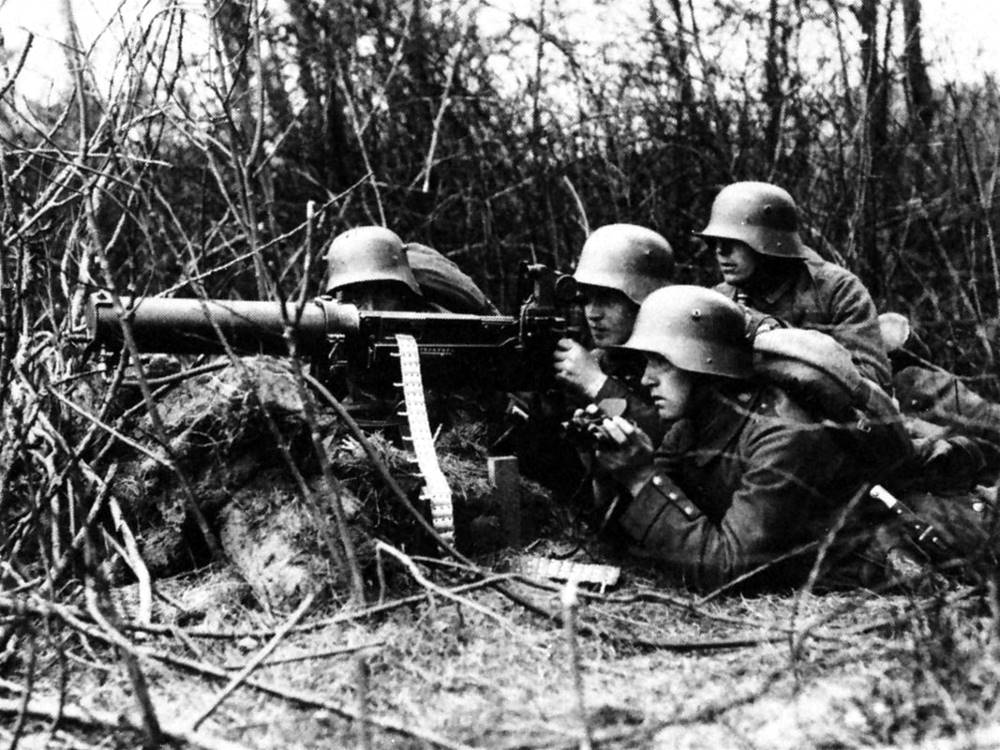
German machine gunners constantly
harrassed the advancing Americans, taking a deadly toll on the
doughboys.
MACHINE GUN NESTS
Frequently our men found it
necessary to clean out these nests. They would sneak up on the
Germans until close enough to make a sudden rush, and then up would
go the hands of the Boche machine gunners and they would cry out
"Americans, Kamerads! Kamerads!"
But whether the chained gunners
were accorded any mercy depended on the individuals who happened
to be in the group that captured them. Very often they were given
the bayonet as a protest against such tactics, but occasionally
they were released from their chains and sent to the rear as
prisoners.
Our men suffered numerous
casualties by being too eager to keep at the heels of the retreating
Hun. Some of the Germans would hide in the woods and after the
Pennsylvanians had passed would suddenly pour in on them a murderous
machine gun fire from the rear. Snipers concealed in trees were
also very annoying. In scores of instances our men found machine
guns and gunners both tied in trees, so that neither could
fall.
There were other instances
of Huns playing dead until the Americans had passed and then rising
up and firing at them from the rear. That is an old trick, but
Allied soldiers who tried it early in the war discovered the Germans
countered it by having men come along after the advancing troops,
bayoneting everybody on the field to make sure all were
dead.
However, the Germans did not
fear to attempt this trick when facing the Americans because they felt
sure the soldiers of Uncle Sam would never bayonet wounded men or dead
bodies.
Sergeant Charles McFadden,
of Philadelphia, had an experience with one of these Huns “playing
possum.” The German was in a shell pit and apparently dead. He
noticed that the eyes were closed so tightly that the man was
“squinting” from the effort. he became suspicious. McFadden
gave the German a vicious jab in the leg with his bayonet with the
result that the “possum” leaped to his feet with a yell.
The German seized the rifle
from the astonished American’s hand and threw it up to fire, but
before he could pull the trigger McFadden’s companion shot
him.
HOW THE HUN FOUGHT
At one point the 110th not
only forced the Germans back to the Marne, but across it. This
was below Fossoy. However, the Germans were now under the
protection of their artillery which laid down such an intense fire
that our men were obliged to get back under cover. The men had
tasted of victory and were loath to pull back. They fell back slowly,
not pressed by the Germans, to their former positions.
On this surge towards the
Marne the Pennsylvanians began to get real first-hand evidence of
Hun methods of fighting - the kind of thing that turned
three-fourths of the world into active enemies of Germans and their
ways, and sickened the soul of all who learned what creatures in
the image of man can do.
In the advance between Mezzy,
Mouline and Courtemont-Varennes they came on machine gun nests with
their comrades who had been taken prisoners earlier in the day tied
out in front so that they would fall first victims to their friend’s
fire should an attack be made on the gunners. Men told with tears
running down their cheeks how these brave lads seeing the advancing
Americans shouted to them:
“Shoot! Shoot! Don’t stop for
us!”
They saw airplanes painted with
the French colors fly low and drop bombs where they believed our
batteries to be stationed, and also pour machine gun fire into our
infantry. The Germans mingled a quantity of gas shells with their
explosive shells during the attempt to stop our advance, and this
caused no little inconvenience for our men because they were obliged
to wear gas masks practically all the time.
Any person who has ever donned
one of these contrivances knows how unpleasant it is, for although it
protects against the deadly fumes, nevertheless it is very difficult
to see and breathe, because the air is impregnated with the chemicals
used to remove the gas.
The Germans also used flamethrowers
on our men for many returned to the rear with burns upon their faces, hands
and bodies. Some had their clothes burned entirely off and others reeled
along like drunken men almost blinded. As the Americans approached
the Huns to give battle, the latter would turn the valve in the nozzles
of these contrivances and a spurt of flame, often thirty feet in
length, would leap forth.
A FATAL ENCOUNTER
During one part of the battle,
a part of the old Eighteenth of Pittsburgh confronted a small wood
which the French believed masked a strong machine gun nest. A patrol
of volunteers and some men selected by the officers, and in command of
a French lieutenant, started out to ascertain just what was in the wood.
There were twelve men and the lieutenant in the party. Private Joseph
Bennet, of Gulph Mills, was one of the twelve.
Advancing with the greatest care,
and with their line no more than normal skirmish distance, they
approached the wood, but there was no sign of life. When closer to the
wood, they saw the body of an American soldier propped up against a tree.
The French officer signaled for the men to close in towards this
point.

German machine gun nests brought a
hail of fire onto the advancing Marines.
As they did so four machine guns,
concealed by the Hunnish ghouls behind the body of the American, raked the
line of approaching men with terrific fire. Every man in that party except
Bennet was killed instantly. Bennet fired one shot and saw one of the Boche
plunge forward from his hiding place. Then a stream of machine gun bullets
struck his rifle and destroyed it.
Bennet quickly dropped to the
ground and, dragging himself to the body of the dead lieutenant, secured
a number of smoke bombs with which the lieutenant had intended to signal
the result of his expedition.
Bennet heaved them over in front of
the nest and created such a dense cloud of smoke that he was able to stand
up. Then he advanced and threw hand grenades into the position killing
the remaining three Germans.
For this deed Bennet was awarded
the Distinguished Service Medal. He also had another experience of an
unusual sort when in company with Private Joseph Wolf, of Pottstown, he
spied a Boche sniper in a tree. He was just drawing a bead on an
American officer when Bennet picked him off.
In falling the body
dislodged a second German. Bennet had not lowered his rifle and the
live German fell directly on the point of his bayonet, impaling himself.
The force of the blow almost dropped the big American, who tipped the
scales at about 200 pounds.
TURNING POINT OF THE WAR
Our boys did not realize until
later the importance of their success in driving the enemy back to the
Marne, but the Allied commanders knew. General Pershing, in an order
to the troops, declared that it was the turning point of the war. He
said:
"It fills me with pride to
forward in general orders a tribute to the service achievements of the
First and Third corps, comprising the First, Second, Third, Fourth,
Twenty-sixth, Twenty-Eighth, Thirty-second and Forty-second divisions.
You came to the battlefield at a crucial hour for the Allied cause.
For almost four years the most formidable army the world has yet seen
had pressed it's invasion of France and stood threatening the
capital."
"On July 15, it struck to destroy,
in one great battle, the brave men opposed to it and to enforce it's brutal
will upon the world and civilization. Three days later, in conjunction with
our allies, you counterattacked. The Allied armies gained a brilliant victory
that marks the turning point of the war."
Our men also received copies of
a great London daily newspaper containing a pleasing estimate of their
prowess:
"The feature of the battle on
which the eyes of the world are fixed, and those of the enemy with
particular intentness, is the conduct of the American troops. The
magnificent counterattacks in which the Americans flung back the
Germans on the Marne, after they had crossed, was more than the
outstanding event of the fighting. It was one of the historical
incidents of the whole war in it's moral significance."
Other cheering news, which was
passed down through the various ranks from headquarters, was to the
effect that our intelligence officers had secured from the body of
a dead German intelligence officer a report which he had prepared for
German great headquarters on the fighting qualities of the
Americans.
He had written that their morale was
not yet broken, that they were young and vigorous soldiers and nearly, if
not quite, the caliber of shock troops, needing only more experience to make
them so.

American machine gunners were
a vital part of both the U.S. defensive and offensive
doctrine.
THE GREAT RETREAT STARTS
After the Germans had been
pushed back to the Marne they made another attempt to move eastward
along the banks of the river near Epernay. The checking of this move
fell chiefly to the French troops. But all the time the enemy kept
up a continuous, vindictive bombardment on the trenches occupied by
the soldiers from Pittsburgh and Western Pennsylvania, without any
apparent purpose but to shake that splendid morale of which their
intelligence officer had written.
The regiments marched off
southward from the rest billets for a few miles and then turned
sharply to the west, thus passing around a district which was still
being shelled heavily by the German artillery. The enemy was
attempting to hold back the Pennsylvanians until they could get their
own materials out of the Chateau-Thierry salient.
After again reaching the Marne,
which turns sharply south at Chateau-Thierry, the regiments made camp
and received contingents of replacement troops to fill up the now
depleted ranks. The four companies which had suffered so severely
at the Marne battle July 15, and had later been formed into one
company, were again separated and brought up to their regular strength.
They were practically new organizations after these replacements
were completed. The new men were made welcome and proved to be
excellent soldier material, although very few of them were from
Pennsylvania.
July 24, the regiments resumed
their march. Their course lay along the road paralleling the railroad
line between Paris and Chateau-Thierry. It followed the river rather
closely except for it's numerous bends. Our boys had heard much of
Chateau-Thierry and were hoping to get a look at the town where the
Marines and some other American troops had written history, but they
were only able to get glimpses of it from the far side of the
river.
The night of July 24, the
regiments camped in the woods along the Marne and the men had their
first experience with enemy airplane night-raiders. Certain units
of the Pennsylvania regiments had been sent out to guard bridges
across the river, and at about 3:00am the Germans attempted to bomb and
destroy these bridges, in order further to retard the advance of our
troops. However, the air defense was too quick for them and the Boche
fled before the air barrage put up by our big guns.
EVENING ACTIVE IN THE AIR
The regiments remained in camp
all the next day, and the next night they were again visited by enemy
airmen attempting to blow up the bridges. This time the Boche flyers
were able to get over the bridges and drop bombs, and about all the
men on guard could do was to seek cover hurriedly. However, the aim
of the Germans was not good and they were only successful in slightly
wrecking the bridge.
Early on the morning of July 26
the regiments started in a northeasterly direction with orders to reach
contact with the enemy as soon as possible and to drive on through the
center of the Marne pocket. The 112th regiment had come up by this
time and had engaged in some desperate fighting with German rear guards
in the vicinity of Chateau-Thierry.
When the Franco-American offensive
from Soissons to Bussiares, on the western side of the pocket, began to
compel a German retreat from the Marne, the old Sixteenth, Pennsylvania
National Guard, was right on their heels. The 111th and 110th regiments
were close behind, and soon all three came in contact with the
enemy.
The Germans were depending on
machine gun nests to retard the progress of the Pennsylvanians, and
orders were issued to beware of every spot that might shelter a sniper
or machine gun. To offset this danger the regiments deployed into
skirmish lines with advanced patrols, and every known precaution was
taken to prevent the men from being surprised by parties of Germans
left behind with these deadly weapons.
The Germans were also using gas
shells, and much of the time the men were forced to suffer the
inconveniences incident to wearing the gas masks. Enemy aircraft
circled overhead, but were prevented from getting close enough to do
damage by our own airmen who continually patrolled the areas over our
troops. What bombs the enemy planes were able to drop did no damage
because of the fact that our men were scattered out in the skirmish
formation.
By night our men rested in the
forests and secured what little sleep was possible. They managed to
evade the vigilance of the enemy airmen and thus were not subjected
to concentrated artillery fire. But the continual thunder of the guns
and the bursting of an occasional shell in the woods didn’t allow them
much chance to slumber, although they were grateful for the rest after
the strenuous activities of the day.
CHAPTER V
CLEARING THE VILLAGES
The Pittsburgh and Western
Pennsylvania soldiers were now in territory where the Germans had occupied
long enough to establish themselves, where they had expected to stay,
but had been driven out sullenly and reluctantly. Here it was that our
boys had their first opportunity to learn what it means to a peaceful
countryside and undergo a German invasion.
The wonderful roads of France
had been effaced in many places by shellfire. Town and villages were
reduced to heaps of broken masonry. Even the stone fences had been
torn down. Not a wall was left standing and mansions centuries old
suffered the same devastation. Priceless rugs and tapestries scattered
about and ground into the mud.
Trees and grapevines were cut off
at the roots and in instances where the Hun had been unable to cut down
the trees, rings were hacked in the bark all around the trunks in order
to kill them. The country was bare of everything, and a Texas cyclone
could not have accomplished nearly so much destruction as did these
merciless and brutish Germans.
To add to this the Hun did not
have time to bury his dead, and the stench was awful from the decomposing
bodies lying about in heaps. At one place our boys came upon a machine
gun position, with many dead Boche scattered all around it. Close
beside one of the guns, almost in a sitting posture, was an American
lad. He had one arm thrown over the weapon as if in pride of
possession, and his fine, youthful, clean-cut face was fixed in death
with a glorified smile of triumph.
As the Pennsylvanians came up
to this spot scores of officers and men unconsciously clicked their
heels together and came to the salute in silent tribute to this
fair-haired boy who had not lived to enjoy his well-won laurels. How
he ever got through to that nest is, and will probably always remain a
mystery.
He was not one of our Pennsylvania
troops, but he was buried tenderly, and the identification tags were sent
back to headquarters. He had evidently won through to the guns and had
killed all the Germans, but in so doing had been so severely wounded that
he was just able to reach the spot where our men found him.
And it was near this gruesome
spot that shortly afterwards our men were treated to another of the
ever changing scenes of battle. The sight was picturesque because
it brought to mind the warfare of the past and to Americans memories
of pioneer days.
Troop after troop of cavalry came
into sight and passed our men, the gallant horsemen sitting on their steeds
with conscious pride, jingling accoutrements playing an accompaniment to
their sharp canter. Some were French and some Americans, and our
Pennsylvanians cheered them heartily. They were on their way to further
harry the retreating foe.
Cavalry was not a common sight
in this war. It had seldom been seen on the battlefield since the Hun
went mad in 1914.
The three regiments from
Pittsburgh and Western Pennsylvania, 110th, 111th and 112th, were now
in contact with the retreating enemy forces and drove steadily
northeastward in the direction of the towns of Trugny and Epieds, where
they met with stiff resistance. During this advance a part of the 110th
regiment sought shelter under an overhanging bank to escape a sudden
spurt of enemy artillery fire.
The men had not been there long,
and the officers were congratulating themselves because of the narrow
escape from being caught in the open while this shelling was under way,
when a big shell burst over the edge of the bank directly above
Company A.
Two men were killed outright and
several were wounded. Lieutenant George W. Martin, of Narberth, with
several of his men rushed to give first aid to the wounded, and the
first man he reached was Private Allanson R. Day, Jr, of Monongahela
City - “Deacon” Day as the boys called him because of a mildness of
manner and a religious turn of mind.
As the lieutenant prepared to
render first aid to Day, the youngster told the officer to attend to
Paul Marshall, saying that Marshall was more severely wounded.
“Dress him first,” said Day,
“I can wait.” Even then the Monongahela lad was wounded to death, as
it developed later, for he did not survive.
It was during these days that
our Pittsburgh and Western Pennsylvania soldiers began to work up a
real and intensive hate for the Hun. They learned more of him and his
ways after they crossed the Marne, and they found their loudly-voiced
threats turning to a steely, silent, implacable wrath that boded no
good for the Boche.
It was a feeling of utter detestation
and it is doubtful if their officers could have turned them back had word come
through at that particular time that peace had been declared.

Gradually the Pennsylvanians
began to close in on Trugny and Epieds. The first named is about four
miles from Chateau-Thierry, and Epieds about one mile from Trugny.
They lie almost in a straight line along the route where our troops
were advancing.
The Germans were having a strenuous
time to get their army and war material out of the Soissons-Rheims pocket,
and they sent large numbers of fresh troops down to Trugny and Epieds in
an effort to hold back the determined Americans. These two villages were
utilized in their scheme of defense and were strongly held with
machine guns and artillery.
HOW TWO TOWNS FELL
At times, as our men moved up
closer, they were so eager that they frequently passed their stated
objectives and ran into their own barrage fire, with the result that
their officers had to call off the barrage to save them from being
destroyed by our own guns. The Pittsburgh and Western Pennsylvania
doughboys were out to avenge some hurts and had forgotten that there
was any such command as “Halt!”
Trugny and Epieds were hard
nuts to crack. The Germans were well prepared to withstand an attack,
and for thirty-six hours our men flirted around the outskirts in
attempts to flank or penetrate the towns.
Finally the Allied guns
were rushed up in numbers and soon brought Trugny down about the
ears of it's defenders and, although the Boche retired to Epieds, strong
machine gun detachments were left behind to hamper as much as possible
the American advance.
Epieds was even more difficult
than Trugny, and our troops were in and out of the town three times
before they were finally able to rid the place of the desperate Hun. The
artillery first treated the village to a heavy bombardment which made
it grow smaller and smaller under the ceaseless pounding of the
guns.
The buildings just seemed to pulverize
and go up in dust. It was a case of the Pennsylvanians getting into the village
streets and driving the Germans from house to house. The Germans would send new
troops in to stiffen the resistance and drive our boys out, but they
would immediately come back to the attack.
Finally the Pennsylvania troops,
learning that their heavy artillery support had come up, decided not to
risk any more lives in this street fighting. The town was now swarming
with Germans as heavy reinforcements had been thrown in with orders to
hold the Americans. The German Army retiring from the salient was
apparently being hard pressed. Word was flashed to the batteries, and the
village was buried under a deluge of heavy explosive shells.
Thousands of Germans perished and
the others fled for their lives. When the bombardment was lifted there were
great heaps of slain Boche, and what was once Epieds was only a cloud of
dust. There was not so much as even a large pile of bricks left standing.
The artillery did terrible execution that day.
DRIVING OUT THE HUN
When the artillery bombardment
ceased the Germans prepared again to enter the site of the village in
order to meet the expected American attack. The debris was soon alive
with gray coats, and with a yell the Pennsylvanians rushed out of the
surrounding woods and were upon them before they could recover from the
surprise.

American troops on the
attack.
The Germans were thrown into a
state of confusion and many were killed or taken prisoner before they
could rally. Scattered remnants of the Kaiser’s soldiery then hurried
northward to get away as rapidly as possible from the cold steel of our
doughboys.
The Pennsylvanians then pressed
on, and there was much elation in the ranks when it was heard that the
53rd Field Artillery brigade was rushing up to go into action in
support of the infantry. This artillery brigade was the 28th
Division’s own. It was under the command of Brigadier General W.G.
Price Jr., of Chester, and included the 107th Regiment.
Word also
came that still other organizations of the 28th Division were
hastening to the front, including the ammunition and supply trains.
It became evident that the division was being reassembled in it's
entirety as an intact fighting unit for the first time since it's
departure from Camp Hancock.
The 107th Artillery was made
up of many Pittsburgh and Western Pennsylvania lads, Batteries B, E
and F, the Headquarters Company, Supply Company and Sanitary
Detachment, being from this section of the state. The 111th and the
112th regiments of infantry were now leading the chase and they
relentlessly drove northeastward.
In many instances they kept the
Boche moving so fast that many officers and men wrote home about
having the enemy on the run and not being able to keep up with him.
The Germans would attempt to make a stand and our doughboys would
literally blast him out of the place and then move on.
The chase
became so fast and furious that at times our Pittsburgh and Western
Pennsylvania men had to be restrained in their headlong drive in
order to allow the artillery a chance to come up and silence the
German guns by expert counter-battery work.
Our men were eager with
excitement. With none but the officers having access to maps, hundreds
of the enlisted personnel believed they were heading straight for
Germany and that it was only a question of a short time before they
would be entering the Kaiser’s domains.
The fighting had been so
strenuous, and the forward movement so fast and confusing, that without
maps they could only have hazy ideas as to the distances they had
traveled.

As the Germans retreated from
the Soissons-Rheims Salient after the Battle of the Marne, they put
up strong
resistance in many villages, ordered to hold back the Allied advance
as long as possible. Pittsburgh and
Western Pennsylvania soldiers cleared out several of these villages
during their advance.
GERMANS TRY TO RALLY
The Pennsylvanians were pictured
as a set of rabid hounds almost whining in their anxiety to get at the
Hun. Deluged by high explosives, shrapnel and gas shells, seeing their
comrades mowed down by machine gun fire, bombed from the sky, alternately
in pouring rain and burning sun, hungry half the time, their eyes sore
and heavy from loss of sleep, half suffocated from long intervals in gas
masks, undergoing all the hardships of a bitter campaign against a
determined, vigorous and unscrupulous enemy, yet their only thought was
to drive on - and on - and on.
Beyond Epieds is the village of
Courpoil, and here the Germans made another stand with many machine gun
nests. It was another case of street-to-street and hand-to-hand fighting
with countless instances of individual bravery and heroism, and many
casualties.
The main body of Germans was cleared
out without so much trouble as was encountered at Epieds, and our men passed
on leaving small detachments behind to “mop up” any straggling Germans that
might have been left behind.
Courpoil is on the edge of the
forest of Fere, and into that magnificent wooded tract the Germans fled.
Captain W.R. Dunlap, of Pittsburgh, Commander of Company E, 111th
Infantry, and Captain Lucius M. Phelps, of Oil City, commander of Company
G, 112th Infantry, with their troops, led the advance beyond Epieds and
participated in the capture of Courpoil and the advance into the
forest.
Captain Phelps for a time had the
difficult task of leading an independent force making flank attacks on the
enemy, to the left of the main battering ram. Both these officers so
distinguished themselves in this difficult fighting that they were
recommended for immediate advancement to the rank of Major.
The Americans battled their way
in little groups into the edge of the forest and were hanging on to this
fringe of the wooded area when night fell. The forest seemed to be an
almost impossible barrier, and it was decided to be utterly hopeless to
attempt to continue advancing in the darkness.
It was while these widely scattered
groups were holding the fringe of the forest after nightfall that
Lieutenant William Allen, Jr., of Company B, 111th infantry, of
Pittsburgh, so distinguished himself as to be recommended for promotion
and a medal. Owing to the groups being separated it was necessary that
headquarters should know their approximate positions so as to be able
to dispose of the forces for a renewal of the attack the next
morning.
Lieutenant Allen took two privates
along with a patrol of three men on either side and set out to traverse the
forest along the line were our groups were supposed to be. The lieutenant
and his men always kept within speaking distance of each other, and
throughout the night carefully threaded their way. They did not know what
instant they might stumble on Germans or be fired on or thrust through by
their comrades.
ACTS OF HEROISM
It was described as a hair-raising
daredevil feat. When Lieutenant Allen found himself near other men he
remained silent until a muttered word or even such inconsequent things
as the tinkle of a distinctly American piece of equipment, or the smell
of American tobacco - entirely different from that in the European
armies - let him know his neighbors were friends. Then, after a soft call
to establish his identity and make it safe for him to approach, the
lieutenant secured an idea as to the location and force of that
particular group.
At the first signs of the
approaching dawn Lieutenant Allen and his men crawled back to the main
American lines where, in a shell-hole which the General was using as
headquarters, he was able to sketch, with the aid of a pocket flashlight,
a map which enabled his superiors to plan the attack. The plans thus
made from the information gathered by Lieutenant Allen worked with
clock-like precision and resulted in the Boche being driven further
into the woods.
Corporal Alfred W. Davis, of
Uniontown, Company D, 110th infantry, was moving forward through the
woods in this fighting, close to a lieutenant, when a bullet from a
sniper hidden in a tree struck the corporal’s gun and was deflected. The
round pierced the brain of the officer, killing him instantly.
This aroused
the ire of Davis, and crawling Indian-like up a ravine he decided to
make the Germans pay dearly for the death of the lieutenant. When he
picked off his 18th German in succession it was nearly dark, so he
called it a good day’s work and rejoined his company.
In the woods the Germans fought
desperately despite the fact that they were dazed by the intense
artillery fire. They contested every foot of the way and used every
conceivable contrivance including camouflage to hinder the advance of
those determined and relentless Pennsylvania doughboys.
They hid in
rocks and under old tree-trunks and in piles of brush, and they
camouflaged their steel helmet with brown, green and yellow and other
shades of paint so that it was almost impossible at times for our boys
to pick them out from the flicker of the shadows in the dense
foliage.
During the progress of our
troops there was one time when touch had been lost with the forces
on the right flank of the 110th infantry, and Sergeant Blake Lightner,
of Altoona, a liaison scout from Company C, 110th, started out to
re-establish the connection.
While engaged in the hunt for
the separated forces, Lightner ran into an enemy machine gun nest. He
surprised and killed the crew and captured the guns single handed.
He hurried back, secured a machine gun crew, and established the
men in the former enemy nest while also re-establishing the
communications.
THE SPIRIT THAT WINS
During the trip he had also
located a line of enemy machine guns nests, and when he returned to
his command was able to furnish information to his officers whereby
it was possible to lay down a barrage on the enemy machine gun
line.
During one of these days of
desperate fighting is was discovered that the ammunition supply of
the first battalion of the 110th regiment was running low due to
the extra heavy showers of bullets with which our boys had been
deluging the Boche.
It was almost nightfall, and the
officers wanted to be sure that the supply on hand in the morning would
be ample to meet all requirements. Corporal Harold F. Wickerham, of
Washington, and Private Boynton D. Marchand, of Monongahela City,
were sent back to brigade headquarters with a message. When they
reached the spot where headquarters had been they found it had
been moved.
There was nothing for the two
soldiers to do except attempt to seek out the new location of
headquarters, so they set off through the woods. After walking for
miles in the darkness they came to a town where another regiment was
stationed and were able to get into communication with their brigade
headquarters over the military telephone, thus delivering their
message.
The two lads were tired and sleepy
after their days of strenuous fighting and the long weary tramp through the
pitch dark woods, and they were invited to remain in the town the rest of
the night to sleep.
But the Pennsylvanians were
fully aware of the need for ammunition. They feared that their
message may not have gone through properly so they set out again, and
in the early dawn reached their units ammunition dump to confirm
the message orally. Even then they refused an offer to rest and
started out to rejoin their regiment.
They arrived just in time to
participate in a battle in the afternoon. It was because the Pittsburgh
and Western Pennsylvania doughboys were one and all imbued with this
wonderful spirit that they were able to write their names so high in
the annals of this great world struggle.
The next village from which our
boys had to drive the foe was Le Charmel, and it suffered about the
same fate as Epieds. For two hours a violent battle raged for possession
of this town and twice it changed hands during this time. Then our men
retired to the outskirts and called for an artillery barrage which soon
made the place untenable for the Huns.
They hastily retreated, and the
Pennsylvanians entered and either killed or captured the Germans who
were unable to get away in time. Here again heaps of the slain were
found, for the artillery had just about wiped the town off the map. Many
Boche were caught in that terrific hurricane of explosive shells
and shrapnel.

Men of the 28th Division attacking
a German position in the Soissons-Rheims pocket. Demolition teams
lead the advance to blow holes in the wire for the infantry following
close behind.
APPROACHING THE OURCQ
The Pennsylvanians were now
approaching the Ourcq River, where the Germans had a second line of
defense, and they began to feel the stiffened resistance. Each
succeeding hour the fighting became more bitter and determined, But
nothing the Germans could offer was sufficient to retard the advance
of our troops, although at times this advance was slowed
considerably.
The dense forests were a maze
of barbed wire, stretched from tree to tree, and the density of the
woods prevented our airmen from locating the enemy, thus preventing
our artillery from getting in it's deadly work.
A new system of attack on enemy
posts was inaugurated at this time in order to prevent the large number
of casualties which always ensued as a result of direct frontal attacks.
The new scheme consisted in “pinching” off and surrounding these posts
just as the British accomplished the capture of St. Quentin, Lille,
Cambrai and other large cities.
Beuvardes, a village in the line
of our advance was strongly held by the Germans with masses of machine
guns. The Germans had concentrated fresh forces in the town and it was
doubtful if it could have been taken by direct assault without heavy
loss of life to the Pennsylvanians. The British tactics were brought
into play, however.
Our doughboys infiltrated La Tournell
from the west and the Forest of Fere from the east, while French troops worked
on the left. As a result, Beuvardes was soon encircled, and became
untenable for the Germans. Many prisoners and machine guns were
captured as the result of the speed with which the enterprise was
carried out.
It was this swift, sure work of
the Pittsburgh and Western Pennsylvania doughboys that always caused
their regiments to be in great demand for tackling the extra hard
military problems. The Pennsylvanians and the Marines were always
assigned to these important tasks, and as a result their casualties
were always extremely heavy.
But our Keystone lads loved the strenuous
work and, when they went up against a supposedly heavy job and found it
to be rather easy, they were always disappointed. Despite the lessons
they had learned on previous occasions about advancing beyond objectives
their officers continued to have trouble trying to drag them back so
they would not fall victim to their own artillery barrages.
During this progress from the
Marne northward, the various headquarters had considerable difficulty
in keeping in touch with the advancing columns. A headquarters section
of a regiment is not as mobile as the regiment itself. There is always
a vast amount of paraphernalia and supplies to be moved, yet it is
imperative that communication be kept with the advancing front.
HAD TO MOVE RAPIDLY
The rapid retreat of the Germans
necessitated our troops going forward quite rapidly at times in order to
stay on their heals and make the Boche move even faster. At other times,
when the Germans were strongly organized in villages and other places
which offered a natural site for defense, our troops were slowed up in
their advance.
Then it was necessary to pause for
a few hours and\ dispose of the enemy rearguards. It was reported that one
Pennsylvania column advanced so fast that it was sometimes necessary to move
the regimental headquarters three times in just one day.
And most of the time the
regimental and even the brigade headquarters were under the artillery
fire of the German’s big guns. It was from this cause that the first
Pennsylvania officer of the rank of Lieutenant Colonel was killed July
28. He was Wallace W. Fetzer, of Milton, second in command of the 110th
Regiment.
Headquarters had been moved far
forward and established in a brick house which was still in a fair state
of preservation. Work was just getting well into swing again when a high
explosive shell fell in the front yard and threw a geyser of earth over
Colonel Kemp, who was at the door, and Lieutenant Colonel Fetzer, who
was sitting on the steps.
A moment later a second shell struck
the building, killing three orderlies. Colonel Kemp was now thoroughly
satisfied that the Boche airmen had spotted his headquarters, and he
gave immediate orders to pack up and move. The German artillery was
registering too accurately to be done by chance.
Officers and men of the staff
were packing up to move, and Lieutenant Stewart M. Alexander, of Altoona,
regimental intelligence officer, was questioning two Hun captains, taken
prisoner a short time previously, when a big explosive shell scored a
direct hit on the building. Seventeen men in the house, including the
two German captains, were killed outright.
Colonel Kemp and Lieutenant
Colonel Fetzer had left the house and were standing side-by-side in the
yard. A piece of the shell casing struck Lieutenant Colonel Fetzer, killing
him instantly. A small piece struck Colonel Kemp on the jaw, leaving him
speechless and suffering from shell-shock for some time.
Lieutenant Alexander, face-to-face
with the two German officers, was blown clear out of the building and into
the middle of the roadway, but he was uninjured except for shock.
It was this almost uncanny
facility of artillery fire for taking one man and leaving another when
the two were standing close together that led to the fancy on the part
of soldiers that it was useless to try to evade the big shells. This
was predicated on the belief that, if “your number” was on one, it would
get you no matter what you did, and if not it would pass harmlessly by.
Thousand of men became absolute fatalists in this regard.
After the death of Lieutenant
Colonel Fetzer and the injury sustained by Colonel Kemp, Major Martin
took command of the regiment and won high commendation for his work
during the next few days.
CHAPTER VI
RONCHERES AND GRIMPETTE WOODS
The taking of Roncheres fell to
the lot of the 110th Regiment. This town, like all the others, was
strongly held by the Germans, who had massed machine guns and fresh
infantry for the sole purpose of making it's capture as costly as
possible for the Americans.
Like every other village in this section
the Boche had no intention of retaining it, but was concerned mostly
with holding back our boys as long as possible in order to successfully
get his armies and material out of the Soissons-Rheims salient.
With their characteristic
disregard for every finer instinct, the Germans had made the church
the center of their resistance. This church stood in such position
as to front on an open square in the center of the town, and the
enemy was thus able to command the roads which entered this square
from different directions.
Every building, every wall,
tree or fence corner sheltered a sniper or machine gun, and most of
the enemy, at this point, kept up such a determined resistance that
they died where they stood. In some instances, when an American was
close enough to point the cold steel of his bayonet at a Boche, up
would go his hands with a cry of "kamerad."
There was always something
in the threat of the bayonet which the Hun could never withstand.
However, it may as well be set down here as in the future that the
men of the 110th took few prisoners, for they did not trust the cry
of "kamerad!" They usually disposed of the foe with scant
ceremony.
GERMAN WARFARE
On previous occasions they had
learned that the Hun was never to be trusted. They had lost comrades
as the result of this treachery because a Boche might still have his
hands in the air, pleading for mercy and at the same time have his foot
on the lever of a machine gun. His hands in the air were frequently
but a decoy to lure our men within close range of the deadly weapon,
which he could set going with his foot.
So, in Roncheres, our men of the
110th played the old game of hide and seek and they were always “it.”
To be tagged meant death for the Hun. They moved steadily from
building to building until they came in range of the village church.
Then their progress was stayed for a time.
On the roof of the church was a
cross made from some kind of red stone. Behind it the Germans had
planted guns. Three guns were hidden in the belfry from which the
Huns had removed the bells and shipped to Germany. Stationed in every
nook and cranny of the magnificent gothic walls and balconies were
snipers, machine gunners and artillerymen with small cannon.
After much careful work,
sharpshooters of the 110th finally picked off the Germans behind the
cross, but the little fortress in the belfry still held out and was
capable of doing considerable execution. Detachments let out to work
their way around the outer edge of the town and thus surround the
church.
Our Pennsylvanians would dodge in and
out, from street corner to street corner, and from building to building ever
seeking to escape the quick eye of the enemy snipers. When they found a house
with sufficiently strong walls to withstand the foe bullets, sharpshooters
would be stationed there to keep the Hun fire down until some of the
men could rush into the next house. It was a fight every step of the
way.
YANKEE STRATEGY WINS
When the Pennsylvanians came to
the roads which radiated from the square to the four corners of the
village they had to pause and work out a new plan of attack. It was
necessary to cross these roads in order to advance further, and to
attempt the feat would have been nothing less than suicidal in view of
the hurricane of bullets with which they were continually swept.
When sufficient detachments of
our men had reached the various corners to provide enough strength for
a sortie, a barrage of rifle bullets was put on the Germans.
Sharpshooters were stationed at every possible point where they could
watch the Boche, and they commenced to pump lead into every place
where they believed the German bullets were coming from.
They did
not give the foe a chance to show himself, but kept showering him
with bullets. In this way the Hun fire was reduced to a minimum and
the rush across the streets was made. Gaining the other side, the
Pennsylvanians worked closer to the church along another row of
houses, cleaning up the enemy as they progressed. It was slow and
dangerous work but our boys never flinched.
During all this fighting the
church remained the dominating figure, as it had been of the village
landscape so many years. It's stout walls, gray with age and built to
last for centuries, offered an ideal shelter for the vandals who were
desecrating it's sacred precincts. Before our men could do anything
more it was imperative that the enemy therein must be
cleared out.
In previous fighting in this
territory a German shell had opened a convenient hole in the masonry
at the rear of the church and groups of the Pennsylvanians worked their
way as close to this spot as possible without exposing themselves to
the Boche in the church. Then they put down another rifle barrage using
the same tactics whereby they were able to get across the fire swept
streets.
A detachment of the 110th rushed
for this hole in the wall and rapidly filtered through into the interior,
which shortly became a charnel house for the Hun. They soon cleaned the
foe out and then tackled the belfry where the little group of Boche still
persisted in the defense.
TOOK CHURCH, BUT NO PRISONERS
One man led the way up the winding
stone stairway, fighting every step of the way, and strange to relate he
was able to reach the top despite the fact that many below him were
caught in the rain of missiles hurled down by the frantic Huns who thus
sought to stay this implacable advance.
When a few of our men had gained
the top of the stairs one German junior officer, presumably in command
of the group, leaped from the belfry to his death on the stones in the
courtyard below. Then the three remaining Huns set up a loud plea for
mercy, wildly waving their arms in the air, and yelled "kamerad!"
Whether or not their pleas were granted
will probably never be definitely ascertained, as the Pennsylvanians who were
there do not have any clear perception as to just what happened. However, the
idea seems to prevail that no prisoners were taken in the church - at least
some of the men say they didn’t see any brought out.
After the capture of the church it
was a comparatively easy matter to mop up the rest of the town, but even
then our boys had only a brief breathing spell, for the regiment was soon
on the march again, swinging over a little to the northwestward towards
Courmont, which was reached just in time to help the boys of the 109th
in wiping out the last machine gunners there.
At Courmont our Pennsylvanians had
almost reached the Ourcq River, where the enemy had taken advantage of the
natural defenses on the other side of the stream to make a determined
stand. In fact, there had been constructed a second line of defense, and
here was fought one of the most stubborn and bloodiest battles of the
war.

THE CROSSING OF THE OURCQ
Our men faced the Guardsmen,
Jaegers and Bavarians with contingents of Saxon machine gunners. These
were the flower of the troops under the command of the Crown
Prince. They had orders not to give way for even a foot of ground
before the Americans. The enemy fought sullenly and with all the
traditional vigor of the famed units engaged, but they could not hold
against the irresistible Pennsylvanians.
The crossing of the Ourcq had been
described as one of the finest feats accomplished by the Americans in the
war. The Ourcq itself was negligible as an obstacle to the troops, for
it is really only a little stream and the Americans called it a “creek.”
At this point it is only about twenty feet wide and six inches deep.
But what makes the Ourcq formidable is the heights beyond. The river
being old, it has worn itself a deep bed with high banks on each
side.
Just north of Courmont, and on the
opposite side of the Ourcq, is the Bois de Grimpette, a small wooded
track. Here was staged the most ferocious fight of the entire line.
This particular phase of the battle has been described as “the One
Hundred and Tenth’s own show.”
It was one of those feats which
become regimental traditions, the tales of which are handed down for
generations within regimental organizations and in later years become
established as standards towards which future members may aspire with
only small likelihood of attaining.
COMPARED WITH BELLEAU
The operation, in the opinion of
many high officers who witnessed it, compared most favorably with the
never-to-be-forgotten exploit of the Marines in the Bois de
Belleau.
There were these differences:
First, the Belleau Wood fight occurred at a time when all the rest of
the Western Front was more or less inactive, but the taking of
Grimpettes Wood came in the midst of a general forward movement that
was electrifying the world, a movement in which miles of other front
bulked large in public attention; second, the taking of Belleau was
one of the very first real battle operations of Americans, and the
Marines were watched by the critical eyes of a warring world to see
how “those Americans” would compare with the seasoned soldiery of
Europe; third, the Belleau fight was an outstanding operation, both
by reason of the vital necessity of taking the wood in order to clear
the way for what was to follow, and because it was not directly
connected with, or part of, other operations anywhere else.
“The Germans have a strong
position in Grimpette Woods,” the 110th was told. “Take it.”
The regiment by this time had
learned something of German “strong positions,” and so the men prepared
to tackle a stiff job. In the early days of their fighting they had
gone about such jobs with an utter disregard of the enemy machine guns,
but they were now more experienced and knew that such recklessness did
them no good, and was of no service to America, because of the useless
sacrifices such tactics entailed.
Yet, when they looked over the
territory which they were expected to rid of the Hun, they were convinced
that they had no alternative but to do just that thing and face a well
organized and strongly held enemy position. Grimpette Woods was fairly
bristling with every sort of Hun weapon and gunners were chained to
their weapons.
The underbrush was laced through and
through with barbed wire, concealed strong points checker-boarded the dense,
second-growth woodland. When the Pennsylvanians took one nest of machine guns
they found themselves fired on from two others. This maze of machine guns
and snipers was supplemented by countless trench mortars and one-pounder
cannon.
INTO A HELL OF FIRE
The most difficult task in
connection with the capture of this wood, the taking of the hilly
section, was assigned to the 110th. The other regiment of the
55th Infantry brigade, the 109th, was ordered to clean out the lower
part.
It was a murderous undertaking,
for the nearest “cover” from the edge of the wood was at Courmont, more
than 700 yards away. The men rushed out from the protection of the
buildings in Courmont, in the most perfect and approved wave formations,
and were immediately met by a hurricane of bullets. Some of the men
said later that it seemed almost like a solid wall in places. There
was not even as much as a leaf to protect them.
The rattle of the
hundreds of machine guns in the woods gradually increased in volume,
until they blended into one solid roar, and the one-pounder cannon
played havoc with our troops. German airmen, who had almost
complete control of the air in that vicinity, soared as low as 100
feet from the ground and poured a stream of machine gun bullets into
the ranks of those dauntless Pennsylvanians. The airmen also raked
the ranks with high explosive bombs. Our men were forced to organize
their own air defense and proceeded to use their rifles, but without
much deterrent effect on the Hun flyers.
How any man ever lived in that
welter of fire is a mystery, but a few managed to reach the edge of the
wood, and, flinging themselves down on the ground, dug in. A few of the
others who were nearer the woods than the town did not attempt to
retrace their steps in that awful rain of lead and steel, but flung
themselves into shell holes or any slight depression in the ground
which offered even temporary safety.
The high officers recalled the
attack, realizing that the losses were beyond reason for the value
of the objective. However, neither officers nor men of the 110th
were satisfied, and they all pleaded for another chance. No matter
what the cost this was Western Pennsylvania’s day against the Hun
and the task had not been performed in accordance with all the
traditions of that section of the great Commonwealth. Furthermore,
there were living and unwounded comrades out there who could not
long be left unsupported.

American soldiers in their
foxholes, awaiting the order to advance.
THEN THEY FOUGHT AGAIN
The higher officers were
impressed by this plea, and after the men had secured a breathing
spell they were allowed to have another try. Forming again,
they set their teeth and plunged into that storm of lead and steel.
They didn’t even have adequate artillery support, for the guns were
busy elsewhere and many batteries were still struggling over the
ruined roads in an effort to get near the front.
On the second attack, another
handful of men managed to filter through to the edge of the wood,
but the main attacking force was driven back. It seemed almost as
if nothing could withstand that withering enemy blast of fire. For
three more times our boys, undaunted, attempted to cross that
bullet-swept stretch of ground, and each time, they were forced back
to the shelter of Courmont.
After this fifth attack
headquarters had receive information, July 30, 1918, that the
artillery had come up and would put a barrage on the wood. Major
Martin, in command of the 110th, when he heard this said: “Fine.
We will clean the place up at 2:30pm this afternoon.” And this is
just what the regiment did.
The artillery put down a
terrific barrage on the wood line and the Huns were driven to shelter.
Holes were opened in the near side of the wood and the wire was
cut in many places. The few Pennsylvanians who had won their way to
the edge of the wood in the previous attacks had to dig in deeper and
find whatever shelter they could, for they were forced to withstand
the rigors of their own barrage. It was a terrible experience to have
to undergo the bombardment of their own guns.
SIXTH ATTACK SUCCESSFUL
Then came the order to advance
in the sixth assault on Grimpette Woods, and as the men rushed forward
the barrage lifted. The big guns had given just the added weight to
carry them across the open space. They were well on their way when
the Germans were able to come out of their dugouts and take position
at their guns. The first wave of Americans, angry and yelling like
Indians, was on them before they could do much damage.
That was the beginning of the
end for the Germans in the Bois de Grimpette, for our boys went through
it in a hurry with man against man, using the bayonet unsparingly and
unmercifully. Some prisoners were sent back, but this was the
exception rather than the rule, and the burial squads put away more
than 400 German bodies in Grimpette.
The American loss in cleaning
up the wood was hardly a tithe of that. It was truly a dashing and
heroic bit of work, typical of the gallantry and spirit of our
men.
After the first attack on the
wood had failed, First Sergeant William G. Meighan, of Waynesburg,
Company K, 110th regiment, in the lead of his company, was left behind
when the recall was sounded. He had flung himself into a shell, in the
bottom of which water had collected. The machine gun fire of the
Germans was low enough to “cut the daisies,” as the men
remarked.
Therefore, there was no possibility
of crawling back to the lines. The water in the hole in which he had sought
shelter attracted all the gas in the vicinity, for Fritz was mixing gas
shells with his shrapnel and high explosives.
The German machine gunners had
seen the few Americans who remained on the field, hiding in shell
holes, and they kept their guns spraying over those refuges. Other
men had to don their gas masks when the gas shells came over, but
none seem to have undergone the experience that Sergeant Meighan
did.
THE DREADED GAS MASK
It is impossible to talk
intelligently or to smoke inside a gas mask. A stiff clamp is fixed
over the nose and every breath must be taken through the mouth.
Soldiers adjust their masks only when certain that the gas has dissipated.
They dreaded gas more than anything else the German had to offer.
It was the single worst thing in the dread category of horrors
with which the Kaiser distinguished this war from all other wars in
the world’s history.
Yet the discomfort of the gas mask,
improved as the present model is over the device that first intervened between
England’s doughty men and a terrible death, is such that it is donned
only in dire necessity. Soldiers hate the gas mask intolerably, but
they hate the gas itself even more.

Army nurses, corpsmen and orderlies at
a front line field hospital wear their gas masks.
For fifteen hours Sergeant Meighan was
forced to crouch in the water in this shallow hole with his gas mask on. But
despite the terrible ordeal he still had plenty of fight left in him.
When in a later attack on the wood, Company K reached the point where
Sergeant Meighan was concealed, he discovered that the last officer of
the first wave had fallen before his shelter was reached. Being next
in rank he promptly signaled to the men that he would assume command,
and led them in a gallant assault on the enemy position.
FOUGHT TO HIS DEATH
There were also many other men
of the 111th who displayed marked gallantry and that spirit of
sacrifice which made our boys so successful in the various enterprises
in which they engaged. Lieutenant Richard Bullitt, of Torresdale, an
officer of Company K, was struck in the thigh by a machine gun bullet
in one of the first attacks, and although unable to walk he crawled 100
yards to where there was a squad with an automatic rifle out of
commission and which the men could not operate.
The corporal in charge
of the rifle squad seems to have been the only one of the men who could
operate it. He had been killed and Lieutenant Bullitt quickly had the
gun throwing death into the German ranks. While he was operating the
automatic five more bullets struck him, but he kept on. He waved the
stretcher bearers away who wanted to take him to the rear. Finally,
another bullet struck him in the forehead and killed him
instantly.
After the wood was completely in
our hands, a little column was observed moving across the open space
towards Courmont. When it got close enough it was seen to consist
entirely of unarmed Germans.
Staff officers were just beginning
to fuss and fume about the ridiculousness of sending a party of prisoners
back unguarded when they discovered a very dusty and a very disheveled
American officer bringing up the rear with a rifle held at the “ready.”
He was Lieutenant Marshall S. Baron, of Latrobe, Company M. There were
sixty-seven prisoners in his convoy and most of them he had taken
personally.

The rough and ready commander
of the 28th Division, Major General Charles Muir - “Uncle Charley”
the boys
called him - and some of the principal officers who led the Pittsburgh
and Western Pennsylvania
to glory in the great drive against the Germans in the Soissons-Rheims
Salient.
(Major General Charles Muir, upper left; Major Edward Martin, lower left;
Clockwise on the right - Colonel
George Kemp, Major Fred Miller, Colonel George Rickards, Lieutenant
Colonel H.W. Coulter,
Brigadier General William G. Price Jr., Colonel Edward E. Shannon -
center.)
CHAPTER VII
HUN ON THE RUN
The night of July 30, after the
capture of Grimpette Woods, the regimental headquarters of the 110th
was moved up to Courmont, only 700 yards behind the wood. Major
Martin summoned his staff about him to work out plans for the next day.
They were bending over a big table, studying the maps when a six-inch
shell struck the headquarters building squarely.
Twenty-two enlisted
men and several officers were injured. Major Martin, Captain John D.
Hitchman, of Mount Pleasant, the regimental adjutant, Lieutenant
Alexander, the intelligence officer, and Lieutenant Albert G. Braden,
of Washington, were knocked about somewhat, but not injured.
For the second time within a
few days Lieutenant Alexander had flirted with death. The first time
he was blown through an open doorway into the road by the explosion
of a shell that killed two German officers who were facing him, men
he was examining.
This time, when the Courmont headquarters
was blown up, he was examining a German captain and a sergeant, the other
officers making use of the answers of the prisoners in studying the
maps and trying to determine the disposition of the enemy forces.
Almost exactly the same thing happened again to Lieutenant Alexander.
Both prisoners were killed and he was blown out of the building
uninjured.
"Getting to be a habit with
you," said Major Martin.
"This is the life," said the
lieutenant.
"Fritz hasn’t got a shell with
Lieutenant Alexander’s number on it," said the men in the ranks.

The Regimental HQ in Courmont after
being demolished by a direct hit on July 30, 1918.
OLD TENTH MEN KILLED
The shell that demolished regimental
headquarters was only one of thousands with which the Boche raked our lines
and back areas. As soon as American occupancy of the wood had been
established definitely, the Hun turned loose his artillery, making life
miserable for the Pennsylvanians. In the 110th alone there were
twenty-two deaths and a total of 102 casualties.
The village of Sergy, just north
of Grimpette Woods, threatened to be another severe test for our boys.
Like some of the other villages, it was understood to be strongly
organized by the Germans, who were prepared to offer every possible
resistance to the advancing Americans. The Pennsylvanians were sent
into the direct assault in company with regiments from other
divisions.
The utter razing of Epieds and other
towns, by artillery fire in order to blast the Germans out of their
strongholds, led to a decision to avoid such destructive methods wherever
possible, because it was French territory and too much of France had been
destroyed already by the ravaging Huns. The taking of Sergy was almost
entirely an infantry and machine gun battle.
It was marked, as so many of the
Pennsylvanian’s fights were, by the “never-say-die” spirit that refused
to know defeat. There was something unconquerable about the terrible
persistence of the Americans that seemed to daunt the Germans.
The American forces swept into the
town and drove the enemy forces slowly and reluctantly out to the north.
The usual groups of Huns were still in hiding in dugouts and cellars,
and other strong points, where they were able to keep up a sniping fire
on our men. Before the positions could be moved up and organized the
Germans were strengthened by fresh forces, and they reorganized and took
the town again.
Four times this contest of attack and
counterattack was carried out before our men established themselves in
sufficient force to hold the place. Repeatedly the Germans strove to obtain
a foothold again, but their hold on Sergy was gone forever. They
realized this at last and then turned loose the customary sullen
shelling with shrapnel, high explosives and gas.
MARVELOUS ENDURANCE
It was about this time that the
Pittsburghers and Western Pennsylvanians were suffering for lack of both
food and sleep, and officers marveled at the way the men marched and
fought when they must have been almost at the end of their physical
resources. There were innumerable instances of their going forty-eight
hours without either food or water.
The thirst was worse than the
hunger and the longing for sleep was almost overpowering. The troops
had been advancing so fast that it was almost impossible for the
commissary to keep up with them and thus furnish the supplies regularly.
Whenever opportunity offered, they got a substantial meal, but these
were few and far between.
The 109th regiment had marched
away to the west to flank the village and reached a position in the woods
just northwest of Sergy. Scouts were sent forward to ascertain the
position of the enemy, only to have them come back with word that the
town already was in the hands of the 110th.
However, the 109th was in
for some trying hours. A wood just north of Sergy was selected as an
aboding place for the night and, watching for a chance when Boche flyers
were busy elsewhere, the regiment made it's way into the shelter and
prepared to get a night’s rest.
They had escaped the eyes of the
enemy airmen, but, unknown to the officers of the regiment the wood lay
close to an enemy ammunition dump, which the retiring Huns had not had
time to destroy. Naturally the German artillery knew perfectly the
location of the dump and set about to explode it by means of artillery
fire.
PERILOUS HOURS
By the time the men of the
109th, curious as to the marked attention they were receiving from
the Hun guns, discovered the dump, it was too late to seek other
shelter, so all they could do was to contrive such protection as was
possible and hug the ground, expecting each succeeding shell to land
in the midst of the dump and set off an explosion that probably would
leave nothing of the regiment but it's traditions.
Probably half the shells
intended for the ammunition pile landed in the woods. Terrible as
such a bombardment always is, the men of the 109th fairly gasped
with relief when each screeching shell ended with a bang among the
trees, for shells that landed there were in no dangers of exploding
that heap of ammunition. The night of strain and tension
passed.
Strange as it may seem, the
Boche gunners were unable to hit the dump, despite the fact that they
knew exactly where it was located, and our boys began to have less
respect for the accuracy of the enemy artillery fire.
In the night, a staff officer
from brigade headquarters had found Colonel Brown and informed him
that he was to relinquish command of the regiment to become adjutant
to the commanding officer at a port of debarkation. Lieutenant
Colonel Henry W. Coulter, of Greensburg, took command of the regiment.
Colonel Coulter is a brother of Brigadier General Richard Coulter,
one-time commander of the old Tenth Pennsylvania, and who was at that
time a commander of an American port in France.
A few days later,
Colonel Coulter was wounded in the foot and Colonel Samuel V. Ham,
a regular Army officer, became commander. As an evidence of the
vicissitudes of the Pennsylvania regiments, the 109th had eight
regimental commanders in two months. All except Colonel Brown and
Colonel Coulter were regular Army men.

The 110th Infantry Regiment of
the 28th Division camped near St. Gilles in early August
REASONS WHY MEN “FIDGETED”
August 1 and 2, the
Pennsylvanians were relieved and dropped back to rest for two days.
The men were nervous and “fidgety,” to quote one of the officers,
for the first time since their innaugural “bath of steel” south of the
Marne. Both nights they were supposed to be resting they were shelled
and bombed from the air continuously.
Both days they were put in at the
“camions sanitaire,” or “delousing machines,” where each man got a hot
bath and had his clothes thoroughly disinfected and cleaned. There
was evidently “reason” in large number why the men were
“fidgety.”
Thus neither night nor day could
be called restful, although it was undoubtedly a great comfort for the
men to be rid of their well-developed crops of cooties and to have
their bodies and clothes clean for the first time in weeks.
Anyway, the stop bolstered the
spirits of the men, and when the two-day period ended they were on the
march again towards the north. They were headed for the Vesle River,
and in store for worse things than they had ever endured before.
It was about this time that the
first of the Pennsylvania artillery, a battalion of the 107th regiment,
came into the fighting zone where the division was operating. Soon,
it's big guns began to roar back at the Germans in company with the
French and other American artillery.
The gun crews had troubles of
their own in forging to the front, although most of it was of a kind
they could look back on later with a laugh, and not the soul-trying
mind-searing experiences of the infantry.
The roadways that had been so hard
for the foot soldiers to traverse were many times worse for the big guns.
One of the Pennsylvania artillery regiments of the 28th Division, for
instance, at one time was twelve hours in covering just eight miles of
road.
When it came to crossing the Marne,
in order to speed up the crossing, the regiment was divided, half being
sent farther up the river. When night fell it was learned that the half
that had crossed lower down had the field kitchen and no rations, and the
other half had all the rations and no field kitchen to cook them. Other
organizations came to the rescue in both instances.
At 6:00pm one evening, not yet
having had evening mess, the regiment was ordered to move to another
town, which it had reached at 9:00pm. Men and horses had been settled
down for the night by 10:00pm and, as all was quiet, the officers went
to the village.
There they found an innkeeper
bemoaning the fact that, just as he had gotten a substantial meal ready
for the officers of another regiment, they had been ordered away, and
the food was all ready, with nobody to eat it.
The hungry officers looked over
the “spread.” There was soup, chicken, cold ham, string beans, peas,
sweet potatoes, bread and butter, jam and wine. They assured the
innkeeper he need worry no further about losing his food, and promptly
took their places about the table.
The first spoonfuls of soup were
just being lifted when an orderly entered, bearing orders for the
regiment to move on at once. They were under way again, the officers
still hungry, by 11:45pm, and marched until 6:30am, covering thirty
kilometers, or more than eighteen miles.
WORK UNDER TERRIFIC FIRE
The 103rd Ammunition Train had
also come up by now, after experiences that prepared it somewhat for what
was to come later. For instance, when delivering ammunition to a
battery under heavy shellfire, a detachment of the train had to cross
a small stream on a little flat bridge, without guard rails. A swing
horse of one of the wagons became frightened when a shell fell close by.
The horse shied and plunged over the edge, wedging itself between the
bridge and a small footbridge alongside.
The stream was in a small valley,
quite open to enemy fire, and for the company to have waited while the
horse was recovered would have been suicidal. So the main body passed
on and the caisson crew and drivers, twelve men in all, were left to
pry the horse out. For three hours they worked, patiently and
persistently, until the frantic animal was freed.
They were under continuous and
venomous fire all the while. Shrapnel cut the tops of trees a mere ten
feet away. Most of the time they and the horses were compelled to wear
gas masks, as the Hun tossed over a gas shell every once in a while for
variety - he was “mixing them.” The gas hung long in the valley, for it
has “an affinity,” as the chemist say, for water, and will follow the
course of a stream.
High explosives “cr-r-umped” in
places within 200 feet, but the ammunition carriers never even glanced
up from their work, nor hesitated a minute. Just before dawn they got
the horse free and started back for their own lines. Fifteen minutes
later a high explosive shell landed squarely on the little bridge and
blew it to atoms.
SIGNALMEN DO HEROIC WORK
The 103rd Field Signal Battalion,
composed of companies chiefly from Pittsburgh, but with members from
many other parts of the state, performed valiant service in maintaining
lines of communication. Repeatedly, men of the battalion, commanded by
Major Fred G. Miller, of Pittsburgh, exposed themselves daringly in a
welter of fire to extend telephone and telegraph lines. Sometimes they
ran them through trees and bushes, and other times laid them in hastily
scooped out grooves in the earth.
Frequently, communication no
sooner was established than a chance shell would sever the line, and
the work was to do all over again. With cool disregard of danger, the
signalmen went about their tasks, incurring all the danger to be found
anywhere, but without the privilege and satisfaction of fighting
back.
Under sniping rifle fire, machine
gun and big shell bombardment, and frequently drenched with gas, the
gallant signalmen carried their work forward. There was little of the
picturesque about it, but nothing in the service was more essential.
Many of the men were wounded and gassed, a number killed, and several
were cited and decorated for bravery.
When the grip of the enemy along
the Ourcq was torn loose there was no other stopping place short of the
Vesle. So, the Hun army hurried back toward this point as fast as he could
move his armies and equipment to form a new defensive front.
Machine guns and sniping rear guards
were left behind to protect the retreat and impede the pursuers as much as
possible, but even these rear guards did not remain very long and it was
difficult at times for the Americans to keep in contact with
Jerry.
The 32nd Division, composed of
Michigan and Wisconsin national guardsmen, had slipped into the front lines
and, with regiments of the Rainbow division by their side, pressed the pursuit.
The Pennsylvania regiments, with the 103rd Engineers and the 111th and 112th
Infantries leading, followed by the 109th and then the 110th Infantry,
went forward in their rear, mopping up the few Huns that the boys of the 32nd
Division had left in their wake and who still showed fight.
GET HUN ON THE RUN AT LAST
It had begun to rain - a heavy,
dispiriting downpour, such as Northern France is subjected to frequently.
The fields became small lakes and the roads, cut up by heavy traffic,
turned to quagmires. The distorted remains of what had been wonderful
old trees, stripped of their foliage, and blackened and torn by the breaths
of monster guns, dripped dismally.
In all that ruined, tortured land
of horror there was not one bright spot. There was only one thing to
keep up the spirits of the soldiers - the Hun was definitely on the
run.
The men were wading in mud up to
their knees, amid the wake and confusion of an Army’s passing, and always
drenched to the skin. They trudged wearily but resolutely forward,
seemingly inured to hardships and insensible to ordinary
discomforts.
They were possessed of only one great
desire, and that was to come to grips once more with the hateful foe and
inflict all the punishment within their power in revenge for the gallant
lads who had gone from their ranks.
And during this march there was
hardly a moment when they were not subjected to long-distance shelling,
for the Huns strafed the country to the southward in the hope of hampering
transport facilities and breaking up marching columns.
At all times Boche
flyers passed overhead, sometimes sweeping low enough to slash at the columns
with machine guns, and, at frequent intervals, releasing bombs. There were
casualties daily, although not, of course, on the same scale as in
actual battle.
PASS ROOSEVELT’S GRAVE
Through Coulonges, Cohan, Dravegny,
Longeville, Mont-sur-Courville and St. Gilles they plunged on relentlessly,
and close by the hamlet of Chamery, near Cohan, our boys passed by the
grave of that intrepid soldier of the air, Lieutenant Quentin Roosevelt,
gallant son of the great American, the late Colonel Theodore Roosevelt.
Lieutenant Roosevelt had been brought down there by an enemy airman a
few weeks before and was buried by the Germans.
French troops, leading the Allied
pursuit, had come on the grave first and immediately established a military
guard of honor over it. They also supplanted the rude cross and inscription
over it, which had been erected by the Germans, with a neater and more ornate
marking. But it was always this way with both the men and women of France.
The grave of an American was always sacred to them, and to care for it
and do honor to the brave man who rested therein was a work dear to their
hearts.
When the Americans arrived the French
guard was withdrawn, replaced by comrades-in-arms from the dead lieutenant’s
own country who mounted guard over the last resting place of the son of the
former President.
Below Longeville, the Pennsylvanians
came into an area where the fire was intensified to the equal of anything
they had passed through since leaving the Marne. All the varieties of
projectiles the Hun had to offer were turned loose in their direction. High
explosives, shrapnel and gas rained down upon the Americans.
Once more the misery and discomfort
of the gas mask had to be undergone, but by this time the Pennsylvanians had
learned well and truly the value of that little piece of equipment and had a
thorough respect for the doctrine that, unpleasant as it might be, the mask was
infinitely better than a whiff of the dread, penetrating vapor
with which the Hun poisoned the air.

ON THE WAY TO FISMES
The objective point on the Vesle
River for the Pennsylvanians was Fismes. This was a town near the junction
of the Vesle and Andre Rivers, which before the war had a population of a
little more than 3,000. It was on a railroad line running through Rheims to
the east. A few miles west of Fismes the railroad divides, one branch
winding away south westward towards Paris, the other running west through
Soissons and Compiegne.
The town was one of the largest German
ammunition depots of the Soissons-Rheims sector, and second only in importance
to Soissons itself. The past tense is used, because in the process of breaking
the Hun’s grip on the Vesle, both Fismes and the town of Fismette, which was
just across the river, were virtually wiped off the map. Here was the Hun’s
Vesle River barrier, and when he was shaken loose he had option but to move
hastily northward towards the next river barrier, the Aisne.
The railroad in Fismes and it's
vicinity runs along the top of an embankment, raising it above the
surrounding territory. There was a time, before the Americans were able
to cross the railroad, that the embankment became virtually the barrier
dividing redeemed France from darkest Hunland along that front.
At night,
patrols from both sides would move forward to the railroad, and, burrowed
in holes, the Germans on the north side and the Americans on the south,
would watch and wait and listen for signs of an attack.
PATROLS CLOSE TOGETHER
Each side knew the other was only
a few feet away. At times they could hear each other talking, and once
in a while defiant banter would be exchanged in broken German from the
south, and in ragtime, vaudeville English from the north. Appearance on
either side was a signal for a storm of lead and steel.
The Americans had an advantage
over the Germans, knowing the Huns were doomed to continue their retreat,
and that the holdup along the railroad was only temporary. The Germans,
despite their customary arrogance, now realized the same thing. Therefore,
the Americans fought triumphantly, with vigor and dash, and the Germans
with sullen desperation.
One man of the 110th went to sleep
in a hole during the night and did not hear the call to withdraw just before
dawn. Obviously his name could not be made public. When he woke it was broad
daylight, and he was only partially concealed by a little hole in the
railroad bank. There was nothing he could do. If he had tried to run
for his regimental lines he would have been drilled like a sieve before
he had gone fifty yards. Soon the German batteries would begin their
daily shelling, so he simply dug deeper into the embankment.
“I just drove myself into that bank
like a nail,” he told his comrades later. He spent the day nailed into the
earthen embankment and crawled away the next night.
FOUR DAYS IN "NO MAN'S LAND"
Richard Morse, of the 110th, whose
home is in Harrisburg, went out one evening with a raiding party. The Germans
discovered the advance of the group and opened a concentrated fire,
forcing them back. Morse was struck in the leg and fell.
He was able
to crawl, however, and crawling was all he could have done anyway,
because the only line of retreat open to him was being swept by a hail
of machine gun bullets. As he crawled he was hit by a second bullet.
Then a third one creased the muscles of his back. A few feet further on
he was struck by two more, making five in all.
Then he tumbled into a shell hole.
He waited until the threshing fire veered from his vicinity and he had
regained a little strength, then crawled to a better hole and flopped
himself into that. Incredible as it may seem, he regained his own lines
on the fourth day and started back to the hospital with every prospect
of a quick recovery.
He had been given up for dead, and
the men of his own, and neighboring companies, gave him a rousing welcome.
He had nothing to eat during those four days, but had found an empty tin
can. When it rained, he managed to catch enough water to assuage his
thirst.
Corporal George D. Hyde, of Mount
Pleasant, Company E, 110th, hid in a shell hole in the side of the
railroad embankment for thirty-six hours on the chance of obtaining
valuable information. When returning, a piece of shrapnel struck the
pouch in which he carried his grenades. Examining them, he found the
cap of one driven well in. It was a miracle it had not exploded and
torn a hole through him.
"You ought to have seen me throw
that grenade away," he said.

Many of the brave leaders of the
28th Division - Clockwise from upper left: Captain Lucius M. Phelps,
Lieutenant Marshall L. Barron, Lieutenant John H. Shenkel, Lieutenant
William H. Allen,
Captain W.R. Dunlap, Lieutenant Cedric H. Benz, Major Allen Donnelly
and Captain Charles McLain.
CHAPTER VIII
HOLDING THE LINE
While the 28th Division was holding
the enemy along the Vesle River, in front of Fismes, and awaiting the order
to cross the river and start the Hun on another backward movement, it was
decided to clean up an enemy position that was thrust out beyond his
general line. A battalion of the 110th infantry was selected to do this
work.
With the 110th was the Reverend
Mandeville J. Barker, of Uniontown, an Episcopal clergyman. Reverend
Barker had won a place in the heart of the boys with his sturdy Americanism,
buoyant and gallant cheerfulness, and his indifference to hardship or danger.
His tender attention to the wounded had also won for him the
distinction of being the most beloved man in the unit.
GOES OVER TOP WITH THE BOYS
The night the battalion attacked he
went over the top, and although it was not his duty to go, and he would
probably have been prevented had the higher officers known of his intention,
nevertheless he believed he would be needed to assist with the
wounded.
The Hun machine gun nest was wiped out
after a sharp attack and our men then retired to their own lines, as ordered.
It was a pitch dark night, and as a result some of our wounded were overlooked.
Later the voices of the men who had been left behind on the battlefield could
be heard out in No Man’s Land calling for help.
It was then that Reverend Barker
performed one of his many acts of heroism, for, taking along some water
and first aid equipment he spilled out into the darkness with only the
voices to guide him, and sought out the wounded lying between the two
armies.
He attended to the men’s wounds as best
he could with the aid of a small pocket flash light which he had to carefully
conceal from the enemy lookouts, or their would have been short shrift for the
wounded and likewise himself.
One after another of the wounded the
clergyman hunted out and did what he could to alleviate their sufferings.
Those who could walk he started back towards their own lines. Some he
assisted, while others drifted away to the Great Beyond while he was
ministering to their bodies and their souls.
When he could hear no more voices,
and thought his work of mercy completed for the night, he started for the
regimental lines, when suddenly he heard some words in German. The wounded
soldier was evidently pleading for help.
Reverend Barker turned right around
and started back, groping in the dark for the sobbing man. He didn’t know if
it might be another of the fiendish tricks of the Hun to trap Americans,
nor did he care. All he could hear was the stern call of duty. There
was a stranger out on the "Jericho Road" wounded and bleeding and requiring
care.
MINISTERING TO GERMAN BOY
He found a fair-haired German youth
wounded so sorely that he could not walk, and he was in mortal terror, not
of death, but of those “heartless Americans who torture their prisoners.”
Like many other Germans, this one had been taught to loathe the Americans,
and had been well-primed with harrowing stories of the cruelty of the men
from the western world.
The clergyman treated the wounds of the
German and then carried him back to the American lines, although it required
considerable explanation to convince the German that he would not be put
to some form of lingering agony. When the wounded boy was convinced, he
kissed Reverend Barker’s hand and insisted on turning over to him everything
he could remove from his person, including pistol, helmet, bayonet,
cartridges, and other odds and ends.
An American sergeant, later
describing the incident, said the "parson was all hung over with
loot."
“The Fighting Parson” the boys
called Reverend Barker, although he did not fight. However, he came very
close to the line at times. One incident is related where snipers were
bothering the men of the Tenth and the clergyman grabbed a pair of field
glasses. After a careful survey, he located four Germans in a
well-concealed position.
They were the responsible parties and
he gave the location to the artillery. Then the big snout of a gun swung
around slowly and barked a few times. The sniping from that direction was
silenced. Two days later the regiment went over and captured that section
of the German line and found what was left of the four snipers.
The Pittsburghers and Western
Pennsylvanians practically lived the lives of cave men during much of
this period of waiting along the Vesle. The line was along the hills, on
the near side of the river’s valley, and little shelter holes had been
dug into the hillside along the little railroad which separated the
American lines from those of the enemy.
Holes had been dug in the embankment.
At night, our men raced for these holes in an effort to listen for signs of
German activity on the other side. These holes were just about big enough
to allow a man to protect part of his body. They were no protection
against a one-pounder, but helped to ward off shrapnel
fragments.

The shattered buildings of the
town of Fismes lurk in the distance across No Man's Land.
WAS TICKLISH WORK
It was ticklish and dangerous
work, this race to the railroad embankment every night, and it was a
crawling operation with every chance that if the enemy got to his side
first and discovered the Americans were not in position, our men would
be shot as they wriggled through the cinders of the railroad ditch
towards the embankment.
The holes along the hillside on
the heights were somewhat more comfortable than those in the railroad
embankment, for the boys could crawl in them, out of the weather, and
then with a blanket around them and some straw for a bed they could
enjoy some real luxury in the way of sleep.
But they were only rest holes.
Our men crawled into them as daylight approached, because that was the
time when the German flyers came over along our advanced lines and
attempted to get information, as well as hurl a few bombs on our troops.
It was only in some of the larger caverns where the men could move
about at will during the day or night. Always in the day they kept well
hid and out of sight of those prying eyes in the air.
Most of the fighting took place
along the railroad at night. There were numerous raids, some large,
some small. They did everything possible to annoy and worry the Germans
and to keep them in fear of the doughboys. The raiding parties would
suddenly race out and rush over the embankment, and then on to the German
dugouts. They would throw their hand grenades into these dugouts and
then race back to their own territory.
BAD DAY FOR DOUGHBOY
One night a private went to sleep
in one of the holes along the railroad embankment and did not hear the
withdrawal in the morning. He was in a sorry predicament, for to try and
run would have meant certain death. So he just wormed his way into the
embankment until he was entirely covered, and he was very careful not to
make any noise. There he remained all day while the sniping and
bombing and artillery fire raged all around him.
John Freidberg, of Mount Pleasant,
held a conversation with one of the Germans on the other side of the
railroad bank one night and finally induced the Boche to come over and be
made prisoner. He convinced the fellow that the best bet for him was to
come over the bank and thus get out of the war, and also acquire some square
meals in the Allie’s prison pens.
Frequently at night our men could
hear the enemy calling: “American, American,” and there is no doubt that
many prisoners could have been taken by merely inviting them to come over
to our lines, assuring them that they would not be murdered. It was
risky work, however, attempting to conduct these talks with the enemy,
because the Hun was not to be trusted.
Occasionally one would make a dive
for our lines. But the chances were that he didn’t get through, unless our
men knew he was coming. If they didn’t, the German was likely to be under
a cross fire before he took many steps, for he would be the target not only
for our men, but also the nearest German officer, who was sure to try to drop
the deserter.
An interesting story is told of how
two of the men of the 110th were lost in a cave for forty-eight hours.
By chance, Reverend Barker gave a movie entertainment in the mouth of
this cavern, and while the festivities were under way the two lost soldiers
saw the lights, thus finding their way out. They came blinking into the
crowd, but in the confusion of war had not been missed, and no one in the
audience was aware of their experience.
One of the lads asked for something
to eat, and this interference with the performance was resented until it was
ascertained that they really had been lost for two days in the cave. Then
there was a rush to provide the two men with food.
GERMAN MAJOR GETS LESSON
Other incidents are related of how
the Germans who crouched on the other side of the railroad bank at night
were surprised to hear the Americans speak to them in their own language.
There were many Pennsylvanians who could speak German fluently.
During
one of these days, a little group of ambulance men from the 111th were
carrying back a wounded German major, who was groaning and complaining.
He cursed the Americans roundly at nearly every step the stretcher
bearers took, until finally Thomas G. Fox, of Hummelstown, one of the
bearers, translated the tirade.
Our men stood it for a while longer
until the German made some particularly offensive remark, with the result
that the litter was turned over and the irate officer deposited, not too
gently, upon the ground. He continued to curse for a while, but when he
learned that it did him no good he started to crawl back. The experience
relieved him of some of his insolence.
Fismes was held by the Hun in
considerable force, although he had moved his big guns across the Vesle,
thus admitting that he did not expect to hold the south bank of the river.
However, the strength left in the town indicated that there was to be the
customary stubborn defense, and that every possible obstacle was to be
placed in the way of the Pennsylvanians.
For two days our men kept to the
woods and watched many French and American batteries coming up and taking
position. It seemed as if they would never stop coming, for there was a
large concentration of preparatory artillery planned for the attack. It
seemed as if an attempt was to be made to literally sweep the country clean
of the Boche with gas, high explosives and shrapnel before the infantry
should be sent forward.

Men of the 28th Division camp in
the woods near Fismes, out of sight of the German airmen.
FIGHT WAY INTO FISMES
Some French and American forces
had crossed the river to the east and west of the town, and it was
necessary that to straighten out the line Fismes must be captured, the
river forced at this point, and Fismette, on the far side of the river,
likewise removed from under enemy control.
Numerous feelers had been put
out to ascertain the strength of the Germans in Fismes, and on Saturday
afternoon, August 3, some of the men from the Rainbow Division had
succeeded in getting into the southern part of the town, where they held
on like grim death until the next afternoon. Then they were so deluged
with gas that it was inadvisable to remain.
It was information they were after,
and they were successful to such extent that the material they furnished
the general staff did much to assist in formulating the plan of
attack.
It was only a few hours after the
return of these men of the Rainbow Division to their lines that the
massed French and American batteries turned loose a terrific hail of
shells upon the enemy in Fismes.
The fire was so intense that the
German fire, which had been going on in spurts since daylight, was stopped
completely. The entire country back of the enemy lines for miles was
raked with every sort of death-dealing shell, and there was nothing for
Fritz to do but seek cover.
The Pennsylvanians had been brought
right up in front for this attack, and it fell to the lot of the 112th to
lead the advance. After about an hour of artillery preparation the rolling
barrage of shrapnel and gas was started. The 112th moved forward supported
by the other regiments. The regiment raced for the southern edge of the
town, and although harassed somewhat by machine gun fire, the boys
never hesitated.

GERMANS SACRIFICED TO HOLD TOWN
After reaching the town there was
another session of street and house fighting. Scouts were sent forward to
creep from corner to corner and work their way by any possible means. They
hid behind any object that offered the slightest protection until they saw
a chance to proceed further.
The streets were swept by machine
gun fire, either our own or the Germans, and frequently some of our men
and a squad of Germans would be in the same house, firing out of different
windows.
The progress was slow, and it was
soon evident to our men that the Germans were showing no disposition to
retreat across the river. Later, it became apparent that they were left
behind as a sacrifice in order to delay the American advance.
They had been ordered to die in their
tracks rather than move, and thus they fought with all the stubbornness of
wild animals cornered. It was a question of selling their lives as dearly as
possible. They had no hope. This was not the first time the German Command
had left men in such a predicament.
Most of the Germans carried out
their orders and died, but a few threw down their rifles and squealed
“kamerad” when convinced that their activities for the Kaiser were
over.
Two officers and some wounded men
forced their way into a house and there found two other Americans who had
preceded them. After making the wounded as comfortable as possible, the
two officers and an enlisted man started out to explore the house and
neighborhood.
They crept out into a sort of walled
garden and, taking a peep through, looked straight into the eyes of two
Germans. One had a machine gun in his hand and the other had a grenade in
each hand. Our boys call the grenades the Germans use "potato mashers," for
they are fitted with sticks for handles. On the end is the explosive
container, which looks like a tomato can.

German soldiers manning a machine
gun post. One soldier prepares to arm a "potato masher" grenade.
At the end of the handle is a wire. Pulling on the wire arms
the explosive in the can.
GRENADIER MEETS SUDDEN END
Both parties were startled and
each paused to stare. Then the German with the grenades started to swing
them, just like Indian clubs. Before he could let go, two shots rang
out and, still clutching his grenades, sank slowly to the ground with
a pair of bullets in his body. The other German beat a hasty retreat and
ran yelling out into the street, where he became the target for some of our
men. He didn’t go far before he crumpled up in a heap on the
road.
It was thus that our boys took
Fismes, and although this sort of fighting is usually costly, nevertheless
they rapidly cleaned out every Boche in the town and wiped out the last
foothold of the enemy in the Soissons-Rheims salient.
When the enemy on the other side
of the river was certain that the Americans were in full possession of the
town, a hail of gas, shrapnel and high explosives was turned loose from the
heights were he had planted much light artillery.
The Germans, from their positions on
the high ground, were able to observe all of the American movements in
Fismes and the surrounding territory. Northward along the Aisne, where the
Hun expected to make another stand, the heavy artillery had been placed in
position, and as this was only about five miles away, our lines were well
within range. The French and American artillery answered.
Night
and day the duel raged as our gunners attempted to search out and silence
enemy batteries. The firing became so violent on August 5 that observation was
impossible for our forces, and maps had to be used in the attempt to destroy
the Hun guns. The Germans were in much better position to inflict damage,
for they had just been driven out of the area now occupied by our troops,
and therefore were perfectly familiar with the terrain.
The German guns deluged every place
within our lines with shells of all sorts and sizes, and the crushing blows
of the four and six-inch shells were especially severe. The Pennsylvanians
held on like grim death. When the town was safely in their possession plans
were formulated for the taking of Fismette, just across the
river.

Damaged buildings line the streets
of Fismes after the tide of war had passed.
MANY DIE AT FISMETTE
Fismette will long be remembered as
one of the bloodiest spots in all the Great War, and in the taking of the
town many a Pittsburgher and Western Pennsylvanian went to his death. The
Germans, although not expecting to make any serious stand short of the
Chemin-des-Dames, had evidently been unable to move their army, and vast
quantity of war supplies, northward fast enough to keep away from the
unrelenting Yankees, who were ever at their heels threatening to break
through their rear guards.
Thus the enemy was forced, in order
to save himself, to attempt a check on our advance at Fismette, and here was
concentrated a major effort. The town was bristling with machine guns, well
supported by artillery, and defended by fresh troops. They were the flower
of the Kaiser’s soldiery, the Prussian Guards.
The plans for the assault called for
units of the 108th Machine Gun Battalion to cross the river and attempt to
establish a bridgehead on the north side. Major Robert M. Vail, of Scranton,
in command of the battalion, sent over two companies. They waded across the
river through a terrific hurricane of bullets.
The water was up to their
armpits and they were forced to hold their rifles, cartridges and other
material which might be damaged by the water, above their heads. The Germans
took a heavy toll of the two companies during this crossing, but sufficient
numbers of the boys gained the opposite bank to put up a demon-like scrap
while waiting for reinforcements.
As the machine gunners waded, the
103rd Engineer Regiment was sent down to the river to throw bridges across
the stream. The engineers were also subjected to a death-dealing fire of
machine guns and shrapnel, but they never wavered and kept at their tasks.
In addition to the steel showered upon them, some gas shells were mixed in,
forcing them to undergo the added discomfort of wearing masks.
GLORIOUS BRAVERY SHOWN
It was indeed a spectacle to see
those engineers working out in the open with comrades dropping all around,
and expecting every minute to go down themselves. It was one of the
grandest examples of bravery ever recorded in the history of the American
arms. The boys worked like Trojans, and when one would go down another
would take his place.
They had been told to get those bridges
over the river and they proposed to do it, even until the last man should fall.
It is a wonder that any of them escaped the hatred which Fritz, from his
vantage points on the other side of the river, poured upon that Spartan
band.
Out in the water, they worked with the
shells churning up geysers all around them, and when a man was hit the chances
were that even if only wounded he would be carried away by the current and
drowned.
When the first bridge was almost
completed the engineers suffered the disappointment of seeing it split
into a mass of splinters in the twinkling of an eye, for a big shell made
a direct hit. Such an occurrence would have discouraged many men, but not
so those Pennsylvania engineers.
They were determined to build those bridges
across the river if it took until the crack-of-doom, and calmly set about
rebuilding the structure which had already cost so many lives.
GREAT KEYSTONE DIVISION FIGHTS
It was slow work to bridge the stream,
and frequently another shell would come and destroy parts of the work, so
that the men had to do it all over again. Time and time again this happened.
Before the bridges were completed officers decided to make an attempt to get
infantry across the ford, as the machine gunners had been successful in the
wading operations and needed support on the other side.
Several detachments
were sent over through the water and, when the bridges were completed, the
process of getting troops on the other side was hastened considerably.
Shells continued to hit the bridges occasionally in places, necessitating
almost constant repair by the engineers.
Those who got across the ford or the
bridges met a stone wall of resistance, for the enemy was fighting under
orders to hold Fismette at all costs. The Germans made every possible effort
to drive the Pennsylvanians back across the river, but attack after attack
was met with a stubbornness which, each time, caused the Hun to fall back in
dismay.
The French and American artillery support
on the heights south of the Vesle did much to assist our men in warding off these
counterattacks. They also had the satisfaction of knowing that it was their own
Pennsylvania artillery in action at last, lending it's aid to their
efforts.
Pennsylvania was now in the fight with
a complete division, and such a remarkable division it was. Those doughboys
proved themselves the peers of any fighting men the world has ever
known.

Some of the gallant men of the 28th
Division who helped push back the Hun. Center - Major Joseph H. Thompson;
Clockwise from upper left - Lieutenant Samuel S. Crouse, Sergeant Robert A.
Floto, Lieutenant Claude W. Smith,
Lieutenant Gilmore L. Hayman, Captain William Fish, Captain William Truxal,
Lieutenant Wilbur E. Schell.
CHAPTER IX
ACTS OF BRAVERY AND HEROISM
While the penetration of Fismette
proceeded slowly, the indomitable courage of the Pennsylvanians shone with
a luster not to be discounted even in the face of weather conditions which
were anything but favorable for their task. Rain fell incessantly. From
a downpour to a drizzle it varied and back again, but it never quite
ceased.
Friends and relatives at home learned
later of the tremendous difficulties and disadvantages under which our brave
boys labored at that time. That they dauntlessly, and without fear, faced and
overcame not only the most destructive war weapons of the enemy, but the most
discouraging forces of the elements, redounds to the credit and fame of the
Keystone soldiers and would render their niche in the hall of fame.
At every point of contact between
the attacking and defending forces the Germans displayed surprising morale
and reacted viciously against the irresistible onslaught of the doughboys.
Despite the stubborn resistance of the foe, many of whose soldiers were
forced into battle and could have yielded to the Yankees only under penalty
of death, the advance of the men under the Stars and Stripes was
unstoppable.
True, it was slightly checked here and
there at times, but always uppermost in the minds of the Keystoners was the
thought of home and loved ones and the grim determination to win at all hazards
and at the earliest possible moment.
FIERCE BAYONET ACTION
The action consisted, in the main,
of a series of sharp local engagements. This was as true here as at every
other point of contact along the entire front between Soissons and Rheims.
American bayonets played an important role in the hand-to-hand fights,
which were frequent.
The Hun hated the “cold steel” of
the bayonets, but he dreaded it still more. Unable to withstand the peppery
rushes of the Americans, he preferred to stand off and shoot, or attack with
gas and artillery. Fortunately, the Hun was not given his choice. The
Pennsylvanians knew full well what weapon was deadliest to use, having been
informed as to that by the British and French veterans, and they used it to
the limit.
The flight of time in undistinguishable
and unrecorded for the men who, amid the battle fever, know not what moment
may prove their last. Friends of boyhood days, chums of later years,
comrades of training camp and battlefield, disappear from human ken between
sunrise and sunset, their lives snuffed out in the twinkling of an eye.
Brave indeed is the man who can patiently and persistently “carry on” under
circumstances like these.
Yet that is exactly what those heroes of
ours were called upon to do, and how magnificently they responded! What
imperishable laurels of fame must be theirs down through all the future years
to the dim, distant end of earthly things, "when time shall be no
more."
Certainly no
honor their government and their countrymen can bestow upon will prove
adequate reward for their long suffering and valiant fight for the
preservation of the principles of democracy.
PSYCHOLOGY OF WAR
Amid the peace and quiet of home life
it is difficult to grasp the psychology of the men going through these
terrible trials. In a single hour a dozen, perhaps fifty or more, comrades
and close associates of weeks and months of work and recreation may be wiped
out of existence - soldiers with whom the survivors have walked and talked
daily and with whom, perhaps, they were conversing when death stepped in to
interrupt all these relationships.
Under such conditions, men’s minds become
abnormal and they are prone, sometimes more from motives of downright anger
than from any acknowledged line of human reasoning, to perform deeds of
prodigious bravery and endurance, the like of which they could not
conceivably achieve in the saner moments. The best there is in a man - and
the worst, too, must come out at such crises in his career.
Loss of a relative, a friend or a
close associate in the home life is apt to mean much to the civilian, far
from the perils of the front line trenches, but it does not mean what the
other thing does to the soldier. Man’s physical condition and his mental
status both are affected.
Too hungry to eat, too tired to rest,
the soldier after vigils of from 24 to 36 hours without sleep, all the while
being under a continuous mental and physical strain, is likely to act as though
he were under the influence of an opiate or some other drug. Long intervals
elapse between meals and there is little to drink that is fit to
drink.
Reaction comes unfailingly and therein
lays the reason that the soldier’s first day in “repose” usually is worse than
the battle itself. The longer his relief is postponed the greater the reaction,
when it does come, is likely to be.
The sense of proportion with which
men are gifted is lost, and in it's stead comes a feeling of bewilderment
and perplexity as to the meaning of spoken or writen words or other
communications from the surrounding world.
The physical being may support
itself even without food, drink and rest over a considerable period of time,
but the effect on one's senses is most marked and seemingly a man’s reason
totters to it's downfall. As the sense of proportion vanishes, all things
ordinarily of prime importance fade into the mental background, except, of
course, the stern necessity of going on until at last the task in hand is
accomplished and the time for rest has come.
LOSES SENSE OF DANGER
In the midst of such stirring events
the warrior feels inevitable that his individual fate is a matter of slight
importance. He knows that he may “go west” at any moment, so he comes to
regard his surroundings with almost indifference, except as to that subtle
sense which keeps him ever on the lookout, subconsciously, to thwart the
designs of the enemy.
Sublime forgetfulness of self, coupled
with an ever increasing knowledge of how directly the welfare of his beloved
home land may rest upon his own faithfulness to his allotted task, keeps the
fighter keyed up to a pitch the like of which it is difficult for civilians
to conceive.
Is it any wonder then that officers
and men that returned from “over there,” even those who escaped being
wounded, plainly tell us on their return home that one of their most
difficult duties now is to “slow down,” to recover the physical and mental
poise which was theirs before they personally entered the awful
conflict?
That is exactly what Lieutenant
Colonel Edward Martin, commander of the 110th infantry, told a little
group of friends on a train en route via Pittsburgh from New York to his
home in Waynesburg, PA, just after his return from overseas. Privates
and officers of all ranks have said the same thing. Even the pleasant
excitement of a baseball game causes a reaction which leaves it's impression
on mind and body for some time after the contest is over.
Imagine then, if you can, what serious
effects must follow the deadly physical and mental strain of days in the front
line or the trenches, with scant food and drink and perhaps no sleep at all,
exposed often to the rain, sleet, wind, hail or snow.
BECAME SUPERMEN
As the Germans hurled fresh regiments
into the inferno which their fiendishness had created, the Pennsylvania
soldiers became almost supermen. Representing a democratic and free people,
to whom the thought of human servitude or slavery is unthinkable, the Yankee
soldiers quickly displayed such prowess and such valor that their deeds of
personal heroism multiplied rapidly.
Fear of death was abandoned and then
came citations and decorations for bravery in action, though many of the
most deserving deeds unavoidably were lost sight of in the heat of battle.
It was enough for each man that he had seen his duty and had done it.
All bounds of personal fear of death or injury were overstepped by the
Yanks.
Small wonder was it then that the
determined efforts of the Germans to dislodge the Americans from Fismette
were futile. Only a handful of Pennsylvanians had yet gained a foothold
in the town, but they held on desperately. They refused to retire beyond
the river’s edge.
Fresh, vigorous forces hurled at the
position five times by the German commanders were repulsed with heavy losses,
despite the fact that all the time the Hun guns kept up an incessant cannonade
both on Fismette and Fismes, the latter being the town across the river,
and on the rear reaches of the Allied front, and that the attacking forces
were strongly supported by the machine guns and airplanes.
Back and forth
across the river swayed the tide of battle. The Americans succeeded in
crossing once or twice, but were hurled back by numerically superior enemy
forces, only to renew their advance against the foe with a dash and courage,
a wonderful gallantry, that has never been surpassed.

GALLANT PITTSBURGHERS
The 111th infantry, formerly the
old Eighteenth regiment, “Pittsburgh’s Own,” fought gallantly in the days
and nights that followed. As a constituent part of the 28th Division, the
111th came into its own in the first penetration of Fismette.
It's officers
and men took high rank in that heroic galaxy of fighters and, though the
regiment’s total of casualties swelled rapidly in the fiercest of the fray,
it's moral held true to it's traditions. It's record of grand merit in former
conflicts remained unsullied and new achievements were added to it's already
magnificent record.
Brave deeds without number, were
inscribed in official records to the credit of the old Eighteenth’s members.
One of the most noteworthy acts of individual heroism unquestionable was
that of Corporal Raymand E. Rowbottom, of Avalon, a suburb of Pittsburgh,
member of Company E, and Corporal James E. Moore, of Erie, PA, member of
Company G.
In the house beyond the spinning mill
on the western edge of Fismette, these two soldiers were on outpost duty
together. With them were automatic rifle teams, defending the mill, which
had been one of the most desperately contested strongholds of the Huns.
The size of the mill and it's thick stone walls made it valuable to either
side.
Had the firing post in the house beyond
the mill been lost, a battalion which was coming up under Lieutenant L. Howard
Fielding, of Lanerch PA, would have been left in deadly peril. Also the whole
military operation which centered on that point would have been rendered much
more difficult, if not indeed impossible.
The mill was one of the keynote
positions of a considerable area about the town, hence upon the bravery of
the men in the house beyond it depended in great measure the success of the
efforts then being made by the American commanders.
SHOW RARE INITIATIVE
On the night of August 12, 1918, a
flare thrown from a German post landed in the room where Moore and Rowbottom
were. The whole room was ablaze in a moment and it seemed impossible to
save the house from destruction.
German snipers and machine gunners were
thus given the chance they had been waiting to see their target. The
attention of the American outpost was distracted, and they were threatened
with being driven from their place of concealment.
It was then that Rowbottom and Moore
displayed that singular coolness and initiative which had come to be
recognized as a marked characteristic of the Yank soldier in any crisis,
however unstable his nerves may appear to be in less dangerous moments.
No water was in the house except the absurdly small quantity contained in
the canteens of the men.
Despite the inadequacy of this supply
of the precious fluid, Moore and Rowbottom used it to such good effect, and
were so disdainful of the peril of burns on their hands and feet, that they
quickly put out the blaze. They then calmly resumed their work with the
automatic rifles.
Considering that this bit of fire-fighting
was done in a room as bright as day and under concentrated machine gun and sniper
fire, the feat may well be considered something more than merely remarkable.
It was heroic, nothing less.
Hours without water to drink passed
and the men suffered the agonies of thirst until their tongues swelled and
their throats were parched. Both heroes were cited and decorated later for
their brave defense of the house.
WOUNDED HERO MANS GUN
On August 10 a detachment of men
from the 111th captured some ammunition and enemy machine guns. The machine
guns captured were of the Maxim type, which few of the American soldiers
knew how to operate. Only one man of this squad, Corporal Raymond Peacock
of Norristown, PA, a member of Company F, could operate the
Maxims.
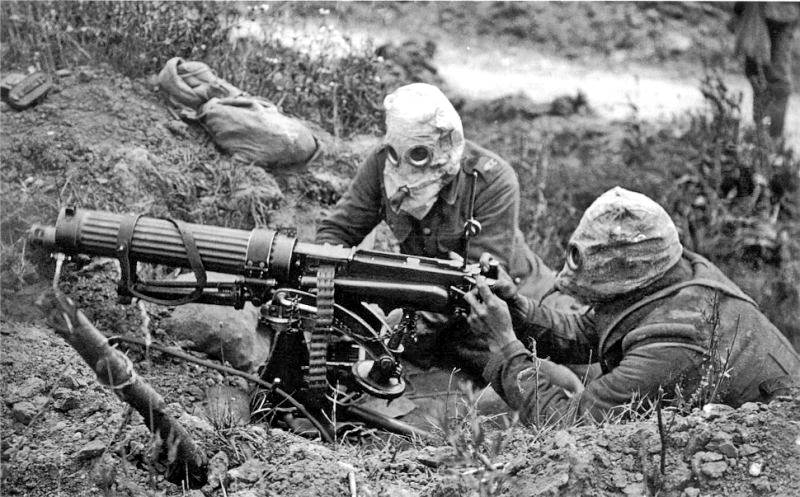
Wounded
so badly in the left shoulder just before this that his arm was practically
useless, he nevertheless volunteered to operate the gun. Despite
excruciating pain from his wound, he operated the gun in a spirited assault,
firing the gun with his right hand until he was wounded again. For this
heroic work he was given the Distinguished Service Cross.
Private Lester Carson of Clearfield,
PA, a member of Company L, is another of the brave boys of the Pittsburgh
regiment who distinguished themselves at about this point in the war. When
an officer of the 111th called for a runner to take a message from Fismette
back to Fismes, across the river, the path that had to be covered was raked
with shells and machine gun bullets.
The man who volunteered was riddled
with a score of bullets when he had gone only a short distance. Heedless
of this sight and of the danger in which a second runner was sure to be in,
Private Carson volunteered and was sent out with a duplicate of the message.
His luck held good and he managed to get through over the same route on
which the other hero had failed. Private Carson later was decorated for
this piece of bravery.
RESCUES WOUNDED
At a point in the fighting a
detachment of the 111th was called back hurriedly from an advanced post,
which it was seen could be held only with great sacrifice. Five wounded
men were left behind unavoidably. Volunteering to go back after them,
Private Albert R. Murphy, of Philadelphia, a member of the sanitary
detachment, exhibited great bravery.
Murphy stuck to his task in the face
of seemingly insurmountable obstacles and the incessant, and vicious, fire
from the enemy guns. Three days and three nights of untiring effort were
required before the last man was brought back. Superlative valor was shown
by the rescuers and for his part in this work Private Murphy was cited and
received the Distinguished Service Cross.
Lying in an exposed position was a
sergeant of Company C, 111th infantry, who was shot and wounded August 10.
It remained for Sergeant Alfred Stevenson of Chester, PA, a member of the
same company, to volunteer to go to the rescue.
Successfully making his way
through fierce enemy fire to the side of his wounded comrade, he leaned over
the man and was attempting to obtain a firmer grasp so he could carry him to
safety. Just then a sniper’s bullet struck Stevenson, who raised
himself partly to his feet and said to the wounded man: “Gee, they got me
that time.” Another bullet struck him and he fell dead.
SHOW SPENDED HEROISM
In a clump of bushes lay the wounded
men and there was a considerable open space between him and our lines.
Stevenson not reappearing, Corporal Robert R. Riley of Chester, a member
of the same company, with two comrades, begged permission to go after the
two men. On their first attempt, all three were wounded and compelled to
go back. Corporal Riley’s wound was not severe and he insisted on another
attempt.
He went out again and found his old
schoolmate, Stevenson, dead. The man for whom the effort was made was able
to crawl back to our lines after being given first aid treatment. Riley was
unable to complete the return to the lines without collapsing. He was carried
in by Private Edward Davis and taken to a hospital. There he recovered and
was given the Distinguished Service Cross for his conspicuous bravery under
fire.
Private Fred Otte of Fairmount City,
PA, a member of Company A, 111th infantry, during five days of the most
intense fighting, from August 9 to 13, acted as a courier between his
battalion headquarters in Fismes and the troops in Fismette.
After making several trips across the
Vesle River under heavy shell and machine gun fire, Private Otte found that
the bridge which he had been using had been destroyed.
He then continued his trips to and
from headquarters by swimming the Vesle despite the wire entanglements in
the water. He received a Distinguished Service Cross for his performance,
which was one of the most notable individual stunts accredited to American
soldiers "over there."
CARRIED AMMUNITION
A Pittsburgher who distinguished
himself was Bugler Harold S. Gilham of Company H, 111th infantry. He and
Private Charles A. Printz of Norristown, a member of Company F, of the same
regiment, not only volunteered as runners to carry messages to the rear, but
on their return exhibited their contempt for the enemy by loading themselves
with heavy boxes of ammunition.
The ammunition was needed badly, and
it was largely due to the efforts of these brave men, and their worthy
comrades, that the tide of battle did not turn against us in these critical
days.
On another occasion, during some of
the most critical and trying engagements of the now famous 111th, Sergeant
James R. McKenney of Pittsburgh, a member of Company E, took out a patrol
to mop up a lot of snipers who had been making havoc with some of our best
forces.
Returning after a successful foray, he
was exhausted and ordered to rest but he begged for and obtained permission to
take out another patrol. It was just such spirit that enabled the Yankees to
make such a splendid showing in the world war, even then pitted against the
crack Prussian Guards and others of the Kaiser’s supposedly invincible
forces.
Though gassed severely and wounded
badly in the head by shrapnel, Sergeant Richard H. Vaughan of Royersford,
PA, a member of Company A, 111th infantry, refused to be evacuated and, after
having his wound dressed, continued to command his platoon until relieved
four days later.
Sergeant Vaughan died soon after that,
from the effects of his wound and the gas. The Distinguished Service Cross was
awarded him and sent to his father, Doctor E.M. Vaughan, together with the
text of the official citation. The concluding paragraph of the citation was
as follows:
WINS IMMORTAL PRAISE
"By his bravery and encouragement
to his men he exemplified the highest qualities of leadership."
Another hero who deserved, and won,
official recognition and reward was Corporal James W. Gleason of Pottstown,
PA, a member of Company A, 111th infantry. He was commended publicly and
given the Distinguished Service Cross for his “great aid in restoring and
holding control of the line in absolute disregard of personal danger and
without food or rest for seventy-two hours.”
Three sleepless days and nights,
aiding and encouraging their men to hold a position, were spent by Lieutenant
Walter Ettinger, of Phoenixville, and Lieutenant Robert B. Woodbury, of
Pottstown, the former an officer of Company D, 111th infantry, the latter of
Company M of the 111th.
Scarcely second to the physical
hardihood and bravery shown by the Western Pennsylvanians, as well as men
from other parts of the state, was their moral courage. Far from home and
loved ones, they waited often for the letter that did not come, the
endearing message of encouragement that would have meant so much to the
tired and battle-worn heroes.
Patiently they endured the discomforts
which are the fortunes of war. Complaint was seldom heard from the men
while there was yet fighting to be done. Grimly, tenaciously, with a
depth of purpose known only to those who have been tried in fire and have
come out pure gold, these brave boys struggled on until their task was
finished - and they wrote cheery letters home. The world owes them a debt
it can never repay.

Pennsylvania soldiers of the 28th
Division - Center; Private Lester Pearson; Clockwise from upper left;
Lieutenant L. Howard Fielding, Bugler Harold S. Gilliam, Reverend
Mandeville J. Barker,
Corporal Raymond E. Rowbottom, Sergeant James R. McKenny,
Private Fred Otte and Corporal Raymond Peacock.
CHAPTER X
STRUGGLE TO GAIN A FOOTHOLD
Odds against them never seemed
to count with the Pennsylvania soldiers. The heroes of the 28th Division
seemed reckless at times in the manner of their advance against the foe,
particularly when the latter was in superior force and in an apparently
incontestable position.
In this seemingly uncalled for daring,
however, there was always a deep purpose, the like of which the Hun has always
been incapable of comprehending, and which the writer has not even a remote
intention of trying to explain so that it's intricate principles might
penetrate the solid ivory dome of the Boche.
When baseball becomes Germany’s
national pastime, and even the windows along the Wilhelmstrasse are
endangered by the ambitious efforts of irrepressible sandlotters with
visions of being future big league phenoms, and when football demands the
same autumnal attention in Prussia and Bavaria that it does in
Pennsylvania and Georgia, then and not until then will the German
intellect be capable of receiving impressions and reaching conclusions
comparable with those of the doughboys.
When the Wagners and Cobbs,
the McLarens and Guyons of Germany, if there are any, are accorded in
the Fatherland the homage which for half a century has been paid there
to silly Crown Princes and strutting military officers, then only can
the German mind hope to attain the viewpoint which swept the gallant old
“Fighting Tenth,” the wonderful old Eighteenth of Pittsburgh, the
unyielding old Sixteenth, N.G.P. and other Western Pennsylvania regiments
over the top and forward with a fury that no human defenses could
withstand.
ALL IN THE GAME
At risk of plagiarizing the famous
remark of a certain British commander, it may be said that America’s part
in the world war really was played during the past twenty years on more
than 1,000 baseball and football fields throughout the United States. The
initiative and skill, the never-say-die spirit and the inherent knowledge
of strategy necessary to win were cultivated over here.
When the boys went
"over there," they simply took those qualities with them. Being what they
were, nothing less than what they did could have been expected of them.
The quarterbacks among them knew enough to aim their heaviest blows at
the weakest spots in the enemy’s front without waiting to be told by their
officers to do so.
Outguessing the enemy and outfighting
him aggressively was exactly what their coaches had drilled into them for
years. They knew that a hit in a pinch was worth ten homers when their team
was way out in front. Trench raiding wasn’t so much different from base
stealing, if you look at it that way. The idea was to catch the opponent
off his guard and go to it like a flash.
German prisoners have admitted that
they had become so accustomed to fighting French and English, with time
out for meals, that they simply couldn’t adjust themselves to the American
style of fighting. Of course they couldn’t. Nobody ever expected them to.
When they had numerical superiority on their side, not to mention better
position, they methodically calculated that the Yanks would let them alone
for the time being.
They fooled themselves and lost the war.
The Western Pennsylvania troops out-gamed and out-pointed the crack Prussian
Guards at every point of contact. The dash and aggressiveness of the Keystoners
seemed marvelous in the eyes of British and French observers, but really not so
very wonderful in the eyes of the folks back home, who knew all along just what
kind of men they had sent into the fray.
Lieutenant Colonel Edward Martin of
Waynesburg, commander of the old “Fighting Tenth,” who is authority for the
statement that, in the battle of the Argonne Forest, the Americans “took a
gambler’s chance on ending the war in 1918,” and he ought to know, for he
was in the thick of it, also had something to say about athletics when he
returned to his home town.
WHAT FOOTBALL DID
Commenting on the wonderful war work
and fighting qualities of Captain “Buddy” Aiken and Major Joe Thompson, two
famous Washington and Jefferson College and University of Pittsburgh football
stars of former years, Colonel Martin declared emphatically that the football
knowledge of these two men counted for a great deal on the
battlefield.
"I certainly wish that every officer
and man in my regiment had played football at some time in his life," Colonel
Martin told a little group of friends soon after his arrival home. From the
tone of his comment, it was inferred that he agreed, to some extent at least,
with the views set forth above.
One of Western Pennsylvania’s great
athletes who gave his life in France that freedom might not perish from the
earth, was Lieutenant Levi Lamb, son of Mr. and Mrs. H.L. Lamb of California,
PA, a little state normal school town up the Monongahela River about fifty
miles from Pittsburgh. A few years ago he was a star tackle on the
Pennsylvania State College football team and was the champion wrestler of
that college.
Previously he had played baseball and
football at the Southwestern State normal school, California, PA, and at Grove
City College. Being six feet and six inches in height, he was affectionately
known ten years ago in his home town as "Little Levi."
That he died bravely on the
field of honor is attested by letters from his superior officers, and that
any Hun who grappled with him must have fared badly will be attested by
hundreds of men who have opposed him in friendly athletic rivalry in Western
Pennsylvania in the past decade. A gold star in his honor adorns the service
flag of Penn State, and his memory will never grow dim at that famous old
school.
Literally thousands of high school
and college athletes from Western Pennsylvania won imperishable renown “over
there.” Hardened by intensive military training on this side of the
Atlantic, under the tutelage of experienced French, Canadian, British and
American Army officers, they were fit for the fray. Is it a matter for
wonder then, that Europe respects the American soldier and the humblest
American citizen now as never before?
MORAL SIDE SHOWN
Aside from the purely military, and
economic or commercial, advantages gained by winning the war, there is a
moral side to it all. Never again will the Kaiser or any other European
monarch delude himself and his subjects into the belief that “Americans
won’t fight.” But that is not all. The doughboys took with them to France,
Belgium and Germany the spirit of fair play which is the essence of all real
American sportsmanship.
Not only did they rever womanhood and
seek to protect childhood and old age, as they had been admonished (rather
than ordered) by Pershing to do, but they accorded even the enemy whatever
admiration they could when his acts justified it, which was seldom. When
Colonel Martin tells how a little group of American soldiers applauded the
pluck of a German aviator attacking an allied observation balloon, when the
odds were against the attacker, he tells what is at first thought incredible.
But it really happened and, on second thought, it is not so
remarkable.
There have been times in America
when a visiting outfielder has been given a hand by the home crowd for
making a marvelous shoe-string catch or a visiting slugger has been given
his due even though he clouted a circuit smash off of the home pitcher’s
delivery.
Probably it was that same sense of
giving honor where honor was due that led the Yanks to applaud the Hun flier,
even though nine-tenths of the German fighters were rotten at heart and
deserving of no comparison.
In the second charge of the Americans
during their attack on the town of Fismette, Sergeant Clarence Davidson of
Tarentum was wounded. He was leading a platoon with great bravery at the
time and, according to accounts of the occurrence given by some of his
comrades, his coolness and courage under fire proved a remarkable
inspiration to his men.
Just before that, while talking to a
commissioned officer, Sergeant Davidson witnessed the death of Lieutenant
Glendenning of Pittsburgh. The Pittsburgher, who was not far from where
Sergeant Davidson and the officer were standing, was killed by the explosion
of a German shell.
HOW THOMPSON DIED
Captain Orville R. Thompson of
Pittsburgh, commander of Company M, 111th infantry, lost his life during
the assaults on Fismette. Captain Thompson had been ordered to take his
company and advance on a German position just outside Fismette. The men,
with their commander in the lead, went over the top at 6:30am on
August 11.
The enemy was in a well-fortified and
well-wired place and capable of offering a strong defense. It was situated
on the top of the little knoll, and this made it's capture doubly hard because
the Boche could sweep the Americans with rifle and machine gun fire as they
charged up the slope.
Captain Thompson was about fifteen
yards in front of his men, urging them on. He had declined to remove the marks
which designated him as a commissioned officer, thus making himself a target
for which the German sharpshooters always looked. He had reached the barbed
wire when a sniper’s bullet hit him and he fell without a groan.
Captain Thompson was a commander very
much loved by his men, as he was always out in front whenever there was
hazardous work to be done. He would never ask a man to take any chances he
would not assume himself. He was a wonderful soldier, according to the
testimony of the men of his command, and by his courage and daring he set
an example that was emulated by the entire company.
Private George Geiley, of Mt. Mary’s,
and Private J. Kelly, of Pittsburgh, both of Company M, performed
distinguished service during this battle. Private Feiley was an automatic
rifleman, and he was right up in the thick of it when a bullet hit him in the
neck.
Although suffering terribly from the
wound he refused to leave his gun and his comrades had to drag him away.
Private Kelly then took over the automatic rifle position and hammered away
at the Boche until the company got back to safety. He returned with several
wounds and the gun.
August 12, the Germans put forth a
mighty effort to drive out of Fismette the Americans who had managed to
gain a foothold there. After putting an intense bombardment on the
town, followed by a rolling barrage, they advanced in force.
There were
too many of the enemy for the small band of doughboys to withstand the
assault and, so to save as many lives as possible, orders were issued for
our men to retire. But it was a stubborn retirement and they caused the
foe many casualties while being forced out of the town.

A phosphorous shell explodes near
an American soldier during the battle for Fismette.
INFERNO IN FISMETTE
When the Americans were again across
the river from Fismette, and the town was in the hands of the Boche, the
Franco-American artillery was given an opportunity to make life unpleasant
for the enemy. The artillery had been massed to protect the advance of the
Pennsylvanians and, when the guns unloosed their iron messengers of
destruction, Fismette became a veritable inferno.
It was apparent that the
Germans could not endure such a concentrated bombardment for long.
Fismette proper was made untenable for the Kaiser’s hordes, and then the
Americans set about planning for another attempt to capture the
place.
The next advance on Fismette was led
by men from Company A, 111th infantry, in the charge of Captain Archibald
Williams and Lieutenant H.E. Leonard, both of Pittsburgh. This unit swam
and waded across the Vesle under terrific shell and machine gun fire.
They took to the water rather than use the bridges for the reason that the
enemy was centering his fire upon these structures.
Our men were able to
gain a foothold on the Fismette side, but they were in a precarious
condition because they were unsupported on the flanks. In order to gain
some protection from that hail of steel, they plunged forward into a little
ravine, only to find that they were in the midst of a gas cloud. It seems
that much of the gas with which the Germans had been sending into the town
had, for some reason or other, settled in this ravine.
And it was a terrible mixture of all
the deadly gasses which the Germans used. Mustard, sneeze, tear and
chlorine gas made up one of the worst examples of Hun devilry, of this form,
which our boys had met. Thus they were forced to fight with gas masks, but
they went forward on the run, cleaning out nest after nest of machine
guns.
The Germans would stand to their posts
and fire until they caught the glitter of our bayonets, and then they either
attempted a quick retreat or uttered their usual plea for mercy. In many
instances they neither escaped nor had their “kamerad” cries given heed.
The Americans were too busy to bother much with prisoners and they still had
many scores to settle.
PRAGER IS CITED
By this time a few more men of the
111th had managed to cross the river in support of Company A, and it was
during this hard fighting that Sergeant Benjamin Prager, Company E, 240
Southern Avenue, Mount Washington, performed deeds of coolness and bravery
under fire which won for him official citation and a recommendation for a
commission.
Lieutenant James C. Boden, who made
the recommendation set forth that "Sergeant Prager’s courage and leadership
was unexcelled by any other soldier in command. As a leader he has been
unexcelled by any other officer under my personal observation. He has never
failed to carry out orders and, in the absence of a superior officer, has
used his own initiative in commanding men, strengthening positions,
etc."
The sergeant delivered his company
under a heavy barrage to reinforce Company G without a casualty. On the
same day at Chateau de Diable, near Fismette, he took charge of the left
flank of Company E, which was under heavy machine gun fire.
He established
a sniper’s post in a building from where our riflemen picked off great
numbers of the enemy, especially machine gunners. He was wounded while
directing his men but gamely dressed his own wound and remained at his
post until relieved.
His wound sent him to the hospital
for two months and it was November 10 before he was able to rejoin his
command.
During the fighting on August 12,
Sergeant Arnold H. Kegler of Pittsburgh, Company M, 111th infantry, was
wounded severely while performing an act of bravery in attempting to rescue
a wounded comrade who was in a shell crater in No Man’s Land.
Sergeant
Kegler noticed a soldier in the crater and, together with Corporal Frank
Aiken and Corporal Jordon of Pittsburgh, decided to get him out. Crawling
on hands and knees, while machine gun bullets whizzed about their heads,
they finally reached the edge of the crater and dragged the wounded soldier
back to the American lines.
Just as they reached the line a big German
shell exploded in their midst, killing Corporal Aiken and wounding Corporal
Jordon and Sergeant Kegler. Sergeant Kegler was blown up a small hill,
with several pieces of shrapnel in his leg, but was able to crawl to a
nearby house. He remained there several hours before a patrol found him
and removed him to a dressing station.
WOULDN’T BUDGE
The manner in which this small
force managed to win it's way into Fismette and stick there has been
described "like a policeman’s boot in the door of a wrongdoer’s house."
They refused to budge an inch, although treated to every form of
diabolic, death-dealing device the Hun had to offer.
High explosive
shells, all sorts of gas, furious infantry counter attacks, bombs and
machine gun bullets were of the continuous variety. But the doughty
Pennsylvanians did not have the slightest intention of being driven
out.
While all this battle for supremacy
was under way, the foe had demolished every bridge across the river except
one, and that was so badly damaged as to be considered unsafe. Thus our
men in the town were practically cut off from their comrades on the other
side of the river.
All the little force could do was
to fight grimly until it was possible to get reinforcements across. Many
of the men had been wounded, and a group of twenty-eight sorely in need of
hospital attention had been gathered in the cellar of a building to await
the arrival of ambulances from across the river. Their comrades realized
that every man in this little group of wounded must be given hospital
treatment as soon as possible, in order that their lives might be
spared.
How to evacuate
them was, indeed, a problem. It seemed almost impossible to get an
ambulance across that lone bridge, which was even then the target of the
Boche artillerymen. It was then that some of the Pennsylvania
doughboys rose to the pinnacle of human daring; they became supermen,
performing the most arduous and perilous tasks without thought of fear
and emblazoned their names at the very top of the scroll of
fame.
To the men of the 28th Division’s
sanitary train came word of these wounded in the cellar over in Fismette.
The house had been struck five times by shells, and it was necessary time
and again to clear the debris off the wounded. Captain Charles Hendricks,
of Blairsville, together with a few men, remained in the building to look
after the wounded.
Frequently, he and his men were buried
under falling plaster and other material. After digging themselves out they
would do likewise for the twenty-eight wounded lads. This went on for four
days, and during all this time it had been absolutely impossible to send
assistance from across the Vesle.
HOW THEY WERE SAVED
The men of the ambulance companies
attached to the sanitary train decided that, no matter what the enemy had
to offer in the way of destruction, something had to be done to get those
wounded men out of Fismette.
The advance party of the rescuers set
out from Fismes in a touring car which carried Major Frederick Hartung of
Pittsburgh; Major Edward M. Hand of Coraopolis; Captain George E. McGinnis
of Philadelphia and Privates Walter Frosch and Walter McGinnis of
Philadelphia. All were members of the Medical Corps.
Frosch was driving the car, and they
made a wild dash down the road to the river in full view of many enemy
gunners. Their only hope was that speed might get them through. Their
car was soon the target for the enemy, and how they ever escaped the rain
of shells put upon that road is a mystery.
The car was hit several times,
but Frosch kept right ahead oblivious to the danger. Reaching the unsafe
bridge, they rushed across at top speed and, luckily, the structure held.
Then through Fismette the car dashed up to the building around which
the big shells were falling thick and fast, and in which the wounded men
were awaiting removal.
The ambulances on the other side
of the river had been made ready for a like dash when the signal should
be given by Captain McGinnis. At this prearranged signal the ambulances
were to dash from cover and attempt to rush across the bridge just as
the officers who had gone over in the touring car. All these ambulances
were marked conspicuously with the Red Cross, but that did not deter the
Boche from shelling them.
Indeed, it seemed to spur him on to greater
efforts to demolish these vehicles of mercy. The cars were manned mostly
by men from Philadelphia and vicinity, namely, James T. O’Neil of Alden;
James R. Gunn, Joseph M. Murray, Samuel Falls, Alfred Baker, Originnes
Biemuller, John Curry, Harry Broadbent, Raymond Onyx, all of Philadelphia;
John F. Maxwell of Williamsport and Albert Smith of Frankford.
AMBULANCES CROSS
When the signal was given, the
ambulances rushed down to the shaky pontoon bridge and thence across
the river, and although the Germans did their best to destroy them not
one car was hit. Up through Fismette the train rumbled, and it was not
easy going through the little, narrow streets of the town half choked
with debris at many points.
The drivers pulled up beside the
temporary refuge for the wounded. The stretcher bearers leaped out and
prepared to load the men into the cars and make another dash back across
the Vesle to the hospitals.

Some of the Yanks from Pittsburgh
and Western Pennsylvania who distinguished themselves during the drive
of the 28th Division. Left - Major Edward M. Iland; Upper right left -
Lieutenant Harry E. Leonard;
Upper right corner - Captain Orville R. Thompson; Middle right - Private
John E. Kelley;
Lower left - Private George Feiley; Lower right - Captain James A.
Williams.
CHAPTER XI
CAPTURE OF FISMETTE
While the ambulances were waiting
in the shelter of the building in Fismette to load the wounded into the
ambulances, the Huns continued to pour forth their hate on that brave band
of Pennsylvanians. It seemed as if they were determined to prevent the
evacuation of those wounded men, if it took every shell in their possession
to accomplish the nefarious task.
But the doughboys kept at their post
with utter disregard for the death missiles falling all around them. Private
O’Neil went back to the river to ascertain if the bridge was still standing,
and while he was standing on the brow of the hill gazing down he happened to
think of a cache of medical supplies in the side of the hill.
He calmly walked to the spot, despite
the fact he was the target for many enemy gunners, secured the supplies and
carried them back to the buildings where the wounded were being sheltered.
Officers who witnessed the feat through field glasses from the far side of
the Vesle have since declared that it was one of the most daring and fearless
pieces of work of which they have knowledge.
When O’Neil brought back the supplies
he reported that the bridge was still standing. At 3:00am in the morning
they loaded the first ambulance and started on the perilous journey to the
other side of the Vesle. Captain McGinnis went along. Within a few minutes
another ambulance was loaded and followed. At the same time O’Neil had
been sent down to take another look at the bridge. Just as he arrived,
when the first two ambulances were safely across, a big shell landed
right in the middle of the structure and broke it in two.
O’Neil hurried back to his comrades
to prevent any more ambulances from starting out until the bridge had been
repaired. Just as he arrived, a big shell burst directly in front of the
dressing station and several of the men were buried under an avalanche of
earth at the entrance to the cellar.
The story is told of how one doughboy
in an ambulance, presumably too severely wounded to move, beat an unwounded
man into the cellar after the shell burst. Several of the men were wounded
by flying pieces of shrapnel and some of the wounded also received new
wounds. One of the ambulances had all four tires punctured and it's top
punctured in hundreds of places.
After this happened the patients who
had been loaded into the ambulances were carried back into the cellar to
wait for the time when the enemy should decide to take a breathing spell.
By 7:00am the bridge had again been repaired and two more ambulances got
away, but when they reached the river front they found the bridge again a
mass of ruins and had to return to the shelter.
RUSH FOR THE RIVER
Efforts to get the wounded men out
of Fismette and across the bridge continued, but without success because of
the heavy bombardment kept up by the enemy. The next day at 4:00pm, there
was a lull in the fire and two more of the ambulances made a break for the
river. They raced out of the town and across
the bridge, but arrived on the other side just in the nick of time to escape
being thrown into the river. A big shell made a direct hit on the structure
and broke it in twain.
This time the bridge was damaged
beyond any hope of quick repair, so the ambulance men prepared to ford
the river on foot and carry the wounded on litters. This was dangerous
work with the enemy fire sweeping the stream, but our boys never hesitated
for a minute.
There never seemed to be a task which
they would not undertake in their determination to make an end to the Hun.
The Fismette affair had become so desperate by this time, and the fighting
had been so severe, that our boys were in a mood where they would have rushed
into anything. They were not in the best of humor because of being held up by
the staunch defense which the enemy was putting up.
In order to get the wounded across
the river by the wading it was necessary to organize some sort of defense
to keep down as much as possible the enemy task while the ambulance men
were engaged in their perilous work.
In organizing this defense First
Sergeant Thomas J. Cavanaugh, of Pittsburgh, a member of Company D, 111th
infantry, distinguished himself in such a manner as to be cited in orders,
and likewise to receive the Distinguished Service Cross.
CAVANAUGH’S DARING WORK
Sergeant Cavanaugh performed some
wonderful work in this instance, and by his courage and daring did much to
assist in getting those wounded comrades back across the river to a
hospital. He took a small force of his men and captured a small building
on the outskirts of the village as a preliminary to the scheme of covering
the evacuation of the wounded.
This he organized as a strong point.
Then he took a position on a street intersection, where, by stepping around
the corner he was protected from the snipers and machine gun fire, and by
going around to the other side, he was a target for the machine gun fire
sweeping the street down which the ambulance men had to rush with their
cars to the river's edge.

Cavanaugh took awful chances that day,
for when the ambulance men were ready to move, he would step out into the
street and, if the Germans were not firing heavily at that moment, he would
beckon to the ambulance men that it was time to make a dash.
He was wounded by
shrapnel but refused to go to the rear until he collapsed and was carried
off a couple of hours later. The next day, after having his wounds dressed,
he insisted on resuming his post and acting as the human target for the
benefit of the wounded and the ambulance men.
When the ambulance men got to the
river they calmly unloaded the wounded and, raising the litters above their
heads, they waded through the water to the other side. All this time with
the machine gun bullets and shrapnel churning the waters about
them.
On the far side the ambulance men
waiting to receive the wounded, and rush them to field hospitals, backed
their cars almost to the water’s edge, oblivious to the death-dealing missiles
falling like rain about them. They watched closely every move of their comrades
in the water and called out advice as to the best way to proceed. In this way
our wounded Pennsylvanians were removed to safety right under the noses of
the enemy.
CAPTAIN LYNCH KILLED
But Sergeant Cavanaugh was not the
only man who exposed himself to the Boche fire on corners to assist in this
evacuation of the wounded and it is but right that mention should be made
of Captain Edmund W. Lynch, of Chester, commander of Company B, 111th, and
Lieutenant Edward S. Fitzgerald, of New York City. Captain Lynch was killed
a short time later. Both these officers took position on street corners
during this period while the wounded were taken out and officiated as human
targets.
And all this time the fight for
Fismette went on ceaselessly. Many were the acts of gallantry and daring
performed, but for the most part the work all called for exceptional daring,
and so every man shared in it. The unusual acts were noticed in certain
instances, but most of them will probably never be known as they were either
unnoticed or forgotten during those strenuous days.
The 111th was relieved about this
time by the 109th. Then, on August 17, the 112th went back into Fismette,
and rotating by battalions assisted in holding the line.
Lieutenant Milton W. Fredenburg,
of Ridgeway, an officer of Company D, 112th, had some ticklish work to do,
for he was ordered to lead a party of machine gunners filtering through
the German lines at night. They worked like Indians, a man slipping
through here and another there. Then by an arrangement made previously
they all assembled in some woods at the rear of the German line.
Next day when the fighting became
furious and the Boche commenced to waver, the lieutenant and his little band
threw consternation into the enemy by sending a hail or machine gun bullets
into his rear. The Germans in this section were sure they were being surrounded,
then broke and fled. The ground was strewn with dead Huns as the result of
this bit of work. Our boys were able to get them coming and going.
MANY WADE STREAM
The bridges were still down and in
order to get more men across the river, Lieutenant Ripley L. Shearer, of
Harrisburg, with men of Company G, 112th, had to cross the river at a place
where it was unusually deep. Some of the shorter men of his command were
obliged to either swim or be supported by tall comrades in order to complete
the crossing.
They had the center of this advance and
captured a building which had been a tannery, and which had been transformed
by the Germans into a stronghold. Lieutenant Shearer and his men received high
praise for this work as it was exceptionally hard and hazardous. It was likewise
costly to our men in killed and wounded.
Company M of the 112th, commanded by
Captain Fred L. McCoy, of Grove City, forged it's way down the river bank in
one of the assaults and captured an old stone mansion held as a defense point
by the Germans. From it's stout stone walls they had been able to pour an
effective fire into the Americans. In capturing this stronghold our boys
took about thirty machine guns, large quantities of supplies and many
prisoners, as the defenders were caught like rats in a trap.
East of the tannery which had been
captured by men from Company G, was where Captain Lucius M. Phelps, of Erie,
commander of Company G, and Captain Harry F. Miller, of Meadville,
commanding Company B, led other detachments in a brilliant advance and were
able to turn their guns on the enemy clinging desperately to the northern
fringe of the town.
Among the instances of individual
heroism recorded around Fismette during these days of carnage and turmoil
were the following:
HEROIC DEEDS MENTIONED
Sergeant Ralph E. Ord, of Dravosburg,
showed extraordinary bravery by his skill in handling his platoon, in
addition to rescuing several wounded men and dragging them to places of
safety away from the shot and shell swept area. With Sergeant Alois J.
Guenther, he helped clear Fismette of snipers. One of their comrades was
lying on the left bank in the open and the two sergeants got him between
them, crawling on their knees, at the same time tugging and hauling the
wounded lad into their own lines.
Private Michael Fisher, of Pittsburgh,
was a runner who crossed the bridge many times under machine gun fire, while
the structure was also under a deluge of three-inch shells. Another exploit
of Fisher’s was to conduct twenty-five wounded men, one at a time, across
this fire-swept bridge. His comrades declared that he seemed to bear a
charmed life.
Private Fred Ott, another runner in
the same outfit, carried messages between Fismes and Fismette for five days
and, when the bridge was down, which was very frequently, he plunged into the
river and either swan or waded across. He would appear at headquarters with
his clothes dripping wet. Frank Prosta was another runner from this vicinity
who performed many daring exploits.
Our Pennsylvanians were using some
French trained dogs as couriers at times, but frequently the animals would
fail to get through, and as wire communication had been cut it was necessary
to call for volunteers to carry the messages. It is needless to say that
there were many more doughboys offering for this hazardous service than could
be used.
RUNNERS FACE DEATH
William Duff, of Pittsburgh, a
mechanic, Maurice J. Hargrave, of Pittsburgh, and Private Paul E. Henderson,
of Sagertown, were on duty as runners from August 9 to 13 carrying messages
across the bridge to Fismette. On August 13, Duff and Henderson were in
Fismette when the Germans made a violent attack and it was reported that
our men were surrounded.
It was necessary to get a message across
the river to our supports on the Fismes side, and as it was absolutely necessary
that the message should get through. Two copies were made. Both Duff and
Henderson, having begged for the opportunity, were sent away. Both got
through and in the afternoon Duff returned with a load of much needed
ammunition. Major Harry J. Kelly says they saved the day, for our boys
were finally able to beat off the German attack.
Hargrave made about twelve trips
across the river and back. Privates Albert R. Murphy, William J. Nixon,
Philadelphia; George B. Matthews, Ardmore; Albert A. Paris, Albert A. Davis
and Robert N. Andrews, of Pittsburgh, were first aid workers who distinguished
themselves, making litters out of twigs. Private Lester Carson, of Pittsburgh,
after a runner had been shot down, volunteered to carry a duplicate message over
the same route and got through.
J.R. McKenney, of Pittsburgh, took
out a patrol in the face of severe machine gun fire and snipers of the
enemy. He was for twelve hours without food. Corporal Charles Reitf, of
Pittsburgh, showed ardor and leadership unexcelled, for he was one of the
first men to force his way into a stone house, occupied by Germans with
machine guns, which dominated our flank.
He afterwards took charge of
the defense of this house, from which seven German snipers were killed.
Sergeant Raymond C. Reisker, of Lebanon, although not required to do so,
dressed the wounds of sixteen men, being constantly under constant fire
at the time, below the slim protection of a wooden bridge.
CAPTAIN CAIN LEADS CHARGE
Captain Robert S. Cain, of
Pittsburgh, armed himself with a rifle and led the men at one exposed
ridge. In one place in the battle he found his company faced by 1,000
Germans, the remnants of three enemy regiments. He defeated them and
captured half dozen German machine guns.
Sergeant John W. Thompson, of
Pittsburgh, distinguished himself by conspicuous bravery, leading a
patrol against an enemy machine gun nest of ten guns. In the face of
direct fire they captured two of the guns. He taught the men to use them
and turned them against the Germans. His patrol had much of it's equipment
shot off, his own rifle being shot through by one bullet. He killed
numerous snipers and his constant aggressiveness inspired the entire
regiment.
Sergeant John Howard Earl, of
Doylestown, not only took command and led a platoon to victory, but also
dressed a major portion of the wounded.
Hospital men who showed conspicuous
gallantry were Privates Carl J. Dunmeyer, of Johnstown, Gerald Maddowar,
of Waynesburg, Ray Beck and Emil M. Lauff, Philadelphia.
Stretcher bearers who worked with
special courage were Sergeants T. Siebert and J. McCune, Blairsville;
Corporal Clair Medder, Zelienople; Privates George Best and Russel Smith,
Pittsburgh; Private James Beach, DuBois; Private Edward Wilharn, Edgewood
Park; Private Walter Vail, Punxsutawney; Private William Lohr, Ligonier;
Privates Raymond Washabaugh, Guy Schorts, Yathboro and Thomas Smith,
Washington.
Private Sam Saplio, of Pittsburgh,
showed great heroism, being almost impossible to keep him from going
alone into the German lines after the snipers and machine guns. So great
was his enthusiasm, not withstanding that his canteen and part of his
equipment had been shot off him.
Sergeant Robert C. Herrman, of
Pittsburgh, took charge of the firing line when all the officers had
been killed or wounded.
Sergeant Richard Vaughan, of
Royersford, was conspicuous by his leadership and disregard of
danger.
PITTSBURGHERS PRAISED
Mechanic Robert A Krans and
Privates William L. Harris and Joseph A. Gehner, of Pittsburgh, won
the plaudits of their comrades for their work in carrying the wounded
back from the firing line under a heavy fire. While Bugler Roy Epley,
of Jeannette, and Private Carl Otto, of Fremont City, without sleep or
food for seventy-two hours, carried messages that were always
delivered.
Others who showed extraordinary
capacity and bravery near Fismette were Lieutenant Lee G. Fletcher and
Godfrey N. Wyko, Sergeant James Mastrovitch, Pittsburgh; Sergeant Alfred
Stevenson, Linwood; Sergeant Edwin McBeth, Pittsburgh,; Corporal R.R.
Riley, Chester; Private P. Amuer, Dravosburg.
During all the time that this fighting
was under way along the front lines, the Pennsylvania artillery stationed
in the hills south of Fismes had been undergoing a thorough drenching of
gas and shell from the German batteries. But our artillerymen gave two
shells for every one the Boche sent over.
At one time just as a battery
was geared up to move into another position a big shell dropped right in
front of the lead team of one of the guns. The horses commenced to
prance and tremble, and it was an ideal moment for a stampede, But the
doughboys sat their plunging steeds as if on parade. By their coolness
they prevented any further damage and won high praise from their commanding
officers.
GUNNERS SHOW GRIT
During the shelling, two men were
killed and three wounded severely. Two of the horses were blown to bits,
but the battery went on to it's position. The wheel driver hurried to a
dressing station to seek aid for the wounded. He then sought out the
ammunition dump and obtained a supply of shells. He proceeded on the
gallop to the battery position to deliver it.
When he had completed his
work he called to one of his comrades and asked him to help dress a wound
in his leg. He had a bad gash from a shell fragment, but he had attended
the other wounded and supplied his battery with ammunition before thinking
of his own hurt. Such was the stuff of which our artillerymen were
made.
Members of the headquarters company
of the artillery regiments were called upon to maintain communications
constantly, and they strung telephone and telegraph wires in the face of
the deadliest enemy fire, and oftentimes in almost inaccessible places.
They never faltered in the work for it was imperative that these communications
be kept working at all times.
For them, to fail might have endangered
the lives of the infantry out in front seeking to drive the Boche from Fismette.
Men would fall at times, like wheat before the scythe, but always there were
others to promptly step into their places. The signal detachments were also
continually busy at this work of maintaining communications. They worked day
and night, frequently without food or water for many hours.

Many of the heroes who distinguished
themselves in the fighting at Fismes and Fismette. Center - Sergeant
John W. Thompson and Sergeant James R. McKenney; Clockwise from upper left
- Captain Robert S. Cain,
Carl J. Dumeyer, Coporal Ralph E. Ord, Captain Fred McCoy, Sergeant
Thomas Cavanaugh,
Maurice Hargrave, Corporal George V. Best and Michael Fisher.
NOTE: George Vincent Best, a member of
the HQ Company of the 111th Infantry, was on assignment to the Second Battalion
Medical Corps during the battle of Fismette. George was cited for bravery in
evacuating wounded comrades in the 111th Infantry during a severe barrage north
of Fismette in August 1918. Best was awarded the Silver Star citation and the
Purple Heart for his efforts during that engagement.
Born on September 29, 1899, in East
Liberty, the seventh of nine children of Isabelle E. and William J. Best. George
enlisted in the Army on April 18, 1917 and was discharged on May 13, 1919. After
the war, George settled in Brookline at 1444 Milan Avenue. He worked as a janitor
at Dollar Savings Bank. George Vincent Best passes away on March 9, 1990 and is
buried at Jefferson Memorial Cemetery.
CHAPTER XII
ADVANCE TO THE AISNE
Considering the hellish fury
of the fighting which ensued in Fismes and Fismette, one cannot wonder
or be astonished at statements made by Captain Robert Pollock of
Pittsburgh’s own “old Eighteenth,” upon his return to Pittsburgh from
France. While still a convalescent at the Parkview hospital, Captain
Pollock one evening addressed an audience of men in the Grace Reformed
Church, located at Bayard and Dithridge Streets.
“If I am shipped to hell,” said
Captain Pollock, “I think I can stand what the devil had for me, after
going through what the Germans had for us in Fismette. They used
everything they had on us, from liquid fire down, and many of my best
friends were killed or wounded there.” Captain Pollock himself was
wounded soon after Fismette was cleaned out and the Americans started
for the Ourcq River in pursuit of the stubbornly resisting
Germans.
Here is the story of Fismette,
as told by Captain Pollock:
"It was in this scrap that
Captain Arch Williams was wounded and Captain John Clarke, of Wilkinsburg,
and Captain Orville R. Thompson, of Pittsburgh, killed. We were advancing
on Fismette when they fell."
"When we got into Fismette the real
fighting started. German machine gunners occupied every window in every
house in town. We had to clear those houses before we could clean out the
town, and our men were dropping like flies. We had virtually no protection
from that awful rain of fire from the machine guns."
"The doughboys, though, went forward,
and they mopped up. They went into the first house in one block and you
didn’t see them again until they came out of the last house on the block.
They dug through the walls from one house to another, and every time they
left a house the Kaiser’s Army was minus several more men."
NO QUARTER ASKED OR GIVEN
"They asked no mercy and they showed
none. They dug through those walls, often with their bare hands, and they
tore at those machine gun men like tigers. No wonder the German defense
cracked, no wonder that it fled before those American doughboys. Many of
our men went down, too, but they got a couple for every one that went down.
There wasn’t a live German left in town when they got through."
"One incident which occurred there
is mighty strange. We found only one inhabitant, aside from German
soldiers, in the town. This was a woman aged about fifty. She said she
had stayed in town to protect her property. She started to tell some awful
tales, but we hadn’t time to listen and sent her back to regimental
headquarters. Subsequently the property which she had been watching was
destroyed. We destroyed it. That was when the Germans recaptured the
town and we had to shell them out."
"After we drove them out again,
however, we went forward, moving toward our third objective; we had gained
our first and second. The third was the plateau between the Vesle and the
Aisne, northeast of Fismette. We were well up on this place when I was hit.
Lieutenant Daniel W. Brooks, of Swissvale, was killed at the same
time."
"He was one of those fine fellows every
person likes. When I fell I didn’t lie long. They came along, picked me up and
started me for the hospital. The last I saw of my men was when, led by
Lieutenant Edward Z. Wainwright, they were moving over the brow of the
hill on to their objective."
"Among the many strange things about
the battles that the old Eighteenth participated in was that it once faced
the Eighteenth regiment of the German Army. This sounded too 'fishy,' so
Captain Robert Cain, of Pittsburgh, cut the shoulder straps from a captain
of the German regiment, who had been killed, and sent them back to his wife
as proof."
Reverting to the thread of our
present narrative, the German guns from their hilltops still poured in a
galling fire on the American positions. Still their snipers and machine
gunners hung on in Fismette. To have attempted to cross the Vesle River
under such bombardment would have been hazardous in the extreme. An attack
in force was obviously impossible, and it was at this point in the campaign
that the American and Allied commanders faced some of their most serious
and perplexing problems.
The Yanks were chafing for more and
more action, although their efforts to this point had bordered on the
superhuman. They were like raging tigers when they remembered how many of
their brave comrades had fallen victims of foe bullets and other means of
human destruction.
All the streets of Fismette were
filled with fighters. The combat continued with unabated fierceness and
varying fortunes for either side until August 28, when the Germans came
down out of their hills in a raging tide of savage and brutal destroyers.
Bolting into Fismette, they drove the little force of Americans back to
the river, where an amazingly few men managed to hold a bridgehead on the
northern bank.
RESISTANCE IN VAIN
This desperate resistance, however,
proved in vain, for the time being, and the town again fell into the hands
of the German hordes.
The American gunners then began
systematically to level the town, for the Yankee commanders had been
forced to abandon all hopes of taking it by infantry assault without an
unjustifiable loss of brave, wonderfully brave, men.
Elsewhere along the battle line
great events of vast importance in a military sense had been taking place
while these developments at Fismette were in progress. In Flanders the
British troops, supported by American brigades fighting shoulder-to-shoulder
with them, had been driving the Germans eastward, while further south the
French were keeping the Hun on the run and demonstrating to the Berlin
warlords in no uncertain fashion that the boastful and ruthless warriors
from the “Fatherland” were by no means invincible.
American forces around
Soissons were pounding away at the Germans in such fashion as to make the
Teuton positions along the Vesle River untenable. Even the stubborn
defenders of these positions soon began to realize that they could not
hold on there much longer without tremendous losses of man power and guns
and ammunition.
Among the brave Americans at
Fismette, just at this time, little was known of the developments in
the other sections. They fought on with bulldog courage, however. Even
the junior officers of the Americans were greatly surprised when word
came back September 4 that the patrols north of the river had met almost
no opposition from the enemy in their latest forward movements toward
the Rhine, which still seemed very far away indeed.
Next it was noticed
that the foe’s artillery fire had fallen off to a little desultory
shelling, so a general advance was ordered. Roads in the rear at once
became alive with big motor trucks, bug guns, wagon trains, columns of
men and all the countless activities of an Army on the march. It was a
wonderful sight to see that main force crossing the river.
Officers
standing on the hills overlooking the scene declared later that it was
one they never could forget. The long columns debouched from the wooded
shelters, deployed into wide, thin lines and moved off down the slope
into the narrow river valley.

The ruins of the village of Fismette
after the savage battle that raged for several days. The Germans held
stubbornly to the village and withdrew only after setbacks on their
flanks forced a general retreat.
TOWNS POUNDED TO DUST
The villages and towns of the Vesle
valley, pounded almost to dust by the thousands of shells which had fallen
on them during the two weeks the armies contended for their possession, lay
before the advancing Americans. Down the hill those brave Yanks went,
moving just as they had done times without number in training camps and in sham
battles and war maneuvers.
Occasionally there was a burst of black
smoke and a spouting geyser of earth and stones to show that this was, after
all, real warfare and that the lives of the advancing men were constantly “on
the knees of the gods.”
Even these incidents had been so well
simulated in the mimic warfare of the training days that they seemed to make
little impression on the observers, held spellbound as they were by the
dramatic values of the momentous and history-making drama being unrolled
before their eyes.
The greatest ocular evidence that this
indeed was real warfare came when now and then a man or two dropped and either
lay still or got up and limped slowly back up the hill. Many of the officers
who watched the whole performance compared it to scenes they had witnessed
sometimes, in the safety of motion picture theatres.
Occasional casualties served not at
all to slacken or impede the advance of the defenders of right, truth,
democracy and justice. When the line, moving steadily forward, reached the
river, there was little effort to converge at the hastily constructed
bridges. The men who were close enough walked over them, while the others
plunged into the water and either waded or swam across, according to the
depth where they happened to be and the individual’s ability to
swim.
On toward the Aisne River the column
moved after reaching the northern side of the Vesle. Up the long slope the
men went as imperturbably as they had come down the other side, although
every man of them knew that when they reached the crest of the rise they
would face the deadly German machine gun fire from the positions on the
next ridge to the north.
Never faltering even for an instant,
the thin line of Yanks went over the crest of the rise and disappeared from
the view of the watchers behind. The German machine gunners resisted
desperately, retiring only foot-by-foot. The Americans, seemingly glad that
the fight was on once more, refused to be checked in their great
advance.
Prediction had been freely made that the
Germans would make their next stand on a high plateau between the Vesle and the
Aisne rivers. The pressure elsewhere on his line made this impossible, and the
Hun plunged on northward, while ever after came the inevitable, inscrutable,
inescapable American doughboy.

Soldiers of the Keystone Division
prepare to resume the advance after the capture of Fismette.
COLONEL HAM WOUNDED
One of the American units which met
real opposition at about this stage of the advance was the 109th infantry,
which crossed the Vesle River from Magneux some distance to the west of
Fismette. Colonel Samuel V. Ham, a regular army officer commanding the
regiment, led the firing line across the river and in it's advance toward
Muscourt.
During a hot engagement, he was
wounded so severely that he was unable to move, but he declined to be
evacuated. For ten hours after that he remained on the field, directing
the attack and refusing to leave or receive medical or surgical attention
until his men had seen every care and comfort which could be afforded them
under the grim circumstances of such a battlefield.
For this great showing of bravery
and heroic conduct, Colonel Ham was awarded the Distinguished Service Cross.
The citation which accompanied the awarding of the coveted cross declared
that "Colonel Ham exemplified the greatest heroism and truest leadership,
instilling in his men confidence in their undertaking."
He was the third commander the regiment
had since going to France. Colonel Brown had been transferred and Colonel
Coulter had been wounded. All except these first two were regular army men
and the regiment had eight commanders in two months.
Fifteen miles away, the towers of
the Cathedral of Laon could be seen by the Americans. From the high
ground ahead, to which the Yank heroes advanced with all possible speed,
the lowlands to the north spread out before them. Laon had been, since
1914, the pivot of the German line. It was the bastion on which the
tremendous front of the Hun armies turned from north and south to east and
west.
The lowlands represented defiled and
invaded France in a very real sense, and the sight of the cathedral towers,
seen dimly in the misty distance, thrilled the tired fighters from across the
Atlantic, even when much of their strength and their irrepressible enthusiasm
had been spent in the terrible fighting of the past few days and
weeks.
The 109th infantry covered itself
with glory in the advance across the five miles of hill, valley and
plateau between the Vesle and the Aisne. Company C of the 109th suffered
heavy losses, and on the Aisne plateau this company displayed amazing morale
and fighting ability and strength with tenacity of purpose, so
characteristic of all the American fighters in the world war for
freedom.
After the capture of a small wood
below the village of Villers-en-Prayeres, which was described in an official
communication as “a small but brilliant operation,” Company G of the 109th
infantry ranked with Company B and Company C of the famous old “Fighting
Tenth” for their gallant stand and heavy losses south of the Marne. There
were 125 casualties in the company of 260 men.
YANKS SUFFERED HEAVILY
At times during these extremely
hazardous operations, following so soon after the taking of Fismes and
Fismette from the Germans, the Americans were subjected to a heavy
artillery fire, especially while crossing the plateau. During the advance
over about the first two miles it was necessary for the doughboys to go
forward in the open across high ground, plainly visible to the German
gunners and constantly swept by their deadly and destructive
fire.
There was little cover and, though
it was very difficult later to obtain accurate reports of the losses, the
Yank heroes are known to have suffered heavily throughout this part of
their advance toward the homeland of the Hun.
Private Paul Helsel came out of this
period of the fighting with six bullet holes through his shirt. Two bullets
had gone through his trousers, the bayonet of his rifle had been shot away
and a bullet was embedded in the first-aid pack he carried. It was
considered miraculous, not only by himself but by his comrades and his
superior officers, that he escaped without a wound of any kind.
Light and heavy artillery swept the
plateau across which the Americans were advancing. Their losses would
undoubtedly have been much heavier had they advanced in the regular
formations. Instead of doing so, they were filtered into and through the
zone, never presenting a satisfactory artillery target for the Hun
gunners.
In their stand along the Vesle, the
Germans had been able to save the bulk of the supplies they had accumulated
there. That which they were unable to remove they burned, so that it would
not be of any material assistance to the advancing Americans. Great fires
sent up dense clouds of smoke, marking in the distance the spot where large
ammunition dumps and other sticks of supplies were being
destroyed.
During their progress forward from
the Vesle, the American soldiers had presented before their watchful eyes
a different vista from that which they had seen between the Marne and the
Vesle.
There, the way had been impeded to a
great extent in some places by the almost unimaginable quantities of supplies
of every conceivable kind which the Hun had abandoned when force to hasty
flight, for which he could not possibly have prepared adequately on such
short notice as was allowed by the ever alert fighters for democracy and
freedom.
On September 7 the pursuit had come
to an end, and the Americans and French were on the Aisne River. The enemy
again was bristling in his defiance across the water barrier.

BLAST HUNS FROM AISNE
The infantry regiments were followed
by artillery as far as the high ground between the rivers. There the
artillery took positions from which they started to blast the Huns away
from their hold on the Aisne, and start them backward to their next line
of defense, in the vicinity of the ancient and historic Chemin-des-Dames,
or Road of Women.
Battery C, 107th regiment, of
Phoenixville, commanded by Captain Samuel A. Whitaker of that town, a
nephew of Samuel W. Pennypacker, one-time governor of Pennsylvania, was
the first of the Pennsylvanian's big gun units to cross the Vesle at that
point.
The night of September 7, the 107th
was relieved by the 221st French Artillery regiment, near Blanzy-des-Fismes.
The French used the Americans horses. They discovered they had taken a
wrong road in moving up and, just as they turned back, the Germans, who
had learned of the hour of the relief, laid down a heavy
barrage.
Lieutenant John Muckel, of Battery
C, with a detail of men, had remained with the French regiment to show
them the battery position and bring back the horses. When the barrage
fell, he was thrown twenty-five feet by the burst of a high-explosive
shell, and landed plump in the mangled bodies of two horses.
All about him were the moans and
cries of the wounded and dying Frenchmen. He had been so shocked by the
shell explosion close to him that he could move only with difficulty and
extreme pain. He was barely conscious, alone in the dark, and lost, for
the regiments had gone on and his detachment of Americans
scattered.
SHELLS FOLLOW OFFICER
Lieutenant Muckel, realizing he
had to do something, dragged himself until he came to the outskirts of
a village, which he learned later was Villet. Half dazed, he crawled to
the wall of a building and pulled himself to his feet. He was leaning
against the wall, trying to collect his scattered senses, when a shell
stuck the building and demolished it.
The lieutenant was half buried in
the debris. As he lay there, fully expecting never again to rejoin his
battery, Sergeant Ninner, of the battery, came along on horseback and
heard the officer call. The sergeant wanted the lieutenant to take his
horse and get away. The lieutenant refused, and ordered the sergeant
to go on and save himself.
The "noncom" then committed the militarily
unpardonable sin of subordination, by refusing to obey, and announcing
that he would stay with the officer if the latter would not get away on
the horse. At last they affected a compromise whereby the sergeant rode
the horse and the lieutenant helped himself along by holding to the
horse’s tail. Thus they caught up with the battery.
The 28th Division was relieved at
the Aisne, September 8 and 9, and ordered back to a rest camp, after about
sixty days of unremitting day and night fighting by the infantry and
approximately a month of stirring action by the artillery.
NAMED “IRON DIVISION”
The men were exhausted but were
borne up and sustained by the knowledge that they had accomplished almost
impossible tasks and had vanquished the most famed regiments of the
Kaiser’s soldiery. It was after the completion of this work and their
withdrawal from the Aisne that the 28th commenced to be spoken of as the
"Iron Division."
Just who was responsible for this
designation has not been definitely established, although the remark:
“You are not soldiers! You are men of iron” has been attributed to
General Pershing.
Anyhow the higher officers soon
heard of it and it rapidly filtered down through the ranks, and likewise
through the entire American Expeditionary Force, with the result that
thereafter our old Pennsylvania guard unit was always spoken of as the
"Iron Division."
And that it was a well earned title
all will agree, for it is written upon the fields of France in letters of
blood, and it is blasted so deep into the memory of the Hun that countless
ages will not cause it to fade.
From the time of entering the
conflict at the Marne when the enemy was turned back from the gates of
Paris and started on that long retreat northward, from which he was never
able to recover, until the Vesle River was reached, our Pittsburgh and
Western Pennsylvania soldiers, as well as all those of the Keystone State,
suffered terribly.
The toll of death and injury was heavy,
and in some of the regiments as many as 1,200 replacements were necessary to
bring them up to the required battle strength.
They were praised in general orders
by both our own and Allied High commands, and they had long since been
recognized as “shock troops,” the highest known type of soldiers.
Citations brought to the division the
designation of “Red” and the men were accorded the honor of wearing upon their
coats the scarlet keystone. And when you see a scarlet keystone you know that
the wearer has proven upon the field of battle that he is the peer of any
fighting man in the world.
After their days of strenuous work
our boys were thinking of a well-earned rest from the rigors of the firing
line for a few weeks, at least, but they were disappointed. The emergency
which had caused General Pershing to brigade the Americans with the French
and British had passed, and the First American Army was in the forming when
the Pennsylvanians turned back from the Vesle.
While the 28th had been battling
against the Hun, transports had been rushing many thousands of Americans to
France, where they were given preliminary training. It was now proposed to
have an entire Army, made up entirely of American troops, and responsible
to only General Pershing and the Supreme Commander Marshal Foch.
PRAISED BY COMMANDER
While the men were grumbling over
the change in plans whereby they were ordered into another sector to become
part of this new Army ,they were cheered somewhat by the fact that their
labors had not been unnoticed by those in the high places. In a general
order from divisional headquarters read to all the regiments, the commanding
officer General Muir set forth:
“The division commander is authorized
to inform all, from the lowest to the highest, that their efforts are known
and appreciated. A new division, by force of circumstances, took it's place
in the front line in one of the greatest battles of the greatest war in
history.”
“The division has acquitted itself
in a creditable manner. It has stormed and taken points that were
regarded as impregnable. It has taken numerous prisoners from a vaunted
Guards division of the enemy.”
“It has inflicted on the enemy far
more loss than it has suffered from him. In a single gas operation, it
inflicted more damage than the enemy inflicted on it by gas since it's entry
into battle.”
“It is desired that these facts be
brought to the attention of all, in order that the tendency of new troops
to allow their minds to dwell on their own losses to the exclusion of what
they have done to the enemy, may be reduced to the minimum.”
“Let’s all be of good heart! We
have inflicted more loss than we have suffered. We are better men
individually than our enemies. A little more grit, a little more effort,
a little more determination to keep our enemies down, and the division
will have the right to look on itself as an organization of
veterans.”
SHORT REST AT REVIGNY
So away they went to the southeast
and came to a halt in the vicinity of Revigny, just south of the Argonne
Forest, and about a mile and a half north of the Rhine-Marne canal. Here
they found replacement detachments awaiting them. And once more the sadly
depleted ranks were filled.
The division was under orders to
put in ten days of hard drilling there. This is the military idea of rest
for soldiers, and experience had proved it a pretty good system, although
it never will meet the approval of the men in the ranks. It has the
advantage of keeping his mind off what he had passed through, keeping him
occupied, and maintaining his discipline and morale.
The best troops will go stale through
neglect of drill in a campaign – and drill and discipline are almost
synonymous. As undisciplined troops are worse then useless in battle, the
necessity of occasional periods of drill, distasteful though they may be
to the soldier, is obvious.
"A day in a rest camp is about as
bad as a day in battle," is not an uncommon expression from the men,
although, as is always the case with soldiers, they appreciate a change of
any kind.
Thus rest camp and it's drills were
not destined to become monotonous, however, for instead of ten days they
had only one day. Orders came from "G.H.Q.," which is soldier parlance for
general headquarters, for the division to move almost directly north into
the Argonne.
This meant more hard hiking and more
rough traveling for horses and motor trucks, until the units again were
"bedded down" temporarily, with division headquarters at Les Islettes, twenty
miles due north from Revigny, and eight miles south of what was then, and had
been for many weary months, the front line.
FACING MORE HARD WORK
The doughboys knew that something
big was impending. They had come to believe that “Pershing wouldn’t have
the 28th Division around unless he was going to pull off something big.”
They felt more at home than they had since leaving America.
All about them they saw nothing but
American soldiers, and thousands upon thousand of them. The country seemed
teaming with them. Every branch of the service was in American hands, the
first time the Pennsylvanians had seen such an organization of their very
own – the first time anybody ever did, in fact.
Infantry, artillery, engineers, the
supply services, tanks, the air service, medical service, the high command
and the staff, all were American. It was a proud day for the doughboys
when showers of leaflets dropped from a squadron of airplanes flying over
one day. They read on the printed pages a pledge from American Airmen to
cooperate with the American fighting men on the ground to the limit of
their ability and asked similar cooperation from the foot
soldiers.
FLYERS PLEDGE SUPPORT
<>I"Your signals enable us to take the
news of your location to the rear," read the communication, "to report if
the attack is successful to call for help if needed, to enable the artillery
to put their shells over your head into the enemy. If you are out of
ammunition and tell us, we will report and have it sent up. If you are
surrounded we will deliver the ammunition by airplane."
"We do not hike through the mud with
you, but there are discomforts in our work as bad as mud, but we won’t let
rainstorms, Archies (anti-aircraft guns) or Boche planes prevent our
getting there with the goods. Use us to the limit. After reading this,
hand it to your buddy and remember to show your signals." It was signed:
"Your Aviators."
"You bet we will, all of that,"
was the heartfelt comment of the soldiers. Such was the splendid spirit of
cooperation built up by General Pershing among the branches of the
service.

General Jack "Black Jack" Pershing,
commander of the American Expeditionary Forces, inspects his
troops.
TIME TO STRIKE
To this great American Army was
assigned the tremendous task of striking at the enemy’s vitals, striking
where it was known he would defend himself most passionately. The German
defensive lines converged toward a point in the east like the ribs of a
fan, drawing close to protect the Mezieres-Longuyon railroad shuttle, which
was the vital artery of Germany in occupied territory.
If the Americans could force a
breakthrough in the Argonne, the whole tottering German machine in France
would collapse. Whether they broke through or not, the smallest possible
result of any advance would be the narrowing of a bottleneck of the German
transport lines into Germany, and a slow strangling of the invading
forces.
Of this first phase of the
Argonne-Meuse Offensive, General Pershing in his report to the Secretary
of War said: “On the day after we had taken the St. Mihiel salient, much
of our Corps and Army artillery which had operated at St. Mihiel, and our
divisions in reserve at other points, were already on the move toward the
area back of the line between the Meuse River and the western edge of the
Forest of Argonne.
With the exception of St. Mihiel,
the old German front line from Switzerland to the east of Rheims was still
intact. In the general attack planned all along the line, the operation
assigned the American army as the hinge of this allied offensive was
directed toward the important railroad communications of the German armies
through Mezieres and Sedan. The enemy must hold fast to this part of his
lines or the withdrawal of his forces, with four years accumulation of
plants and material, would be dangerously imperiled.”
"The German army had as yet shown
no demoralization, and, while the mass of it's troops had suffered in morale,
it's first class divisions, and notably it's machine gun defense, were
exhibiting remarkable tactical efficiency as well as courage. The German
general staff was fully aware of the consequences of a success on the
Meuse-Argonne line."
"Certain that he would do everything in
his power to oppose us, the action was planned with as much secrecy as possible,
and was undertaken with the determination to use all our divisions in forcing
a decision. We expected to draw the best German divisions to our front
and consume them, while the enemy was held under grave apprehension lest
our attack should break his line, which it was our firm purpose to
do."
"Our right flank was protected by
the Meuse, while our left embraced the Argonne Forest, where ravines, hills
and elaborate defenses screened by dense thickets had been generally
considered impregnable."
"Our order of battle from right to
left was the Third Corps, from the Meuse to Malacourt, with the 33rd, 18th and
4th Divisions in line and the 3rd Division as corps reserve, the Fifth Corps
from Malacourt to Vauquois, with the 17th, 37th and 91st Divisions in line
and the 32nd Division as corps reserve; and the First corps from Vauquois
to Quienne-de-Chateau, with the 35th, 28th and 77th Divisions in line and
the 92nd in corps reserve. The army reserve consisted of the 1st, 29th
and 82nd Divisions."
"On September 25 our troops quietly
took the place of the French, and thinly held the line in this sector, which
had long been inactive."

Some fighting men of the 28th
Division. Clockwise from upper left - Captain Robert Pollock,
Lieutenant Milford L. Gredenberg, Captain John M. Clark, Lieutenant
Daniel W. Brooks,
Captain Harris F. Miller, Samuel A. Whitaker.
CHAPTER XIII
ARGONNE-MEUSE OFFENSIVE
Preparatory for the great
Argonne-Meuse Offensive by the First American Army, another division,
composed for the most part of Pittsburgh and Western Pennsylvania
selective service men, was sent to join the First American Army to
battle along with the 28th Division.
This was the 80th Division,
which trained at Camp Lee, Virginia. The 319th and 320th infantry
regiments of this division were made up almost entirely of men from
this district, although many more were scattered through every part
of the unit.
The division broke camp at Lee
about midnight of May 23, 1918, and hiked down to the James River.
Boats transported the division to Newport News. Troop transports
were waiting, and the troops put to sea about 3:00pm on the afternoon
of Sunday, May 26. The crossing was uneventful, and after fourteen
days at sea the Pennsylvanians landed in Bordeaux, France.
Then the intensive finishing
preparations for the battle front were begun and the boys were put
through every conceivable form of tactics. It was train, train, train
from that time until the division was declared ready to meet the
Hun.
After a week at Bordeaux, the
division entrained for Calais, where it encamped in a English rest
camp. After four days there it was taken to Hesdenel and billeted
in barns at Hesdin l' Abbe. After two days the men moved out into
their tents. Almost three weeks were spent at Hesdin l'
Abbe.
The place was close to Bolougne,
and several nights there we watched the Hun aviators bomb the town.
After marching to Desores and Samre several times, and attending musketry
school at Carle, the infantry entrained for Boquenaisan and hiked to
Ivergny, where the regiments remained for three weeks.
From Ivergny
the boys hiked through Sus St. Leger to Saulty, from where they made
several trips to the front line trenches in front of Blaiseville, just
south of Arras. Several trips were also made into the lines at Bausart,
and at times they were kept busy dodging shells.
The course of instruction on the
Arras front was with the British, and various platoons and companies sent
into the front line trenches at times had considerable actual battle
experience as the result of desultory raids and other clashes between
the British and the enemy. In this way our boys were prepared for the
great work they were to perform in the Argonne.
The Eightieth was in line and
ready to tackle anything the enemy had to offer when the word was given
for the great Argonne-Meuse Offensive.


EIGHTIETH DIVISION
Major General Adelbert Cronkhite, Commanding
Chief of Staff - Colonel William H. Waldron
Adjutant General - Major Charles H. Jones
Inspector General - Major Albert C. Goodwyn
Judge Advocate General - Major Barry Wright
Surgeon General - Colonel Thomas L Rhoads
Ordnance Officer - Major Earl D. Church
Signal Officer - Major Stephen E. Kerigan
Division Quarter Master - Lieutenant Colonel Albert W. Foreman
Intelligence Officer - Major J. W. Stilwell
Aid - Captain Armstead M Doble
Aid - Lieutenant Horace Harding
INFANTRY
159th Brigade - Brigadier General George H. Jamerson
317th Regiment - Charles Keller
318th Regiment - Colonel Ulysses G. Warrilow
314th Machine Gun Battalion - Major Jennings C. Wise
160th Brigade - Brigadier General Lloyd M. Brett
319th Regiment - Colonel Fred Buchan
320th Regiment - Colonel E.G. Payton
315th Machine Gun Battalion - Lieutenant Colonel Thomas A. Rothwell
ARTILLERY
155th Brigade - Lieutenant Colonel George B. Hawes, Jr
313th Regiment - Colonel Charles J. Ferris
314th Regiment - Colonel Robert S. Welsh
315th Regiment - Lieutenant Colonel William Tidball
305th Trench Mortar Battalion - Captain Paul B. Barringer, Jr
ENGINEERS
305th Regiment - Colonel George R. Spalding
SIGNAL
305th Field Signal Battalion - Major Thomas I. King
TRAINS
305th Supply Train - Major Jeremiah W. O’Mahoney
305th Sanitary Train - Lieutenant Colonel Elliott B. Edie
305th Ammunition Train - Lieutenant Colonel Orlo C. Whitaker
305th Engineer Train - Captain Jacob Schlessinger
DIVISION UNITS
Headquarters Troop - Captain George Marvin
313th Machine Gun Battalion - Lieutenant Colonel Oscar Foley
And thus, with the stage set for the
offensive which was designed to break the backbone of the German military
machine, and force an early termination of the war, and with Pennsylvania’s
two divisions ready, one a thoroughly tried and tested division of the
highest type of shock troops, and the other trained to the minute and
shortly to be designated as a "red division," the zero hour
arrived.
But let an eyewitness describe
that wonderful scene wherein the Americans gained the victor’s wreath.
Thomas M. Johnson, staff correspondent of THE PITTSBURGH PRESS, stood
at a vantage point where he could view the great panorama of battle and
he wrote:
"In the great amphitheater of the
Meuse heights, with the citadel and forts of Verdun looking down, the
American First Army this morning struck it's second blow at the
enemy."
"Before the blue gray mists of
early morning had risen, khaki clad lads swept beyond the famous battleground,
over line after line of German trenches. They were beyond Varennes,
Montfaucon and Dannevoux, where the trenches were fewer and it is almost
open country."
"They were writing new American
history where 'They shall not pass' was born. Giving way before them are
the troops of the Crown Prince. Thousands who could not escape are prisoners,
while the American artillery has crossed the famous brook Forges, now firing
from the old German trenches."
"Positions that the Germans have
held since the big drive of 1916 have fallen before the Americans, at
some places without the loss of a single man."
"At the first onrush our troops
stormed Malancourt, Bethincourt and Forges of immortal
memory."
"The Americans captured the German
first and second positions at Dannevoux, Montfaucon and
Varennes."
"Attacking the third position they
over powered, with slight difficulty, the German forces, which included
Prussian guards, who gave determined resistance to screen the German
retirement northward, which already commenced."
"The way for the attack was blazed
by a hurricane of shell fire, which commenced at 11:30pm last night and
reached its climax at 2:30am this morning. Using liquid fire, a smoke
screen and fleets of tanks manned by Americans, they captured prisoners
and guns."
U. S. GAS DEADLY
"General Pershing commanded the
assault, and Secretary Baker watched the battle from one of the Verdun
fronts. Some of the finest fighting of all was done by Pennsylvania,
Kansas and Missouri troops who smashed the Prussian guards and forced
their way up the valley of the Aire, capturing Varennes and the fortress
of Vauquois Height, with it's miles of subterranean galleries, where the
German dead lay thick, overcome by our gas."
“The infantry and tanks took
Varennes, while the capture of Monfaucon, protected by deep trenches,
was accomplished with the aid of these monsters driven by Americans,
punching through the mists that swathed the ground. The air was filled
with the clamor of thousands and thousands of guns, great and small, and
the Forest of Hesse was packed with American artillery, when at 11:30pm
the first great flash, and the flickering of fireflies, ushered in the
concentrated bombardment that paved the way for the attack."
"From Fort De Marre, one of the
famous Verdun fortifications, and later from the even more famous Morthomme
Hill, the whole panorama of the Meuse heights and valleys filled with the
smoke of our guns, and on the horizon the taller columns of smoke from the
German ammunition and supply dumps which were burning."
"The infantry went forward,
seemingly crawling yet actually moving rapidly, for our artillerymen
nearby were already complaining that the infantry had got so far that it
was unsafe for them to continue firing. A little earlier, Secretary Baker,
observing the battle from Fort De Marre, stood spellbound at the sight of
the smoke of our shells boiling up from the valleys."
"The Germans made a wild resistance
in many places, but in others only a machine gun screen was encountered.
As I watched from the hill the drumming sound died out, and the infantry
pushed on."
"A little before noon, the early,
low-hanging mists lifted and the sky remained cloudless and blue throughout
the day, giving a chance to the myriad American and French airplanes which
drove through the air singly or in flocks, maintaining complete mastery
despite the later attempts of the Boche to wrest the supremacy from then.
Within the first hours a score of the Hun airplanes had been brought
down."
"Besides their blindness in the
air, the Germans seem to have worked in the dark for two other reasons.
The first of which is that our St. Mihiel attack drew their attention
towards Metz, and the second that during the first two hours our artillery
fire was concentrated on their positions east of the Meuse, so that they
thought the attack was coming westward."
"Still, yesterday the Germans
moved their artillery out of the sector before us. Some of the prisoners
say they knew of the attack four days in advance, and others are amazed to
find Americans attacking them."
TIMELY AID BY TANKS
"There was some heavy fighting at
the Fayel farm, near Montfaucon, but the tanks came up in time and helped
the infantry, who were aided also by flame throwers."
"From all sections of the front line
comes the report that the German artillery fire was light, while for every
enemy shell which burst, we saw a hundred from the guns of the Allies.
Some divisions found German resistance not especially fierce."
"This is
regarded as remarkable, for the Americans are attacking in country which
is considered extremely difficult terrain. The heights of the Meuse are
a constant succession of valleys, hills and ravines, often heavily wooded
and strongly entrenched."
"All this ground now swarms with the
greatest American Army ever assembled - veterans of the Marne, the Ourcq,
the Vesle and St. Mihiel, intermingled with the newer troops eager to win
their first laurels."
"They are all pressing forward, young
in spirit. One of the wonders of Verdun is this road which is marked by
signs worded in English, “Keep to the right,” with American policemen directing
it's traffic. It seems that the spirit of those weary older men, clad in
faded light blue, who went down that road to die looks down upon these
young Americans beneath."
"There were two great places in
Verdun from which to see the attack as it gradually emerged from the mist.
The first of these was Fort De Arrme, which lies straight across the Meuse
from the famous Vaux Donau Mont, and the second is Morthomme Hill, which
means Dead Man’s Hill, and which is situated to the north of Fort De
Marres."
"To reach Fort De Marres, one ascends
a hill that once was supposed to be the abode of cavemen and monsters.
The fort itself is built firmly of masonry and concrete, and is but little
damaged from the shelling it received when the Boche held Morthomme Hill
three miles away."
"It is currently held by a French
Garrison, but on the highest peak of it's fortification were artillerymen from
Buffalo who were acting as observers, watching for the bursts of American shells
falling beyond the Brook of Forges, which two years ago ran red."

A section of trench on Morthomme Hill
near Verdun. From here the 319th Infantry joined the attack.
BARRAGE VISIBLE
"From the observatory of Fort De
Marres, there is a broad view unfolded through the thick ground mist which
filled the valleys with seemingly dark clouds. Seemingly on the horizon,
but in reality only four or five miles away, dark smoke dimmed everything.
It was the smoke of our barrage. In front and a little to the left was
Morthomme Hill, and still further beyond was Hill 304."
"As the mists lifted more, the
bursts of our shells became plain and were striking the German positions
on the east bank of the Meuse. Our observer pointed out a little knoll,
known to be a German observation post. Our shells were bursting all
about, but the few Boche shells that came near us struck far down the
slope. Thus were the German gunners smothered by the millions of shells,
and the gas that we sent, wherever we knew that their batteries were
placed."
"Off on the left, toward Montfaucon
and Varennes, came the dread drumming of the machine guns which seemed
to bode ill for our men. But a brief message which came back reassured
us that the score of machine-gunners were in the Melancourt Wood, which
was being pinched out by the converging advance upon Montfaucon. That
large town itself stood out upon it's hill like a lighthouse, with spurts
of our shell bursts all about it."
INFANTRY ADVANCES
"The thick mists prevented our
seeing the first waves of our advancing infantry, but beneath us we could
see, crawling across the valley, some of the support troops with the machine
gun carts and the wagons. The whole scene of the war was curiously peaceful.
Before noon, however, many of our guns had ceased firing because the
infantrymen had gone beyond their range, while whatever firing the German
artillery was doing seemed to be on the front line."
"The sausage balloons
hung overhead in bunches like clustering grapes. Never before were they
so thick and undisturbed. Our airplanes were everywhere, swooping low to
drop messages. Not far away some saw that they were practically all marked
with the white centered target of the American Air Service."
"From the top of the Morthomme Hill,
the top of which is simply skinned, leaving a spot miles in area on which
nothing grows, a better view of the brooks and gorges was obtainable. Some
distance beyond one could see Americans hauling guns across the brooks, and
a little later the heavy traffic followed."
"While at this time just
entering from the mist which still clung, although it was thinner, could
be seen the first wave of our infantry advancing along the bank of the
Meuse. They were apparently as undisturbed as though they were on a drill
ground."

IT WAS SLOW WORK
After the first tempestuous rush
there was no swift movement. The Yanks gnawing their way to the vaunted
Kremhilde line and hacked their way through it, overcoming thousands of
machine guns, beset by every form of Hun pestilence.
Even conquered ground
they found treacherous. The Germans had planted huge mines of which the
fuses were acid, timed to eat through a container days after the Germans
had gone, and touch off the explosive charge to send scores of Americans
to hospitals or to soldier’s graves.
To the Americans, not bursting fresh
into battle as they had done at Chateau-Thierry, but sated and seasoned by
a long summer of continuous campaigning, fell the tough yet unspectacular
problem of the whole western front.
While the world hung spellbound on
the France-British successes in the west and north, with their great bounds
forward after the retreating Germans, relatively little attention was
given to the action northwest of Verdun, and not until the close of
hostilities did America begin to waken to the fact it was precisely this
slow, solid pounding, this bulldog pertinacity of the Americans, that had
made possible that startling withdrawal in the north.
So vital was the action in the
Argonne that the best divisions the German High Command could muster were
sent there, and, once there, were chewed to bits by the American machine,
thus making possible the rapid advances of the Allies on other parts of
the long front.
FOUGHT HARD FOR GAINS
The Pennsylvania men looked back
almost longingly to what they had regarded at the time as hard, rough days
along the Marne, the Ourcq and the Vesle. In perspective, and from the
midst of the Argonne fighting, it looked almost like child’s play. Back
home, over the cables, were simple announcements that a certain position had
been taken.
Followers of the war news got out
their maps, and observed that this marked an advance of only a mile or so
in three or four days, and more than one asked: "What is wrong with
Pershing’s men?”
It was
difficult to understand why the men who had leaped forward so magnificently
from the Marne to the Aisne, traveling many miles in a day, should now be
so slow, while their co-belligerents on other parts of the front were
advancing steadily and rapidly.
A very few minutes spent with any
man who was in the Argonne ought to suffice as an answer. Soldiers who
were in the St. Mihiel thrust and also in the Argonne, coined an epigram.
It was: “A meter in the Argonne is worth a mile at St.
Mihiel.”
The cable
message of a few words nearly always covered many hours, sometimes days,
of heroic endeavor, hard, backbreaking labor, heart-straining hardship and
the lavish expenditure of boundless nervous energy to say nothing of what
it meant to the hospital forces behind the lines, and to the burial
details.
September 24, division headquarters
of the 28th moved up to a point less than two miles back of the front lines,
occupying old, long-abandoned French dugouts. That evening Major General
Charles H. Muir, the division commander, appeared unexpectedly in the lines
and walked about for some time, observing the disposition of the
troops.
With the Iron Division now completely
assembled, and every part working with the smoothness of a clock, each
performing it's necessary and vital function to the other, the big unit
moved with unusual celerity from the Aisne plateau forward into the
western battle line, to engage in one of the greatest battles the world has
ever known, during which the artillery brigade, of which the Iron Division
boasted, laid down the so called "million dollar barrage," for it is
estimated by officers and men alike that this barrage, the mightiest, and,
considered from the standpoint of difficulty encountered, the most successful
ever fired in the world war, cost at least this amount of money.
The advance from the Aisne plateau
was somewhat hampered by the presence of the artillery brigade, as the heavy
guns could be moved only by night, and at daybreak had to be camouflaged
to prevent discovery by the watchful eyes of enemy aviators.
In the fight against time, the division,
impeded by it's artillery, covered a distance of thirty miles in the space of
one night, which is record time, especially when nothing but the solitary moon
afforded light in the open lands, while travel through forests, was accomplished
in almost total darkness.
To have a light of any kind burning
meant a possible discovery, as the enemy aviators made frequent night forays.
The lighting of a cigarette or pipe was strictly forbidden unless done with
the utmost care and under cover.
Daybreak always found the division
carefully hidden. When it rained, soldiers and horses alike felt gloomy,
for they each knew that with the sinking of the sun, the task ahead would
be harder. But their spirit never faltered. It was dogged determination
that pulled the caissons with their full ammunition boxes through mud
hub-deep, down a hill, through a valley, up a hill, across a level space,
through a dense forest, over a stream and ever onward until day would again
bring it's rest.
Added to the rain would be the
possibility of no moon, and the night would be blacker than ever. Patrols
sent ahead guided the artillery by means of the ghost-like, phosphorescent
glow from radium wrist watch dials. It was uncanny the way these tiny bits
of mechanism could be seen in the dense atmosphere of darkness. They served
their purpose well.
At last, after many nights of this
sort of travel, the artillery reached it's destined point in the heavy
forest, from which the first bombardment in the big offensive movement was
to take place. The infantry was several miles ahead, placing full
confidence in it's artillery to lay down an effective barrage, beneath
which it might advance against the enemy positions.
NEW DIFFICULTY OVERCOME
Concealment of the artillery
positions in an engagement is regarded as one of the most vital points
to be considered. To have cut down trees, and cleared spaces in the
forest, in which to set the heavy guns, would have been utter foolishness,
for enemy air observers were quick to see these openings, and immediately,
before the batteries of the “Iron Division” could open fire, would have
determined the range, and put then out of commission.
To overcome this
difficulty, engineers of the division found it necessary to saw many
trees partially through, and wire them rigidly together to prevent
falling until the time came when the various batteries could open fire.
In this manner the positions were so well concealed that not the keenest
eye could detect their hiding place. A total of over a thousand trees
were cut and wired together in this manner.
THE BOMBARDMENT COMMENCES
Within easy range of our guns lay
the ramparts of the enemy positions. At dusk on the night of September
25, artillerymen cut the wires supporting the trees, and the monarchs of
the earth, many of then centuries old, fell crashing to the ground, leaving
the space cleared for the direct fire of the heavy guns.
With everything in readiness, every
man in his position, lanyards in hand, stocks of ammunition piled high in
the rear of the pieces, the moments dragged. They were tense moments, the
nerves of every men tingling with excitement, muscles itching for
action.
Hours passed. At last at 11:30pm,
far down the line the signal rifle barked. It was only a faint report,
yet it was heard distinctly. The echo was terrific.
An instant of time did not elapse
until the great guns roared forth and sent their messengers of death
hurling and whistling through the air overhead. Hundreds of guns were
used, ranging in size from the light field artillery to the big naval
guns, which fired a shell sixteen inches in diameter. Along the fifty-four
mile front there were 3,000 guns, of which the 28th supplied it's recognized
number.
The barrage beginning at 11:00pm that
night lasted many hours. The cost in the shells hurled far exceeded a million
dollars, but because of the magnanimity of the expression, it has become known
as "the million dollar barrage."
The intensity of "drum fire" was
exceeded. It was a continuous roar, and with the cannon muzzles belching
flame and smoke, the area for miles about took on the aspect of a huge
forest conflagration.
Shortly before morning a Trench
Mortar Battery, consisting of twelve ugly, squat weapons, under Captain
Ralph W. Knowles, took up position a little in advance of the artillery,
and just to the rear of the infantry, which was patiently waiting. It
was the purpose of the trench mortars to cut down the barbed wire
entanglements before the enemy positions, and clear the ground of any
obstacle that would be an impediment to the advancing foot
soldiers.

ZERO HOUR FOR INFANTRY
As the gray dawn arrived, on the
26th, cold and damp, the artillery fire increased in intensity somewhat,
and at 5:30am infantrymen emerged from their places of concealment and
went over. The so-called “Zero Hour" is a dreaded moment to the soldier
for it means that he is going out into the open to face the guns of the
enemy.
It is far from a pleasant task,
but the fighting blood holds sway over the minds and nerves of the men.
There are few who do not go over with a prayer on their lips. The waiting
is nerve racking. Officers as well as privates feel a sort of nauseating
sickness, for death or a serious wound appears inevitable.
There can be no faltering. Every man
is a component part of the machine. It is duty that must be fulfilled.
Hysteria prevails in many cases. Here and there along the line, some
soldier, with his thought of loved ones at home, will break forth with
incoherent mutterings. More stable comrades comfort him. It is not
cowardice, only a weakness found in all human beings when facing
death.
The clocks of officers who are
to start the advance into the open are all carefully timed together
previous to the attack, so that when the zero hour arrives the action
may be harmonious all along the line.
All signs of fear disappear when
the signal is given. Those who have experienced the weakness of fear
are instilled with new strength. The fighting spirit comes out stronger,
and with bulldog determination to do or die, they go over the
top.
The old National Guard of
Pennsylvania was only one of the many divisions that participated in the
Argonne Forest advance. The front extended for fifty-four miles, from the
Meuse clear over to the Champagne, and formed a connecting link with the
rest of the flaming western front. The American Army alone covered
twenty miles of the attacking front, while to the west was General
Gouraud’s French army, and beyond that the British forces.
ARTILLERY EFFECTIVE
The great effectiveness of the
artillery fire preceding the advance became evident only after soldiers
had gone over the top. The route ahead was virtually clear of all
obstructions, but six feet of level ground could not be found. The
whole field of the forward movement was pitted with massive shell craters,
making the advance more like mountain climbing.
Observers in the rear
could see the infantry, disappearing suddenly from view as they went into
a hole, and then clambering up it's other side. Often a pool of muddy
water awaited the soldiers at the bottom of a shell hole, as well as mud
knee deep, so that climbing out was no easy task considering the weight
of the heavy equipment each man carried.
Over this same field a part of
the Battle of Verdun had been fought in 1916, and the holes scooped out
by the artillery at that time, with those constantly added by the opposing
forces in the meantime, could be distinguished from the newly made ones
by grass which grew on the sides.
Occasionally a few bleached bones
could be seen, grim reminders of the heroes who had died and were being
avenged. Instead of disheartening the men, this sight only added to
their ferocity. The graves of dead comrades have always brought sorrow
to the hearts of soldiers, but as well, a greater hate for the
Hun.
The early morning of the advance
was gray and forbidding. The land was covered with a heavy mist which
impaired the air observations. Overhead the sky was clear, and bore
evidence of a warm sun which would soon dispel the mists and permit the
work to go on unhampered. It was the season of the year when nights
were cold and damp, and days fairly warm.
Consequently, infantrymen wore
slickers when they started out in the chill of the early morning. These
soon became unbearable, and an impediment to the rapidity of the advance.
Hence, hundreds of men, in the heat of battle, discarded them. When night
came again, they bitterly cursed their actions, for they were wretched
in the cold.
IN THE ENEMY TRENCHES
With machine gunners ahead and
behind, the infantry advanced rapidly into the domain of the enemy.
The first German trench seemed to have been obliterated by artillery
fire. It was easily detected, however, but found to be practically
deserted of German soldiers. The advance beyond the first German trench
was not so easy.
As soon as the artillery barrage
had passed, Germans appeared quickly from their dugouts. Many of these
were of the pillbox type, covered with a rounded mound of concrete about
a foot in thickness, beneath which the machine guns were mounted a few
inches above the ground level, their muzzles protruding through small
oblong holes in the concrete.
The oblong holes permitted
traversing of the guns and enabled a sweeping fire. These pillboxes were
usually covered with leaves and foliage, and cleverly camouflaged. The
machine gun was one of the most deadly weapons in the war, and one of
them firing at the rate of 600 shots per minute has been known to cause
havoc in the ranks of a whole brigade.
Keystone soldiers had profited in
dealing with these machine gun nests by previous experience. When they
discovered one of them spitting fire and flame in such deadly volume that
a direct frontal attack would prove too costly, they flanked it on either
side by passing around it to the right and left.
In case it could not be
destroyed with grenades and rifles, it was left for the heavier guns
advancing in the rear. Trench mortars usually had no difficulty in
completely demolishing the pillbox type. Consequently Captain Knowles’
trench mortar battery had considerable work to do in the American sector
of the advance.
For the pillboxes fairly dotted the
surface of the territory. The capturing of a machine gun nest and it's
gunners was a hazardous attack. It usually cost many lives, but the
sacrifice was imperative, else the general advance would be greatly
impaired.

Some Pennsylvania Artillerymen.
Clockwise from upper left - Captain Josiah L. Reese,
Lieutenant Peter King, Captain Weaver, Captain Samuel A. Hollis,
Major William Reese, Captain Clinton T. Bundy.
CHAPTER XIV
THE BRUNHILDE LINE
The Argonne battle is noted for the
large number of “clean” wounds sustained by the allied forces. A “clean”
wound is one in which the bullet goes clear through the body. Such wounds
are usually not vitally serious. A “clean” wound closed rapidly, and
external as well as internal hemorrhaging ceases in a very short
time.
This fact in the Argonne battle is
attributed to the ineffectiveness of the enemy artillery fire. It is the
shrapnel and big shells that tear men to pieces. This weakness of the enemy
artillery was a surprise to the American Doughboys, and in view of the great
number of men struck during this campaign, it is extremely fortunate, for
had the German fire been as effective as it had been in previous battles,
the American casualty lists would have been appalling.
When the infantry came to the second
line trenches, a great number of Germans appeared from their dugouts, yelling
“Kamerad” and offering absolutely no resistance. Some of them inquired the
way back to American prison cages in the rear, stating that they were tired
of the war, and wanted to quit. They testified to the havoc wrought by the
artillery brigade. What few Germans offered resistance in the second line
trench were quickly killed off by the “wipers” up, with hand grenades and
rifle fire.
BEYOND ARTILLERY FIRE
Across the second line trenches, which
were just south of Grand Boureuilles and Petite Boureuilles, flanking the
Aire River, German resistance began to stiffen. Our own infantry had now
passed beyond the area in which the artillery and trench mortars had wiped
out all barbed wire, and hence encountered much trouble from this sort of
defensive preparation, which was woven around and between trees.
The wire was a maze, laced through
the forest from tree to tree, and interwoven so thickly that many hours were
consumed in making a distance that otherwise could have been accomplished
in a few minutes. The doughboys had to literally cut and hack their way
through yard by yard. Their clothing was torn to shreds.
It was a common boast of the Germans
that the Argonne forest was such a great wooded fortress that it could never
be taken. The Pennsylvania soldiers who participated in the fight are proud
they had a share in displaying the vanity of this boast. But they went
through an inferno to do it, and lost hundreds of men.

German stronghold in the Argonne.
Nests and dugouts like this dotted the war-torn landscape.
TOWNS CAPTURED
The Pennsylvania infantry was
advancing in two columns. The 55th Brigade, including the 109th and 110th
infantry regiments, was pushing along the Aire River, and the 56th Brigade,
made up of the 111th and 112th regiments, advanced through the forest on the
west of the river. On the right of the 28th Division was the 35th Division,
while on the left was the 77th Division, consisting of selected New York
state troops. The 80th was about fifteen kilometers to the right of the
28th.
The towns of Boureuilles, great and
small, were taken and cleaned up, after severe fighting, and the advance
was continued up the valley of the river in the direction of Varennes,
which stands in a bowl-shaped valley and is rich in historical significance,
for it was here that King Louis XVI was captured when fleeing from France.
When our troops entered it, it was gorgeous in autumnal
coloring.
The “Iron Division” coming up from
the south in the enveloping movement on Varennes forged ahead faster than
the troops in the forest could advance. This fact became noticeable to the
Pennsylvania commander when the enemy began pouring in a hot fire from
pillboxes on the flanks of the advancing men.
Liaison men discovered this
movement too late to apprise the marching division of it's predicament.
Ordinarily it would have been held up, until the other section of the army
had caught up, but under the circumstances it was allowed to continue
onward, while an effort was made to hurry up the lagging
divisions.
Major Thompson was dispatched to
the east with a battalion from the 110th regiment to quell the flanking
fire of the enemy. Shortly after he entered the woods with four
companies of troops, increase in the sound of gun firing indicated they
were hard at work. In a little over an hour the troops returned after
silencing the enemy machine gunners. The division then had easier
going.
The battalion discovered that German
pillboxes were like a great many other German contrivances of the war
- largely bluff. In instance after instance, where intensity of the fire
from these places had led the Pennsylvania Troops to believe that a small
garrison of men was manning the pillbox, a single solitary soldier was
found in charge.
The German commanders, however, had
placed at his disposal several guns so it would appear there were many men
in the pillbox. Soldiers captured when a number of these pillboxes were
taken, stated that their instructions had been to fire as rapidly and as
long as possible, without thought of surrender.

VARENNES ENTERED
At length the Pennsylvanians forced
their way to the ridge at the south of Varennes, from which they could see
the village spread out below them. A number of officers of the division
stepped out into the open to determine the next movement of the division.
Among the officers was General Muir, in command of the division.
German snipers still lined the edge
of the Argonne on the right, and shortly after the officers had stepped into
the open, got busy. Several bullets zipped overhead and a number stuck the
ground in close proximity to the General. General Muir remained in the open
until he had finished his calculations. He then turned to two of his aides,
Lieutenant Raymond A. Brown, of Meadville, and Captain William A. Morgan,
of Beverly, Massachusetts, and said:
"Get me an idea of what is over in
that wood."
It was a risky mission. Lieutenant
Brown borrowed a rifle and a cartridge belt from a private soldier, and the
two set out on their mission.
Three hours elapsed before their
return, but they brought important information, which changed the course
of action somewhat from what General Muir had at first decided upon. They
told nothing of their experiences, but Lieutenant Brown had added a German
wrist watch to his possessions, while Captain Morgan displayed a German
shoulder strap, showing that the Germans in the forest were
Brandenburgers.
The troops were switched slightly
to the south, well spread out, and the advance down the hill into Varennes
was begun. Very little difficulty was encountered. The painstaking
efforts of the Germans to make their dugouts and trenches as attractive
as possible were seen. The entire slope was terraced off with great care,
and the dugouts were arranged in tiers. The officer’s shelters were
fitted out with porticos and arbors.
German trenches were evacuated
quickly as the Americans advanced. The Huns had not dreamed that Americans
could advance so fast through the wooded fortress of Argonne. As evidence,
members of the 28th found a luncheon set out on a table in an officer’s
dugout. It had not been touched and the coffee substitute was still
warm.
In another dugout a piano was
found. It had evidently been looted from the town below, and moved up the
hill at the expense of much labor. It was in perfect playing condition.
American soldiers who took the dugout gasped in astonishment when they
saw real American ragtime sheet music on the piano.
Peculiar enough, this
music was published long after America entered the war, as shown by the
publishers name and the date on each copy. How the music got into the
German hands was a puzzle to men and officers alike. No definite information
concerning it's presence could be secured.
A number of crates of live rabbits
and a few chickens were left behind by the retreating Germans. These were
all collected, and when mess call was blown that evening, the officer’s mess
was laden with fried chicken and rabbit a la Varennes. The dinner table was set
in the open square of the little town, in the shadow of the gaping sides of
it's ruined church.
Only a few of the buildings of
Varennes were intact. The terrific cross artillery fire was so hot
that the Germans evacuated the town long before the infantry arrived. The
shells had cut off most of the structures near the second story.
An
electric light plant, which the fleeing Germans had attempted to wreck
before leaving, was one of the few buildings left intact. It's machinery
was repaired by mechanics and engineers and, while the Pennsylvania boys
were in the old town, electric light was enjoyed.
German occupants of the village
had planted a large number of pretty little gardens, in which vegetables
of different varieties were plentiful. Cabbage, radishes, turnips,
cauliflower, potatoes, and other vegetables were added to the daily mess
menu for quite a few days.
As dusk fell on the evening of the
memorable 26th of September, the Iron Division rested safely in and around
the once beautiful village of Varennes. Now it is ruined. Time or modern
industry will never be able to wholly blot out the marks of war.
IN VARENNES
Despite it's dilapidated appearance,
the Pennsylvanians, during their brief stay in Varennes, found the shelter
of the half-ruined houses of much advantage. Of course, the town was not
large enough to shelter all of the boys of the “Iron Division,” and those
who were within the confines of the little city were envied by those who
had had to pitch their “pup” tents in the surrounding fields, amid shell
craters and greater desolation.
But they were all happy, and although
tired, elated over their success in the big drive. They were commended by
their officers. The first day of the campaign did not have Varennes for
it's objective.
The boys of the 28th had exceeded the
expectations of the commander-in-chief, and gone far in advance of the
designated point at which they were supposed to have stopped. This was
permitted for the infantry was going ahead in such orderly shape, that to
have stopped then, in all doubt, would have injured the morale of the
division.
The feelings of the infantrymen when
they went over the top in waves, on the morning of that first day of the
advance, were now forgotten. The heat of battle, and the encouragement of
success, had strengthened them. They were hopeful, bright, and happy, over
the prospect of the engagements to follow.
As one of them expressed it, “I
was scared to death when we first started but now I can hardly wait until
the next attack. You know, the sooner we reach Berlin, the sooner this thing
will be over, and the sooner I’ll get back home to the wife and
kids.”
Quite a number of amusing incidents
occurred while the Pennsylvania troops were in Varennes, even if their
stay was brief. During the night, enemy airmen dropped a number of bombs
on Varennes. A few of the members of a squad which had found shelter in
an old kitchen, got badly frightened. An old stove that was still intact
was roaring with a healthy fire when the raid broke.
Two of them jumped
from beneath their blankets on the floor, and lost no time crawling under
the stove, feeling that the steel above them would aid in protection.
Whether they considered the heat of the stove previous to the act is not
known. They stuck it out until the raid was over, but for some time
following, cronies noted that they rarely sat or lay down unless they
could find a soft spot.
On another occasion, shortly after
the boys had entered Varennes, and to be exact on the evening of the first
day, just following mess, a big car rolled along the main road of the
village, dodging debris here and there and finally coming to a stop where
a number of soldiers were lying about in a group upon the ground. No
sooner had the car stopped, they were all on their feet standing
at the most rigid “Attention.”
"What town is this" said a tall,
handsome looking man, as he returned the salutes of the
soldiers.
“Varennes, sir,” remarked a
private after a short silence, in which all of them had tried to say
something, but couldn’t because their words got mixed up. They were
grateful to their comrade for the reply. With a wave of his hand, and
another salute, the big car rolled on while the parting words of General
Jack "Black Jack" Pershing, for it was he, rang in their ears, "You boys
of the 28th are fortunate. I'd like to lunch with your division today
and enjoy your enviable reputation." He left a bunch of red-faced
privates behind.
TEAM WORK OF DIFFERENT BRANCHES
A great deal of credit is due the
103rd Ammunition Train, which kept all of the men supplied, without a break,
with the necessary powder, hand grenades, cartridges and shells. The 103rd
Engineers again covered themselves with glory in the Argonne battles. Many
times they were sent out to repair those roads which existed after the heavy
shell fire, and build new ones.
Often times they worked right under the
heels of the advancing infantry. It was only after they had performed their
work that supplies could be brought up to the fighting troops, and the
artillery maintain their changing positions to continue the barrage ahead
of the advancing soldiers. To the machine gun battalion supporting the
infantry, considerable praise is due. While their work is more dangerous
when a division is retreating, it is one of the greatest actors in the
advance.
To some of them falls the duty of
advancing immediately behind the infantry and throwing a time barrage just
a few feet ahead of the first wave of advancing troops. Great care must be
exercised to time these barrages accurately, lest the men run into the barrage
and be subject to the direct fire of their own guns.
To others of the machine gun companies
fall the privilege of advancing in the first line with the troops. A group
of the enemy, which otherwise might sorely harass the troops from one of
the flanks, can easily be put out of action by one of these guns correctly
manned.
The 103rd Supply Train creditably
maintained it's work in the face of almost insurmountable difficulties.
Doughboys rarely thought to give a word of praise to the men who handled
the motor lorries. More often they said "You fellows have a soft job
riding around, while we have to walk in the mud."
But these men were
continually subject to trying night drives over perilous roads, very often
under enemy shell fire. Sometimes the roads were almost indistinguishable,
so pitted were they with shell craters.
Many times those drivers were
subject to long and continued work without thought of food, drink, or
sleep for themselves. Their duty was to bring food to the hungry soldiers,
who were fighting, and they did it in a manner well deserving of praise.
If the doughboys didn’t get their “chow” when they were enjoying a breathing
spell, then the supply train came in for no end of knocks.
HOSPITAL UNIT GETS COMMENT
Men of the four field hospitals
supporting the 28th oftentimes found themselves nearer the front than
they were required to go. So well had the opening attack been planned
that it was realized the hospitals would have to be close to the front,
in order to prevent too long a carry for the wounded after the first rush
had been made, and the men beyond the “jumping off’ place.
The hospitals took their positions
in the night, so they would not be subject to air bombing before the attack
commenced, and so they would not betray the place of concentration of
forces. French officers who passed along the front previous to the
opening of the assault were amazed, for when the bombardment started,
they discovered they had been squeezed in between the first line of
infantry and the support.
They were far ahead of the big guns,
with whom they were usually stationed. The position was well, for after the
advance was started it went forward so rapidly that a great number of wounded
men would never have reached the hospitals had they been at their regular
station in the rear.
Throughout the Argonne campaign
they performed their duties in a well-deserving manner, and found their
chief source of recompense in the gratitude expressed by wounded and
suffering men who passed through them, on their way to permanent hospitals
in the rear, and who had been given the best of first aid
treatment.

Men of the 28th Division advance
toward the Brunhilde Line after liberating Varennes.
“IRON DIVISION” GOES AHEAD
After a short time in Varennes and
it's immediate vicinity, the Pennsylvanians again started forward. A double
liaison service was maintained between the two divisions, by means of
patrols of men, and also by telephone communication, which was established
by the engineers. The liaison service was under the direct supervision of
Colonel Walter C. Sweeney, chief of the divisional staff, formerly of
Philadelphia.
The circuit of communication was
not broken once, largely due to the efforts of the 103rd field signal
battalion, and Lieutenant Colonel Sydney A. Hagerling, of Pittsburgh,
divisional signal officer, who was untiring in his efforts. Lieutenant
Colonel Hagerling has said that many times the communication threatened
to break, due to the stiff fight the Germans were making, but that it's
maintenance was the result of constant vigilance and work. He has been
officially commended for his good work.
Each brigade commander was always
kept informed of how far the others had advanced. Both of these were regular
army men, and they united in giving credit for the remarkably successful
advance of the troops to the “unexcelled” team work of officers and men,
and to Brigadier General Price of the artillery, for the superb handling
of his men.
GERMAN RESISTANCE STIFFENS
Beyond Varennes, the infantry found
advancing a tougher proposition than they had experienced on the first
day of the attack. The Germans had their backs to the famous Brunhilde
line, and fought with desperation to hold off the American troops, until
the vast Hun armies in the North would have time to extricate themselves
from the cunning trap which Marshal Foch had devised.
The great jaws of
the pincer-like movement were threatening to close rapidly on the
retreating armies, and if the Americans in the center could not be held,
the retreat would be cut off, the jaws closed, and the Hun divisions
surrounded and either captured of annihilated by enfilade or cross
fire.
The advance now lay in the direction
of Apremont. Flushed with victory the troops easily took Baulny and
Montblaineville, two towns situated on the route to their objective.
Apremont was located on the Brunhilde line, and it was here that the Yanks,
with hard work, and after they had been partially checked by heavy
opposition, broke through the line, and played an important part in the
second great German retreat to the northward, which ended with the
armistice.
When the artillery reached
Varennes, they encountered a severe shelling from the enemy positions
on the hills to the south. The artillery had previously cut a path
in the Argonne forest advance two miles wide. Through it they gradually
advanced right into Varennes.
The effect of their fire upon the
green fields beyond the forest was noticed only when they came close enough
to use powerful field glasses, when it could be seen that practically
every few feet, a great hole had been torn in the earth’s surface. There
were blackened mounds of dirt, beside each shell hole, covered with bits
of burned foliage and brush torn from the trees as the heavy shells mowed
through the forest. The ground appeared as if it had been visited by a
forest fire.
INDIVIDUAL BRAVERY SHOWN
Not only were the various separate
units of the Keystone division officially cited for their work in the great
Argonne campaign, but many individuals received official decorations for
valor and bravery on the fields of action. The courage manifested by
officers and men of the ranks alike, was of the sterling quality. A few
of the instances are of note and are herewith recorded. Among the heroes
are several from Pittsburgh and Allegheny County.
Thomas Corry, of Pittsburgh, had a
string of Hun prisoners tied to his record. A German sniper shot and
killed his “Bunkie,” and Private Corry, being of a revengeful nature,
started out to get the man who did the deed. He was gone all day. In the
evening he came back with six German snipers. He had killed ten others
who would not submit to capture. He has every reason to believe that he
got the one who shot his pal, for he covered much territory and battled
with every German sniper in the immediate vicinity.
Color Sergeant Miles Shoup, of
Braddock, had a reputation of being a “remarkable soldier.” He was
extremely fortunate on a number of occasions, and anything dare-devilish
was in his line. One day Colonel Dubb of his regiment, the 112th infantry,
became lost from the company. Shoup volunteered to look for him. He passed
through terrible artillery and machine gun fire, located the colonel, and
directed him back to the company.
An officer of the 112th noticed that
every time he called for a runner, from any one of the three companies under
his command, it was always the same man who responded and performed the
difficult and dangerous duty. He made an investigation and discovered that
Private Charles J. Ryan, of Warren, a member of Company I, had requested that
the other runners permit him to do all of the work.
Those assigned to the
duty from each company, should have taken turns in fulfilling the dangerous
task. Ryan, himself, confirmed the information the officer gleaned from the
other runners. He put a stop to the agreement. Ryan said “he wanted to do
it all, because he liked it.”
As an example of the remarkable
spirit within the division Major General Muir, head of the division,
appeared in the trenches one day, just as the first wave of infantry
was going over the top to take a machine gun nest. Three companies were
to participate in the capture, and after standing around for a few
minutes, talking to the commander of the engagement and acting in a rather
fidgety manner, the General said “I guess I’ll command one of these
companies today.”
And to the utter amazement of his
men and officers alike, he did, with the commander of his chosen company
becoming second in command. He leaped out over the parapet with the men
of the company, and despite the fusillade of shells kept right on. Several
shells fell near him, and grave doubts were entertained concerning his
safety. One shell alighted about twenty-five feet from him but fortunately
it was a “dud” and did not explode.
The machine gun fire from the nest
under assault, as well as from surrounding nests was terrific. In a few
minutes the General’s company played an important part in the short battle
with the enemy machine gunners. The guns were captured and brought back
to the trenches amid the cheers of those remaining behind. The General
was a little more flushed of face on his return, but he remarked in glee,
that “it took him back to the old days in the Philippines.”
A few days later the General was
out again among the troops accompanied by Colonel Sweeney, Captain Theodore
D. Boal, of Boalsburg, PA, Lieutenant Edward Hoopes, of West Chester,
and Corporal Olin McDonald, of Sunbury, all members of his
staff.
A group of German airplanes were
hovering over the neighborhood, one of which suddenly swerved from it's
course and swooped down to within a hundred feet of the little group.
It began to spit machine gun bullets at them. Several of them landed
close by. A rifle leaning against a nearby tree, served the purpose
of General Muir. He picked it up, and placing it to his shoulder, fired
several shots at the German aviator. Whether he scored a hit is not known.
At any rate the flyer fled after the second shot.

Men of the 28th Division and some French
Poilus rest upon a German dugout recently captured in the
Argonne.
WINS DISTINGUISHED SERVICE CROSS
When the artillery was at Varennes,
Sergeant T.O. Mader, of Audenreid, Luzerne County, a member of Battery A
of the 109th artillery, performed the feats that won for him official
citation for bravery and the Distinguished Service Cross.
A section of the battery was making
it's way over a shell torn road, under shell fire. Eight men of the section
and ten horses had been killed. One of the horses was being ridden by the
sergeant himself when it dropped under him. A swing team was unruly under
the fire. Sergeant Mader dismissed the driver and took charge himself.
In the course of the procedure he was so badly wounded that he was no
longer able to control the fractious team.
After refusing to have his
wounds treated, he continued to direct the gun carriages to places of safety.
Then, disregarding his own injuries, he directed medical officers to take
care of the wounds of his comrades first. The official citation stated that
the sergeant’s conduct was an inspiration to the men of his
battery.”
One night the Germans suddenly and
unexpectedly opened up on the 112th with a sharp barrage, in the excitement
of seeking cover the men became separated. Lieutenant Smith got them
together after considerable effort, and affected their complete
reorganization. On another occasion, Lieutenant Smith was repairing a
line of communication with a detail of Headquarters company men.
He ran
out of telephone wire, but so persistent was he that he crawled through
the German lines and cut sufficient wire from one of their lines to complete
his own job. The men including Lieutenant Smith were working with gas masks
on, for the Boche was mixing up the shells and occasionally sent over one
filled with mustard gas.
Most of the men who distinguished
themselves on the second day of the Argonne fight were those who had
performed good work during the opening of the attack along the Vesle,
Ourcq, Marne, and Aisne, but they were emulated by many men, inspired
by their deeds, whose names previously had not figured in the “Iron
Division’s” record of honor.
Men of the Trench Mortar platoons
vied with the members of the Trench Mortar brigade, in efforts to help
the advancing infantry. They carried their heavy weapons through almost
fathomless depths of mud, in and out of shell craters. Throughout the
heat of the day, and the chill of night, the Trench Mortar platoons,
despite their heavy burdens, were always at hand, when the infantry
became stalled by an entanglement of barbed wire or embankment of brush,
and called for the men to open the way with shells from their short,
stocky guns.
These shells were called "flying
pigs," because they were cumbersome in their flight, and looked like a
huge pig, waddling through the air. They seldom failed to do the work.
Some of them were of the contact variety, and when their nose pushed into
the wire, they exploded with a loud report, completely destroying the
entanglement, and making a path through which the infantry could push
forward.
CHAPLAIN OFFICERS AN ATTACK
In the United States Army, men
of the cloth are exempted from actual military duty, but are offered
an opportunity to serve their country and humanity, as well as their
calling, by acting as chaplains to the fighting men. France puts her
clergy in the field as fighting men, on the same basis as other fighting
men.
On the second day of the Argonne
drive, all the officers of the 111th infantry were incapacitated. Lieutenant
Charles G. Conaty, of Boston, a Catholic chaplain, was the only commissioned
officer remaining with the battalion. Although he had recently been gassed
in the Marne-Vesle drive, and had not fully recovered, he immediately jumped
to the breech, assumed temporary command, and led the men in a victorious
charge.
An incident worthy or note befell
Captain Burke Strickler of Colombia, PA, when he and a handful of men
were separated from his battalion. They were acting as runners, and had
been sent out from the 111th infantry to ask for aid from the 109th
Machine Gun battalion. A guide was sent with them. They followed the
guide over one hill and saw no signs of the enemy.
Captain Strickler
then asked the guide if the machine gun battalion was far away. He
replied not more than 100 yards, and started up the hill alone to make
sure. The guide was riddled by machine gun bullets from the enemy, a nest
of which opened fire from a masked position a short distance away on the
left. The guide had not traveled more than twenty feet. Captain
Strickler immediately realizing the danger he and his men were in,
ascertained the location of the infantry line from a wounded soldier who
happened along on his way to the rear, and started for them.
In the
meantime the infantry, which had been having a tough time, had ceased
fighting for a short period while the artillery was permitted to lay
down a barrage fire. Unaware of this Captain Strickler led his men up
the hill toward the infantry line, and ran into the edge of our own barrage.
He immediately returned to his former position and waited until the barrage
had advanced, when he finally reached the infantry lines. Fortunately none
of his command was injured or killed.
BURN AND PILLAGE IN RETREAT
While advancing around Apremont,
the 111th ran into difficulties and was delayed. Runners carried the
word to the 55th brigade and Captain Meehan with a battalion of the 109th
was sent over to assist. They cleaned out the Bois de la T’Aibbe, which
was garrisoned so strongly that it offered an almost impregnable front.
Many men were lost in the capture of these woods, but it enabled the 111th
to move up in the line with the rest of the regiments which were likewise
engaged in the enveloping movement on Apremont, the fall of which was
pre-eminent.
The effect of the American pressure
was now being felt far behind the German lines of defense, back of the
Brunhilde line, this was evidenced by great sheets of flame by night and
heavy clouds of smoke by day. It signaled the burning of large heaps of
stores, and the explosion of ammunition dumps far to the north, as well
as the application of the torch to little French towns which they were
evacuating. The knowledge of this only increased the ardor of the
Pennsylvanians. They realized that they were breaking the backs of the
German resistance, and it had a heartening effect upon them.

Soldiers of the old Eighteenth
of Pittsburg who distinguished themselves in battle. Clockwise
from upper left - Romer Johnson, Chaplain Lieutenant Michael W. Kieth,
Leslie H. Walter,
Daniel L. Minahan, Sergeant William B. Frederick, Sergeant Christ A.
Meletis.
CHAPTER XV
GERMAN FRONT COLLAPSES
In taking Apremont, the “Iron
Division” had the attack all planned, and the men were ready and eager
to strike, when the Huns broke thing up in general with a bungling attack
of their own. The assault on Apremont has been recorded as one of the
bloodiest in the history of the war.
The Boche was not only the one to
suffer, for the “Iron Division” lost hundreds of men, while thousands
were wounded. Officers who participated in the battle have, under solemn
oath, testified that the gutters in the streets of Apremont actually ran
red with blood.
The enemy had brought up strong
reinforcements of comparatively fresh troops and had apparently decided
to make a stand. The importance of Apremont was great to them for it was
on the Brunhilde line and constituted the first defense. On it, to a
considerable extent, hinged the success or defeat and rout of the German
armies to the north.
The town was held in force, much as
were Fismes and Fismette, and presented the same problem to the Pennsylvania
commanders. Every approach to the town was held by a concentration of forces
manning machine guns, while snipers were in every vantage post
possible.
Previously the Germans had left one
man in charge of a machine gun nest, but now they were manned by small
garrisons. The bombardment of the town was terrific, and hand-to-hand
fighting raged for many hours which stretched into days, before the town
was actually occupied by the Pennsylvanians.
This was the last big battle that they
participated in before the signing of the armistice, although they continued
the advance and fought a number of successive minor engagements
later.
Not until compelled to do so, did
the Germans relinquish their hold on Apremont, and when they finally did
fall back, it was only to gather strength again, reinforce themselves
with fresh troops and launch counterattack after counterattack. None
of them were of any avail for the Keystone boys who, once inside the town,
could not be shaken, and their heroism has never been equalled.

A Trench Mortar batallion of the
28th Division camps near the village of Apremont.
GERMANS ATTACK FIRST
A few hours before the Americans were
to make their attack the Germans broke loose with their attack. This was a
surprise to the Pennsylvanians, and the result of it was more than the
Keystone men had planned to receive in their own attack. Although reinforced
strongly by machine gunners, the slaughter of Germans was terrible. The
first wave ran right past our own machine guns into the hands of the
infantry.
When those who survived saw the plight
of their advancing comrades, but too late to escape, then made a half-hearted
attempt to return to their own lines. In so doing they again ran past our
machine gunners, who were secreted in shell craters, and they were mowed
down almost en masse. The few who survived were lucky.
The American losses were not heavy. It
was a blundering attack, and nothing was gained by it. It was planned to have
a demoralizing effect upon the advancing Allies, but instead, like some of the
previous German attempts to break up the offensive, had a heartening
effect.
The attack caused some confusion
in the American lines, and the assault that had been planned for 5:30am that
morning had to be reorganized, but it went on just the same, and the Yanks
entered the village of Apremont, just as they had intended.
GERMANS LAUNCH ANOTHER ATTACK
After the Americans had entered the
village the Germans, after extensive preparations, launched one great attack,
by which they evidently had proposed to unseat the holders of the village
and drive them back beyond it's limits and the surrounding positions. They
came on confidently and with undeniable courage like gallant veterans, never
flinching or giving an inch. The Pennsylvanians stood up to them, while wave
after wave swept forward, and was mowed down in pitiable slaughter.
The
fighting was desperate. In many instances it resulted in hand-to-hand
grapples, as dogged and determined as the primitive struggles of man in
the dark ages, and brutality reigned supreme. It was not for our men to
fight this way, and they didn’t like it, but orders were orders - and hold
they would, regardless of life or the methods that had to be resorted to in
order to keep back the tides of enemy infantrymen that threatened to
overwhelm them and sweep onward.
There was no time or inclination either,
to take prisoners or surrender, and the only one eventuality under such
circumstances was resorted to. They killed as swiftly and as mercifully as
was possible. There were a few places where the Germans gained slight
advantage. Many instances of personal and individual bravery worthy of
note, took place during the desperate fighting that raged around Apremont
and in it's streets.
ORGANIZED FRESH ATTACK
It was at this time that Corporal
Robert E. Jeffrey, of Sagamore, and Sergeant Andrew B. Lynch, of
Philadelphia, distinguished themselves. As members of the headquarters
company of the 110th infantry, they were in charge of a one-pounder trench
mortar battery, located at a position slightly north of the village.
Receiving orders to move their position to the rear, they did so, and
shortly afterward learned that their commanding officer, Lieutenant Myer S.
Jacobs had been taken prisoner.
Immediately the two men organized a rescue
party consisting of five men and moved forward, attacking a machine gun nest
manned by thirty-six Germans, who it was known, had Lieutenant Jacobs in their
custody. The little party killed fifteen of the Germans, took three prisoners
and released the lieutenant uninjured.
Immediately after his return to the
American front lines, Sergeant Lynch took seventy-five fresh men, and with
revolver drawn, led them against the enemy in a fresh attack. The group
penetrated the German line to a depth of two-thirds of a mile and established
a new position in a ravine north of Apremont. Sergeant Lynch was officially
cited for bravery.
PENNSYLVANIAN CITED FOR BRAVERY
Although he had formerly distinguished
himself at the Marne, Captain Charles L. McLain, of Indiana, again gained
prominence in the Apremont fight. While engaged in fighting with his own
company, he was informed that Company C of the 110th infantry was without
officers. His own company was a part of the reserves and he had a number of
junior officers under him.
Without a moment’s hesitancy, Captain McLain
turned the company over to one of these and went to the aid of Company C.
He personally led the first wave that this company made in a hot attack and
was wounded himself. But his wound did not stop him. He went right along
with his men, hobbling with a cane, until the objective was reached. Then he
permitted them to send him to a hospital. He later recovered from his wounds
and rejoined his company.
The 109th infantry bore the brunt of
the second German assault on the American lines while they were in Apremont.
Major Mackey, who, as Captain Mackey distinguished himself at the Marne, had
established his headquarters in the basement of an old building, the top of
which had been destroyed by shell fire.
With him were the battalion adjutant
and a chaplain, members of his staff. When telephone communication was
severed from his headquarters, and runners which had been giving him
information from different points along the battle line ceased to come, he
instantly knew that the Germans had gained some ground and were advancing.
This would mean he would be captured unless the post was removed further to
the rear of the fighting troops.
While pondering the threatening situation,
he and his men suddenly heard the cracking of a machine gun, which had been
set up on the floor over their heads. It blazed away merrily for a time,
with its regular “rat-a-tat, tat-tat-tat” which sounds like a pneumatic
riveter at work sealing together heavy cordons of steel.
Simultaneously he
heard the bawling of commands in a hoarse German voice. This was sufficient
to make the major aware that the machine gun above their subterranean post
was manned by a crew of German soldiers.

Infantrymen of the Keystone Division
enter Apremont on their way towards Pleinchamp Farm and more
fighting.
INFANTRY ADVANCES BEYOND APREMONT
When the last desperate German
assaults were successfully stemmed, the American division forged ahead
once more and advanced beyond Apremont. The fighting was severe, however,
and the advance was made over ground that was contested every rod. Directly
in the way of the advance was Pleinchamp Farm, which was cleared up only
after considerable effort and some very brisk fighting.
The farm was a
group of small buildings, as is usually the case when the term “farm” is
used in France, and was so arranged that a body of men making an attack
on one of the buildings would be subject to the whole fire of the Boche
from the others.
The buildings afforded excellent places
for the secretion of machine guns, automatic rifles, one pound mortars and
snipers. The walls of the structures were usually of stone, very thick, and
an excellent protection from invasion. The Germans were finally cleared out
of Pleinchamp Farm, and the next objective, Chattel-Chehery, lay straight
ahead.
Undaunted, the heroes kept right on
going. There were a number of cases where companies emerged from combat
under the command of a corporal, or some other non-commissioned officer,
because all of the commissioned men had either been killed or wounded so
badly that they could not direct the fight. The Apremont fight was a costly
one, but through it the name of the Keystone division has been written in the
records of time.
From Apremont, the course of battle
veered slightly to the west, although it still followed the course of the
river. The artillery now came into Apremont and there ran into severe shelling,
the same circumstance that was met when it entered Varennes. One battery of
the 109th artillery was almost completely knocked to pieces by the heavy
shells.
Guns were torn
from their carriages, caissons destroyed and men injured. Colonel Asher
Miner of Wilkesbarre, PA, seeing the plight of the battery went out in
person and supervised the work of reorganization of the battery and it's
reconstruction. For his personal care, and the attitude shows he was
commended very highly by Brigadier General Price - in the following
words:
“Colonel Miner has shown bravery
on many occasions, but it is when men do what they do not have to do that
they are lifted to the special class of heroes. Miner is one of
these.”
Colonel Miner was constantly looking
after his men, and their equipment, and his general efficiency and ability
are not questioned. It was shortly after the above quoted commendation that
he was injured so severely that his foot had to be amputated. A piece of
shell struck him in the ankle.
The 112th infantry took Hills 223
and 244, which lay directly in the path of Chatel-Chehery. These two hills
presented formidable obstacles and were of considerable military value to
the enemy. They were strongly garrisoned, but despite this fact the
Americans never hesitated. Because of their vantage point at the top of
the hills the Germans were only able to postpone the advance, for it took
four days to capture both hills, in conjunction with Chene Tondu
Ridge.
The Americans were careful, for it
was a situation in which much might be lost, and where much might be gained.
The methods employed were of the nature of a siege. The Pennsylvanians
were familiar with this method of fighting. While some of the forces
spotted the German firing positions and turned their guns upon them,
keeping up a steady and non-intermittent fire, others crept forward to
selected posts.
These in turn set up a peppery fusillade,
while the others would advance up the side of the hills in the same manner.
For four days this kept up, and finally when the doughboys were near enough
to the tops they dashed over. For their faithful work that night, they were
permitted to remain on the crest and sleep until morning. More of France’s
territory was redeemed.

A German machine gun and communication
outpost located on the hills approaching Chatel-Chehery.
WARREN BOY IS HERO
On the night before the capture of
Hills 223 and 244, afflicted with Spanish influenza and suffering from a
number of wounds in his shoulders and legs, Sergeant Ralph N. Summerton, of
Warren, PA, sat in the kitchen of his company, feeling mighty
miserably.
The wounds were the result of a German
"potato masher" as the German hand grenade is familiarly known, which went
off close to him. Sergeant Summerton, despite his wounds, refused to go back
to the hospital, but had been treated at a field hospital. He had a couple of
metal tags with him to show for this. Hence he was not made to go to the rear
hospital.
While nursing his troubles,
Lieutenant Dickson, battalion adjutant, and Benjamin F. White, Jr., a
surgeon, entered the kitchen. Sergeant Summerton asked how the regiment
was getting along. He was informed there was no one to lead Company I
into the attack. Summerton immediately applied for the job.
He was admonished to rest up by the
surgeon, but Summerton refused to listen and started for the company. He
assumed it's command, and was at the head of the first troops to go against
Hill 244. He actually was the first person of the attacking forces to
reach the top of the hill.
The brigade commander saw him do the
deed and realized his courage, knowing that he was almost reeling from his
illness and his wounds. Even after the soldiers reached the top he continued
to lead the attack until a bullet in the shoulder forced him to
retire.
CHATEL-CHEHERY FALLS
With the principal defense out of
the way, the “Iron Division” steadily marched up the valley of the river
on to Chatel-Chehery. In the course of the progress the men captured a
German railroad that had been a part of the communication system, with
268 cars and seven locomotives. The locomotives and cars were camouflaged
cleverly to blend with the trees, ferns and bushes of the
forest.
The locomotives were of a peculiar
design, having a large boiler, small drive wheels, and a large fly wheel
located centrally on top of the boiler. Four of them had been partially
destroyed before capture, but the 103rd Engineers soon had them in order
and they were running full tilt, performing valuable service.
Two other valuable captures were made
by the “Iron Division” at the time of the fall of Chatel-Chehery. One of
these was a saw mill and 1,000,000 feet of sawed lumber. The saw mill was
an electrically operated one, and with it were several electric stations, all
of which were immediately repaired and set to work for the conquering division.
The other capture was perhaps of greater benefit.
It was a complete field
hospital, consisting of fifteen cottages, built in an attractive spot on the
side of a hill. The buildings were all connected with picturesque walks made
of red brick and red painted concrete. A large building in the center, used
as the operating quarters, was modernly constructed and equipped completely
with a modern operating room.
A ghastly sight greeted some of the doughboys
of the 28th when they entered this room. So hasty had been the German retreat
that a patient upon whom they had been working was left on the operating table.
He had one leg cut off, and was dead. Instruments being used in the
operation were lying on the table, and it was evident that the patient had
been left to die at the moment of operating.
Chatel-Chehery proved easier than had
been anticipated. There was severe fighting which could end only in one way
- the way the Pennsylvanians intended it to end. They entered the town on the
same day of the opening attack.

The French village of Chatel-Chehery.
It was near Chatel-Chehery that Sergeant Alvin York
of the 82nd Division was recognized for almost single-handedly killing
twenty-one Germans,
and capturing 132 more while crossing behind enemy lines to search out
and destroy
enemy machine-guns that were blocking the American advance. Soon he was
awarded the Medal of Honor and the French Croix de Guerre.
STOPPED AT GRAND PRE
Fleville lay in the path of the
fighting division, and it was captured. The outskirts of Grand Pre, a
formidable German stronghold, lay just ahead. The American division under
it's able commanders immediately commenced to surround the city and capture
it, when official orders were received checking them in their preparations
and returning the entire division back into billets for rest.
It was stated
in the order that fourteen days of continuous fighting was enough for any division.
Another division took it's place before Grand Pre, and in one of the severest
fights of the war, succeeded in capturing it just before the armistice was
signed.
In the meantime the “Iron Division”
was moved southward across the Aire, and finally came to rest in positions
at Thiacourt, about four miles back of the front lines, and sixteen miles
from the German fortress of Metz.
Following the capture of the St. Mihiel
salient by the Americans and French, a general assault on Metz was being
planned, but again the armistice saved a bloody combat, for the assault did
not materialize. The Allied armies were ready however, and in all
probability would have captured this fortress that hundreds of military
men have pronounced invulnerable.

The route of the 28th Division up
the Aire Valley towards Chatel-Chehery and Hills 223 and 244.
ARTILLERY ON DETACHED SERVICE
While the units of the Keystone
Division were resting at Thiacourt, the artillery was detached and sent
to harass the fleeing Hun on the roaring, blazing battle line in the north.
The German Army was now rapidly nearing complete collapse, and the part
the Pennsylvanians played in the achievement is one to be proud
of.
Traveling to the northward for many
miles, the artillery finally found itself in Belgium, that shell torn,
scarred, black waste, over which armies had fought for four years. Here
they were attached to the army of pursuit, which was intended to hound the
fleeing Huns to the last stand.
The artillery of the "Iron Division,"
however, did not see action, for the armistice interrupted. To see the
devastation, black ruin and bleak barren wasteland of Belgium incensed the
gunners with an increased abomination of the Hun, and they are sorry they
did not get to do the work that had been mapped out for them.
Unexpectedly, orders were received
while the 56th Brigade was at rest near Thiacourt, two days after the arrival
of the division at that rest camp, ordering them into the line extending
from Haumont, Xammes, to Jaulny, evidently in preparation for an assault
on Metz. This was shortly after the middle of October, and the men were
looking forward to some more severe fighting. They had now become a part
of the Second American Army.
The 55th Brigade was to have relieved the
56th Brigade in ten days, but this order was countermanded, and the brigade
moved up in line with the 56th instead. A number of sharp engagements were
fought, which unfortunately lost their importance and received very little
publicity due to the rapid collapse of the German Army, which was now
inevitable. Therefore it was in these positions that the armistice stopped
the Pennsylvanians.
Six months overseas fighting, during
which an enviable reputation was made, won for the Keystone men the right to
wear the gold chevron on the right sleeve. After the signing of the armistice
the whole division was moved back to a position near Heudicourt, where it
enjoyed a fine rest with very little work attached to it. Daily drilling took
the place of fighting. The men were kept in good condition by this process,
ready for any emergency.
Finally when the Army of Occupation was
well up to it's positions on the Rhine, the 28th was chosen as one of several
divisions to make up a line of support to the troops entering Germany and
were assigned a base in Lorraine. By being assigned as part of the army
of support, the division was given a direct share in the final triumph,
and the honor came as recognition of the excellent service and sacrifice
it had made during the last months of the great World War.
Major General William H. Hay succeeded
General Muir in command of the division after the armistice was signed, and
General Muir was given the command of the Fourth Army corps. He left the
28th with deep regret. Before leaving he took occasion to once more commend
the division in it's entirety for it's part in the war, and directed that
special orders commending each unit, and mentioning some of the special
feats it accomplished, be drafted and distributed to every man in the
division. This was done. The communication in part read:
“The Division Commander desires to
express his appreciation to all the officers and soldiers of the 28th Division
and of it's attached units who, at all times during the advance in the Valley
of the Aire and in the Argonne forest, in spite of their many hardships and
constant personal danger, gave their best efforts to further the success of
the division.”
“As a result of this operation, which
extended from 5:30am on the morning of September 26 until the night of October
8, with almost continuous fighting, the enemy was forced back more than ten
kilometers.”
In spite of the most stubborn and at
times desperate resistance, the enemy was driven out of Grand Boureuille,
Petite Boureuilles, Varennes, Montblainville, Apremont, Pleinchamp Farm,
Le Forge and Chatel-Chehery, and the strongholds on Hills 223 and 244 and
La Chene Tondu were captured in the face of strong machine gun and artillery
fire.”
“As a new division on the Vesle River,
north of Chateau-Thierry, the 28th was cited in orders from General
Headquarters for it's excellent service, and the splendid work it has just
completed assures it a place in the very front ranks of fighting American
divisions.”
“With such a position to maintain,
it is expected that every man will devote his best efforts to the work at
hand to hasten that final victory which is now so near.”
Although the 109th, 110th and 111th
infantries distinguished themselves throughout the Argonne-Meuse campaign,
the 112th displayed equal valor, and took it's share of the severe fighting
with equanimity of feeling, fulfilling each task with a thoroughness that
only true Pennsylvanians can accomplish. Major C. Blaine Smather, of the
University of Pittsburgh, who resides in Oakmont, during a portion of the
offensive, was second in command of the regiment.
He later became it's
commander when officers ahead of him received promotions. Major Smathers
was gassed and was forced to undergo treatment at a hospital. He tells of
many incidents that occurred to the 112th infantry which are
interesting.
He tells of how previous to the
opening of the Argonne-Meuse offensive, the 56th Brigade, composed of the
111th and 112th infantries, was stationed near Epieds, just north of the
Marne River. A battalion of the 111th was in woods nearby and apparently
was lost.
The exact location of the battalion
could not be learned and the predicament was exasperating for the brigade
artillery could not let go at the Boche for fear of shelling the lost
battalion of the 111th. The one thing that had to be done was to locate the
lost battalion, which was in command of Colonel Shannon, also commander of
the 111th infantry.
Accordingly on the morning of July 28,
1918, the first battalion of the 112th, under command of Major Smathers,
went forward to locate the lost battalion. During the advance through the
woods the searching battalion was heavily shelled. It stopped to reconnoiter
at a vantage place in the forest, and Captain James Henderson, of Oil City,
with a patrol of men was sent out to locate Colonel Shannon.
He went several hundred yards,
succeeded in locating the missing battalion and Colonel Shannon. But when
returning with his command, the colonel was struck by a Boche high explosive
shell and killed instantly. Location of the battalion, however, proved of
decided advantage for it permitted brigade artillery to open fire on the Boche
positions, and removed the danger of striking the lost battalion.
MAJOR SMATHERS BECOMES FIRST IN COMMAND
During the second Marne offensive,
Brigadier General Weigle, in command of the 56th brigade, was promoted to
major general and sent to the north to command a division. Colonel
George C. Rickards assumed command of the 56th and Major Smathers was
promoted to first in command of the 112th infantry regiment.
Just before the 28th was relieved
at the Aisne, Major Smathers was gassed. He was leading an attack and
going forward under difficulties. The day was a hot one, and the Boche
persisted in sending over a gas shell every so often. “Mixing them up”
the doughboys called it.
Major Smathers had trouble with his
gas mask. The air was sultry and with the poorly functioning mask the major
could not get his breath. Accordingly he removed it from his face for a
minute or two and tried to adjust it. In so doing he inhaled a slight
quantity of gas which later necessitated his removal to the hospital.
He was confined there for three weeks but rejoined his command on
August 19.
After a short rest the 56th brigade
moved again up into the front lines. On the night of September 5, the
112th was located in a small patch of woods near the Vesle River. The
divisional artillery was in the same woods with a large number of artillery
horses.
During the afternoon of the following
day a Boche plane flew overhead at an unexpected moment, located the small
concentration of troops, and flew back to the German lines. That night, and
it was not unexpected, bombing planes flew overhead and dropped several huge
bombs in the midst of the troops. Many were killed and injured and fifty
artillery horses were killed.
On the night of September 19 the
112th infantry relieved a French regiment in the front lines of the Argonne
sector. For several days there was little action by either the Americans
or the Germans in the trenches opposite them. On September 23, Lieutenant
Colonel Bubb took command of the regiment, and then on the 25th the entire
division was moved up into position for attacking.
The Argonne forest lay
just ahead of the attacking armies and the offensive was carefully planned.
Zero hour was set for 5:00am on the 26th. The 111th infantry was in
support of the 112th, which bore the brunt of the first attack. The
Pennsylvanians went over the top after an all-night bombardment, with the
111th following closely. Throughout the entire day the fighting was
severe.
About evening the regiment drew
an intense machine gun fire from the enemy, which resulted in heavy
losses. The fighting regiment, however, kept on, and Company M, of the
112th, made up almost entirely of Grove City boys, saved the
day.
Reconnoitering through the woods the
company captured forty-nine Boche artillerymen that were about to man two
German 77mm guns. They had been placed on the edge of the woods and commanded
a considerable portion of the valley, up which the conquering armies were
marching.
With their tremendous capacity, the
German gunners could have swept the invading forces with such an intense
fire that further progress would have been almost impossible. Fortunately
Company M located them before they got into action.

THE EIGHTIETH IS READY
Parallel with the conquests of
the 28th or “Iron Division” are the deeds and fighting valor of the 80th
Division, which was made up of men from Pennsylvania, Virginia and West
Virginia. The 80th Division has been named the Blue Ridge Division, it's
members being recognized by a shield insignia of olive drab cloth, upon
which is superimposed in the center three blue hills, representing the
Blue Ridge Mountains, all outlined in white.
This insignia is worn on
the left shoulder of the uniform. The greatest number of Pennsylvanians
grouped together in separate units of the 80th were in the 319th, 320th
infantries and 315th machine gun battalion.
The Blue Ridge Division encountered
it's severest fighting in the Argonne-Meuse offensive from September 26 on
until the armistice. It advanced to positions father to the north than
did the “Iron Division,” which had a more strongly defended sector to
fight against and was materially checked by the concentration of troops
around Varennes and Apremont. The part the two divisions played in the
Argonne fight was intended to be different.
It was the severe defeat of
the Germans at Apremont and Varennes that permitted the American armies
to pursue the fleeing Hun so far to the north. Unlike the 28th division
the 80th had no set battle front during the Argonne fight, once the
offensive was under way, but was shifted from one place to another in the
battle line. This shifting about subjected the 80th to many long,
wearisome marches.
FIRST BIG FIGHT OF THE EIGHTIETH
On September 25, after having marched
two nights from a rest camp in the St. Mihiel sector, the Blue Ridge
Division reached the Bethincourt sector of the Argonne-Meuse offensive,
which place they had been accorded by the higher command. From the
morning of September 26 until the 29th they advanced into the Argonne.
From October 4th through the 12th they were in the Nantillois sector
of the Argonne-Meuse battle, and were moved forward on November 1 to the
St. Juvin sector where they fought until the 6th.
The Blue Ridge fighters, in their
big drive of seventeen days from September 26 until October 12, and in
their last days of the offensive, of November 1 to November 8, reflected
the great manhood of the three Blue Ridge states: Pennsylvania, West
Virginia and Virginia. Recognition of the division’s great work was
exemplified in the promotion of it's commander, Major General Cronkhite,
who was placed in command of an American army corps.
The honor would
probably have carried a three-star decoration had it not been for a war
department order prohibiting promotion under certain conditions. Major
General Sturgis, whose father held the same rank in the Civil War, was
placed in command of the 80th after the promotion of Major General
Cronkhite, and continued to command until the armistice was
signed.
The 160th brigade, made up largely
of scrappers from Pittsburgh and vicinity, was fortunate in having for
it's commander Brigadier General Lloyd M. Brett, who had been in active
command of troops for forty years. General Brett was rated among the
A.E.F. leaders as one of the very best. His military genius was
tempered so generously with fatherly action that he soon became dear
to the hearts of the 7,000 troops who made up his command.

Officers at 80th Division Headquarters: Left to Right - Brigadier General
George H. Jamerson, 159th Infantry; Major General George W. Reed,
2nd Army Corps; Major General Adelbert Cronkhite, Commanding 80th
Division and Brigadier General Lloyd M. Brett, 160th Infantry.
USED EXCEPTIONAL STRATEGY
General Brett was exceptional in his
methods of fighting. He used military strategy that has not been surpassed,
and in very few instances did he adhere to the set forms that were commonly
known by the allied and German forces. Peculiar enough his many schemes
resulted in decided successes. In the capture of machine gun positions,
for example, General Brett employed a brand new method when it was found
impracticable to use a flanking movement. General Brett’s orders were to
have the men seek cover and re-form.
Meanwhile the artillery would be
instructed to lay down a barrage over the positions infested by enemy
machine gunners, which would be so severe that the Boche would be compelled
to seek shelter in their dugouts. The order would be given for the barrage
to cease, and suddenly, before the Germans could get back to their guns,
General Brett’s men would sweep down upon them and capture the Hun crews
in their shelters.
Another method employed by General
Brett to combat the deadly machine gun was to resort to tactics which
required the enemy gunners to maintain a continuous fire. Machine guns
are capable of keeping up a sustained fire for a period of twenty minutes,
when they become to hot to be efficiently handled. After the enemy would
be kept busy firing for this period, and forced to change gun barrels to
avoid overheating, an advance would be made upon them and their capture
would be made possible at a minimum cost.
It was not an infrequent occurrence
it is claimed, to see General Brett out in front in the thick of the
fighting with the men of the units in his command. He was where his men
were, and he was often seen giving water and aid to a fallen soldier.
While at Camp Lee, and during the fighting in France, he was fairly idolized
by his soldiers, and the men declare that he was more of a father to them
than an officer, as he always had their welfare at heart. He was in touch
with the men in the ranks and it was not an uncommon sight to see him
chatting with them.

Some of the fighting men of the
“old Eighteenth” of the 28th Division. Clockwise from upper left -
Earl A. Allan, Captain Frank A. McHenry, John A. Davis, John F. Austin,
Albert Heimann, Sergeant Thomas M. Jarrett.
CHAPTER XVI
THE BLUE RIDGE DIVISION
In presenting this story of the
activities of the 80th Division, THE PRESS has been fortunate in securing
a copy of the diary of Corporal Arthur N. Pollock, Company F, 320th
infantry, whose home address is 614 Wallace Avenue, Wilkinsburg, Cpl. Pollock
carefully jotted down the events from day to day in the great Argonne-Meuse
Offensive.
Perhaps no more faithful record of
this great battle and the work of the Pittsburgh and Western Pennsylvania
men, who made up a large part of this division, could have been obtained,
for it comes from a man in the ranks who was actively engaged out on the
very brink of that far-flung battlefront, and who was gifted with the
facility of observing and recording the swiftly moving panorama of that
stupendous occasion. It is a wonderful, gripping story simply, and
intelligently, and thoroughly told, and it is intimate, for it concerns
our boys.
Future histories of that wonderful
drive by the First American Army through a German stronghold reputed to
be impregnable will no doubt give more detail in dealing with the operation
from a military viewpoint, but they will not tell of the daily grind of
the sons whom the fathers and mothers of Pittsburgh and Western Pennsylvania
sent into that contest for the freedom of the world, and of their
achievements.
Corporal Pollock’s diary covers the
work of our soldiers; of their dangers and their privations; and even amidst
that awful carnage with death stalking on every hand; with throats parched
with thirst; with stomachs crying out because of the gnawing pains of hunger;
with their bodies weakened from incessant strife in the daylight hours and
sleepless nights they still found time for humor and to laugh, and best of
all, to "carry on."
Corporal Pollock and these lads of
whom he speaks were one of the big factors in breaking the back of the German
military machine; that mighty mechanism which had almost crashed it's way
through to Paris, the sea, and victory before America answered with her
unconquerable legions; those wonderful legions whose glittering steel
withered the most famous of the Kaiser’s regiments and cut them down like
wheat before the reaper’s blade.
Here is Corporal Pollock’s story as
he set it down whenever he had a moment’s respite, while the events were
fresh and indelibly stamped in his memory:
"On September 24 about 5:00pm, near
Lempere, we rolled full packs and, in addition to the Chat-Chat automatic
rifle, I had two bombs, one hundred rounds of ammunition in my belt and two
bandoliers of 60 rounds each. At 6:00pm we had our supper of beef stew,
bread and jam, Karo and coffee. On this date we received semi-automatic
pistols of .45 caliber. Our iron rations, or emergency rations, consisted
of four boxes of crackers, known as hard bread, and one can of corned beef.
At 7:00pm we started on a twelve kilometer march toward the
front."
"On this march we passed the great
Verdun cemetery, where two million soldiers are buried, of which over one
million are German and the balance soldiers of the allies. When near
Germanville, the Hun started to shell the road we were marching on, so we
put on our helmets. We marched through Germanville and up a long hill to the
trenches and dugouts in the woods northeast of the village. Here we were about
six kilometers from the front line with French heavy artillery all around us,
some of it capable of firing eighteen kilometers."
"We arrived here shortly after midnight.
F. Kirk Earls and I did not pitch tents but just rolled up in our blankets and
shelter halves. For the first and only time in my life I slept with a pistol
under my head. All night the Huns were firing shells over our heads into the
town we had come through earlier in the evening, and how we hoped they would
not shorten their range."
SHELLS KILL MANY
"On September 25 we got up at 6:00am.
It was a very pretty morning and the weather was fine. We had breakfast
at 8:00am, and Earls and I cleaned our automatic pistols and rifles, pitched
our tent, and visited dugouts Number 6 which had been assigned to “F”
company in case of an emergency."
"The main stairway down was fifty feet
deep. One room at the foot of the stairs was fitted up with bunks and
there was also on this floor a fully-equipped power plant for lighting the
whole series of dugouts. About halfway down the stairs there was also
another large room equipped with bunks. Electric lights were used
throughout."
"At 2:00pm we had dinner – beef
stew, potatoes, bread and coffee. At 3:00pm, Captain Maag gave us a lecture
on the use and care of the pistol. At 5:30pm, we had supper, then the company
was assembled and a bulletin was read telling of the good behavior of the men
while in training and their determination to do their bit, and that now as
the time had come to fight, they were to show the same determination to win
and fight to the end."
"Later, we put our rations and
toilet articles in one small pack and fixed up all our other belongings in
a roll. At 9:00pm, we lined up at the kitchen wagon for another meal, this
time – beans, bread, syrup and coffee."
"I had just left the wagon with my
mess kit full when Jerry dropped a shell not fifty feet from me. It hit
our limber, or supply wagon, for the kitchen, smashing it all to pieces and
throwing our eats everywhere. He dropped quite a few shells there among
us in the next few minutes, killing and wounding many of our regiment. We
ran to dugouts and stayed there until things quieted down a little, then
formed on the road preparatory to leaving the woods."
"While we were forming the shelling
continued. One struck a tree by the road a glancing blow and the shell
came rolling down the road not three feet from me. Luckily it was a ‘dud’ and
did not explode. It was an awful sensation to lie there (I was in a ditch
of gutter beside the road), and hear the boom of the shell as it left the
German gun, then the whistling as it came toward us (more like a
who-o-oo-oo-oop) and the bang as it burst around us, then the pitiful cries
in the dark for help and first aid. Later we heard there were eleven killed
and thirty-one injured while we were in this position."
MILLION DOLLAR BARRAGE
"We left about 11:00pm on a six
kilometer march for Bethicourt. As we left, the greatest barrage the world
has ever known started. ‘The million dollar barrage’ it is called and it
lasted for twelve hours. Had all the cannon used in this barrage been
placed in line hub to hub, the length of the line formed would have been
longer than the entire battle front in Europe."
It was about 4:00am when
we were deployed and ready for the word ‘Forward’ over the top into ‘No
Man’s Land.’ We rested until 5:03am. The 4th Division regular army was
on our left, and the 319th infantry on our right. ‘G’ and ‘H’ companies
were in the first wave, and ‘F’ and ‘E’ companies were ‘moppers up.’ The
305th engineers were with us carrying rifles on one shoulder and sections
of bridges in the other."
"The Second battalion was covering
a two kilometer front. The First and Third battalions were in support. The 317th
infantry was in reserve for the 320th, and the 318th were in reserve for the
319th infantry. The great barrage was put over for our division by the
33rd and 82nd Division artilleries. There were about 600,000 Americans
and 300,000 French soldiers engaged in this drive (Private Killinger was
killed in the woods at Germanville.)"
"At 5:03am on September 26, the
‘zero hour’ arrived. The noise made by the cannon and machine guns behind
us was terrific. You couldn’t hear the man next to you, but then he was
about fifteen feet away in this combat formation. The fog and smoke was
so dense, too, that one could hardly see the next man although the sun was
slowly coming up."
"Soon after we started, Sergeant
Halsey was shot in the neck and spit the bullet out of his mouth, dying
later. In the confusion, the smell of smoke and powder was mistaken for
gas and the awful masks were put on."
"As we charged down the hill through
the smoke, fog and barbed wire entanglements with our masks on, we soon
found ourselves in the cellars and ruins of buildings which the retreating
Huns had left burning. Our squad had become detached from the rest of the
company."
"After removing our masks we
attempted to locate our company. Hearing familiar whistles to our right and
ahead of us, we double-timed it in that direction and attached ourselves to
Company C of the 319th infantry, which was in the front line of
assault.
"So far our progress had all been
down hill, and now as we charged up hill the fog lifted and we could see
the work our artillery was doing. The whole side of the hill was filled
with shell holes, some fifteen feet in diameter and nearly as deep. Barbed
wire entanglements had been torn all to pieces, and trenches and dugouts
completely blown up."

The 319th Regiment of the 80th
Blue Ridge Division. Click on image for a larger photo.
IT WAS UPHILL WORK
"In spite of the great noise made
by our artillery in the rear we could hear the German machine guns in front
of us. We advanced up the hill by jumping from shell hole to shell hole.
Sometimes the shells would destroy the home of a jack rabbit, and he
would go jumping across No Man’s Land."
"Pretty soon a German popped up out
of a trench ahead of us with his hands up and yelled ‘Kamerad.’ As no one
fired at him he came toward us asking which way to go. Someone behind me
told him ‘New York’ was back in the rear, and away he went in that direction
on the double, hands up all of the time."
"I wasn’t advancing very fast, for
the Jerries must have seen my automatic. Anyway when I wasn’t in a shell
hole they were making it pretty warm for me, and the bullets were singing
around my helmet at a great rate. Finally I made a dash the rest of the
way up the hill and into their trench."
"There they were, two youngsters,
one looked a lot like Frank Brosius and neither one looked a bit older.
Both were crying ‘Kamerad.’ The German machine gun is a water-cooled affair
and we had come upon them so swiftly, they hadn’t had time to connect it up
but had fired it until it was so hot it wouldn’t fire anymore."
"I searched my prisoners, and as they
had no arms I destroyed their machine gun and showed them the way back to
the cage. You can understand why a guard is not sent back with two or
three men when I tell you that about every three of four hundred yards there
were lines of soldiers following the front line."
"Over on my right there was
a great deal of cheering and yelling. The boys had captured a dugout in the
same trench and twenty-seven ‘square-heads’ as we called them. They were
filing out to be searched and started to the rear; some old men, some boys,
but all appearing to be well-fed. A lot of ammunition and some German grub
were captured in the trench."
"I might say right here that later
reports showed that 1,500 prisoners had been captured in the first half hour
of battle. That is a pretty good record considering that we occupied only two
kilometers of the one hundred kilometer front."
"Then we went ‘over the top’ again
and forward to the next German trench, leaving the ‘moppers-up’ to get all
of the Germans out of the dugouts and take captured material back. The
machine guns continued to fire on us and quite a few of our comrades were
being wounded, but there were a great many of dead and wounded Germans
lying around also."
"Before we reached the next trench
a long string of Jerries came out toward us with hands up; some were laughing
and seemed to think the war was over as far as their fighting was concerned.
They handed our boys their watches, knives, money, cigarettes, etc. as they
filed up to be searched. A dachshund dog came with them answering to the name of
'Kaiser' and followed the 'squareheads' back to the prison camp. Here is
where we got the name of 'not knowing when to stop.'"

Americans advancing through the
Argonne during the Meuse-Argonne Offensice in September 1918.
INTO THEIR OWN BARRAGE
"In the excitement of taking prisoners
we had charged forward too fast and were ahead of our own barrage, in other
words, ‘between two fires.’ Quite a few of our own men were badly mangled
here. Not being with my own company, I didn’t know any of the wounded, and
it was hard to leave them, but for our own safety we were ordered to the
right into some trenches."
"The doctors, first-aid men, and Red Cross,
followed right up and took care of the wounded. Rocket signals were sent up
and our airplanes which were flying overhead, hurried back to the artillery
and soon the shells were tearing great holes in the earth ahead of us again.
I was now with Company A of the 319th infantry."
"As we advanced again we came to a
swamp where the engineers were putting up a pontoon bridge. After crossing
this we ran into machine gun fire from some woods. Locating a machine gun
and attempting to flank it, I found myself with Company G of the 319th,
Karl Hewitt’s company. I connected myself to the company and was assigned
to Corporal Shafer’s automatic squad. We soon captured the machine gun and
advanced into the woods, and to dugouts, where we spent the early part of the
night."
"On our left 25 to 30 Germans started
toward us across an open field with their hands up. Some of the foreigners in
the company opened fire on them. They fell back and gave us an awful battle.
Later in the evening the German artillery got our range and airplanes dropped
bombs on us. All told we spent a very uncomfortable night to say the least.
Corporal Shafer is a Wilkinsburg boy, and worked at Hall’s Roundhouse on the
Union Railroad."
"Soldiers killed or dying from being
hit by shrapnel turned a horrible yellow color, but those hit by machine gun
bullets turned blue."
"On this afternoon when Jerry was
making things warm for us our artillerymen sent over some liquid fire shells
which set fire to the woods which the Huns were holding, and with the
officer’s field glasses we were able to see them retreating far over the
hills."
"On September 27, at 4:00am (before
daylight) we combed the woods which seemed to be a lumber camp or source
of wood supply for the German army. Without a barrage we conducted a raid
on a little town which the Germans had used as a hospital, and which as
they retreated they left burning. We encountered a great deal of barbed
wire before reaching this town."
"Passing through the town we went
up a hill through another patch of woods, then down the other side of the
hill to the edge of the woods overlooking the Meuse River. The city of
Dunnsur Meuse could be seen in the distance. In the last woods we met
several machine guns and captured them. We had reached our objective
at about 10:00am, but the 320th infantry on our left had met with stiff
resistance and had not advanced as far as we were."

Machine gunners of the 80th "Blue
Ridge" Division man a position near the Meuse River.
IN THE ENEMY’S QUARTERS
"We dug bivrys big enough to shelter
us from machine gun fire, and Company headquarters were established in what
had been a German officer’s quarters. Here there was glass in the windows,
lace curtains, a desk, a table, a big leather Morris chair, and a ‘regular’
bed in another room. The rooms were wired for electric lights. While here
we were shelled quite a bit."
"They used gas on us in the woods. This
little bungalow occupied by Company headquarters had also been a first aid station.
We spent the night here, another company relieving us in the morning and
at 6:00am we moved back to support trenches on top of the hill."
"On September 28, the 320th on our
left, had still not reached their objective, and we were in a pocket being
shelled from three sides, getting quite a lot of gas. German airplanes fired
on us with machine guns but our planes drove them off. Towards night, to make
matters worse, it started to rain and continued all night."
"We were in a shallow
trench and had to stay down on account of the flying shrapnel and machine gun
bullets. The ranch was soon a creek and we were soaked. German planes flew
over us again, not a hundred feet above, firing their machine guns directly
at us."
"On Sunday morning, September 29,
around 5:00am we were relieved and started on our march back. Having no water
in my canteen, it was on this march that I got so thirsty that I drank water
from a shell hole. I had given nearly all of the water in my canteen to
wounded men. It was very risky business to drink water out of a shell hole.
A hole made by a gas shell leaves residue that poisons the
water."
"On our way back we saw great quantities
of ammunition and rifles, and even heavy artillery that had been captured from
the enemy. Some of this artillery had already been turned around and our
gunners were firing German ammunition from German guns. Our wounded had been
taken care of and the dead were being buried. In some places there were great
heaps of dead Germans. A great number of horses were dead along the roadside,
most of them having been gassed. Some of then even had gas masks on, probably
put on too late."
"The boys called these horses and mules
'more bully beef.' We passed several German airplanes that had been brought down
and saw lots of terribly mangled soldiers when we passed a field hospital. Further
back we met some of the little French whippet tanks, going like the dickens to
the front. They were probably making fifteen miles per hour and are about the size
of a Woods Mobilette with two men in each. We also met auto trucks full of
ammunition and rations, and plenty of artillery was being brought up closer to
the front."
"About noon we stopped in a woods and
the kitchen wagons came up, but before we could get started to eat ‘Jerry’
commenced shelling the woods. About the same time we received word (by
airplane, I believe) that the 79th Division, in front of where we were, was
being driven back. There certainly were a lot of wounded soldiers being
brought back."
"Without waiting for dinner and as
tired as we were, we turned around and started forward to help our comrades.
We had progressed only a short distance when another plane flew over us and
dropped a message telling us the 79th Division had overcome the resistance and
was again advancing. Then we had our dinner by the roadside, the first warm meal
in four days."
"We marched past reserve trenches at
Cuisy, where Corporal Shafer, Private Brooks and I dug a bivry and tried to
sleep. We had just finished our little dugout when it commenced to rain.
All night long the army mule rent the air with his unearthly braying. (The
warm dinner consisted of stew, tomatoes, coffee, bread, jam and
sugar.)"
"On September 30 we were moved to
another part of the trench and made a new bivry and a fire. For dinner we
warmed up some canned roast beef and bacon and made coffee. In the
afternoon I cleaned up my equipment and rifle and at 6:00pm supper was
served from the kitchen, which was now located in the trench. We had
roast beef, beans, coffee, doughnuts, bread, syrup and
sugar."
"On October 1, at 2:00pm, the men
who had been lost came back to the company. Breakfast was at 8:00am
consisting of bread, bacon, and coffee. In the forenoon I cleaned up for
inspection, and also washed my feet before we had foot inspection. For
lunch at 2:00pm we had fresh beef stew, bread, jam, coffee and sugar. In
the afternoon the first mail came since September 22, via ‘G’ company.
After supper at 6:00pm Shafer and I had a long talk about
Wilkinsburg."
"On October 2, I was on gas guard
from 1:00 to 2:30am. The Germans were throwing shells over our heads at
artillery trenches on the hill behind us. Then we had breakfast. I was
placed again on gas guard from 8:30 to 10:00am. We could see and hear
the great shells going over our heads, and we could see them tearing great
holes on the other hill."
"Dinner was good, consisting of
steak, gravy, potatoes, bread, Karo and coffee. About 3:00pm, I located my
own outfit (Company F, 320th infantry) in the same reserve trenches about
two kilometers to the right. The boys made quite a fuss over me and seemed
glad to see me again. Corporal Cast and Corporal Scheidor in particular
seemed glad that I hadn’t been wounded or taken prisoner."
"I did not know until now that Kirk
Earls had been killed and Lewis Gray wounded. I received three letters
from him, two from brother Earl, nine from Florence, one from Cousin Pearl,
one from Frank Gibson and one from Johnny Weaver, also two ‘Sentinels.’
This mail we were told was delivered by airplane. One of the letters from
Florence had also made the trip from Washington to New York via airplane.
I returned to ‘G’ Company for my equipment and Captain Smith gave me a
very nice note to my own captain which I was permitted to
keep."
"About 6:00pm, Joseph Herdman of
'D' company came to see me and told me Corporal Townsend of 'C' company had
been wounded. Bienna and I made a bivry together. My roll had been opened
and I lost many of my personal belongings, (I was wearing my heavy sweater,
but a light one and my camera were among the missing
articles.)"
SAW AIRPLANE BATTLE
"On October 3 I finished reading my
letters after breakfast. I cleaned my equipment for inspection in the
afternoon. I had a long talk with Worley Gilham in the afternoon and saw
some American planes engage a German aviator. The German machine was brought
crashing to the earth not far from where we were located."
"After supper I visited the 313th
Machine Gun battalion and learned that Coyle Carothers of Wilkinsburg had
undergone a successful operation for appendicitis at Base Hospital No. 38 at
Chatalon, but would not be back to his outfit. The artillery’s captive elephant
balloon (observation) had to be taken down several times this afternoon on
account of German airplane attacks."
"Jerry sent over a good bit of gas
at night and we had to put on our gas masks no less than a half dozen times.
Some of us went to sleep with them on."
"We got up at 5:45am on October 4
and rolled our packs. This was done so that we could always be ready for
any emergency. Corporal Martin came back from gas school today and joined
the company. A jack rabbit running across the hill attempted to jump over
our trench and fell into Corporal Timmor’s arms and we had rabbit for
dinner."
"During the afternoon three Boche
planes were brought down by American aviators within a very few minutes. It
was rumored that the 318th had reached their objective and the 319th had gone
forward to help the 317th. After supper we unrolled our packs and tried to
sleep. We were gassed all night but had no casualties."

The route of the 319th Infantry on the
night of October 4 was past these farmhouses and through the woods.
The Germans were driven from the farmhouses by rifle fire and
grenades.
"On October 5, after breakfast, we
rolled our packs, then cleaned up for inspection and wrote letters. After
dinner we signed the pay roll. First Sergeant Thompson was sent to the
Officer’s Training School for good work done in the line. German planes
again attacked the elephant balloon a number of times, the operator
dropping in a parachute each time, and the balloon being pulled down in
time to save it. We unrolled our packs and slept in the trenches
again."
PLANES ATTACK BALLOON
"On October 6 we were up at 5:30am.
In the forenoon I took a walk over the battlefields at Cuisy. In the
afternoon German planes made four attacks on the artillery observation
balloon, the operator getting away safely each time. Finally a Jerry
plane dropped from a great height, firing white hot bullets which set
fire to the balloon and it came down in smoke."
"The operator landed safely
with his parachute. All the machine guns, automatic rifles and anti-aircraft
guns fired at the enemy plane but it got away. I slept in the trenches again.
In back of our trenches, the heavy artillery was throwing shells into the
enemy lines a distance of about 15 kilometers. Corporal Castor was made
sergeant for his exceptionally good work in the line."
"On October 7, we were treated to
butter at breakfast. I worked in the kitchen all morning carrying water,
shining pans, etc. – regular kitchen police work. At 3:00pm we rolled our
packs and after a light supper at 7:00pm marched two miles to our left in
a heavy rain to trenches back of Montfaucon."
"Here our coast artillery
reserve guns were throwing eight-inch shells twenty-two kilometers into
Anereville at the rate of thirty a minute, every other one being gas. It
rained all night, and on the hike I tripped over barbed wire a number of
times and fell into shell holes. Cope slipped and broke his leg on this
hike. I was on gas guard two turns of one hour each in these
trenches."
"On October 8, we again rolled packs
and marched to our left to some other trenches. This march was not long
and we reached our destination before noon. While cleaning my equipment
in the afternoon rumors came in, supposedly by wireless, that peace had
been signed by Turkey, and Germany was asking for an armistice. The
dispatch was received by the artillery. The 308th engineers, of Ohio,
formerly trained at Camp Sherman, were working on a road nearby. Airplanes
flew low and dropped copies of newspapers."
RUMORS OF THE ARMISTICE
"On our left we could see the ruins of
a castle on top of a high hill, where it is reported the Kaiser watched the
slaughter of his legions before Verdun, in the first Verdun offensive,
through a million dollar telescope. The telescope could not be removed in
time and was destroyed. The high hill was near Montfaucon. We went to bed
shortly after supper."
"On October 9, we were up at 6:00am,
rolled our packs but did not move out until 5:00pm. There were rumors that
officers were betting five thousand francs (one thousand dollars) that no
guns would be fired after the following Monday, October 14. As we moved
forward from the reserve trenches to the support trenches, Dan Strang of
Wilkinsburg walked along beside of me for quite a distance through the
woods before we said goodbye and he returned to his company."
"We stopped
near the top of a hill and dug in. Later we left again and went to trenches
near Nantalois, about five miles from Cuisy. On this march we met a long
string of German prisoners being taken back. As they passed we heard one
German say in pretty good English: ‘The American soldier is not very big,
but he knows how to handle the bayonet.’ They may have met some of the
little Italian boys of our division, who certainly were adept in the use
of the cold steel."
"One prisoner had been shot in the
knee. He told us that he and four other Germans had started over to give
themselves up. The others got scared and started back and were killed,
but he came on and was wounded. He said they hadn’t eaten for ten days.
Someone gave him half a loaf of bread and he devoured it quickly, in a
manner supporting his statement."
"He told us there were not many
Germans ahead of us, and that they had no soldiers in support or reserve,
and practically no ammunition. He also told us the people back home (in
Germany) were starving and he was glad to be in the hands of the
Americans."
"He was well advised for he knew
that nearly three million Americans had reached France, that Turkey was suing
for a separate peace, and that Austria was liable to break with Germany at any
minute. After a rest until 2:00am we carried rations up to the men in the front
line."
"On October 10 at 11:00am we were
ordered from the support trenches, with full packs, to follow up the
advancing front line. On the way up we took our blanket rolls from our
haversacks and left them by the roadside. A Jerry plane or observation
balloon must have seen us, for soon after we started again the Huns shelled
the road and blew our rolls all to pieces."
"I lost everything I had except
my razor, shaving brush, soap and towel, which I was carrying in my
haversack on my back. Corporal Kellerman, Bax and I found a trench, removed
a dead soldier from it, and dug a bivry which we covered with a piece of tin
we had torn from a destroyed German billet. The sheet-iron probably saved
us from some painful scratches, for shrapnel was continually raining on it
all night and set up a merry patter. All night we took turns on gas
guard."
"Moving up through the German trenches,
it was not an uncommon thing to stumble over a shoe with a foot in it, or a
glove with a hand in it, and at one place I saw a helmet with brains in
it."
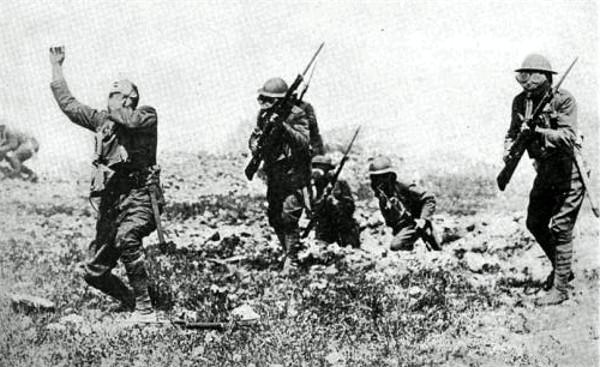
Men of the 80th Division going
"over the top" to attack a German position in the Argonne.
“OVER THE TOP” AGAIN
"On October 11 we were up at 6:00am,
and at 8:00am we marched about one kilometer to other trenches at the front
and went over the top at 2:30pm into the woods. Here Captain Maag was
wounded in the chin by a rifle grenade, Corporal Herrig was killed and
Corporal Kellerman wounded by machine gun bullets. Joseph Herdman was
gassed here. As it got dark, Vogel, Semanchuch and I were ordered back into
the woods by Corporal Schedemantel."
"We were met by 315th Machine Gun men
who told us our division had been relieved. We went back with them to
battalion headquarters, then to the bivry Bax and I made the day before,
where we ate our canned salmon, beans and crackers and took turns on gas
guard all night. About 3:00am Jerry sent over quite a bit of gas with his
high explosive shells. I was very tired and slept with my gas mask off.
Gas shells burst with a puff instead of a bang, throwing liquid which turns
into gas when it evaporates."
"The Germans have a habit of sending
gas over early in the morning along with high explosive shells. The liquid
scattered by gas shells of this particular variety over bushes and grass
doesn’t evaporate until the sun comes up, and one may be unsuspecting of gas
until it is too late."
"Anybody lying on the grass or
passing through bushes where the mustard liquid gas had been scattered
usually gets terrible burns. German machine gunners have been wearing
bands on their arms with a red cross on them. They are sometimes mistaken
for our own first aid men."
"In these woods we found some trees
which had two and three platforms built between the limbs, upon which machine
guns were operated. There was also a large box buried in the ground under bushes
at the foot of a tree, where another machine gun had been placed. Worley
Gilliam was gassed today."
"Having been relieved by the 60th
and 61st infantries on October 12, we moved back to support trenches near
Nantalois where we washed up, shaved, and slept in the morning. While
eating supper about 4:00pm, the Huns shelled the area, one shell knocking
a horse from under a military policeman and blowing it all to
pieces."
"An American soldier was bringing
back six German prisoners when a shell killed all the prisoners, but only
shook the guard up a bit. Stretcher bearers were bringing back quite a few
wounded men, and many prisoners were being marched to the
rear."
"At 5:00pm we started on an eighteen
kilometer hike over very rough roads to woods near Avocourt, where the whole
battalion was resting. We arrived here at 11:45pm, and as I had no shelter-half
and no blanket, I slept with Semanchuch. We used our slickers for a mattress and
threw his blanket over us."
IN THE REST AREA
"On October 13, bread, bacon and
coffee were served for breakfast at 8:00am. Then Martin and I walked five
kilometers for water and missed our dinner. We had a band concert in the
afternoon. We also got two blankets and new clothes. The YMCA issued each
man one and one-half cakes and two square inches of
chocolate."
"After supper
I visited with 'C' company. Learned that Hanley had been killed, and also
about Herman’s wound. Artillerymen here tell of finding a German chained
to his cannon, but who when released turned his gun around and made a
direct hit on a German ammunition dump ten kilometers back."
"On October 14 we got up at 4:00am
and had breakfast at 5:00am, then hiked four kilometers to Brizeaux. We
were taken past the town about one kilometer and had to walk back. Here
we were billeted in barns and old buildings. I was located in an old barn
No. 26 and was under Corporal Sheidmantel."
"I soon found the remains of a
cot, which I repaired and made into a comfortable bed. Here we were able
to buy milk and Dutch cheese sandwiches. The kitchen did not arrive until
the next day, and so we ate the iron rations we were carrying with
us."
"On October 15 there was no
reveille. We got up and got our own breakfast at 7:00am. We were issued
more new clothes in the morning, and in the afternoon we had a hot shower
bath. Our underclothes, being full of ‘cooties,’ had to be thrown away,
and I had none for a few days. The kitchen came in the afternoon. It
rained all evening. Three sick soldiers who hadn’t been able to keep up
with their outfit stayed with us for supper and slept in our
billet."

Some of the fighting men of the
“old Eighteenth” of the 28th Division. Clockwise from upper left -
Earl A. Allan, Captain Frank A. McHenry, John A. Davis, John F. Austin,
Albert Heimann, Sergeant Thomas M. Jarrett.
CHAPTER XVII - PART I
ARTILLERYMEN OF THE 28TH
The 53rd Artillery Brigade of the
28th Division, of which the famous 107th artillery regiment, comprised mostly
of men from Pittsburgh and Western Pennsylvania was a part, is the only unit
of the American overseas forces that went directly into the thick of battle
after receiving the necessary training.
Other units were usually permitted
to visit some quiet sector of the line for a few weeks until they became
accustomed to occasional shelling and the horrible sights before being
transferred to a section of the line where the heat of battle was at it's
height. The 53rd brigade, however, made such rapid strides during the
training period that no hesitancy was exercised when the time came for them
to see action. They were sent into the battles of Fismes and Fismettes,
which were two of the fiercest and bloodiest engagements of the
war.
The artillery brigade, after the
splendid work it performed during the Argonne fighting, was detached from
the 28th division as a part of the army that went into Belgium and was
called the “army of liberation.” This was an honor and a recognition of
it's former good service, for the Belgian liberation army needed confidence
to go forward and, with the best American artillery unit behind them giving
support and protection, their advance was rapid and their success all that
could be desired.

AT CAMP MEUCON
When the 107th regiment arrived in France
it went into training at Camp Meucon, situated near the west coast of France,
which is admirably adapted for artillery practice on account of it's magnificent
range. It is said that it is the finest artillery range in the world. Almost
immediately after it's arrival at Camp Meucon, intensive training was
begun.
In the United States, the Pennsylvanians
in training had used the American three-inch guns of the light field artillery.
In France now, the famous French 75s were assigned. This made it necessary for
the gunners of the 53rd brigade to learn how to operate the new guns. The French
75mm gun is regarded by military experts as the most accurate firing piece ever
invented, and it's great work in the late war upholds their
opinions.
The American three-inch
gun which was used in training by the 53rd brigade at Camp Hancock, GA, is
a close second to the French 75mm, although not as rapid or accurate. It's
barrel is slightly shorter than that of the French gun.
The Pennsylvania men learned how to
operate the French weapons in an incredibly short time. Every man in each
of the regiments got personal training in handling the guns, and each battery
was organized into four distinct squads of gun crews which became efficient
firing units.
Besides the actual gunners, and as
significant in importance, were the men who specialized in signal, telephone
and instrument work, mechanics who mastered the intricate mechanism of the guns,
and the drivers who drove the teams that brought the firing pieces up to the
battle front. The latter found it necessary to learn part of the French language
to make the French horses understand what they wanted them to do.
The unit trained for one week at Camp
Meucon, learning the fundamentals, and then went to the artillery range.
Here it went through conditions which were found later in actual combat.
While at the range Battery “E” had the distinction of laying down the first
successful barrage fired by the brigade. The fine range permitted the
gunners to see where the fired shells struck, and the results were evidenced
by the straight line of bursts and upheaval of earth.
It would have been
impossible for a single living thing to have emerged from the barrage, and
the men of the 53rd received a vivid impression of what these mighty little
guns would do, and what power lay within their command.
A few weeks of this sort of training
went by and then it was announced that the 107th regiment would engage in a
firing contest with other regiments of the brigade. This placed new zest in
the training and the gun crews immediately got busy with all the
determination possible to win, perfecting their already skillful manipulation
of the guns, and working early and late. This diligence by the 107th won for
them the regimental championship honors when the contest was
held.
To further stimulate the boys to good
work, another contest was held - this time to ascertain the most efficient
battery.
BATTERY “E” WINS
It was staged one Saturday morning in
the rear of the 53rd Field Artillery headquarters, and consisted of all such
conditions as would later by found existing on the front line, including the
methods of fire, such as sweeping, progressive sweeping, barrage, and actual
handling of the guns while wearing the gas masks. As the contest progressed
it was clearly evidenced that Battery E of the 107th was leading in
practically all of the events.
About three thousand spectators viewed
the contest, but were barred from making any demonstrations whatsoever, and it
was with difficulty they restrained themselves. The competition was keen,
and when the outcome of the contest at times became in doubt, members of the
different regiments which were participating found it hard to keep from
encouraging their favorite gun crews.

American artillerymen wearing gas
masks.
At last the contest came to an end,
and after a conference by the judges, who were selected from the French
Field Artillery, the commanders of the various batteries and regiments were
called to the center of the field. It was announced that Battery E of the
107th regiment had won by a safe majority of points.
Then the great crowd
broke loose and cheered. Captain Weaver was warmly congratulated by
Brigadier General Price for the excellent work of his men, and was informed
that Battery E would have the first opportunity to fire a shot into the
German lines when actual combat was begun.
It was by hard, honest,
consistent and diligent work that the boys of the battery carried away the
honor. Every man in the battery showed a personal pride in being among it's
numbers, and at all times tried to acquit themselves worthy of the great
city in which the battery was organized - Pittsburgh.
MOVE TO BATTLE FRONT
The training at Meucon lasted six
weeks, during which Battery E became known as “the pride of the 53rd.” It
was in August that the brigade bade farewell to the comfortable quarters
found at Camp Meucon and set forth for the battle line after twelve months
of careful training and “make believe” fighting.
The men boarded a train riding in the
famous French “Hommes 40 Cheveaux 8” box cars, which could not be praised to
any great extent for their easy riding qualities nor comfort, and rode for
thirty-six hours, finally arriving at Mezy at 3:00am on August 12.
The
brigade detrained, and at daybreak crossed the Marne and marched forward on
ground that had been recently won. The sight of newly made graves, and the
sound of distantly rumbling guns, were sufficient to tell the men as they
trudged silently along, each absorbed in his own thoughts, that war was
really a serious thing, and that a great task lay before them.
It would
be impossible to describe the thoughts of these men as they went forward
beside the rattling guns and caissons. Back in the training camps they
had heard the stories of the battlefields. To a certain extent they
were nerved to expect the worst horrors of the war and if, in the gray dawn,
the courage or confidence of any of the men of the 53rd was shaken it was
not known. Later deeds prove that the grim determination they had so
carefully fostered never faltered for an instant.

DESOLATION EVERYWHERE
War’s desolation could be seen on
every side. A number of hopelessly wrecked villages were sights that
brought home the true gigantic destruction possible with artillery guns.
Sometimes only a wall would be left standing, or a corner of a once
beautiful chateau or church.
The course lay through dense woods
about six kilometers from Mezy. Upon entering the little forest, the
stench of dead bodies, human and animal, became so oppressive that it was
almost unbearable. The odor from decayed bodies was one of the most
reproachable things of the war.
Finally the troops reached the villages
of Roncheres, where they were billeted in old barns and buildings, occupied
by the Germans four weeks earlier. They remained here all night and the
following day. While at Roncheres the troops witnessed their first air
battle. The Germans succeeded in destroying an Allied Army observation
balloon.
After the short rest, the batteries
moved forward again on the evening of August 13, in the direction of Fismes,
where they were told they would take up their first gun position. As they
marched along they enjoyed the hellish fireworks of man’s ingenuity. Flares
and star shells lit up the heavens. It was hard to associate their beauty
and magnificence with the brutality they were intended to aid.
A German
bombing plane flew overhead and dropped two large bombs about fifty meters
in advance of the marching column. Protecting Allied planes immediately
swooped down from the heavens and gave chase to the Hun aviator. A running
fight ensued. and finally the merry spat of the machine guns died away in
the distance. Apparently the German aviator had escaped behind his own
lines.
SET UP GUNS BEFORE FISMES
Twice during the march, the French
guide who was leading the column got off the right road and delayed the
marching men. Finally, at 2:30am, they reached St. Martin and were met by
Captain Weaver and other officers who had gone in advance to locate a gun
position. The position selected was finally reached just a few minutes
before daybreak, but the men, working with considerable rapidity, succeeded
in getting the guns in position and camouflaged. The dawn found the
artillerymen exhausted but “sitting pretty” in the little sector of the
Western front. Forty-eight hours had elapsed since leaving Mezy.
The first day was quiet, and it
was well, for it permitted the new soldiers to rest and become accustomed
to the front. However, the German airman who had observed the marching
column probably delivered his information, and that night, August 14, the
“Fritzies” let loose with a terrific shelling and wound up with a
five-hour gas-barrage. The fumes from the bursting shells filling the
valley with their deadly poison. After the barrage ceased it was
necessary for the men to wear their gas masks for an additional two
hours.
The valley mentioned was known
as “Death Valley,” and the Pennsylvanians were located in it. Jerry
seemed to have a particular spite against the place and was continually
gassing the area. Almost every night he would open up about midnight
with hundreds of gas shells, and in an incredibly short time the poisonous
vapor would fill the entire valley. Because of the pocket formed by
the valley, the gas would hang close to the ground, creating a dangerous situation.
The variety of gas used was mostly of the mustard type, and caused a number of
casualties in the 53rd brigade during it's stay in Death Valley.
On the second day after arriving
before Fismes the gunners of the 107th regiment prepared their guns, and that
night got busy on the Hun. The French guns worked like charms, and it
was only a short time after firing had begun when information was received
by airplane that the gunners were doing good work in annoying enemy supply
trains that were going to the German front line trenches. They also learned
that they had succeeded in registering a direct hit on an ammunition dump.
This sort of work spoke well for the Pennsylvanians.
There was little variance in the
daily routine to break the opposing monotony of the cave-dwellers life
which fell to the lot of a soldier in this strange war of wars. The days
were more or less quiet, and were spent in fighting the flies and yellow
jackets which annoyed them almost as much as the enemy shells, while the
nights had plenty of work for everyone, as practically all of the fighting
was carried on after nightfall.
As a rule it was possible to obtain
a few hours of sleep in the early morning, but occasionally this sleep was
interrupted, by one of the enemy’s gas barrages, in which case the soldiers
were “outta luck,” since the extremely torrid weather and the flies
rendered it quite impossible to sleep during the day.

American artillery battery in a
camoflauged position, awaiting the order for fire support.
STENCH OF DEAD BODIES ANNOYING
The Jerries almost hourly shelled
a small clump of trees about 500 meters from the position of the 107th,
which contained a large number of dead “Heinies” and a large number of
dead horses. The enemy evidently believed that a battery was located
in the woods, which accounted for their frequent shelling.
The dead
bodies thus uncovered and stirred up created a terrible stench, which
the wind carried down the valley to the Pennsylvania soldiers. It was
so offensive that at times it became almost maddening, and invariably
the shelling would take place about mess time, making eating
impossible.
The infantry ahead of the artillery
was doing great work. While the artillery laid down barrages and received
the enemy’s barrages, they slowly and surely pushed the German hordes back
to the Vesle River, where a short pause was made, during which the German
forces were greatly strengthened by reinforcements.
But it was to no
avail, for on September 4 the American doughboys crossed the river under
a terrific shell fire and completely routed the enemy. The division
suffered greatly in the effort, for company after company was almost
completely wiped out. But, in the end it was a great effort, and a
successful one.
CHAPTER XVII - PART II
The Story of the Artillerymen from Pittsburgh
and Western Pennsylvania attached to the Twenty-Eighth Division, is replete with
instances of bravery and daring and unremitting toil under the most hazardous and
nerve-racking conditions and the way our boys bore up through it all was at times
almost miraculous.
On the night previous to the battle in
which the infantry crossed the Vesle river the enemy began a heavy barrage at
10:30 o'clock which lasted all night and until 2pm the following day. This
evidenced the fact that the Boches were trying to get rid of large stores of
ammunition which they could not move before their forced retreat.
As soon as
the enemy barrage ceased the men of the Fifty-third brigade were ready for them
and let loose with a dose of the same medicine, only worse, hampering the retreat
of the Germans to a considerable extent by wrecking the roads over which their
heavy camions and motor lorries had to pass.
On the 5th of September the One Hundred
and Seventh regiment got orders to proceed ahead across the Vesle and keep in
touch with the advancing infantry.
ADVANCED FIVE MILES
With the final strokes of the "Second Battle
of the Marne" in full swing the Fifty-third artillery advanced five miles to the
river in broad daylight while German airplanes whizzed by overhead and dropped
bombs on the men. The artillery wound around on open roads in clear view of the
big German sausage balloons.
Coming to the Vesle the only bridge that was
not destroyed was repaired by members of the One Hundred and Seventh regiment under
the supervision of engineers. The first American artillery to cross the Vesle was
composed of Pennsylvanians. The Germans knew the bridge was there, for they
themselves were forced to cross the river on it. They attempted to destroy it, but
did not have time before the advance of the infantry.
So they did the next best
thing. Their gunners tried to get the range of the structure and thought they had
it later, but their shells all fell amiss and the artillerymen advanced over it to
positions on the German side.
With considerable difficulty a position in a
clump of pine trees about 500 yards from the enemy first line was reached and the
guns placed in firing position. This position was in reality taken up in the second
line infantry trenches, a most unusual place for the artillery.
The position was in
sight of the great cathedral of Rheims and in territory that had been hotly contested
for four years. No orders came to fire and the men were uneasy. They knew the enemy
was close and they wanted to give him a good reception with their 75's before it was
too late. The truth of the matter was the batteries were so close to the allied
infantry that to have fired would have endangered them.
After the position had been firmly established
and the infantry got under way once more after crossing the Vesle, communication
between the artillery and Second battalion headquarters was establiched and soon
the order came to commence firing. The batteries of the One Hundred and seventh
let go with a vengeance and showered the enemy machine gun nests with
shrapnel.
Machine
guns and snipers had been causing annoyance in the ranks of the infantry as well as in the
batteries. Rifle and machine gun fire was very unusual for artillery to contend with,
but in this case due to the close proximity to the enemy lines, the enemy rifle balls
were kicking up dirt all around the guns. One-pounders came floating over from the
German infantry and burst among the men. The men of the batteries were tormented to
the point that they ached for a chance to go out and get the snipers, but stuck to
their various tasks like veterans.
It was a new experience to every man. Just why the
Boche did not centralize his artillery on the allied artillery batteries is not known.
Fortune smiled on the Pennsylvania batteries, for no casualties resulted from the enemy
rifle and machine gun fire. Darkness stopped the rifle fire, but brought on the gas
shells from German guns and the German airmen, who menaced the Americans with their
terrible bursting bombs.
The sights on the American guns were working well,
however, and all night they gave back as much steel as they were given, never flinching
in their task, and from the results noticed the next day, September 5, they must have
caused heavy losses in the retreating German masses, for all day Hun prisoners and
wounded men were being taken to the rear. The majority of them were big husky fellows,
and from their insignia it was seen the Pennsylvanians were bucking against the crack
Prussian Guards.
During the day a German airman came over and
photographed the positons of the Fifty-third artlliery, paying marked attention to
the One Hundred and Seventh regiment. It was evident that somebody had caused the Huns
considerable trouble on the night previous. The observer could frequently be
seen hanging far over the side of the plane, and he was not content merely to look at
the positions and photograph them, but flew down and turned his machine gun on
Battery E, which was helpless in its defense against him, for it possessed no
anti-aircraft guns.
Occasionally he came so close he could be fired
upon with pistols and salvaged rifles. *Sgt. Walcamp darlingly exposed himself in order
to take a shot at the airman with a Springfield rifle he had picked up. Time after time
this same German aviator came back over the American lines in his huge powerful plane
and attacked the artillery observation balloon, sometimes referred to as the "eye of the
artillery." (He was driven off by the American anti-aircraft guns on the other side of
the Vesle each time.)

Following the trip over the allied lines by the
German observer the German batteries broke loose and showered shot and shell on the
American lines for several hours. Every sort of shell came over, air bombs were used,
and about the only thing missing was the hand grenade.
The Germans weren't close enough
to use them. A huge mine, evidently planted by the retreating Germans and set off by
electricity, exploded in the American lines to the right of the artillery brigade. The
concussion was terrific and shook the ground. The explosion caused a sun-like light and
the whole valley for miles around was lit up as though in mid-day.
It was a moment for
German airplanes hovering above. During that brief time they saw a lot of things they
didn't know were going on. They flew back to their lines and presently bombing machines
came over six strong. They flew so low to the artillery batteries that occasionally the
black cross on the wings could be seen. They had plenty of bombs with them,
too.
As the
great bombs struck the ground and exploded the terrible report and the trembling air made
the soldiers shiver. The artillery brigade was fortunate. No casualties resulted from the
air bombing, but considerable damage was done to the lines in advance.
RELIEVED
On September 7, at noon, French artillery officers
arrived and the soldiers were told that a French regiment was to relieve them. Their guns
were due up to the front line at nine o'clock and the American brigade would then remove
their guns back across the Vesle, with the assistance of French limbers. At mess time
that evening it started to rain and the Germans added to the elements by mixing in a
shower of shell.
The Fritzies shelled every road with every gun
they had in their possession. This fire held up the French guns and made their travel
difficult. It was eleven o'clock before they arrived. The French guns were put in the
places of those manned by the American gunners and the start to the rear was
made.
Every man felt considerable uneasiness over the
trip, for the road lay in a winding course and ran for some distance directly towards the
enemy. It was also exposed. A small town lay in the path before the Vesle was reached.
The troops finally came to the village, after experiencing only a few shells which burst
near the marching line.
However after leaving the village, the road was
suddenly shelled. The movement to the rear must have been known to the Germans, for
their guns were exceptionally accurate. The rain prevented the gas from having much
effect.
The night was one to strike terror to the heart
of the soldiers but they kept up the steady march. Traffic in the opposite direction
at times stopping the retiring doughboys, for at places the road was so narrow that two
vehicles could not pass.
A French damion loaded with food supplies which
was moving up to supply the relieving French soldiers was caught in the shell fire and
completely destroyed. The only lights were those from the flashing shells whizzed all
about and splattered against trees. Finally the Vesle was crossed , but not until the
batteries of American artillerymen had sustained some casualties.
DISAPPOINTED GUNNERS
Finally the retiring artillerymen pitched camp
in a small forest north of Dravigny. There was not an officer or man of the One
Hundred and Seventh regiment whose nerves were not almost shattered, and who did not
feel like collapsing under the strain. They were physically worn out. When the battery
left Dravigny after a little sleep, it was the opinion of the men that they were going
to a rest camp in the south of France.
They traveled all day long, and were later
informed they were going to another sector of the battlefront. It was discouraging
news, but the Pennsylvanians soon yanked up their heads and with the determination
of veterans set out for the new task as they did for the first one. They knew they
were going into battle again, but they did not know that this march was the march to
the Argonne forest where the greatest assault in the history of the war was
made.
The regiment made its way by degrees across
the Marne river, down the valley towards the Champagne front. At the town of Vinay,
Battery E was separated, some of it going with the guns and the remainder consisting
of those slightly wounded and those more or less unable to keep up the killing pace
set by the regiment, were carried in motor transports until St. Eulian was reached.
Later orders were received to rejoin the men. The men who had gone with the guns had
a gruelling night's for a distance of thirty-eight kilometers and finally united with
the others at Ravigny.
MARCH FOR FOURTEEN DAYS
From this point the marching was conducted with
the utmost secrecy. As soon as darkness descended the troops would roll their packs,
strike tents, and march until the dawn of the following day when they would be secreted
in some forest of swamp until night fell again. Finally, on September 22, the batteries
arrived at the famous Argonne Forest. Although the men were in dire need of rest, the
guns were hauled up and immediately put in position.
Before any firing could be done it was necessary
to fell a great number of trees. This task was accomplished by a detail of engineers
aided by the boys from Pittsburgh and Western Pennsylvania. For nearly four days the
ring of axes could be heard as the men worked diligently. At dusk on the fourth day,
a change of orders necessitated clearing a wider space in the forest.
The gun crews kept
up their laborious work until a space equivalent to one hundred square meters had been
cleared. The trees were left standing and wired together so they could be pulled down
when the guns began to bark. This ruse was adopted to keep the enemy from locating the
positions of the artillery.
AT THE ARGONNE
While the One Hundred and Seventh regiment was
busily engaged in taking up its positions, other regiments, and whole brigades were taking
up similar positions in what was sometimes called the "boundless" forest of
Argonne.
It
was all being done secretly, and as the men worked and the great scheme of the developing
offensive became know to them, they exerted every effort to leave nothing undone, so that
when the big movement was started there would not be a single hitch in the performance.
The Germans were located on the eastern edge of the forest and believed their positions
to be invulnerable.
Thousands and thousands of American troops were
rushed into the line and were only awaiting the word to advance. No American troops were
permitted in the front line before the Argonne battle opened, for had the Germans seen a
single Yank in his khaki uniform they would have grown suspicious and probably secured
heavy reinforcements.
Occasionally an American was in the front lines,
but always wore a French uniform. A day or so previous to the beginning of the
offensive, this caution was of course dropped, and the Americans went right into
position in the front lines.
All this time ammunition trains had been hauling
thousands of rounds of shell and shrapnel of every size and description to the massed
artillery in the forest.
IRON SYMPHONY BEGINS
These hurried but careful preparations were
finished a few hours before time. Events of overwhelming importance were to follow and
each man realized, deep in his heart, that the whole of the great effort depended upon
his individual action. At 1:30am on September 26, a hot meal was served to the
gunners.
CHAPTER XVII - PART III
A few hours before this however, the heavy
French rifles and howitzers had opened up with a slow desultory fire, which while
seeming to portend the rain of steel that followed, was not of such character as
to make the German armies grow suspicious.
They may have been wondering where all
of the shells, even from that slow fire were coming from, when at 2:30am the
maginficent "Million Dollar Barrage" broke forth from the allied lines with a
stupendous roar that seemed to shake the heavens.
The guns of the One Hundred
and Seventh regiment barked in a single voice when the command "Fire" was given,
and threw their deadly charges of dynamite into the lines of the surprised foe.
The great Argonne-Meuse offensive was on.
Everything was in order in the American lines.
The section chiefs grew hoarse shouting commands to the men who were working like
beavers. The gun corporals manipulated the gun sights with speed and accuracy and
the crews eagerly put forth superhuman efforts in serving their pieces which were
being loaded and fired as quickly as possible.
The terrific detonations shook the
forest which seemed like a huge living monster vomiting fire, smoke, and destruction
and roaring with a horrible voice. Every man in the gun crews of the One Hundred and
Seventh regiment was rendered temporarily deaf by the heavy reports.

American artillerymen wearing their
gas masks pound German positions.
Lit up by the ghastly flare from their own
guns they looked like veritable devils working with a mad, fiendish joy, faces
gleaming as they leaped into the gun pits to shift the gun trail or jumped to the
wheels at which they pulled and tugged with might and main.
It was strenuous and
tiresome work for the Pittsburgh men and the rate of fire was so rapid that many
times throughout the long night, they were forced to wait until the sturdy little
French 75s had cooled from the heat of many shells.
It was a thrilling sight to see
a stalwart lad, bareheaded, eyes heavy and red from the burning powder gas, jaw
firmly set, face dripping with perspiration, arms bare to the elbows and black with
grease, standing by the gun swabbing out the bore with a slender rammer after each
shot was fired.
A lanyard broke from too constant use on one
of the guns, but the gunner did not pause. He used his fingers to draw back the
"striker." Corporal Lamison, well known in Pittsburgh as a boxer, fell limp and
exhausted into the gun pit. Members of his gun crew quickly pulled him to his feet,
but he remained unconscious and lay quite still throughout the terrific
barrage.
About six o'clock in the morning the gunners
saw a wonderful display of shooting fire about a hundred yards ahead of them. It
appeared like a fire works exhibition. It proved to be a barrage of liquid fire which
the Germans used as a last resort before deserting their guns. It was fortunate for
the One Hundred and Seventh that they were out of range.
The heavy booming of the guns, the rapid staccato
of the machine rifles, mingled with the various tones from different caliber pieces and
the screaming and whistling of shells as the carried their death and destruction combined
into sounds of a massive iron orchestra which played a Wagnerian score of "defeat to
German arms." The iron instruments were laid aside at 10 o'clock in the morning for the
"Fritzies" had scampered away over the hills.
NO REST FOR THE ARTILLERYMEN
Early in the afternoon with no rest whatever the
guns of the One Hundred and Seventh were advanced to keep within range of the retreating
foe. As they moved slowly over the congested roads the local boys had an opportunity to
see the effect of their shells. This is an opportunity that is seldom afforded an
artilleryman.
The guns of the One Hundred and Seventh had been
directed in particular against Hill 244, a German stronghold that had withstood the
assaults of the allies for over three years. Barbed wire entanglements, which would
have made infantry advance impossible, had been entirely removed by the artillery
fire.
As seen in the distance from the road the hill
looked like a huge mound of pulverized earth with nothing but the jagged stumps of trees
that previously had been part of a forest which covered the slopes of the
hill.
Continually subject to the fire of lurking machine
gunners and snipers, the One Hundred and Seventh pulled into positions one after the other
as the enemy kept retreating. One day they took up three different positions in order
to keep hammering at the rear of the fleeing Huns.
On September 27 the artillery passed
through the historic town of Varennes where they encountered severe shelling from a German
group of batteries located on the edge of the Argonne forest to the right.

28th Division artillery outside the
village of Varennes in the Argonne sector.
In Varennes the Germans had built some of their
most palatial dug outs, but the Pennsylvania artillery had ruined practically all of them.
Ludendorff is credited with making the statement that Varennes was such a German stronghold
that it could not be captured. The ease with which the Pennsymvanians walked through the
village must have been a surprise to him.
Even the town was a complete wreck, German dead
were everywhere and it was in Varennes that the Pittsburghers saw General Pershing for the
first time. Shortly after the capture he rode through in a large touring car, stopping only
long enough to ask what regiments had effected the capture.
RELIEVED AT LAST
The batteries of the One Hundred and Seventh
gradually advanced with the retreating enemy. The steady pounding, and
never-stopping-to-test-and-aleep pace which was being maintained was commencing to tell
on the boys. With no thought of sleep or rest the men endured their hardshops patiently,
however, and advanced with the rest of the army. They were constantly under shell fire
and suffered losses only occasionally. Their luck is a miracle in this
respect. The horses which were compelled to be in harness
for days at a time without rest were becoming so weak that four of them could hardly pull
a gun carriage. The boys gladly put their backs to gun carriage wheels and helped to push
the heavy pieces forward.
At one time, Battery E took up a position near a
large German gun which their own shell fire had destroyed. The retreat of the Germans was
so rapid they could not take it with them on account of its massive size and great
weight.
After this continual pushing forward, the regiment
reached a crossroads near Montblainville where it was stationed for a few days. The
position was under direct observation by the enemy. The Pennsylvanians kept throwing a
harassing fire into the few remaining machine gun nests until October 10, when they were
relieved. They had nobly and bravely acquitted themselves in one of the greatest tasks
of the war.
INTO BELGIUM
Proceeding to the south they went into a rest camp
for a few days, but were soon detached from the Twenty-eighth Division and attached to the
Ninety-first which was to start after the fleeing Hun in Belgium, and liberate the Belgians.
For this reason it was called the "army of liberation." The Fifty-third artillery brigade
was proud of the appointment to go to Belgium.
It was a reflectiuon of the sterling quality
of work with which they had been credited and it was a honor and privilege. Battery E of
the One Hundred and Seventh regiment had the honor of leading the brigade into position
on the line.
The soldiers of the Fifty-third found new conditions
of fighting awaiting them in Belgium. As they proceeded to the front through Ypres and many
other famous battlefields in that section of the battle area, where the British had fought
so nobly and sacrificed hundreds of lives, it was evident they would meet with new
experiences dissimilar to those encountered in the Argonne-Meuse fight. The terrain in
Belgium is low and flat, and gun positions were hard to get. Nearly all of the best
positions were occupied. These were in swamps that were hardly accessible.
Many English soldiers and horses had been lost in
the quicksands while trying to cross these swamps. The Firty-third concealed its guns by
placing them in hedge fences, or in old buildings and camouflaging the building with a huge
net which each battery carried as part of their equipment. Similar methods had to be used
with the horses.
Nothing will conceal the flash of a gun at night
and this often revealed the location of the guns. An artillery observation balloon can
observe for a distance of thirty miles, so it can be seen what great care was taken in
camouflaging of positions. In France the guns could always be located in a ravine, a
strip of woods or behind a hill, but not so in Belgium.

The first night the Pennsylvania boys went into
positions in Belgium is one that will long be remembered and often recounted. It was as
dark as pitch. The men could not see more than a foot ahead, and travel was entirely by
the way the road lay. Many times the gun caisons slipped from the little shell torn path
and it took superhuman effort to get them back on the highway. It had rained and mud was
knee-deep.
Many times the weary horses were unable to pull
the gun carriages from the deep holes, and then the men would literally lift the wheels
free from the black, slimy, sticky mud. After traveling for several miles this way, the
men reached the Scheldt River about four kilometers from the firing line. A pontoon
bridge across the river was the only method of crossing.
When the Pennsylvanians started across the "Jerries"
began firing. Evidently the location of the bridge was known. There was no doubt the bridge
was the object of their fire, but because of the darkness of the night the Germans were
unable to "unload" properly and fortunately none of them struck the bridge. Finally all of
the guns and men were gotten over safely.
As the brigade continued Battery E became
separated from the One Hundred and Seventh regiment and got on the wrong road. They finally
pulled up to within rifle fire of the German lines before the mistake was discovered,
however they soon ascertained their bearings and laded back with the regiment. The "Heinies"
were none the wiser. Throughout the march, after they had passed the Scheldt River, the
Germans put up a slow harrassing fire all around the column and added to the difficulty
of travel.
GERMAN INHUMANITY
Although the firing of the Fifty-third on the Belgian
front was very effective, it was continually handicapped by the large numbers of Belgian
women and children who came streaming through the German lines and rushed toward the
Americans to safety. They did this as they were liberated by the German hordes which were
beating a hasty and forced retreat.
The use of gas shells by the American artillery
would have meant the death of a large number of these helpless people. Day and night
through the cold, rain, and mud, Belgian civilians kept streaming back, many of them
barefooted and scantily clad.

American artillery engaged in barrage
fire with French model 1897 75mm howitzer.
Some were fortunate enough to possess a cow which
they used to pull their wagons, loaded with a few household belongings, and many times
infants could be seen riding on them, but more often they were carried in the arms of less
fortunate mothers and fathers who trudged their way across the open stretch. Even when
defeated the German arms were not content to let these tortured people go without some last
act of devilry.
They told them the Americans were more cruel than
they and would punish them and keep them in slavery or kill them. As a consequence many of
the refugees fell on their knees when they reached the American lines and implored the
soldiers for mercy. The kind treatment they received soon dispelled their fears and after
four years of German tyranny their faces once more lit up with joy and
thanksgiving.
A marked example of German inhumanity was perpetrated
on the second night of the battle of the Lys River. The fire of the Pennsylvanians was
evidently getting too hot for the retreating Huns, and to check it, they resorted to one of
the kaiser's "ways and means" by sending a large bunch of Belgian civilians through their
lines and into the American barrage. Out of humanity the Americans ceased their firing but
not until they had killed a large number of the helpless victims before becoming aware of
the situation.
On the following morning the troops got hold of all
available ambulances and gathered up the dead and wounded. It was a sad and sorrowful sight,
but it only served to increase the intense hatred for the Germans that was engendered in the
heart of every soldier by the cowardly action often employed by the German
commanders.
The
slaughter of these Belgian civilians was not the only deed of cowardice the Americans had
seen the boche perform. More than ever there was a determination to crush them forever, and
so it was they went forward with increased ardor.
CHAPTER XVII - PART IV
The effect of the hatred of the
Americans was realized by the Germans. They started to retreat so fast
that the artillery almost killed their own horses in trying to keep in touch
with them. Occasionally the German rear guard would resist long enough
to prevent a wholesale slaughter of the whole army. The batteries of the
107th were on their heels at all times and fired at every opportunity.
Upon reaching the Lys valley, the Germans had flooded the surrounding
lowlands and further advance was delayed for a short time.
The batteries
of the Pennsylvania regiment took position on the west bank of the valley
and set their gun sights toward Audenarde on the other side. The sights
were then elevated so that the shells would not strike the town. For
two days they shelled the area outside of the city, doing effective work.
Their only target was over eight kilometers away. While in this position
the armistice negotiations were begun.
THE WAR OVER
When the armistice was signed, the
Pennsylvania artillery moved across the Lys River and stayed in the old
war zone for about a month, billeting from time to time in small villages
and farm houses. A stall in a cow stable was regarded as a “good” place
to sleep, the floor of a house “excellent” and to get a bed,
“heaven.”
The artillery brigade from
Pennsylvania finally moved back to Proven, Belgium, near the French border,
and occupied a little camp which had previously been built up by a
regiment of Canadians. This was almost a month after the armistice was
signed. Christmas was fast approaching and the boys had nothing to do
that day, but to "exist."
On Monday evening before Christmas,
Battery E planned an entertainment at the suggestion of Captain Weaver.
Sergeant Walcamp was appointed to arrange the program. No one had time to
prepare anything and the acts put on by the men were entirely impromptu.
The engineers found an old barn which, with a little fixing, soon included
a stage and a few seats.
At 7:00pm, Christmas Eve, the show was
on. From first to last it seemed like a show staged by professional artists.
Chaplain Peters, Captain Bundy, Captain Reese, Lieutenant McGovern and
several English officers who were present responded to the call of the
footlights. There may have been better shows given by the soldiers in
France, but none were appreciated more than this one.
On Christmas Day the cooks, using
only the field kitchens and their accompanying utensils, prepared a dinner
which was a pleasure and a joy to all of the men. The menu consisted of
roast beef, rich brown gravy, Brussell’s sprouts, home baked beans, corn
starch, home baked cake, tea or coffee, oranges and apples.
Sergeant Phillips took special pains to
see that each man was filled up to the neck. No one applied for seconds,
according to authentic information except Horseshoer Hedrick, of the North Side,
Pittsburgh, and that was due to force of habit. Every man pronounced it an
enjoyable Christmas.
Shortly after Christmas the
brigade moved to France and was stationed at LeMans in a “homeward bound”
zone.

CHAPTER XVIII
THOUGHTS OF HOME
The diary of Corporal Arthur N.
Pollock, of Wilkinsburg, which appeared in Chapter 16 in connection with
this history of the Pennsylvania troops in the war, revealed the activities
of the 80th Division up to and including October 15, 1918, and only the
first phase of the Argonne-Meuse offensive was set forth.
The troops of
the 80th Division had been relieved at the front and sent back to Cuisy
to rest. They had successfully captured Bethancourt, Montfaucon, crossed
the Meuse, and at the time they were relieved were pursuing the rapidly
retreating Hun to the northward. The 80th was not through with fighting,
however.
They fought many important engagements
before the armistice was signed. In this installment, the diary of Corporal
Pollock is again taken up where it left off on October 15, and vividly portrays
the final battles of the 80th, and the soldier life after the armistice was
signed.
"After resting four days at Cuisy,
the 320th and 319th infantries went back into the front lines, this time
on the Metz sector, to relieve the 159th brigade of our own division. The
enemy had just rushed up four fresh divisions from Metz, and in this
encounter the Pennsylvanians were put to their first real
test."
"Many airplanes dashed down from the
clouds, turning their machine guns on us, and giving the enemy artillery our
range. Whizz-bangs, mustard gas shells, and shrapnel tore the earth around us,
while hundreds of machine guns poured a deadly fire into our
troops."
"Yet the Pittsburgh
brigade kept on and on, gaining yard after yard, until we wrested almost
four kilometers from the enemy despite the fact that we were outnumbered four
to one. Our brigade was later relieved by the 5th Division, but I regret
to say not all of our boys went back into the rest camp. Beneath the moss,
grass and forest ruins of the Argonne lay many of Pittsburgh’s best and
bravest sons."
"After resting for two weeks in
reserve quarters, the 80th Division, with the Marine Corps at it's side,
attacked the German lines on November 1 at St. George. In company with
it's worthy companions, they captured the town, then went on to Immecourt,
Buzancy, and other small towns, which all fell after the severest of
fighting."
"Many wooden crosses in this
sector today tell the story of the men who gained the victories. A wounded
Marine at Fleville, on November 3, spoke these words to me: ‘God bless the
boys of the 160th brigade who fought with us today. America never produced
better.’"
"A general order issued,
while the battles from the 1st of November until the 5th were in progress,
and signed by Major General Cronkhite, commending the 160th brigade, and
stated that it had borne the brunt of the burden. Major General Cronkhite
was in command of the division, and he further said that the brigade, during
the five days of continuous fighting, had advanced a total distance of 153
kilometers and captured two Huns for every man wounded, besides large
quantities of munitions and other stores, and accomplished these results
with a far less percentage of casualties than any other
division."

The terrain covered by the 80th
Division on November 1. A captured German artillery piece is in the
foreground.
"Our last push is over it seems.
I am writing this by candle light on November 12, the day following the
signing of the armistice. There was general rejoicing at the signing of
the armistice, but most of the boys wanted to go on. From the dope we have
now we will never have to go up front again. I was in it all, right to the
finish, and I wouldn’t trade my experience for any in the
world."
"No doubt the papers have been
telling you about our last push. It was more like a ‘run’ and quite
a success. I have been getting the copies of THE PRESS you have been
sending and, when I came out of the trenches the last time, I got the
box from Horne’s. I am feeling fine and getting plenty to eat. How’s
this for a breakfast on the battlefield - Pancakes, syrup, rice, bread
and cocoa, chewing gum and cigarettes? Sometimes we have
doughnuts."
"We haven’t had the flu here but
some of the men have had it before they arrived here. It seems great to have
bonfires and candle lights, lights on autos and trucks, and funnier still to
have everything so quiet, and no planes overhead. From THE PRESS clippings
you have sent me, I judge the papers must be getting the right dope about
our fighting. Pittsburgh people should not be ashamed of her soldiers. I
believe that we have made a good showing over here, and we went “over the
top” like a true fighting division."
"We have lots to be thankful for
since Thanksgiving Day. Just two months before, I spent the worst and most
awful nights and days of my whole life. How thankful I am that those nights
and days are over for both me and for everybody."
"December 4 - I am writing this in
the kitchen of an old French woman. She keeps talking away to me all the
time in broken English, but mostly French. An interpreter informed me that
she was telling me to be sure and write to my papa and momma, so I am doing
that very thing. We are still in Nicey, south of Paris and not cold at all.
I am gaining weight and I know the good eats and nice climate agree with me.
The French women are good cooks, and we get the best of white bread.
We received the Paris edition of New York papers here a day late and knew
almost as soon as you did that the Fourth Liberty Loan was a success. We
were glad to hear it, too, for we knew that the loan would help bring us
home."
"December 20 - It looks very much
like we will spend Christmas this year in Nicey, but I am hoping New Year’s
Day will find us a little closer to home. We spend much of our days
gathering around with friends talking over our experiences. There is a
'Y' and a canteen with services every Wednesday night, and on Sundays.
The people all think President Wilson is the greatest man in the world.
A few days ago we were issued new clothing and we got a hot shower twice
a week, so that cooties have almost become a thing of the past."
"December 26 - Christmas Day has
passed. It was unlike all of my other Christmas Days, but we all had a
good time under the circumstances. The cooks fairly outdid themselves
for us, and the French women of the town lent their efforts. They helped
bake 65 pies for our company alone. In the afternoon I had my first ride
on a French passenger train. Soldiers do not have to pay. The coaches
look something like the Pittsburgh summer street cars. Give me the
U.S.A."
"December 29 - We have been here
now almost a month and indications are we will remain until we see how
things come out up on the Rhine. There are rumors that we will get to
sail for home soon, but we don’t put much credence in them."
Corporal Pollock’s story of the
320th infantry regiment ends here. The 320th regiment was never separated
from the 80th Division throughout the fighting, and the account therefore
can be taken as an authentic one of this famous division’s activities in
the war.
CHAPTER XIX - PART I
BASE HOSPITAL NO. 27
Note: The following history of
Base Hospital No. 28 was written by Max E. Hannum, Sergeant First Class,
who was attached to the unit, and who is a member of the staff of THE
PRESS.
The University of Pittsburgh Base
Hospital Unit 27 was organized in response to Surgeon General Gorgas’
request that large medical schools, and hospitals throughout the country,
prepare to supply commissioned and enlisted personnel for the medical
service. The Medical Department of the Army evidently anticipated the
actual declaration of war by some time, and thereby avoided considerable
confusion in the quick mobilization of medical units.
When war broke out
those medical schools which were connected with universities were urged
not only to supply the necessary commissioned personnel of surgeons and
physicians, but also recruit enlisted men from the university students and
graduate nurses from the neighboring hospitals. The American Red Cross was
to furnish the original equipment for these units and to keep in close
touch with their needs throughout the war.
A gift of $25,000 by Mrs. H.L.
Collins, of Sewickley, was the foundation upon which the Pitt unit was
built. Realizing that the University of Pittsburgh provided a rich field
in which to recruit a splendid organization, the government offered reserve
medical corps commissions to twenty-five professors and instructors in the
medical school of the university.
Dr. Robert T. Miller, Professor of
Surgery at the university and surgeon for the Mercy hospital, was made
director of the unit with the rank of Major. Dean Thomas S. Arbuthnot,
of the University Medical School, also accepted a Major’s
commission.
The names of the other officers,
with their original ranks follow:
Majors J.D. Heard and H.G. Schleiter,
Captains S.S. Smith, F.L. McCague, W.B.G. Ray, J.R. Simpson, P.R. Sieber,
H.H. Permar and E.W. Zurhorst, Lieutenants J.W. Robinson, L.A. Fisk,
B.Z. Cashman, J.W. Fredette, R.J. Frodey, C.B. Maits, R.R. Snowden, A.P.
D’Zmura, F.M.Jacobs, J.H. Wagner, A.H. Colwell, Max Neal and H.C.
Metz.
RECRUITING OF UNIT
With all the commissions accepted,
the recruiting of enlisted personnel began early in May, 1917. The unit
was originally organized to care for a 500-bed hospital, which, according
to the army tables or organization, required 153 enlisted men. Appeals
were made to the university students and men from all departments flocked
to the recruiting stations, with headquarters at the university and the
Eighteenth Regiment armory. Contrary to general expectations, the physical
requirements were rigid and many university men were rejected.
The ranks
were filled up by non-university and other college men from the Pittsburgh
district, lured by the prospect of getting overseas soon. Enlisted up to
it's full strength, the hospital was distinctly a Pittsburgh district
organization. Pittsburgh and it's immediate suburbs furnished the larger
proportion of the men. Jeannette, Greensburg, Punxsutawney, DuBois, Beaver,
Youngstown, Butler and other towns were represented.
Men who through
athletic and other ability had become not only famous at the university,
but also well known in Pittsburgh, were numerous in the enlisted ranks.
Such men as "Andy" Hastings, "Jim" Morrow, "Jimmie" DeBart, the Younkins
brothers, who helped to make football history at W & J; Heister Painter,
a former Penn State center; Orson Wilcox, later fatally stabbed by an apache
in France; Leon Kelly, and others whose names and faces are known to many
people around Pittsburgh, were among the first to sign their enlistment
papers.
The nurses, headed by Miss Blanche
Rulon, of the Pittsburgh Eye and Ear hospital, were drawn from practically
every Pittsburgh hospital, those trained at the Mercy hospital being in a
majority. The complement of nurses was sixty-five, and many more responded
to the call.
Major Royal Reynolds, an officer of
the Regular Army Medical corps, was designated as commanding officer by the
War Department and ordered to Pittsburgh. He arrived in the middle of
summer. Establishing his headquarters with the Red Cross in the
Chamber of Commerce building, he supervised the purchase of equipment and
final preparations for mobilization. Captain W.D. Candler, of Washington,
D.C., was ordered to Pittsburgh as Quartermaster.
The entire personnel were enlisted
and ready for instant call by the middle of June. However, it was not
until August 18 that the government was ready and able to order the unit to
active service and assemble it in a mobilization and training camp. It was
then instructed to proceed to Allentown, PA, where the training camp for
medical units was located, and to arrive there by August 22, 1917.
Members
of the unit were apprised of the orders by telephone and telegraph, and
ordered to report to Red Cross headquarters. Departure plans were outlined
and the men received their first army orders when they were told to be at
Red Cross headquarters on Monday, August 21, at 6:30 pm. Base Hospital 27
was now in active service, governed entirely by Army staff
orders.
A special train carried the officers
and men to the preparation camp, but the nurses were sent directly to
Ellis Island, New York, to be held there until the officers and men should
be ordered to embark for foreign service. Arriving at Allentown early in
the morning of August 22, the men, after drawing clothing and equipment,
began their work of preparation.
The commanding officer and the top sergeant
were the only men of previous military experience, and it must have been
discouraging to them to have to whip into shape this rather motley band
in a few short weeks.
A remark of Sergeant Ross D. Strock’s at
this time to the commanding officer: "Sir, these damned college boys will never
make soldiers," was afterward referred to one private by another during the
Argonne offensive, after sixty sleepless hours of unloading trains and
carrying stretchers. "No," said he, "they didn’t make soldiers of us, but
we haven’t rivaled Rip Van Winkle the last month, either."
TRAINING PERIOD
Drills, hikes, daily instruction in
first aid and general hospital work, and working details gradually hardened
the civilian faces, and educated the minds and hands for future work. The
principles of discipline which were as necessary in the medical corps as
in any line company, were also instilled in them.
Six weeks were spent in the vicinity
of Allentown before embarkation orders were received. They arrived while
the men were encamped near Easton. PA, training under field conditions for
the contingency of being split up into several field hospitals, which was
the prevalent rumor at that time. The orders directed Base Hospital 27 to
move to Hoboken, NJ, and to report to the embarkation officer, August 27.
Camp was broken in half an hour and the unit moved back to
Allentown.
At
midnight, August 26, the unit marched out of camp, through the quiet streets
of Allentown, and boarded a special train. As the sound of 175 pairs of
feet striking the pavement in rhythm reaching the people in the houses
lining the streets, windows were thrown open, lights flashed, and the
retiring townsfolk called out “Goodbye and good luck.” Few troops had
moved out of camp, and there was little doubt in the minds of the residents
of Allentown as to the final destination of these men.
By 10:00am, August 27, officers,
nurses and men were aboard the English Black Star Lines “Lapland,” with
the 103rd infantry regiment and other units of the 26th Division. At 2:00pm
of the same day, the liner put out of New York harbor, all soldiers being
ordered below decks. The anxiety of the men that they would not reach
Europe before the war was finished had now disappeared.
At this time, Halifax, Nova Scotia,
was a congregating point for vessels making the transatlantic trip, and the
“Lapland” met the ten vessels which were to accompany her there on August 20.
The trip across the Atlantic consisted of the zig-zagging and back-sailing
tactics which characterized navigation after the increased activity of the
German submarines.
Convoyed the entire journey by the
British cruiser, “Columbella,” the fleet was met 600 miles from the English
coast by eight destroyers, four of them flying the American flag.
The same evening, in
the heart of the danger zone, the fleet experienced it's first difficulties.
The mine sweeper of the “Lapland” became disengaged, necessitating a stop
of several hours, and a small freighter, unable to equal the increased
speed of the convoy in the submarine zone, fell far behind. Late in the
evening all the destroyers turned and steamed swiftly to the
rear.
The
fleet stopped. The limping and unprotected freighter had been torpedoed
and sunk. The destroyers were too late. Consequently of only ten instead
of eleven steamers, the ships docked at Liverpool on the morning of
September 10. The trip across had taken thirteen days.
CAMP AT SOUTHAMPTON
On the evening of September 10,
Base Hospital 27, and the 103rd and 104th infantry regiments, were in camp
at Southampton, England, awaiting their turn to slip across the channel
into France. For a week they remained at Southampton in the rain and mud,
which are the only memories the men of the corps have of their stay in
England.
The voyage across the English Channel
was made without a mishap, and on the morning of September 17, the organization
was located in Rest Camp 1, Le Havre, France. After a day in this camp, the
unit entrained for it's final destination, which became generally known at
this time as Angers, in the Department of Maine-et-Loire.
The picturesque cities of
Rouen, Alencon, Le Mans and La Flech, through which the train passed in
succession, attracted great attention, both for the historical anecdotes
connected with them and the quaint style of their architecture and
lay-out.
Arriving in Angers the afternoon of
September 19, the nurses were detrained and taken to the hospital site in
cabs. The men and officers marched there, the first body of American soldiers
to parade in the town. The French, always a curious people, flocked quickly
to the streets along the line of march.
ARRIVAL AT ANGERS
It could easily be seen that Angers
was a city of some size and consequence. By inquiry, it was learned that
the pre-war population was 60,000. Since the war began, that amount had
increased to over 100,000 by the influx of refugees. The streets were well
laid out, but narrow and closely crowded to the sidewalks by plain, stone
buildings.
There were trolley lines and the sight
of the first trolley car, smaller by far than the ordinary American summer car,
brought an involuntary laugh from the men. The people were decently clothed
and seemed to be well-fed. There was an extreme dearth of young men among the
crowds lining the curbs, and those who were in sight were evidently wounded
and discharged soldiers, many of them with empty coat sleeves or wooden
legs.
Great interest was evidenced upon
approaching the hospital site. It would be the future home of the men for,
they knew not how many, months or years. A large stone and concrete building,
surrounded on all sides by high stone walls and sitting in the center of a
spacious plot of ground, could be seen as the column passed two sailors
guarding the great gates. Naval Base Hospital 1 was stationed temporarily
at Angers.
The building was an old French monasterial
school, but since the war, had been used for various purposes by the French,
serving as French Hospital 57 just before being turned over to the American
government. The officers, eagerly planned the future, remarked that there was
sufficient land around the main building upon which to construct many frame
annexes.
Extension and enlargement was in the mind
of each of them before they were settled in their quarters. After almost a month
of steady traveling, covering over 3,000 miles, the men were eager to get settled
down and begin the work of constructing, repairing and creating a modern American
hospital facility.
But an immediate commencement of the
construction was not to be the job of all the men, for just two weeks after
the arrival at Angers, orders for thirty men to proceed to Base Hospital
101, a regular army hospital, stationed at St. Nazaire, one of the ports of
debarkation, were received. Medical work in connection with the debarkation
of troops was becoming so heavy that assistance was necessary at Hospital 101.
Thirty men were chosen.
They rolled up their packs and left Angers
on November 10. The did not return for eight months. The remaining men were sorry
to see the unit breaking up, and realized that the departure of the thirty
meant more work for those who stayed behind. However they knew the causes
which forced the separation and appreciated the difficulties of the then
small A.E.F. Medical Corps. They also envied the departing men their
opportunity of gaining valuable experience.
Settled down in a location which
offered great possibilities for the construction and operation of a great
hospital, the other men immediately set themselves to the preparatory work
of construction. In the unit were men of practically every profession and
trade. An enlisted man of Base Hospital 27 had the plans of all the
additional wards and annexes completed by the time the constructing
detachment of engineers was on hand.
An expert electrical engineer
arranged and installed all of the complicated lighting and electrical
appliances. With the arrival of a detachment of the 503rd engineers, the
real work of construction began, and the work progressed so rapidly, and the
facilities were so excellent, that notification was received from the
office of the Chief Surgeon that henceforth Base Hospital 27 would be
constructed and operated on a 1000-bed capacity basis, a doubling of the
original estimate.
Within a month this capacity was
increased to 1,500. The original equipment designated for the hospital was
inadequate, by far, to provide for these increases. Soon, carload after
carload of additional medical supplies, beds, instruments and appliances
of all kinds were being rushed to Angers.
THE FIRST PATIENTS
Long before the additions were
completed, patients began to arrive at the hospital in the main building,
which had been equipped immediately upon arrival of the unit and stood
ready for just such eventualities. Men suffering from mumps, measles,
pneumonia and minor injuries, to the number of several hundred were soon
congregated in the hospital.
With the first trench raids, minor
engagements or gas attacks sustained by the then small American
Expeditionary Forces, victims of actual fighting only came in small
numbers and were viewed with great interest by the Pittsburghers, who
several months before were several thousand miles from the battle
front. This interest would soon turn to concern as the occasional
war casualty rapidly became a flood of war-torn soldiers.

Some officers of the Pitt Hospital
Unit. Clockwise from left - Lieutenant Colonel J.S. Arbuthnot,
Assitant Director; Colonel J.O. Heard, Director of Medical Services;
Major W.R.B. Ray,
Director of the X-Ray Department; Major J.R. Simpson, Head
of Nose and Throat
Surgery; Captain J.L. Boots served as Surgeon General.
All were from Pittsburgh.
CHAPTER XIX - PART II
A French railway system passed
within a half a mile of the hospital, and a spur of track was laid from
it into the hospital grounds, thus assuring rail communication between
the receiving ward of Base Hospital 27 and any part of the front.
Supplies were brought in on this branch by the car load, thus doing away
with the necessity of trucking patients from the French terminal, in the
center of the town, to the hospital.
When the 26th Division sustained
the first German attack in force at Seichprey and Xivray in the Toul
sector, the men of the hospital received the first inklings as to what their
future work would be like. One day the news of the heroic stand of the
New England regiments reached Angers, and next the human wreckage of the
battlefield began to arrive at the hospital.
The casualties of these
first engagements were light compared to later ones, and those apportioned
to Base Hospital 27 were easily accommodated. The first stretcher case
to be carried in was recognized as a fellow passenger on the "Lapland."
Men who bore the brunt of this latest attack had crossed the Atlantic with the
Pittsburghers. Many acquaintances made on the boat were renewed at bedsides
in the hospital.
By this time the hospital grounds
resembled a small city. Orders were received calling for indefinite
increases in capacity. As soon as one frame structure was completed, work
was commenced on another. Accomodations for more than 3,000 patients were
soon to be ready. A plea was made to headquarters for additional enlisted
personnel, but medical corps men were scarce, and additions to the Angers
hospital were not made for some time.
FRENCH SYMPATHETIC
When the great German offensive
started in March, 1918, and General Pershing placed the entire A.E.F. at
the disposal of the Allies, Base Hospital 27 was ready to do it's part in
caring for the wounded. As Allied hospitals overflowed, and meager forces
of Americans were placed at vital points in the straining lines, French,
British, Belgian, Portugese and Italian, in addition to American soldiers,
arrived for care in increasing numbers. Six nations might be represented
in one ward. As the hospital filled up, trips to the little cemetery
reserved for Americans at Angers, were almost daily.
These military funerals gave a keen
insight into the character of the French people. A band played a dirge
preceding the slowly moving ambulance which carried an American who had
made the supreme sacrifice. As the procession passed along the street
to the cemetery, people of all ranks and stations crowded the sidewalks
and paid their last respects to the dead. French Generals stood at rigid
salute.
Drivers of rubbish cars halted their
teams and doffed their hats. During some 300 military funerals, no Base
Hospital man ever saw a Frenchman standing covered. Of a very sympathetic
temperament, French women often wept. On Sundays, the American cemetery was
crowded with French people who came to place flowers on the graves of the
dead American heroes.
When the American First Division
attacked and took Cantigny, almost all the enlisted hospital corps men
were in wards with the influenza. With about ninety of them incapacitated,
the force was badly crippled. Consequently, the unloading of the first
hospital train, which arrived about this time, proceeded with great
difficulty.
Fortunately only slightly more than a
hundred men were on this train. The train pulled into the hospital grounds
on the spur track and stopped beside the receiving war. Stretcher squads
assisted the train personnel in getting the men off. Each car of the train
had twenty or thirty beds which could be detached from the sides.
If a wounded man was
unable to be removed from his bed to a stretcher, the entire bed was taken
out. The men were placed on the stretchers or beds, or on the floor of
the receiving ward. Those whose clothing had not been removed were undressed.
Physicians passed rapidly down the line, diagnosing each case. The men
were then tagged and carried to a clerk who assigned them to wards. As
each man was assigned to a bed, the clerk checked it off, thus preventing
any overflow in a certain ward.
Patients who could walk entered the
receiving station through a separate entrance, removed their own clothing,
tossed it into a place provided for that purpose. They passed rapidly through
a bath, then were escorted to the assigning clerk, diagnosed and placed in a
ward.
By this system, a trainload of
patients could be unloaded and gotten
to bed in incredibly swift time. The discarded clothing was sorted. The
serviceable items were removed and placed in the quartermaster’s clothing
room for reissue. Clothing was scarce in France at this time. The unserviceable
was carefully bundled and shipped to the American salvage depot.
Despite
the scarcity of help, the officers all expressed their satisfaction with
the detraining and subsequent activities, and were confident that in the
future Base Hospital 27 would be able to take care speedily of all the men
shipped in.
PERSONNEL INCREASED
About this time relief for the
over-taxed personnel seemed to be at hand, for a field hospital known
as Unit K was ordered to Angers and arrived late in February. The unit
was composed of about forty enlisted men, in addition to about a dozen
medical officers. There was a sufficiency of work, and they were all put
to tasks in the hospital. Their period of usefulness at Base 27 was not
long, however, for on March 5 they departed for another station under
orders from headquarters.
The town of Angers began to fill
up with Americans. A western engineer organization, the 116th, established
a replacement depot in town, and soon as many Americans as Frenchmen could
be seen on the streets. With caring for wounded from the front, and sick
from the surrounding areas, the hospital was taxed to it's capacity at this
time. Angers was becoming almost an American center, with railroad yards,
a large hospital, a replacement depot and camp, and truck trains passing
through daily.
At this time the Pittsburgh boys had
their first opportunity to participate in a review. Late in March
decorations were bestowed upon French heroes in the town. In company with a
French regiment of infantry, the engineers and the hospital men were formed
in a large square in the town as the Guard of Honor at the ceremony. Being
their first affair of this kind, the Americans attended the ceremony with
great interest. Some thirty Frenchmen were decorated with the Croix de
Guerre, the Military Medal and the Medal of the Legion of Honor.
During all this time, the great
German offensive was proceeding with dispatch and initial success. The
rapidly increasing American Expeditionary Force was being drawn more and
more into action. With each additional sector taken over by the United
States troops, the demands upon the medical corps became heavier. There
were not enough medical men with the line troops, there was an insufficiency
of field dressing stations, and the field hospitals were greatly
over-worked.
Drafts upon the personnel of base hospitals
had to be made in order that the front line work might be carried on. Base
Hospital 27, like other organizations of it's type, was called upon to furnish
surgical teams for duty at the front. Several of the surgeons received immediate
departure orders and left for the front. Their work, under the most trying
conditions, reflected great credit on the University of Pittsburgh
organization.
A little incident, connected with the
service at the front of one of the first groups of surgeons to be dispatched,
shows that the nerve of the Pittsburgh surgeons was not confined to the
operating room and the dressing station. Allied planes combating German
planes behind the allied lines had forced one to make a descent.
Believing
that he would be forced to land, and knowing that he was well behind their
lines, the allied aviators did not follow the stricken German to the ground.
He landed near a dressing station where the Pitt doctors were working.
As it happened, no body of armed troops was in that immediate vicinity. The
aviator stepped from his damaged plane uninjured and armed. Lieutenant
Colonel, then Major T.S. Arbuthnot, in peace times the Dean of the University
Medical School, though without arms, made the German his prisoner.
Thus
the combat record of Base Hospital 27 up to this time was the following:
Kilometers advanced under enemy fire, none; ammunition dumps destroyed,
none; heavy guns captured, none; small arms captured, one; prisoners captured,
one; planes captured, one.
Shortly afterward several more officers
received orders to depart for various field hospitals and field dressing
stations. Some of these men served long and arduously at the front, bringing
great credit to their organization, their city and their university. The
officers were not alone in actual front line service, for as soon as orders
came in, nurses and enlisted men joined them.
Major R.T. Miller, the Director
of Base Hospital 27, with Lieutenant B.Z. Cashman, Captain J.W. Robinson,
Captain W.B. Ray, Nurses Mary DeLozier and Marjorie Aaron, Sergeant First
Class D. Strock and Sergeants P.R. Bennett and H.I. Strasser left for the
front about this time.
It was many months before the rest of
the unit an Angers had the opportunity of welcoming them back again. They were
attached to Mobile Hospital Unit No. 1. Their experiences while on this
duty were varied, and at times, exciting. Working at high speed constantly,
their services to the wounded doughboys and officers cannot be
overestimated.
They were attached to the French forces,
but soldiers of all the allies passed through their hands. In such high regard
were their services held by the French that four of the team were decorated
with the French order of the Service de Sante, “for tireless work and valiant
service under shell fire. Those decorated were Captain Cashman, Nurses Mary
DeLozier and Marjorie Aaron and Sergeant Strock.
Calls for service in evacuation and
field hospitals and front line dressing stations were always liable to come
at unexpected times, so ten teams of two surgeons, two nurses and two men
each were always held in readiness for these emergencies.
While some of their comrades were
experiencing life under actual fighting conditions, the rest of the unit
was busy rushing the Hospital construction work to completion and organizing
the departmental system for the rapidly approaching time when Base Hospital
27 would be crowded, and over-crowded, with wounded from the first big
American action.
The motor transportation department,
in charge of Sergeant William J. Mulherron, of Pittsburgh, resembled a
modern garage in any American city. Many men had to be assigned to Sergeant
Mulherron in order to keep this department in a constant state of high
efficiency. Many more men had to be assigned to the quartermaster and the
medical supply department.
It took many men to do the necessary work\
in the general and registrar’s office. There had to be men on the various
cleaning and working details around the hospital. Most of the men were
needed in the wards as ward-masters and orderlies. The workload was
increasing and the hospital was running short-handed. Relief in a short
time was promised by the Chief Surgeon.
LOST FIRST MAN
About this time Base Hospital 27 lost
it's first man. The unit had never been a large group during the months that
had elapsed since it's call to service, it's period of training, it's trip
across and it's preliminary work at Angers. The 153 men composing it had every
opportunity of getting well acquainted and of becoming very much attached to
each other. Consequently the first death in it's ranks was quite a
shock.
Harold
Rowland, a sophomore at the university before his enlistment, a member of
the Sigma Alpha Epsilon fraternity, popular alike in civil life and the
army, contracted spinal meningitis, and in a few weeks was dead.
He was
given a military funeral and laid to rest in the little Angers cemetery
beside some of the soldiers of the first American engagements. The death
of one of the happy-go-lucky “gang” caused a void which it seemed could
not be filled. More deaths and separations came to the unit, but the shock
of the first one always lingered.
By this time the grounds of the
former Petite Seminaire de Mongazon d’Angers were completely filled with
buildings constructed by the Americans. The rise of the great hospital
can be compared to the mushroom growth of some Western towns.
The buildings
were constructed in sections at a French factory in town, loaded onto
trucks, brought to the hospital and assembled on the foundations which the
engineers had already prepared. With all construction work nearing
completion, the capacity of the hospital was close to 4,000.
It would
have been manifestly impossible for 25 surgeons, 65 nurses and 153 enlisted
men to run a hospital of this size. Other hospitals in France were in the
same predicament, with actual construction and adaption to present conditions
far exceeding original plans and specifications.
Men for the medical
service began to arrive in France about this time, and as soon as they
could be collected in a central place, were sent out to assist the
over-burdened veteran personnel of the various hospitals. In due time
Base Hostpital 27 got it's proportion of these men, It was not until the
armistice was signed, however, and the work slackened slightly, that the
personnel was ever entirely adequate for the tasks at hand.
BARRACKS COMPLETED
New officers, nurses and enlisted
men’s quarters had been completed by this time, and were now occupied. The
unit had previously been living in empty wards. Situated in an isolated
corner of the grounds, they were well-constructed and fairly
comfortable.

Scenes at Base Hospital No. 27,
Angers, France. Top - one of the wards were our doughboys
were given the best care possible; Lower left - The first hospital train
arriving with wounded
from the front; Lower right - Teaching disabled soldiers new trades was
of top importance.
CHAPTER XIX - PART III
Storage sheds had been built for the
supply detachment. A YMCA building had been constructed for patients and
corps men. A Red Cross hut for nurses was in the process of construction.
Plans for a large Red Cross amusement hall and auditorium were ready. The
preliminary work was almost finished.
Technical and office organization was
rapidly shaping up. The main department of the hospital was divided into
two branches, surgical and medical service. Under these headings came all
the surgeons, physicians, nurses and enlisted men doing ward duty. There
were three groups of offices: the general office, the registrar’s office
and the office of the supply department.
The general office was presided
over by the adjutant, Lieutenant S.S. Rodman, who enlisted with the unit
and received his commission before leaving the United States. All general
hospital business and all details relating to the personnel were handled
through this office. Captain E.W. ZurHorst held the position of Registrar.
He was the commanding officer of all patients in Base Hospital 27. Patients
were admitted through the registrar, kept track of by the registrar and
discharged by the registrar.
The work connected with admission slips,
card indexes, reports and discharge formalities was enormous, and a large office
force was required to dispose of it. Accurate records and histories of
every patient in Base Hospital 27 were accessible in his office. Captain
W.D. Candler was the quartermaster. His duties were to feed, clothe and
accumulate and dispense medical and general supplies for the entire hospital
and everyone connected with it.
His office took care of maintenance and
repair work, purchased supplies, paid all the troops in town, transacted
business with the French, looked after any other odds and ends of business
which were not handled by another department, and, until the advent of the
hastily organized motor transportation corps, had charge of all the
transportation. The work of his office also required a large
staff.
SOUGHT COMMISSIONS
With the preliminary work of
construction and organization nearing it's completion, the monotony began to
pall on the enlisted men of Base Hospital 27 who had not been detached for
service in other parts of France. The novelty of the town and it's inhabitants
had passed away, and with so much occurring in other parts of the country,
it was not at all surprising that the men should find their positions a little
irksome. The greater part of the enlisted personnel was made up of college
men whose training and experience made them good commission material.
Consequently, it was not surprising that
at this time, many of the men should
get out copies of army regulations and general orders and circulars to learn
how to apply for commissions in the various branches of the A.E.F. The first
men to actually receive commissions were Sergeant Louis Broido, of Pittsburgh,
and Sergeant Charles P. Herring, of Derry. They were commissioned second
lieutenant in the Quartermaster corps after several months of study and a
rigid examination at the service of supply headquarters in Tours.
Sergeant
Burrell Huff, who afterwards died in the service, was detached to do liaison
work in Paris. He was commissioned a first lieutenant in the Sanitary Corps
shortly afterward, and placed in charge of evacuation of sick and wounded men
at a large regulating station in St. Dizier. His work there won him
commendation from his superior officers.
In a responsible and nerve-racking
position, the constant strain of his work seriously undermined his
constitution. When Lt. Huff was attacked with acute heart trouble, followed by
influenza complicated with pneumonia, he was unable to resist the diseases
and died January 12, 1919, after months of faithful and brilliant
service.
Many high army officers of the allies
subsequently paid tribute to the
character of Lieutenant Huff’s work. He was a son of the late-Representative
George F. Huff, of Greensburg. He was awarded a Medal of Honor by the French
government for services rendered sick and wounded French soldiers. Although
he did not live to receive the medal, it and the certificate accompanying it
were sent to his mother, who treasures them among the remembrances of her
son.
Brigadier General George V. Moseley,
assistant chief of staff of the American Expeditionary Forces, said of
Lieutenant Huff: “During the St. Mihiel and Argonne offensives he was
largely responsible for the evacuation of our sick and wounded by rail,
and due to his conscientious efforts and devotion to duty, nearly 200,000
sick and wounded were safely transported from the front to the hospitals
in the rear without mishap.
During times of stress this
often entailed day and night duty, and never did he fail to meet the demands
the service made upon him. Words can do little to lessen the pain and sense
of loss to his relatives, but the knowledge of the great and important work
he accomplished for his country will be a source of comfort and great pride
to them.”
Major L.C. Doyle, writing of Lieutenant
Huff, said: “It was through his conscientious application to his work that his
health was undermined and his resistance so weakened that his short illness
proved fatal.” He was buried with full military honors January 15, 1919, and
lies with sixty other Americans in a small military cemetery on the banks of
the Marne River.
MANY MEN PROMOTED
The success of these men encouraged
the others. The A.E.F. artillery officer's training school was but eighteen
miles northeast of Angers, and had long been the goal of ambitious would-be
second lieutenants in that branch. The first Angers hospital man to receive
an appointment to the school was Private Ray Huff. The course was of three
months duration, and in the duly allotted time, Huff returned to Angers on a
short leave, wearing the gold bars of a Second Lieutenant in Artillery.
Private George R. Sherrerd, who
had been in charge of the work installing
the complicated electrical system in the hospital, was next to have the
satisfaction of knowing that his work had been noticed and was appreciated.
He was examined for a commission in the corps of engineers, passed, and was
granted a Second Lieutenant’s rating. However, his success did not stop there,
for subsequently he was made a Captain.
One of his colleagues in the hospital
construction work, James Hays, of Sewickley, was shortly afterward made a Second
Lieutenant of Engineers. Meanwhile Privates George Perritt, of Beaver Falls, and
Willard Ford, of Homestead, the latter of whom was among the men detached to St.
Nazaire, were appointed to the Artillery Training school, graduated, and added
two more to the list of ex-hospital commissioned men in the artillery
service.
At this time there was a pressing need
for more commissioned men for duty at the hospital. Consequently, the
applications of Sergeants Bertram S. Webber, Roger B. McKahan and Edward I.
Lovitz went in for commissions in the Sanitary Corps. Sergeant Webber was
the first to receive his commission, as a First Lieutenant in the Sanitary
Corps. Eventually he became adjutant of Base Hospital 27. Soon afterwards
Sergeant McKahan’s commission arrived, and he was made mess officer of the
hospital, a position of no little importance and responsibility.
Sergeant
Lovitz’s commission came next and he was made medical supply officer, his
duties being to collect, store, keep a record of, and dispense medical
supplies. The responsible positions relating to the business activities
of the hospital, as well as it's medical work, were being handled by Pitt
unit men, rather than by imported outsiders. There was general satisfaction
because of this.
Subsequently Sergeants Arleigh B.
Williamson and John Garber
and Civilian Employee Clifford A. Bayard received commissions as Second
Lieutenants in the Sanitary Corps, and were added to the hospital staff on
commissioned officers. Sergeants George R. Dickey and John C. Fryor received
Second Lieutenants commissions in the Quartermaster Corps. The signing of
the armistice kept a further fifteen University of Pittsburgh men from
receiving their commissions.
It was a tribute to the standard and ability
of the men composing the Pitt unit that so many of them should receive
commissions, and that so many more should have the ambition to try to better
their positions in the Army. When the armistice was signed there were very
few men of the original unit who were not making some attempt to obtain
commissions in the various branches of the Army.
We have now come to the time when the
construction work of Base Hospital 27 was entirely finished: when everything
was in readiness for the vital part it was to play in the efficient handling
of our wounded soldiers.
With it's stately main building surrounded
by row upon row of wooden wards hastily but strongly flung together by American
engineers, it's many storage buildings, it's little railroad system, it's
intricate layout of roads and passageways, it could be likened to a small
city. When it was filled to capacity, it was a small city, with 5,000
inhabitants.
The speed of it's construction and the
neatness and orderliness of it's appearance were a constant source of
wonderment to the local French people, who were almost as proud of it as the
American Army medical officers. As the hospital stood there were more than
eighty wards, with an average capacity of about sixty beds. There was a series
of isolation wards for the care of contagious diseases.
There was a large and well-equipped
laboratory. There was the spacious “E” shaped receiving ward. There were
two barracks for the officers, two for the enlisted men and one for the
nurses. There was an evacuation ward for patients about to be discharged.
There was one large Red Cross hut for the nurses and another for the
men.

Top - Convalescent patients passing
the time on the Recreation Court at Base Hospital No. 27;
Bottom - The Base Hospital No. 27 Band, all Pittsburghers led by
Chaplain J.R. Cox.
CHAPTER XIX - PART IV
There was a roomy and well-equipped
garage. There were separate kitchens and mess halls for the nurses, the
officers and the enlisted men. There were other kitchens and mess halls for
the patients. In the main building, besides many large wards, there were
the administrative offices, the operating room, the pharmacy and a large
dining hall.
About this time, one of the enlisted
men of the unit, Private Robert Titzell, became very ill and suffered some
temporary mental derangement. It was decided by the authorities to send him
back to the United States, as it was not possible to give him proper care
and attention in France. Consequently he was started for home. Some weeks
later the members of the unit were greatly shocked to hear that he had
fallen overboard on his homeward trip, and had not been picked up. He
was the second man Base Hospital 27 lost by death.
When the building work had been
completed, the men were also trained to take care of their respective cogs
in the hospital machine. Every man understood what was required of him,
and everyone was able to do his individual part when the time came. Base
Hospital 27 knew that American soldiers were on their way to assist the
hard-pressed French.
Base Hospital 27 was prepared to receive
a great influx of patients. The equipment of the wards and the operating room
was carefully inspected and placed in the best possible order. All sick and
wounded men who were on a fair road to convalescence were sent out to
replacement depots.
When the First and Second Divisions went
into action around Chateau-Thierry, it was like a dash of cold water on the
spirit of a nation! Excitement did not run higher than in the French city of
Angers, except for on Armistice Day.
Crowds thronged about the bulletin boards
of the newspapers. The one thought in the public mind of France was: “We are
saved. Have they not proven they can fight?” The famous remark of the
commander of the First Division when his men were forced back on Jaulgonne:
“Retreat? Sir, the American flag has been forced to retire, and my men
would not understand did I not give instructions which would tend to reverse
conditions. We shall attack immediately,” thrilled the citizens of Angers days
before it was featured in American newspapers.
Americans can realize the effect
of such dramatic events on the temperamental French. When the Marines wrested
Belleau Wood from a greatly superior force of Germans and held their
positions against odds never equaled since Thermopylae; when they carved
a pathway through Vaux; when their comrades entered Chateau-Thierry, it
would be difficult to attempt to describe the joy of the French nation. In
their minds there was no doubt as to the final outcome of the war, for
were there not 300,000 big, strapping Americans landing on their shores every
month?
WOUNDED MARINES ARRIVE
There was a peculiar contrast between
the wild abandon of the celebrating French and the grim preparations that
were going forward in the hospital. Those who had paid the supreme sacrifice
would never know that hundreds of millions of tongues were shouting “heroes.”
But there were other broken and twisted bodies to which life still
clung.
For them such institutions as Base
Hospital 27 existed. When the news came that the first train load of wounded
Marines was approaching the hospital, a great crowd gathered around the
receiving ward. As it pulled slowly down the track with it's suffering cargo,
there was no hat throwing or cheering. These battered bodies were the ones that
had barred the road to Paris. Their work for the present was finished. The
hospital men’s was just beginning.
You could hear the phrase “Our
cheerful wounded” until it means nothing to you. Could you have seen
the first train load of Marines pulling into Base Hospital 27, you would
never again pass over that phrase casually. Not all the men on the train
were so badly hurt that they had to recline constantly. Here and there
a grinning head was thrust through a window, answering questions and
dispensing information without it's being solicited.
"Yes, most of us are
Marines. No, these are not all the wounded from the Chateau-Thierry action.
We left some more at another hospital up the road. Say, this is only the
advance guard. You will have the whole Fifth and Sixth Marine Corps down
here in a few more days."
Then the actual work of detraining
began. It was almost a repetition of the detraining after Cantigny. There
were several hundred wounded on the train, many of them badly injured.
Under such unfavorable conditions had the fighting been pushed, that most
of the men had received no previous medical attention. With their clothing
torn, their bodies dirty, blood clotted on their faces, and here and there
a crude home-made bandage showing, they fully looked the part of
battle-stained heroes.
The stretcher cases were placed in bed
immediately. The walking cases went through the showers first. Many were carried
directly from the train to the operating room. The surgeons and their
assistants prepared for a series of operations and dressings. The work
of salvaging the most precious waste of a modern battlefield was
begun.
WOUNDED FROM PITTSBURGH
Base Hospital 27 slipped into it's
new era smoothly. The surgeons worked day and night as if they had done
it always. Men who a few months before had been going to school, or
working in offices, dressed wounds and assisted the surgeons and nurses
like experienced hospital apprentices. Eager for first-hand information
of the battle of Chateau-Thierry and other tales of the front, all the men
made friends with the wounded, visiting them, supplying them with reading
matter and chatting with them by the hour when they were off
duty.
Not a few of the wounded were from
Pittsburgh and vicinity, and more than once it happened that a hospital man
unawares carried in an old friend of his, only to place him tenderly in a
bed and hear him say, "Thanks, Ed," or "How are you, Joe?"
The world knows the story of the
reduction of the Chateau-Thierry, Rheims, Soissons salient, but in measuring
the glory of the achievement, and in praising the prowess of the American
arms, that part of the world which never saw a hospital train picking it's
way carefully along the hastily constructed tracks in the forward areas,
with it's lights extinguished as a precaution against hostile planes, then
gathering speed as it reaches a more solid roadbed in a less dangerous zone,
thread it's way quickly and quietly to a hospital with it's load of patients,
suffering ones - that part of the world can never realize the aftermath of
a great victory.
Day after day the Americans and French
pushed on the sides and center of the sharp point in the lines, and day after
day more trains of wounded were rushed back to the hospitals.
The 28th Division went into
action, and soon many Western Pennsylvania men were pouring into Angers,
members of the old Eighteenth and the “Fighting Tenth.” When the Vesle was
finally reached, and the last sharp struggles took place around Fismes and
Fismette, the hospital was crowded and the personnel thoroughly
exhausted.
Men had worked as they never had in
their lives before. Called out to unload trains, or to leave for duty at the
front, at all hours of the night, and keeping the hospital running in the day,
taxed the woefully small unit to it's utmost. Not only was the personnel
inadequate in numbers to care for the patients properly; but bed space was
becoming very scarce.
So
authority was requested, and received, to open an annex to Base Hospital 27.
After some search and deliberation a building several miles distant, and
on the opposite side of the Maine River, known as the “Seminaire,” was
chosen. This building had formerly been occupied by a French school. Work
to put it in order for hospital purposes was immediately begun. Partitions
had to be torn out and beds and appliances installed.
Lieutenant S.S. Rodman, adjutant of
Base Hospital 27, was designated as commanding officer of the annex, and
some men and nurses from the main hospital were detached for service there.
As the annex was intended primarily to house convalescent patients, a large
part of the necessary work could be done by them. Lieutenant Bertram S.
Webber became adjutant of Base Hospital 27, succeeding Lieutenant
Rodman.
PLANS FOR CAMP
Plans were also gotten under way for
a convalescent camp to be constructed near the Seminaire. The three
organizations were to be known and operated as Hospital Centre, Angers.
Major Reynolds, now promoted to lieutenant colonel, commanding officer of
Base Hospital 27, was to command the group.
Work at the annex progressed rapidly,
and soon it was ready to receive patients. The convalescent camp sprang up
rapidly also. It was composed entirely of tents, one hundred of them.
Captain A.A. Lawton was assigned to command the “Con Camp,” as it was known
to all, and it was necessary to furnish him with more staff from the fast
dwindling unit.
Just when it seemed that the men could
no longer keep the hospitals running small additions of medical men would arrive,
and the crisis for the present would be averted. The unit was also further
relieved about this time by the return of the thirty men who had been detached
to St. Nazaire. They had seen eight months of interesting service at the base
port and brought back much encouraging news concerning the rapid arrival of
Americans in France.
At the end of August, probably the
saddest event connected with the service of Base Hospital 27 in France
occurred. Leaves had been granted to many of the men and the work had
slackened perceptibly. Everyone was in good spirits. Things looked
bright for an early ending to the war and Base Hospital 27 was anticipating
getting back to the States soon, perhaps by the 1st of January.
Breaking into the comparatively smooth
life at the hospital at this time was the untimely death of Orson Wilcox, one
of the most promising athletes ever matriculated at Pitt, and one of the most
popular men in the unit. Returning to the hospital one evening he was waylaid
by three French boys, who demanded cigarettes.
Being a non-smoker, Wilcox was unable to
comply with their demands. They then attacked him with knives. Sergeant Elmer E.
Rawdon, passing by at this time, rushed to his assistance, but was immediately
stabbed in the neck by one of the boys. Meanwhile, several other members
of the unit came up and removed Rawdon to the hospital. Just as more Base
Hospital 27 men came up, Wilcox was seen to collapse on the ground. The
boys got up and ran away.
Wilcox was hurried into the hospital,
where it was ascertained that his death had been almost instant. A search for
the murderers was immediately instituted and one of the boys was captured. He
confessed, implicated the others, and they were apprehended the following
day.
Just as Base Hospital 27 was leaving
France, sentence was passed upon these boys. One of them was sentenced to hard
labor for life, another to hard labor for several years and the other was
released. The French system of hard labor is a very severe type of
punishment.
The boys never recovered from the
shock of “Willie’s” death. At Pitt he was captain of the freshman football
team, besides playing on the freshman basketball and baseball teams. He
was a member of Phi Gamma Delta fraternity.
He was a splendid type of clean young
American manhood, with a happy disposition and an even temper, a smile and
a good word for every one, and a willing, conscientious worker, His memory
will linger with the boys with whom he was associated as long as they
live.

Upper left - Orson Wilcox, killed
by Apaches; Upper right - Evacuating convalescent patients;
Lower left - Band concert; Lower right - Harold Dowland, died of
spinal meningitis.
MEN SENT TO FRONT
In the reduction of the St. Mihiel
salient the first All-American engagement, the casualties of the First
American Army were on around the 7,000 mark. Consequently, the strain upon
the hospitals was not so great.
The wounded were distributed equally among
the hospitals of the A.E.F. and as the medical service was reaching a high
state of efficiency at this time, no trouble was experienced in handling
all the injured men. During the drive, several surgical teams from the
hospital were at the front continuing their service there throughout the
Argonne Offensive.
During the lull between the battles
of St. Mihiel and the Argonne, the activities of the enlisted men of Base
Hospital 27 while not on duty can be described. Despite the fact that the
men were forced to tie themselves down to their work pretty closely, there
were many opportunities for amusement and relaxation.
Celebrations were
in order upon the slightest provocation. They celebrated the anniversary
of the call to active service, the anniversary of the departure from the
United States, the anniversary of the arrival in France, and sundry birthdays
and other occasions.
French restaurant and cafe keepers in
the near vicinity of the hospital became moderately wealthy through the tendency
of the Americans to celebrate. Each group of men had their favorite cafe
or restaurant. None of the men will forget “Mama’s” or “Lizzie’s.”
To celebrate the close of the first year
in France, the men had a picnic in the country. Through the kindness of the
hospital officials, several trucks were placed at the disposal of the men to
convey them, and the refreshments, to the scene of the festivities.
CLUBHOUSE ERECTED
Through the efforts of Captain P.F.
Bagley, Red Cross representative at Base Hospital 27, a clubhouse was
erected for the enlisted personnel. This was tastily fitted out, and
when work was finished the men would gather around a log fire for a half
hour’s chat before turning in.
The hospital had a crack baseball
team which met and defeated many other American teams in the
district.
But the climax of the amusement
activities came with a farce football game staged after the armistice was
signed. Two teams of has-beens and mediocres were chosen and, togged in
ludicrous outfits, they staged a side-splitting contest in the rain and mud
of a typical French fall day.
The game was preceded by an orthodox
parade, led by the Base Hospital 27 band. Stretcher and ambulance squads
added touches of local color. The patients were loud in their praise of this
event, which was gotten up mainly in an effort at diversion and amusement
for them.
NOTHING NEW
To return to the work, the hardest
ordeal for all branches of the A.E.F. came with the Battle of the Argonne.
It is not necessary to tell how the doughboys fought their way through
almost impenetrable obstacles until they broke the back of the German
defense system, and poured into Sedan just before the armistice was
signed.
As a result of the stubborn fighting,
hospital trains were working between the front and the hospitals night and
day, and a steady stream of wounded men, dirty, disheveled and suffering,
thronged all the wards, corridors, tents - in fact every place where a bed
could be located. Except for redoubled energy and many sleepless nights,
there was nothing new in the activities of Base Hospital 27 during the
Argonne drive.
TIME TO GO HOME
With the signing of the armistice,
time began to drag for the Pittsburghers. But it was not until early
January, 1919, that word was received that the unit had been ordered
relieved. In a few weeks Base Hospital 85, previously located in Paris,
arrived in Angers, and took over the work of the hospital center. In a
month, Base Hospital 27 left Angers on it's way to a base port, and eventually
the United States.
Tied up for a month at St. Nazaire
awaiting transportation, it was not until March 24 that the men saw America
again, after an absence of eighteen months, during which they had cared for
over 20,000 wounded soldiers and made an enviable record among A.E.F. medical
units. On April 10, the men were mustered out of service, and Base Hospital
27 existed only in the history books.
CHAPTER XX - PART I
THE FIFTEENTH ENGINEERS

To the famous Fifteenth Engineers,
A.E.F., organized in Pittsburgh early in 1917, and then known as the Fifth
Engineers, U.S.A., goes the glory of being the first complete regiment to
leave the Steel City for that then mystically far away place
"over there."
This may be said without in the least
detracting from credit due other units that went later, or due the individual
men by the dozens who rushed coincidentally with the embryo engineers to the
local recruiting offices, but entered the Regular Army, the Signal Corps, the
Navy or the Marines - and marched away with only a couple of non-coms or
boatswain’s mates to see them safely aboard a train at the Pennsylvania
Station.
It was only natural that the Fifteenth
engineers, after nearly two years of service, and with a glorious record,
should have been widely acclaimed and sent away by the Pittsburgh populace
with a might ovation. They were the very flower of Western Pennsylvania’s
young manhood, most of them college or university men, and all imbued with the
spirit that made them first respond when “war’s wild alarm” sounded.
During
their brief training period at Oakmont, the engineer's camp was visited each
Sunday by monster throngs of loving friends and relatives, who were amazed
even by the first stage of the transition which was to turn their boys from
care-free laughing youths into disciplined, dependable veterans, fit to
challenge the admiration of Europe.
Colonel Edgar Jadwin, long before
Uncle Sam entered the world war, had conceived the notion that Pittsburgh
would be an ideal city in which to recruit a regiment of engineers. When
he was told by Washington to “go ahead,” he wasted no time. He recruited
several hundred more than enough men to fill the regimental roster, then
selected the best of what material he had and started with it for
France.
That was characteristic of the way
Colonel Jadwin, then and for some years previous in charge of the United
States Engineer's Office in Pittsburgh, did things. He has since been
promoted to Brigadier General. He and several other officers of the regiment
had served in the Spanish-American War.

Western Pennsylvania, West Virginia
and Eastern Ohio were well represented in the Fifteenth. Thousands of
young men from towns near Pittsburgh swamped Colonel Jadwin’s office.
Little was said about it at the time, nothing at all for publication, but
it is an open secret now that the surplus problem left behind by Colonel
Jadwin caused regular army recruiting officers and others to cudgel their
grey matter and tear their hair.
Some of the things they said, at first,
were unprintable, anyway. The boys who had “joined the engineers, but had
been left behind, couldn’t be taken into any other branch of the service
until a lot of red tape had been cut. Eventually, this was done. Meanwhile,
they chafed because some of them thought their friends regarded them as
slackers.
CAMP NEAR OAKMONT
From the Pyle Farm, near Oakmont,
where they pitched their camp May 22, 1917, and where they were augmented
by other companies up to June 6, the engineers came into Pittsburgh July 4
and joined in a parade which was one of the greatest pageants ever seen
here. A large gathering at Forbes Field in Oakland was a last chance for
the citizens of Pittsburgh to mingle with these soldiers before they
embarked on their great crusade.
Knowing that these brave lads were
soon to go overseas, the Pittsburgh stay-at-homes, those who could not
enlist and those who intended to enlist or be drafted later, spared no
effort to make this farewell review all that any event of it's kind possibly
could be. Enthusiasm was boundless, and it is scarcely too much to say that
at this juncture came the first real thrill that brought home to the common
people, with unmistakable force, that fact that the country was at
war.
Jarred
a little in their peaceful pursuits, the people had not yet comprehended the
enormity of the task Uncle Sam had undertaken. As George Ade says, the war
in Europe seemed too much like a close finish in the Pacific Coast League,
“interesting, but too far away to arouse local excitement.”
The example set by the engineers,
as they prepared for action, under Colonel Jadwin’s orders, was powerful.
It was a great stimulus to recruiting. The more local boys joined the
colors, the better the Red Cross and other like agencies were supported.
The engineers and the old National Guard units led the way.
Thousands
of brave boys enlisted, and opposition to the selective draft died away
to a whisper. Pro-Germans sensed the change in public opinion, and changed
their loud clamor to a subtle and cringing propaganda, and even that became
hazardous when the fighting spirit of the Workshop of the World was fully
aroused.
From the time the regiment broke
camp at Oakmont, July 6, 1917, until it returned to Pittsburgh for a welcome
home parade on May 7, 1919, the interval was filled with activity of many
kinds. Disconnected reports of it's work have been gathered from many sources
and every work printed concerning it has been read with interest.

Camp Gaillard in Oakmont, where
the 15th Combat Engineers formed and were trained for duty in
France.
OFF FOR FRANCE
On the morning of July 6, Colonel
Jadwin issued orders that the regiment would entrain that night for an
Atlantic port of embarkation. The destination of the engineers was not
announced, but it was understood they soon would be "going over."
Special
trains were sent over the Pennsylvania Railroad to Oakmont. Camp was
broken, and the camp site was so thoroughly “policed” that scarcely a trace
of the big military maneuver ground remained visible. Several hours wait
in the stuffy coaches ensued, and quite naturally the men became impatient
to be on their way.
Suddenly, notice came from the War
Department at Washington to delay the start from here for 48 hours. A strike
by stevedores in New York harbor was given as the reason for the delay. The
men of the regiment were enjoined to secrecy about it, but they knew then
that Gotham was to be the embarkation point from which they would jump off
for the great adventure.
Not wishing to have the razed camp
rebuilt, Colonel Jadwin took the troop trains to the Pennsylvania Railroad
yards at Verona, and the men were told to remain aboard the trains. These
coaches were their only homes for 48 hours and the discomfort was great, but
the spirit of the men showed they had understood from the beginning that
they were not out for a pleasure jaunt.
In the early part of Sunday, July 8,
orders came for the regiment to move east. Trains bearing the heroes, for
they were already that, left the Verona station at 9:15am, amid the cheers
of hundreds of spectators.
Few events of importance transpired
during the long rail journey to New York. There was a prisoner in one of
the baggage coaches, closely guarded by Corporal Gordon Faust of Company F,
son of Mr. and Mrs. Philip Faust of Monaca. The identity of the prisoner
has since been kept secret “for the good of the regiment.”
It also came
out, after the armistice was signed, that an attempt to bomb the engineers’
coaches and kill all on board was made while the regiment was en route from
Verona to New York. Details of the alleged plot are scarce, except such as
might be gleaned from the more or less fevered imagination of a hectic and
excited “correspondent.”
After their arrival at Hoboken, NJ,
the engineers were held for several hours, and there was another delay at
Jersey City, where the regiment arrived July 9 at 5:45am. From the Pennsylvania
Railroad ferryboat, the "Washington," the engineer's train next transferred
to the White Star Line pier on the New York side of the Hudson
River.
About
3:00pm the men boarded the White Star liner "Baltic," from whose broad decks
they obtained their first glimpses of New York’s skyline. Soon they would enter
the awful conflict in which great nations and millions of men were struggling
for existence.
SEA SICKNESS
Sea sickness was one of the terrors
encountered by the brave Pittsburgh district lads on their voyage across
the ocean to France. July 10, at 6:45am, most of the boys were on deck.
The "Baltic" was then 200 miles from New York, and a school of whales attracted
the attention of the soldiers aboard shortly before time for lunch. Life
boat drills started at 2:00pm that day, and were continued throughout the
remainder of the ocean trip.
The "Baltic" took a northerly course
about thirty miles off shore and maintained it until the waters in the
vicinity of Newfoundland were reached. The boys studied the manual of arms
while the "Baltic" headed directly for the English coast.
Cheerfulness and good humor marked
the demeanor of the engineers, who endured the rigors of seasickness with
a fortitude which caused Colonel Jadwin to say he was proud to be in command
of such a capable and uncomplaining outfit. The ship’s hold contained a
cargo of copper wire, wine, etc., valued at about $50,000,000. Guarding
against U-Boat surprise attacks was one of the most constant activities of
the gunners aboard the "Baltic."
Talks and sermons to the men were
given daily by Bishop Israel, of Erie, PA. Times when the boys were not
studying, drilling or at target practice they spent at ease on the decks
and, being plentifully supplied with books and magazines, they read a great
deal.
The engineers were compelled to
scurry for cover when a heavy rainstorm came up on the morning of July 14,
but there was an abundance of entertainment during the afternoon. Boxing matches
were hastily arranged, and the engineers took great delight in watching
the leather slingers. When a great ship, bound for New York, passed the
"Baltic," about four miles away, the boys of the Fifteenth watched it until
it disappeared below the western horizon, it being regarded by then as a
connecting line with the beloved land left behind.
Warning was given that night by
the ship’s officers that the "Baltic" was approaching the submarine zone
and there was great danger. They boys spent a wakeful and anxious night,
but nothing happened out of the ordinary. Communion service was administered
by Bishop Israel, after which the engineers retired to the berths below,
being driven from the decks by rain followed by a dense fog.
LAND IN ENGLAND
A coast patrol boat, which turned
back on the first morning out from New York, escorted the "Baltic" at the
start. Late in the afternoon of July 18, the coast of Ireland was in view,
according to the ship's lookouts. The engineers first set foot in
England on July 20, 1917, after which they were entrained at the docks and
transferred to Camp Borden, in the southern part of England.
After a
review by a British general, while thousand of Canadians, Australians and
other British soldiers looked on, the engineers listened to a brief
address by the reviewing general. He expressed his pleasure at welcoming
the first armed forces of the American Expeditionary Forces, and the first
armed legionary forces of a foreign power to land on Great Britain’s
shores since the Norman conqueror, William I, landed at Hastings while
defying Harold’s lances, nine hundred years before.

The engineers a short time later
boarded the channel steamer "Viper" and crossed the English Channel without
mishap. They landed in the port of Le Havre, France, July 27, 1917. Strange
sights met their gaze on every hand, but they were soon too busy to take much
notice of the outlandish aspect of their surroundings.
GREETED BY FRENCH
As the boys reached the docks of
Le Havre, they let go a real American yell, and were cheered loudly in
response by thousands of peasants, French soldiers and British Tommies,
gathered there to welcome them. Equipment was hurriedly packed and, at
9:00am, the march to the railroad station was begun. The engineers hiked
ten miles, from 10:00am until 12:10pm.
In the camp where they rested at the
end of the hike, the engineers met and mingled with about 1,000 British
soldiers. The camp overlooked the Bay of Le Havre and, although it was
210 miles from the firing line, it had a warlike aspect because of the
presence of so many soldiers and the almost daily arrival of more
troops.
Rising at 5:45am the next day, the
boys of the Fifteenth packed up and left the Le Havre camp, hiking three
miles to a station where they entrained about noon on the Etate Railroad for
"somewhere." Forty-four coaches were in the train, which was first-class
and well-equipped. It traveled slowly, owing to the railroad congestion,
and passed through Yootot, Rouen and Roudon. Rouen was a big railroad center,
and there the Pittsburgh boys witnessed many sights similar to those enacted
daily in the Conemaugh or other yards of the Pennsylvania
railroad.
Much of the work then in progress there
consisted of repairing many engines and cars that had been damaged while in
use near the battle front. When the train stopped at Mantos, and the
Pittsburghers were enjoying their mess, they also had their first glimpse of
the strange troops Great Britain had called under her banner from the far
outlands. More than 1,000 Hindus, on a train en route to the front, passed
the Fifteenth Engineers and waved a cheery greeting.
The remarkable chalk hills of France,
really mountains in many places as high as the Alleghenies in Pennsylvania,
were the next scene which confronted the eager gaze of the engineers. These
were a short distance from Mantos. The boys passed within eight miles of
Paris when they went through Versailles, which they reached at 1:00am, while
most of the boys were asleep in their train berths.
More than 350 miles the engineers
traveled, and then a bugle sounded at 3:00am, July 28. The boys next gazed
upon the city of Vierzon, which afterwards was frequently referred to in
many official dispatches, being at various times the site of a dozen different
division headquarters. After spending nineteen hours aboard the train, the
engineers were indeed glad to hear an order to detrain, even though that
meant that there was more work to be done.
Inspection followed, and then
the boys marched to their camp outside Vierzon, which they reached at 10:00am,
and where they found 160 new tents pitched and awaiting occupancy. Company F
was assigned to pitch other tents in the camp.

The 15th Engineers enter the town of
Vierzon on July 28, 1917.
The French peasants brought light red
wine from their vineyards, and the boys enjoyed this, besides feasting on plums
in a nearby orchard. Everyone was granted leave at 11:00am, and until 9:00pm
the engineers spent their time in getting acquainted with the neighborhood
and the natives, although the latter was a difficult task because the boys
could not speak French and the natives could not understand much
English.
A fifth inoculation against diseases
was administered to the men of the regiment on July 30. Company D was
withdrawn from the camp and sent to another camp “somewhere.” From this
time forward there was no time when the regiment was together intact again
until after the armistice was signed and the boys were ordered to assemble
at Bordeaux.
ASSIGNED TO DUTY
Early on July 31, Company E was
summoned and assigned for duty elsewhere. Company F was placed on guard
duty. On August 1, Company F was doing detail and Company C on guard duty.
Twenty-four members of Company F went to Vierzon, catching rides on army
trucks toward town. They were sent to work in Vierzon, loading and unloading
vegetable in cars. Fifty German prisoners, minus the arrogant air they
formerly had assumed, were sweeping the platform and doing other menial
work.
Some of them, talking with the
Pittsburghers, said they had been forced into the Kaiser’s army, and that
they never had wanted to fight. Rain fell that day and the air was cool.
After finishing their labors about the depot, the engineers doffed their
uniforms at a stream close by and enjoyed a refreshing swim, despite the
chilly air. Company F went to Vierzon, where they demonstrated their
expertness as wielders of billiard cues.
On August 3 it was rainy and cold,
and all the men of the regiment were off duty part of the day. They were
then supplied with books pertaining to the construction of railroads, barracks
and docks. Most of the day was spent in studying these.

Upper left - Colonel Edgar Jadwin,
who organized the pioneer regiment; Upper right - The
color guard marching to the station; Lower - The regiment boarding trains
preparatory to departing from Pittsburgh for the long trip to
France.
CHAPTER XX - PART II
As was previously stated, at no
time after the arrival of the Fifteenth Engineers in France were the
companies all together. Some were assigned one task, others were sent
to different supply centers and depots, and still others to railroad centers,
hence a continuous narrative of the adventures of the famous regiment on
the battlefields of France is impossible.
However, by taking up the
activities of the companies separately, a slight conception of the great work
it wrought can be obtained. Mention of various companies will be made
throughout this account, and efforts exerted to correlate the work and
adventures of the entire regiment.
The work of a regiment of engineers
is vastly different from the work of the combating forces. However, it
must not be concluded that the Pennsylvania engineers saw a service that
was devoid of thrills and the wildest of adventures, for even if they were
not supplied with the combating equipment, oftentimes their work was ahead
of the infantry in the very thick of the fighting, and upon hundreds of
occasions they were menaced by airplane bombs and shells from enemy
guns.
It was a particular delight, and,
of course, one of the strategems of war,
for the German airmen to pick out the regiments of engineers and harass
them continually. The work of the engineers was to remove the obstacles of
advance by building bridges, repairing roads, constructing dugouts for
shelter, erecting hospitals, supply centers, laying railroads and repairing
those destroyed by shell fire.
Within the regiments were men fit to do
every kind of engineering work, from the repairing of a broken motor lorry
to the digging of trenches. Without the aid of the engineers war would be
an impossible thing.
The same can be said of all other units
of an organized fighting force. Each has separate tasks, which, when timely
performed, connected and organized, make war a business. A mail order
concern would be useless without a shipping department.
An army would be
useless without it's regiments of engineers. Realizing the part they were
to play in the greatest of all war dramas, the Fifteenth Engineers vigorously
entered upon their duties and performed them in a commendable manner under
Colonel Jadwin.
GETS SEPARATE TASK
Like a huge family, the Fifteenth
regiment had lived for a few days at Vierzon, absorbing the conduct of the
war from various experienced teachers, when suddenly on August 15 Company B
received orders to pack up and entrain. Whither they were going was not
known to them.
They were placed under sealed orders.
The men of Company B, while not unwilling to meet their task, disliked the idea
of separation from their comrades, but bravely packed up without a murmur of
objection, marched into Vierzon and entrained for their unknown
destination.
Company B was one
of the busiest companies of the regiment throughout the war, and it's work
was of a highly varied nature. It was transferred from one place to another,
and during the whole period in France was in more than a dozen different
places.
Sometimes it would be just starting a
project when it would be ordered to leave. In it's path other companies of
engineers followed and completed the job it had begun. Sometimes it completed
a task before moving on, but more often it was used as an advance company.
Occasionally, however, it took up a bit of work that had been left by other
companies and completed it.
Before boarding the train under their
sealed orders, members of the company sadly took leave of their pals who had
been with them ever since the training period at Oakmont. Wishes of good
luck and safety went with Company B, which, after two days of hot, sultry
traveling in a French train, detrained at Lanuville, where over a month was
spent in arduous work.
WENT INTO BARRACKS
At Laneuville the men went into
barracks, much more comfortable than the tents they had occupied at Vierzon.
Military authorities of the United States had selected Laneuville as one
of the base supply centers, and Company B was given work which is familiarly
known in army circles as the S.O.S., or Service of Supply.
New men from the
states were arriving here almost daily. Huge ships with supplies of every
description assigned to Laneuville. Warehouses had to be built, additional
barracks must be erected, new roads made, old roads repaired - and these
tasks fell to Company B of Pittsburgh’s pioneer Fifteenth
regiment.
In a
comparatively short time new barracks took form, but the work that mostly
engaged the Pittsburgh lads was the repairing of the roads about Laneuville.
These were in almost impassable condition. They were not fit for travel,
nor were the arteries over which men and supplies for the conflict raging
in the north must pass.
It was labor that the men of Company
B indulged in while preparing these roads, and as day after day passed the
existence became monotonous. The heat was grueling, but the rain was worse.
At times it rained torrents, which swept along the roads, making work on
them impossible. But every shower that came and went was not a signal to
halt.
The men kept at it, sometimes in
mud almost knee deep toiling away like veterans. There were a few occasions
when they studied books in regard to war engineering, but for the most part
their days were filled with labor. Whatever the feeling in the men’s hearts
as they worked, they always continued their task until
completion.
From romping boys, they were suddenly
transformed into hardened men, who worked with seriousness and determination
that was unsurpassable. Had mothers and fathers from Pittsburgh chanced
upon their sons while engaged in this work, they would have noticed and been
amazed at the wonderful transformation wrought by the realization of duty
which gripped every man of them and impelled them to do their
best.

Combat Engineers spent much of
their time repairing the road network in France.
French Poilus watched the work of
the Americans in amazement. Their methods were new, and the rapidity with
which they completed one thing and went to another was, to them, startling.
They were the first engineering unit from America to actually engage in
work in France.
Hampered by a lack of material, the
French methods were slow, and when they did materialize the transformation
had been so slow that nothing out of the ordinary was thought of it. Even
the hardened British Tommies took notice of the work the Americans were doing
and, through the part Company B was playing, came to realize most suddenly
that America had entered the war in earnest.
FRENCH METHODS SLOW
Members of the Fifteenth who have
returned to this country scoff at the methods of engineering used in France
and England. Although these countries contain works bearing the admiration
of the whole world, they employed antiquated tactics in hasty work of the
war nature, and did not seem to work with the same zeal and determination
as did the Americans. London, it is asserted by the returning boys, is
100 years behind the times. America is the new world, and industry has
advanced in rapid strides here.
It should be realized that the old
cities of the world are much harder to transform into places with all modern
conveniences such as are had here. The railroad system in France and
England has been severely criticized. No great moguls hauled all-steel
coaches over the roads in France until America’s engineers reached
there.
It was an ever source of wonder to the
French peasantry and villagers to see the Americans lay the great steel rails
and operate huge trains over them. All of the material necessary for building
these roads, of course, was brought from America. So it is not a matter for
much consideration that the French were astounded when they saw the power
America meant to expend in their behalf.
There wasn’t any lolling around in
the American camp at Laneuville. The Americans were absorbed with two
thoughts: First, to make it possible for combating forces to wage a
winning war, and second, to get the thing over with and get back to the
U.S.A. The men had long since become aware that war was no play. It was
serious business and far from pleasant. The desire to get back to their
homes was a natural one, and sufficient to stimulate them to their greatest
efforts.
Occasionally, passes for a few hours
leave of absence were granted the boys by their commanding officers. On
such occasions the fortunate recipients of the slip of paper that gained
them admittance through the lines went to Laneuville and took part in what
amusements the little city afforded. And Laneuville always knew when a
bunch of Americans was in the city.
BREAKS CAMP AGAIN
And so the days at Laneuville passed
until finally on the night of September 19, after repeated rumors had been
received concerning another move, orders came to break camp and move
elsewhere. This time they went to Neufchateau, accompanied by what seemed
to them the whole French army. Laneuville had profited much by their little
visit, and they left it in a far better condition than they found it. The
stay at Neufchateau was short, lasting only one day, during which the
company rested.
On September 22 they again moved, and
after an all-day trip arrived at Certilleaux, which is situated in the
mountainous country of France. Here the pretty green hills met their gaze
for the first time, and for seven days they enjoyed the relief from the chalk
country they had been in for almost a month and a half. The mud was of a
different variety, and this, too, was a source of delight to the Pittsburgh
troopers.
The seven days was replete with
work for the service of supply. Every day found them busy repairing roads
and building a few small structures for the housing of supplies. Again
orders came to move. The destination was Jonchery. Early on the morning
of September 30, the company set out on one of the most tiresome hikes it
ever experienced. By nightfall it reached Liffol-le-Grand.
The next morning it commenced a hike
to Rimancourt, which was in the Haut-Marne sector. Arriving in Rimancourt
after nightfall, the company enjoyed a real night of rest, but was hiking
again at daybreak on the following morning. Bologne was reached that day,
and then it was hike for another day until Jonchery was reached on October
2 at noon. The hikes were tiresome to the Pittsburghers, but they did much
to condition them for the work that lay ahead.
Separated from their comrades, but
a family within themselves, the men made Jonchery their home for eight long,
wearisome months. They were only one unit of a great mass of engineers
which had been brought to Jonchery to convert it into one of the greatest
centers of military supplies in France.
Although far from the battlefields,
the city was the scene of intense activities. Great barracks were
constructed, huge warehouses arose rapidly and were filled with stores
and supplies of all sorts; military railroads in the vicinity were given
attention and new roads were built, over which passed horses, wagons,
huge guns, ammunition, food and every article needed by the men who were
stemming the advancing German tide to the northward in it's desperate
effort to reach Paris.
The same determination shown at the
other stations in which Company B had worked was in evidence throughout the
long winter in Jonchery. The deep significance of the important work they were
performing had penetrated the hearts of the heroic Pennsylvania men, and
they worked from morning until night, desperate in their purposes to do
everything within their power for the brave fighters facing death on the
firing lines.
WINTER AT JONCHERY
It was in Jonchery that Company B
saw the summer die and winter come on with it's bleak coldness, spring dawn
with the effulgence of youth and the hills and valleys again take on their
new dress of verdure. They declared it was the longest, and worst, winter
they had ever spent.
The long stay at Jonchery and the
noble work they had done won warm admiration in the hearts of the French
residents of the city, who did everything possible to make the visit of
Company B a pleasurable one, but not withstanding their generosity, the
hearts of the men rejoiced when on March 5, 1918, they received orders
to break camp and move to Villers-le-Sec.
The order was carried out on
the same day it was received. Villers-le-Sec was only a few kilometers
from Jonchery, but the little change was what the boys needed. They
were tired of the grueling work at Jonchery amid the same surroundings week
after week.
Already the men had begun to have an
itch for real action. The feeling was just commencing to gain a foothold,
although it was not until after they had been at Villers-le-Sec for a few
weeks that the fever broke out in such earnestness that their officers,
influenced by the storm of requests, attempted, through appeal to higher
authorities, to have the boys assigned to duty near the front lines. All
the appeals they made, however, were refused, and the men of Company B being
denied what they wanted, resigned themselves to their fate.

Combat Engineers construct a
pontoon bridge across the Marne River on July 21, 1918.
MORE WORK IN THE S.O.S.
From May 5 until August 6 Company
B worked at Villers-le-Sec, but here they were engaged more generally in
the service of supply. Every day news from the front line trenches filtered
back to them, and fired their veins with the fierce desire to win themselves
more glory. But they never reached the front line until November 11, the
day on which the armistice was signed, and many times the brave lads have
cursed their luck.
On August 7 the company moved out of
Villers-le-Sec and went to Is-Sur-Tille and Lux, where it worked until August
27, and then began a series of trips from one place to another, which kept the
lads for the most part on the hike, in trains, or in motor transports.
They called themselves the “traveling engineers.”
On August 30 they arrived
at Sorcy. On September 6 they went to Menil-la-Dour. Then they came back again
to Sorcy, and from there, on September 7, went to Ansauville. The latter
trip was made in huge army transports, and was described later as being
one of the roughest rides the boys had ever had. At Ansauville the company
commenced work on some barracks. They had hardly started them when they
moved again on September 11 to Sampigny.
AT SAMPIGNY
During the trip from Ansauville to
Sampigny, some of the members of the company were forced to walk, while
others rode in motor trucks. This was necessitated by a lack of a
sufficient number of trucks. While en route to Sampigny a short stop was
made at Vadonville, where some little work was done.
Sampigny was reached
on September 15. Here the boys were enthused over the smell of powder,
which floated back to them on the winds of sunny France. They were a
good deal closer to the front lines now, and they believed they would get
to see some real action. On September 18, orders came to prepare for a
trip to the Argonne.
Secretly exhilarated, the men
prepared to leave with considerable feverishness. It was in the Argonne
that the infantry and artillery regiments of the 28th and 80th Divisions were
spilling their life’s blood for the cause, and Company B was eager to help.
The long hike was commenced on the following morning and, despite weariness
from the weight of the heavy packs the men carried, they were light of heart
and whistled as they trudged along.
The big drive was to start on
September 26, but none of the boys of Company B knew it, or their hearts
would have been lighter than ever.
HIKING TO THE ARGONNE
The proximity to the battle line,
and the danger of being seen by enemy aviators, now necessitated that all
the marching be done at night and the sleeping during the day, under cover
of a friendly clump of trees. On and on the company hiked, through Rupt,
Beauzee, Raracourt and Clermont.
Finally, it reached the Beauchamp woods,
on September 22. In the Beauchamp woods the lads of Company B worked
until September 27, repairing roads over which hundreds of wagons of
ammunition, heavy artillery, supplies of all nature, and men were passing
almost continuously. In the meantime the great battle to the north had
begun. The allies launched the famous Argonne-Meuse drive, the death-blow
of the German autocracy, on September 26. Company B itched for a chance to
go on. On September 27 orders came to move again.
DISAPPOINTED TROOPS
They felt certain that this march was
to take them far into the front, but it only lasted a half day, and the
company came to a stop again, this time at Neuvilly. Here it remained until
October 8, while their conquering comrades from Pittsburgh, who to them were
fortunate enough to get in the real fighting forces, kept in hot pursuit of
the fleeing Hun. It was a glum bunch of lads that remained at Neuvilly.
According to them they had reason to be glum, but their work was just as
important to the success of the great drive as was the work of the men who
faced the bullets of the Germans at the front.
GO TO VARENNES
On October 8, the company quit
Neuvilly and marched to Varennes. Here they were on recently conquered
territory. All around them were the marks of the terrible conflict.
The little town of Varennes had been one of the big points in the battle
line, and it was here that the combating organizations of the Eightieth
had wrested meter after meter of territory from the Germans. Company B
was wide awake, but as one member put it, “it seemed like a mockery to
arrive after all the fighting there was over, and see the place where
many of their pals had bled and died.”
At Varennes, all sorts of rumors
reached their ears. They heard the Kaiser had abdicated, that Hindenburg
would have to surrender in a few days, that the war wouldn’t last a week
longer. But as they worked, they hoped and prayed it would last long enough
for them to at least see one gun shoot. Unfortunately for them, it didn’t.
The company worked at Varennes repairing roads, packing supplies in motor
lorries for the front, and doing a hundred other jobs until November 11,
when it was ordered to Verdun.
THE ARMISTICE
“Verdun” - that was the word they
had waited for. They hurried preparations for the march, but it was folly,
for on that very day the armistice was signed and the great guns of the
Allies ceased firing. The beginning of the end of the war had come. The
cheer that burst from the throats of the boys of Company B, when the order
to proceed to Verdun was received, died out in almost the same breath, for
simultaneously the news of the armistice reached them.
The company, however,
proceeded to Verdun, where it found everything in a dilapidated state and
needing repairs. It was assigned to the task of rebuilding the railroads
in and about the famous sector which the Crown Prince’s armies couldn’t
take.
Day after day, even if the war was
over, the men of the company
stuck to their tasks of repairing the railroads. The rapidity with which
they worked was marvelous to the French. The Army of Occupation was
moving rapidly forward over the roads the company was repairing. It was
at Verdun that Company B and other engineering companies from American
regiments won the reputation of being real railroad builders.
But as the
work neared completion, thoughts of home permeated the minds of the
soldiers, and they gradually developed a longing that materialized January
18. At Verdun, practically the whole Fifteenth regiment had been brought
together. On the day news came that they were really going to sail for home
reached them, they were working on the Verdun-Sedan railway.
ORDERS TO SAIL
The orders to sail first leaked
out when the men were commanded to police up the entire neighborhood in
which they were stationed. News that they were to sail reached America
before it reached the boys, but finally the engineers were ordered to
entrain for Saulmory. Next the regiment arrived at Camblanes, where it
was billeted. Anxiety to get back home died here, for the men waited until
March 15 before more orders came to move.
The speculation concerning when
they would reach America at first was hot and heavy, but it soon died out
as they saw regiment after regiment reach Camblanes and march on the
embarkation camps. To make the waiting a little easier, officers were
lenient in the matter of granting passes and furloughs to the men, but
they didn’t help the boys much, because most of them didn’t have enough
money to go anywhere, even if they did get a furlough.
Finally, on March
15, the regiment moved up to Embarkation Point No. 1, at Geincart. On
March 16, it moved to Embarkation Point No. 2, and was given an examination
which, in the words of the soldiers, “consisted largely of red tape.”
It took until March 19 to complete this episode, and then orders were
received to move. The regiment went to Bassens, on the coast.
They boarded the boats and were taken
to Paullac, the sailing point. Day after day passed here, and almost hourly the
Pittsburghers saw huge transports dock and pull out again for the States with
their cargoes of human freight. Bordeaux was near, and considerable time was
spent there during the waiting days.
It was on Saturday, April 12, that the
boys got word they were really to sail. On the following day, at 10:00am, after
all preparations had been made, the regiment boarded the huge transport Santa
Clara. With a last farewell wave at the land wherein many days of hard work had
been spent, it sailed for “God’s Country.”
IMPORTANT WORK FOR COMPANY C
Company C was another company of
the Fifteenth engineers which saw an unusual amount of activity. Shortly
after it's arrival at Vierzon, like Company B, it was detached from the
regiment and sent out on separate tasks. It worked in conjunction with engineering
units from other American and French regiments, although it was sometimes
detailed to a job alone. It worked throughout the war on many important
projects, and like Company B, won singular praise from the French and
English for it's splendid efforts.
A few days after the regiment arrived
at Vierzon, orders were issued for Company C to move out on August 7, and
proceed toward the coast. During the company’s stay at Vierzon, it made
numerous visits to the city, which boasted of a population of 30,000 and
consequently, when the order came for it to leave, the people of the village
turned out to bid them farewell.
The Americans were more or less idolized
by the French, and the Fifteenth Engineers especially, for their work kept
them back of the lines for the greater part, and thus they were almost
daily thrown in contact with the French people. The fact that the
Fifteenth Engineers were practically the first American soldiers to be
seen by thousands of French people had much to do with the great and hearty
manner in which the French received them. At times they even seemed to
be regarded with awe.
So it was when Company C took leave
of Vierzon on August 7. Carrying their packs they boarded a train early
in the morning, amid the plaudits of thousands of the townspeople, and
set off. None of the members of the company knew their destination. As
the train rolled through the beautiful valleys, magnificent in their
summer grandeur, French people in many places were lined up along the
tracks to gain a fleeting glimpse of the Americans.
Occasionally the
train stopped at small villages through which it passed. The French,
especially the girls at work in the vineyards, would gather about the
windows of the long, low coaches and hand the boys fruits and sweetmeats,
for which they disdained to accept remuneration of any sort. Their
generosity was greatly appreciated. Finally, on August 8 at noon, the
company arrived at Bassen, a few miles from Bordeaux, where it detrained,
pitched tents and prepared for a stay.
Orders for duty came on August 9,
when the company was detailed to assist in constructing a railroad along
the river to Bordeaux. Over this railroad would come supplies for the
construction of the great docks which had to be built there to take
care of the enormous amount of materials and supplies which was arriving
daily from America, across the seas.
Bassen at first was only a small
bunch of houses in a huge field of clover. Shortly after Company C
arrived it took on an entirely different appearance. Barracks sprang
into existence like magic, and soon Company C was well quartered. In the
meantime, work on the railroad was begun and the soldiers received their
first real taste of what being a member of the engineers was like. They
worked in the hot sun throughout the long days, keeping to their task
like well-trained veterans of the railroad building industry.

Men of Company C 15th Engineers
But it
was new work to the most of them, and there were many complaints about
lame backs and calloused hands brought on by the work with the pick
and shovel. The construction of a railroad bed is not the easiest thing
in the world. This fact became impressed upon their minds very quickly.
But the realization that the war was a serious thing, and they had been
picked out for this individual task, predominated in their minds and
spirits, and it was with dauntless morale and determination that they
stuck to their laborious tasks day after day.
PASSES TO BORDEAUX
Occasionally the soldiers would
be given passes to Bordeaux. Here great numbers of French wounded were
seen, and the sight of legless and armless men, horribly disfigured
faces, and blind soldiers sent the boys of Company C back to their road
building tasks with new vigor, for they wanted such outrages to humanity
stopped forever.
CHAPTER XX - Part III
The Boys of the Fifteenth Engineers didn't
think much of the weather of France and they were particularly disgusted with the
seemingly endless seas of mud. The construction of wagon roads, railroads and
barracks and other buildings fell to their lot and they eventually became very
expert at their tasks.
On their passes in Bordeaux, issued while
Company C was at Bassens, fights with British Tommies were frequent. There was
keen rivalry between the American and British, and the Yanks didn't like the
haughtiness with which the English looked upon them. So whenever the opportunity
presented itself, a warm fight ensued.
Sometimes a single Yank would challenge
a group of Britishers; sometimes the number on each side would be even; often
two men would stage a fistic duel, and usually the Yanks came out on tip, for
they were a bigger, huskier bunch, and had a little advantage over the Tommies.
The Australians didn't even like the British in Bordeaux, and whenever they
could they would always side in and help the Americans. No arrests were ever
made over these fights.
Near Bassens was a great powder mill,
which employed Indo-Chinese labor. These people were very filthy and dirty.
They were not liked by the French, English nor Americans. They lived in a
slovenly condition and all attempts to make them clean up failed.
The hatred
that was thus engendered often culminated in a murder, in which the
Indo-Chinese laborer would be the recipient of a bullet. The laborers were
often caught stealing. It was not an uncommon sight to see one of this race
lying dead in the early mornings. Nothing much was ever done about such
matters, although it was generally understood these unfortunates had been
murdered.
AT VIERZON AGAIN
On September 10, the company completed
its work at Bassens, and made ready to leave for some other destination. Orders
were received to return to Vierzon on September 10, and after packing up, the
men went to Bordeaux and bought candy and other delectables which they knew
would help make their return trip a little more pleasurable. On September 11,
the company departed. They following day, shortly after noon, it arrived at
Vierzon.
Here they found most of the regiment had
been broken up and companies sent hither and yon to perform tasks, just as
Company C had been detailed out. However, a few comrades remained in the town
and there was rejoicing at seeing them and getting news of where the other
troops of the regiment had been sent. Next day the company was detailed to
string telephone and telegraph wires in and around Vierzon. After completing
this work Company C was ordered to Mehun, ten miles distant, and instructed to
build twelve new barracks in which an oncoming bunch of American soldiers were
soon to be quartered.
While engaged in work on the barracks
many of the men were granted five and ten day furloughs, and went to Paris,
that widely-heralded mecca of revelry. Paris was something new to all of the
Pittsburghers. They were greatly impressed by the beauty of the city and spent
many happy hours visiting the places of interest and watching the French models
of Parisian style trip gaily through the crowded streets.
A notable feature,
however, that caught the eye of every doughboy on his first visit to Paris was
the great number of women in mourning. It seemed to members of Company c that
every other woman, or so wore the black dress and veil, signifying the death
of a husband, son, brother sister or sweetheart at the front. Sometimes the
faces of the mourners were hard and drawn with expressions of sadness for the
lost one.
More often, however, and peculiar enough,
a brave smile lit up their features. They seemed courageous, and they acted
courageously in spite of their tender bereavement, ant it was this factor that
helped the French poilus leave their homes and enter the bitter struggle. The
bravery of the French women has been hailed with glowing tributes.
No sacrifice
to them was too great to save France from the threatened invasion of the Huns.
They cordiality with which they treated the American trooers did much to show
how sppricative they were in the nammer in which they were being assisted. The
loss of life France suffered was appalling, but it did not sap all of the
vitality of the French.
THE WORK AT MEHUN
It took six weeks for the men of Company C
to complete the barracks at Mehun. The conditions at Mehun were not of the best.
Drinking and bathing water had to be carried in huge casks for over a mile to
their camp. It rained and rained, and sometimes the water from the clouds was
caught in barrels as it ran from the eaves of the completed barracks, and this
a few trips were saved. Most of the time the troops worked in mud.
It grew deeper
and deeper the longer they stayed at Mehun. It was a disgusting task, but the
engineers stuck to the job until it was completed, despite the distastefulness
of the surroundings and the conditions under which they labored.
Mehun in time, however, became unbearable
and finally the company was ordered to Foecy, a short distance away, where it went
into camp and hiked the interveining distance to Mehun to and from work. Foecy was
a dream in comparison to Mehun. The barracks were completed in good time, and then
the company was set to work on roads again.
The mud in this region along the
highways was so deep and thick that a heavily-laden motor lorry could not travel
over them. They tried it, but the sinkholes were so deep that invariably they had
to be pulled out. For a time the mud threatened to stop all activities at Foecy
and Mehun.
The heavy traffic over the roads had
destroyed the bridges and culverts, and these were rebuilt by the engineers.
During nearly all of their work in and around Mehun and Foecy it rained. It was
a demoralizing influence. Continuous work in the mud was not at all pleasant,
and many times the men of Company C got discouraged.
Day after day passed, and
the mud grew worse and worse. Tired, soaked to the bone, dirty and longing for
nice clean clothes and just a glimpse of the Sun, the men would finish up a
day’s work and return to their quarters. Here they had longings for
home.
America was a paradise in comparison with
France, they thought, and it was a pleasure for them to talk about the happy
times they had all had back in America, when they did not realize what a good
and wonderful country it is. They each resolved that when they got back, they
would never find any reason to kick about conditions here. The mud, the rain
and the disagreeable conditions were a lesson. They compared their fortunes with
those of the French and then thanked God they belonged to the ONLY country in
the world – America.
True, they would have rather fought,
because their work was so irksome, with nothing new from day to day to relieve
the monotony. They lacked excitement. However, they worked like beavers – and
“beavers” is good, because mud and water were so predominant in all their
activities – and plugged up the sinkholes, filled ruts, dug drainage gutters,
tore down old bridges, built new ones, mixed concrete and made culverts, and
generally made the roads passable, although putting then in first-class
condition was impossible.
RAILROAD BUILDING AGAIN
Simultaneous with the repair of the roads
came orders to engage in the construction of a huge railroad yard, capable of
holding thousands of cars. It took until November to complete this task and, of
course, Company C did not work alone at the immense undertaking. The yards
covered several acres of ground, and while none of the tracks were long, there
were many of them laid parallel to each other.
This necessitated the construction
of a wide expanse of roadbed, and much hauling of dirt, gravel and cinders were
done. Roundhouses were constructed. Several turntables were installed. While the
work was nearing completion of Company C received orders to entrain for
Jonchery.
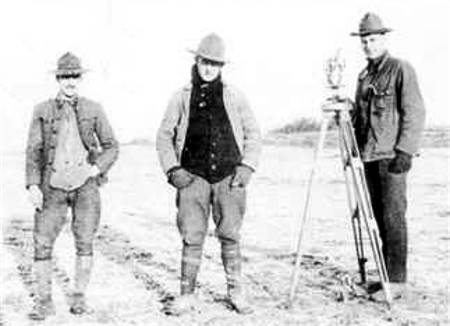 
Members of Company C 15th Engineers surveying
and building a railroad line in France.
Jonchery was a new place to them, but
they knew that Company B was there, and so it was with a willingness they laid
down their railroad-building tolls at Mehun and Foecy and proceeded to Jonchery.
It was known also that Jonchery was a much more desirable place than either Mehun
or Foecy to spend a winter. It was December 7 that Company C arrived at Jonchery
and greeted their comrades in Company B. The reunion was a joyful
one.
The first cold days of winter were
setting in, and as the men looked on the comfortable buildings of the little
city they were glad they could avail themselves of their shelter in the long,
dark wintry evenings that were to follow. The camp was in the open. However,
the men visited much in Joncery, and this helped to dispel the “blues”
considerably.
Chilled after the long trip, Company C men
rushed the coffee pots in the camp shortly after they detrained for a nip of the
warming fluid. It didn’t always have sugar in it, and practically never any milk,
but it was good. A trooper who didn’t like coffee without either sugar or milk
before the war soon learned to like it in this state after a few weeks of service
in the field.
AT JONCHERY
Company C, like Company B, wintered at
Jonchery. The cold and bleak weather encountered here did not stop the work by
any means. Company B had been engaged in railroad construction here for several
weeks previous to the arrival of Company C. From time to time other units of
the Fifteenth engineers arrived at Jonchery to assist in the work.
Although conditions were better here than
in many other places where the engineers had worked, they soon became almost
unbearable, hence Colonel Jadwin, who was stationed with the troopers at Jonchery,
was lenient in grating passes. The little city boasted of several motion picture
theatres, and these were nightly visited by hundreds of the Pittsburgh troops.
Although the pictures were French ones and the boys could not read the captions,
they enjoyed them just the same.
Company C had to erect barracks for
itself, and this was the first task it was assigned to. In the meantime the
other companies were engaged in the construction of huge warehouses. Company C,
at the completion of their barracks buildings, switched over to the warehouse
construction game also. Days stretched into weeks and weeks into months. The
evenings found the lads around a fire in their barracks or in Jonchery trying
to drive dull card away.
Home was the big topic among them, and
they were all commencint to long for the liberty that marked their lives in
the civilian days. Many long letters were written to relatives and friends
back in the States, and the time otherwise whiled away when not a work. The
men weren’t discouraged – only homesick,- and that was a natural feeling.
The winter is always a sort of a “blue” time, anyway, even amide the
pleasantest of surroundings.
Sometimes while the men were engaged
in their daily work, blinding snowstorms would descent and try in vain to
drive them away, but they failed, for the men stuck like leeches. The
importance of completion of the work was impressed upon them by officers.
Hundreds of American soldiers were to arrive here later and be quartered.
It was a central distributing point for supplies and munitions. The
warehouses were absolutely necessary, for each day saw trains arrive with
great quantities of military stores.
Jonchery was well situated in
respect to the fighting lines to the north. For supplies could be shipped
out with directness and a saving of considerable time. Hence It was chosen
by stategists as a supply depot.

Building railroad lines to keep supplies
flowing to the front was a grueling task for the engineers.
MORE RAILROAD CONSTRUCTION
A part of the Fifteenth engineer
contingent at work at Jonchery was taken from the work on warehouses and
roads, and set to work building railroad beds and laying rails. Company G,
because of its experience at Joecy, was, of course, picked as one of the
units to engage in this work. The yard was not to be as large as the one
recently constructed at Joecy by Company C, and was to contain only about
forty miles of track. However, it took much hard work. Engineer surveyors
first surveyed the plot of ground on which the rails were to be laid and
then the work of laying the bed was commenced.
The task was identically the same
as that experienced at Joecy, and was nothing new to Company C. However,
the company had profited by their former experiences, and the work went
ahead much more rapidly, the system evolved at Joecy being carried out to
the minutest detail, with the elimination of those features which had at
first hampered their initial attempt. Colonel Jadwin was ever ready to
grant short passes to small bunches of the men, and his leniency did much
to keep the soldiers from Pittsburgh in good spirits.
HANDLE SUPPLIES
As fast as the engineers constructed
the railroad tracks trains would enter Jonchery and shunt long strings of
cars on them. These would be immediately unloaded into huge motor trucks
and rushed to the warehouses. The empties would be removed and another train
would be stored, but almost as soon as they were stored they would be removed
again and placed in trains going toward the front lines.
![Shoulder Patch: Advanced Section [A.S.]
of the Services of Supply](images/Memorial/WWISupply.JPG)
Shoulder Patch: Advanced Section
[A.S.] Services of Supply
At the front end of the warehouses
the soldiers worked with fury to store the supplies. At the other end men
worked to remove them. The storing was essential, because requisition orders
varied; sometimes a quantity of this would be taken, and at other times the
same supply would not be listed on the requisition. It all depended upon the
fighting forces needed.
It was therefore necessary to first
store the supply before they were removed. This was exasperating to some of
the men. For example, a trainload of shells would arrive today, and be
unloaded and stored in the warehouses.
Tomorrow an order would come demanding
every one of the shells just unloaded, and thus the reloading process would
have to be gone through with again. Only in very few instances where the
supplies taken from one train directly to the other. Occasionally a car was
not unpacked at all, but switched directly to the track leading to the battle
front. For the greater part, it was one constant grind of unload and
load.
WORK EXTENDED
The work of building the warehouses
and the railroads at Jonchery neared completion the latter part of February.
Villers-le-Sec, a few kilometers distant, was the next moving point of the
units of the Fifteenth engineers, and on March 24 they moved to this town.
Here the work was the same as it had been at Jonchery. The building of
warehouses, the unloading and reloading of trains, constructing of barracks,
and repair of the roads.
While here the weather became
gradually warmer and the snows of the winter turned to rain. Spring arrived,
with budding trees, green grass, the singing of birds – and mud! All of the
Pittsburghers concluded France was the muddiest country in the world. The
downpour of rain, which seemed a daily occurrence, together with the
thawing of the ground under the influence of the warmer sun, made a mushy
mud surpassing description. In May the work at Villers-le-Sec was
completed.
NEXT STOP ABAINEVILLE
On May 4 the Pittsburghers left
Villers-le-Sec for Abaineville, making the journey in trucks. At Abaineville
headquarters was established and the troops thought they would remain there
for some time. Their stay was a long one as far as headquarters was
concerned, however, the Pennsylvania engineers were detailed to surrounding
towns on jobs of similar and dissimilar natures. Sometimes they were absent
from Abaineville for weeks at a time, at others only a few days, always
returning to headquarters when a job was completed, loafing a couple of
days perhaps, and then being detailed out again.
Abaineville was situated back of
the front a distance of twenty miles. The frequent details provided the
Pittsburghers with the opportunity they had waited for, because their work
sometimes lay very close to the trenches in No Man’s Land. They had all
wanted a look at the front and most of them got it during the stay at
Abaineville. When off duty, the troops would visit the battlefields and
gather souvenirs.
One of the tasks of the engineers
while at Abaineville was to build a railroad from that city to the front
lines. This work was not new to them and they built it in a jiffy. When
the line approached the trenches, the engineers worked a great part of
the time under shell fire. The nights they would spend in the dugouts,
making frequent expeditions into No Man’s Land just for the experience of
the thing. Some of them had exciting times, too, and some very narrow
escapes.
THE ST. MIHIEL SECTOR
Just as the railroad was completed,
the American forces commenced their great drive in the St. Mihiel sector,
completely wiping out the salient that had been held by the Germans for so
long. Once the salient was wiped out, the task ahead was the capture of the
great German fortress of Metz, and in preparation for this intended
onslaught, the Fifteenth engineers were ordered into the St. Mihiel sector
to build railroads and gun emplacements.
It was in the St. Mihiel sector that
the engineers saw practically all of their excitement. Here they were
attacked by enemy airmen frequently, worked under an almost ceaseless rain
of bullets, and saw many pretty little Alsace-Loraine villages wiped out
one by one as the Hun artillery got their ranges.
Several of the Pennsylvanians were
gassed here, a few wounded, and a number killed by accidents. Often, as the
men worked under the sweltering sun, thrilling air battles would take place
in the clouds above. These always entranced the troops and upon such
occasions they were permitted to drop their tools and perform the task of
interested spectators.
One battle in the colds is recalled with
vividness by the troops. Eleven French planes and three American planes attacked
a raiding party of sixteen German planes late one afternoon, and succeeded in
driving them away after five of the enemy machines had been dropped. The
allied airmen lost only one plane, a French DeHaviland.

A small town in the near proximity
of the camp of the Fifteenth engineers was totally destroyed one night by
the enemy big guns. All the previous day the heavy artillery of the Huns
had been quiet. About twelve o’clock that night the engineers were rousted
from their tents by the whine of big shells and the bursting of
bombs.
The
whole sky seemed aflame. Enemy planes whirled overhead dropping bombs on
the little village, which soon burst into flames and was burned. Later the
American artillery got the range of the battery that had done this piece
of work, and completely obliterated it.
MENACED BY AIRMEN
As the engineers worked it was not
uncommon for a swaud of enemy planes to fly low above them with bombs and
machine guns. One afternoon as the boys were industriously building a
railroad they were startled by the sudden staccato of airplane
engines.
Looking above they saw three German
machines approaching. Throwing themselves flat on the ground they awaited
their arrival. The machines suddenly dropped from a great height, and swept
back and forth over the prostrate lads, all the while belching machine gun
bullets.
The engineers seized their rifles
and fired almost continuously at the planes. Miraculously enough not a
single engineer was wounded or killed by this engagement. The airmen
finally gave up the attempt to annihilate them, after the rifle fire of
the sturdy Pennsylvanians became too hot. This was only one of many such
occurrences, however, and they soon got to be so common that the troops
didn’t mind them at all.
METZ DRIVE PLANNED
The big drive for Metz was under
contemplation at this time, and troops now commenced to arrive from all
fronts in France. A portion of the Eightieth Division arrived in the St.
Mihiel sector after grueling fighting in which the Hun had fallen back
so hurriedly that keeping up to them with commissary wagons and heavy
guns was almost next to impossible.
Members of the famous Iron Division
or the Twenty-eighth from Pennsylvania next arrived in the sector, and
preparations went quickly forward for the coming ordeal. Already America
across the seas was anticipating the great attack, but due to the strength
of German fortress of Metz it had to be a carefully planned
movement.
It was known the United States
command would not sacrifice men because of lack of preparation. As the
time went forward the engineers from Pittsburgh played a bigger part
than ever in the preparation. The great naval guns of the Americans were
arriving on the sector, and it fell to the lot of the Fifteenth engineers
to construct the concrete emplacements upon which they were to be mounted.
Metz was in range of these guns. Not only were the Americans sending guns
of huge caliber into the sector but the French and British added to the
equipment with heavy field pieces.
Out on the forward-most points
the American engineers worked with determination in the construction
of these concrete emplacements. Their work was camouflaged as much as
possible from the sight of air observers. While some were building the
emplacements, others of the units of the Fifteenth were laying
rails.
As fast as they were laid, locomotives
moved forward over them with carload after carload of ammunition and supplies.
Sometimes these locomotives would be within a few feeet of the hardworking
engineers, waiting until another twenty feet of track was laid that they
might advance that far. Some of the engineers manned locomotives, too. In
fact there wasn’t anything the Fifteenth engineers didn’t do in
France.
And so day after day the work
in the St. Mihiel progressed toward the great day when the dogs of the
American army would be unleashed and dash for Metz made.
Meanwhile another group of
Pittsburghers, as was recounted in previous chapters, was at work in
the Verdun salient. This group of the regiment had become separated from
the others through the fortunes of war and had been assigned separate
tasks, until now, in the closing days of the war, they were assisting
the conquering allied troops by building portions of the destroyed Sedan
railway, the chief artery of supply in the Verdun sector, and advancing
its length into the lands recently vacated by the Germans in their
headlong flight for the Fatherland.
It was the holding and maintenance
of operation of the Sedan railway during the earlier months of the war,
and later as well, that made Verdun invulnerable to the Germans early in
1915 and in 1917. Without this road the supplies could not have been
brought to the besieged city and its rings of outer fortifications and
surrender would have been inevitable to the brave French forces holding
it.
It was at Verdun that the famous war
phrase "They shall not pass" was coined, but few realize the part the little
Sedan railway played in making that statement true. The terrific shelling of
the Germans at Verdun badly destroyed the portions of the extreme end of the
road.
French and British engineers were
continually repairing it, realizing its importance. The Americans were
engaged at the same task, when the backbone of the German army was broken,
and the forces that had threatened the ramparts of the famous city for so
long were forced to withdraw. The French, British and American forces in
the sector were quick to see the break hurled themselves after the running
Hun armies.
To bring up supplies, keep the lines
of communication intact, and permit the allied forces to take advantage of
the retreat, the Sedan railway had to be advanced and it was advanced by
American engineers from Pittsburgh. They, like the men at St. Mihiel were
putting every ounce of energy into their efforts.
HOME
And so in the midst of their most
strenuous activities the armistice was signed and hostilities ceased. But
November 11, 1918 did not mean rest for the Fifteenth engineers. They kept
on with their work until the winter was well advanced. In the Verdun sector
the contingent of Pittsburghers saw their fellow comrades, members of the
Eightieth and Twenty-eight Division relieved from duty and their places
taken by fresher troops. They too, hoped to be relieved but they were held
repairing spots which had been devastated by four years of modern
warfare.
The contingent at St. Mihiel was
the first to break camp and progress toward the coast. This took place
in the early part of January 1919. The men at Verdun knew then that it
wouldn’t be long until they, too, would be homeward bound. Soon orders
came to proceed and the whole regiment was assembled during the latter
part of January at Camblanes, France. Here the troops went through a
long and tedious wait.
Troops arrived daily at the camp,
waited a few days, marched on to the sea coast and sailed for America while
the engineers sweltered and fumed with impatience. Finally, orders were
received on March 19 and the regiment proceeded to Bassens. Here another
wait ensued until the necessary red tape of examinations and quarantine
could be gone through with.
The regiment boarded the Santa
Clara at ten o’clock on the morning of April 13, and sailed to America.
It was a welcome day for the Pittsburghers and the trip homeward was a
more joyful one that the trip going over. The men were tired of
war.

Illustration that appeared in the
Company C 15th Engineers 50th Anniversary photo album - 1969
On Saturday, April 26, the Santa
Clara docked in New York. Hundreds of Pittsburgh relatives welcomed the
boys there. At Camp Dix the lads went through their last quarantine period,
and on Wednesday morning, May 7, 1919, reached Pittsburgh. In the afternoon they paraded through the
downtown streets amid the applause of thousands of admiring people who
welcomed them home with outspread arms.
That evening they proceeded to Camp
Sherman, where during the next three days they were all honorably discharged
from the service. Since then they have been gradually absorbed back into the
civilian populations. They will never be forgotten. France does not forget
such deeds of valor and sacrifice, and Pittsburgh will ever keep green the
memory of what her stalwart sons achieved.
CHAPTER XXI - Part I
CHEMICAL WAR SERVICES
Note: This story of the Chemical Warfare
Service was written especially for this history by G.K. Spencer.
Pittsburgh and Western Pennsylvania men
took a major part in the chemical warfare service, both in this country and
overseas, and they made Uncle Sam’s gas forces, both defensive and offensive,
an important factor in deciding the Great War. Indeed this service had attained
to such proportions and efficiency that it would have annihilated the German
armies during the past spring if hostilities had continued.
The greatest slaughter of all history; the
virtual nemesis of the manhood of a nation, would have occurred early in 1919 on
the German southern battle line, the “Western Front,” if the armistice had not
been requested by the German command, according to Colonel W.H. Walker, in chief
command of the Chemical Warfare Division of the United States Army.
The German
lines, at whatever sacrifice, it was panned should be driven back almost to the
enemy frontiers, where a series of valleys were to be deluged with new and hitherto
unutilized chemicals while the Germans were busied with their retreat.
In the opinion of Colonel Walker the war
could not possibly have endured longer than the first of April. The enemy was
aware of this, also. In March of 1918 he had precipitated his own gas coup de main
which was supposed to fix a climax for the war and result in German victory. The
British fifth army, however, be an admirable sacrifice in which it was practically
destroyed, defeated the German hopes.
HAD CONCENTRATED CHEMICALS
When hostilities were terminated in November,
the United States Chemical Warfare Division had concentrated almost a half million
tons of various forms of offensive chemicals along the western front. To this, other
tons of more deadly gases were being added each week. At the present time one of the
most intricate problems faced by the field command is how to dispose of these stores
of gas. It cannot be safely kept, cannon be released for obvious reasons and it is
impossible to reduce it.
Though they suffered from a lack of material,
ordnance, munition and man power, the Germans were very successful in securing
information of activities across the line. In numerous instance, this information
procured at their own expense, gave birth to many misgivings in Boche minds. The
enemy, it has since been demonstrated, was fully aware of the plans laid for the
spring offensive of this year. To the ton they knew how much gas had been prepared
by the Chemical Warfare Division of the Army of Penetration. He had even despairingly
turned his hand to incipient preparations for defense.
Not only was this Chemical Warfare Division
one of the most romantic and remarkably successful branches of the service, but the
most obscure as well. If native pride exists in the hearts of Pittsburghers, it
should not be lessened by knowledge of a war record which is not being claimed with
sufficient ostentation.
A PITTSBURGH PROPOSITION
The problem of chemical warfare was distinctly
a Pittsburgh proposition from the very beginning, from the basis of materials,
technical methods and leadership. So the great offensive, which would have been
ordained had the military genius of Generalissimo Foch failed to bring capitulation
when it did, would have been another Pittsburgh achievement.
In fact, the battle
series developed by Foch through the month of August, September, October and November,
depended to a large extent for their effectiveness on new and surprise gases evolved
by the strategy board headed by Colonel Raymond F. Bacon, director of Mellon
Institute.
ENEMY FACED ANNIHILATION
New and horrible – there being no known defense
against either – two concentrated gases, conceptions of United States chemists, would
have transfixed the German army machine by a great coup de grace. There had been weary
weeks of grinding trench fighting when it appeared as though nothing short of this
application of the killing art would suffice to end the war.
Colonel Bacon
and his conferees, in view of their taciturnity, their reputation for conservatism,
cannon be accused of boyish enthusiasm when they now declare that “almost certainly,
in view of exhaustive tests made by us no our test fields near Chaumont, we can say
the enemy armies would have faced annihilation.”
MUSTARD GAS
One of the new developments evolved among the
gas offensive weapons is “ultra-mustard’ which is described as being a burning compound
greatly transcending the agony and effect of the German mustard gas, or that used by the
Entente. Mustard gas, even in its mildest form, has no antidote in the way of clothing.
But the United States mustard is explained by chemists to be eminently more vicious than
the enemy prototype.
There is also a new phosgene achievement. Many
varieties of phosgene gases were in use, and masks and other protective coverings were
invented to counteract their attacks. But, according to Colonel Bacon, there is no
reactive chemical to apply in defense against the new phosgene invented by American
chemists. It is said, the enemy mask would be a failure in combatting it. In fact, the
new phosgene will destroy even the masks in its ambitious effort to get right down to
business.
Early in the progress of the war effort all
chemical warfare problems were under the mentorship of the Bureau of Mines, and a very
loose organization it proved to be.
Minds and plans focused, however, in early
December, 1917, when Colonel Charles L. Potter, an officer of the regular
establishment, was requested to form a “Gas and Flame” corps.
CHEMICAL DIVISION FORMED
When the skeleton organization was decided
upon, with four Pittsburgh men at the head of the four departments into which the
corps had been divided, namely production, research, defense and offense, the
concensus of opinion was that all hands and heads should concentrate on extreme
measures of defense.
It came to light that the German gases had
been very much over-rated. From the first it appeared that everything Berlin spread
about their ‘wonderfully destructive “ gas implements, was taken up by the Entente
and religiously believed. The Allied experts had admittedly failed to produce anything
quite as deadly as the Boche in the way of gas and flame, and they were loud and long
in their plaint that it would be quite impossible to surpass the Hun – whose deviltry
was believed to be supremely artful.
However, the United States experts, on arriving
in Europe to make researches into foreign formulae, found they had left a land behind
that was potentially able to eclipse anything France of Great Britain had to show.
True, the older warriors had advanced in design, from very necessity. So the United
States, working at first on Entente original designs, eventually produced both
offensive and defensive implements that were copied by the other associated
nations.
To proceed chronologically, the Chemical Warfare
Service is the present cognomen for what was the old Gas and Flame corps. This Chemical
Warfare Service has been a special child of Providence. Time was when it was a polygon
group of loosely coordinated activities under the Bureau of Mines. So Colonel Potter
came in and organized the corps to function healthily and in a business-like manner.
Then followed a phenomenon.
ORGANIZATION EFFECTED
Colonel Potter needed first an expert to take
charge of the manufacture of gases and subsidiary apparatus. W.H. Walker, originally of
Pittsburgh, was very much interested in his work as head of Department of Chemistry in
Massachusetts Institure of Technology. The colonel needed Walker. A month later Colonel
Walker was directing the Department of Production!

Top - Painting shell with varied colored
bands to identify the gases contained in them;
Middle - Mustard gas plant; Bottom - View of shell dumps;
Insert - Colonel W.H. Walker, commander of the United States division of chemical
warfare.
Colonel Potter also needed a chief for the
Defense Laboratories. Bradley Dewey, of Pittsburgh, chiefe chemist for the American
Sheet and Tin Plate Company, at the colonel’s request secured an indefinite leave of
absence from the Tin Plate company to accept a commission as colonel in charge of
defense!
Then there was the Research Department. George
A. Burrell, of Pittsburgh, who had acted as chief of research of the division, was
prevailed upon to become Colonel Burrell, July 15, 1918. Colonel Burrell was formerly
stationed at the Arsenal Park depot of the Bureau of Mines.
Fate seemed to rule things for every time
Colonel Potter started out to chase up an expert, it was tit-tat-toe all over the
rest of the industrial fields, with the decision always going to Pittsburgh. So to
save time, he pounced directly on Pittsburgh for his chief of Offense. He found his
man in Dr. Raymond F. Bacon, director of Mellon Institute.
Colonel Bacon was assigned
to “observing” and “reporting” from a post in France the Allied advanced in the art
of gas fighting. He was further placed in charge of all the division’s work in France
as directing chief. So, for better or for worse, it was “up to
Pittsburgh.”
On July 15, 1918, in view of the unexpected
results attained by the Germans in the March offensive by the application of strategy
in chemical warfare, Major General W.L. Sibert, who directed river and harbor
operations in Pittsburgh from 1900 to 1907, as charge of the local United States
Engineers office, and who went to France with Pershing, as second in command, took
over the command of the organization Colonel Potter had arranged.
The service
destined for actually “ending the war” now began to forge ahead in a series of
astounding brilliant developments. With the enthusiasm of school boys and the
experience of veterans the several chiefs in charge began dispensing Democracy to
recalcitrant Jerry without mercy.
MANY INTERESTING FEATURES
There were quite as many interesting features
of the “Game” in America in the production and research program as there were in
France in the defensive-offensive sphere and in combat strategy.
Early in 1918 Colonel Walker, chief of
production, began his work of organizing a number of factories to produce gases,
gas shells, masks and all the paraphernalia connected therewith. It was still early
in 1918 when he announced that six of his “pets” were producing. They were situated
at Niagara Falls, Hastings On The Hudson, Kingsport, Tennessee, Charleston, South
Carolina, Bound Brook, New Jersey, and Edgewood, New Jersey.
The last named plant was producing in three
months from the time the first crew of laborers walked over the site, armed with
shovels and wondering who had gone crazy.
These factories produced thermite and
incendiary bombs, all varieties of gases and liquid fire apparatus.
Throughout these factories the employees
became enlisted men, but at the beginning, before a series of set-backs had occurred
they were civilian workers, many of whom were southern negroes.
FACTORY TROUBLES
One day a great tank containing poisonous gas
developed a very slight lead. Some experienced workmen casually walked up to it and
began repairing it and were none the worse for the experience. However, among those
not yet familiar with the manufacturing process and safety procedures, through the
factory, from nervous lips to rolling eye, the word spread, “the gas is
loose.”
In no time thousands of new employees left their
important work in the buildings and commenced a frenzied rush for the open country,
every one convinced in his own heart that death was right at his heels. Meanwhile the
workmen who had repaired the leak were quite curious to know of the excitement. In time
order was restored and soon all employees were made aware of the proper protocol for
dealing with leaks and panic strewn instances like this were not repeated.
But it was not all farce. There were many
instances where actual tragedy entered with real accidents. In fact, thousands of
lives might be chocked up to catastrophes in the war plants. There is not a
superintendent of department who will not emphatically assert that his men in the
factory were in some cases entitled to more credit than the men in the line. The work
is considered by those who know as very dangerous.
It is also interesting to note the every
well-known chemist in the land was associated with one of another of these factories
– taking his instructions from Pittsburghers. A great many were also located at the
American University, where the research work was carried on by Colonel George A.
Burrell.
RESEARCH WORK
Here, in the American University, at Washington,
D.C., 1,400 notable chemists worked assiduously on research into death-dealing
chemistry, types of flame-throwers, new gases, new defenses against gases. Always
keeping several steps ahead of Fritz, they formed one of the vital brain centers
during the war. It was these men who evolved the two new gas weapons.
And when they produced them, it was they who
arranged to have general headquarters sanction an offensive for which they would be
responsible – all to be carried out by their own strategy department in France. “We
are satisfied we could have utterly destroyed the German army,” they said. The
officials have refused to give the details of their new gases “because they will
probably be legislated out by the Peace Conference; they are terribly
destructive.”
Colonel Bradley Dewey, with his factories at
Philadelphia and New York, employed 12,000 people, mostly women. Colonel Dewey, it
will be remembered, controlled the department of defense.
This department produced all sorts of masks,
horse masks and dog masks, protective suits for the artillery, dug-out blankets to
seal in dug-outs and exclude enemy gases, and also protective ointments.
In every part of the process girls and women
were the handiworkers. And only women-folk with brothers and sons, husbands and fathers
in France were accepted. On all the walls throughout the workrooms appeared signs,
“Make Certain of That Mask; Your Sweetheart May Wear It.” “Daddy Must Be Safe.” “Would
You Want YOUR Brother to Put It On?” etc. Every mask must be perfect. Even an
infinitesimal pin-hole would incapacitate a man.
In these factories 5,000,000 masks were made.
At first they were duplicates of foreign masks. During the last four months of the
war the British turned to United States masks entirely. They admitted thus the supremacy
of Uncle Sam.
“Regarding masks,” said Colonel Bacon, head of
the force in France, “there never was a time when we wanted for them; always had plenty.
At times,” he went on, “that’s the only thing of which we did have plenty.”
GAS SUPREMACY
According to authorities it was the German March
drive that produced the American gas and mask supremacy. In that maneuver the enemy
utilized mustard gas in great quantities and with peculiar strategy. “We knew we had
to beat them and our men in the American University did it,” say the chiefs. Italy,
after that action, also equipped her armies with the American masks.
CHAPTER XXI - PART II
Men from this section of the state
were at the head of many important tasks allotted to the chemical warfare
service of the army. Many useful and destructive devices for combating the
enemy were invented and manufactured, and progress was made to such an extent
that this arm alone would soon have been able to either force the enemy to
surrender or be annihilated.
(Note: This section of the History
was compiled and written by G.K. Spencer.)
While the Germans were enjoying their
little game of “Kriegspiel,” things were happening. Colonel Bacon, in France,
needed at once a first class laboratory. For the time it appeared as if the
success of the United States gas and flame effort depended upon getting a
laboratory, a good laboratory, in a marvelously short time at the test field
of Chaumont, where headquarters was located.
“You want too much all at once,” Bacon
heard on one side, and on the other, “It can’t be done, y’know.”
Bacon didn’t pretend to be an Aladdin,
nor would he have rubbed a lamp if there had been one available. But he took
the alternative of rubbing C. G. Fisher, president of the Scientific
Materials Company, of Pittsburgh.
At the first suggestion, almost the first
“rub,” one might say, the idea appealed to Mr. Fisher. “How soon do you
want it?” was his query. “It is needed at once, has been needed for some
time, but we would like to have it in any reasonable time, say two months,”
was the reply.
LABORATORY FINISHED
In one month the best equipped
laboratory in France or England was humming along under full steam at
Chaumont.
The first thing Fisher did was to
list every conceivable piece of necessary apparatus. And then his own
company, and every company and laboratory in the United States which held
any special instrument or piece needed, shipped it to France.
Colonel Bacon himself has termed it
“not the best equipped WAR laboratory, but the BEST EQUIPPED LABORATORY in
all France and England.”
The Chaumont experimental field is
twenty square miles in extent. On the field are physiological and
pathological laboratories. Trench systems and artillery batteries are
laid out. All ideas are tested on a full battle scale. Following are
a few of the results:
In the Argonne forest our troops
encountered a great system of machine gun nests. The Germans had developed
the machine gun to tremendous efficiency. Recourse was made to the chemical
division to solve the problem. It was a big problem but the Division
couldn’t afford to fall down on a solution to it. Besides, every day of
delay meant that the nests were being set upon by the good old doughboys
who perished by the score for every gun that was captured.
The special "gas and flame" troops
set up machine gun nests at Chaumont and experimented. Before a week had
elapsed the doughboys were welcoming gas and flame units equipped to throw
thermite bombs and liquid fire over the nests. "It solved that problem,"
laconically commented Colonel Bacon.
GERMAN GAS EFFECTIVE
The heaviest use of gas, however,
came with the German March Offensive. While the British claimed to be aware
of both the time and the place of attack, they were apparently surprised by
the enemy, who “walked all over them” for a little while. The First Army
suffered tremendously, and the Fifth Army was obliterated. Why?
It was a surprise tactic in gas warfare.
The Britons held like heroes, to their glory, as they had held before at the
Second Battle of Ypres in 1915, when the gas first struck them. Both
times the German Army could have gone on through but, with all their
preparation, they committed the fatal error of not having enough gas to
“carry on.” This fault, says Colonel Bacon, “was the only thing that
saved the allied armies from defeat.”
The British system of defense, up
until March 1918, consisted of a lightly-held advance trench line with
heavy groups of artillery and machine guns immediately behind the lines,
entrenched on eminences controlling certain fields of fire by a criss-cross
zone of action. All spots of the field could be fired upon and drenched
with barrages. The theory was that the German troops might possibly come
over and take a portion of the lines, but they, if it happened to be a mere
trench raid, would be immediately ejected by a drench of artillery
fire.
If it were a general attack, the
front lines would fall, but the artillery from their secure eminences, which
would have to be captured one by one, would place a double barrage in
conjunction with heavier guns further to the rear, and the infantry in
support trenches would move up and counterattack after the guns had cut
off the enemy mass from retreat.
In the March Offensive, the Germans
developed a mustard gas shell, threw it in great numbers upon the buttressed
eminences, and silenced the big guns to a great extent. They then placed gas
shells over the support trenches, and fired gas so heavily that in the
Montdidier sector alone, on a five-mile front, 300,000 shells of six-inch
caliber and larger were sent over in the space of 24 hours.
The support troops, due to casualties,
and incapacitated by being compelled to wear their masks for 24 hours
before when the attack came, couldn’t go into action.
The enemy attack infiltrated between
the fortresses. There was no active infantry to meet it, and what appeared
to be a great German triumph was about to be enacted. That the war was not
won then and there, according to the gas and flame men, was only due to the
magnificent willingness of the British troops to stand there ground. while
entire brigades were wiped out, and to the fact that the German gas was not
so plentiful at the finale of the action.
In that action eighty percent of all
shells fired were gas shells. During the first two days of the attack,
practically all the enemy fire was gas. Sneeze gas would first be thrown
to force the men to take off their masks. Then they would be dosed with
deadlier gases. So the war had evolved into one of gas into which the
Chemical Warfare Division of the United States Army entered with a zest
and won out over all.

American soldiers blinded by exposure
to German gas move in a line.
“CAMOUFLAGE” GAS
The first use of “camouflage gas,”
or innocuous gas used to force the enemy to fight with masks on, while
your own troops, being aware of it's harmlessness fought without masks,
was used by the British, who originated it. They began to build up huge
stores of it along the front for a great surprise attack. But the German
agents became possessed of the secret and the enemy “beat us to it,” as
one officer expressed himself. It was largely used by both
sides.
In the latter months of the war,
the department under Colonel Bacon had felt that German chemists were
becoming scarce. It is a custom for the chemists of one side to analyze
the “duds,” or shells which fail to explode, of the enemy.
So the Americans, in order to keep
the German chemists busy, too busy to have the time to make and research
and evolve new mixtures, began to fill hundreds of shells with a mixture
of all kinds of strange solutions, anything, in fact, that the wags among
them happened to think of.
These
they threw over to Fritz with insufficient charges to explode, whereupon
he recovered them assiduously and sent them back to his chemists. This
is how the report was born in Germany in the later days; that the
Americans couldn’t make good shells. The Boche was too dumb to see the
joke, until it was too late.
GERMANY EQUALLED
When the mustard gas shells were
first issued to the German batteries, their infantry was informed of the
dread properties of the new invention, which by it's mistral blight would
win the war. This enhanced their morale very greatly, until the Allied
batteries began to throw the same stuff at them. Then they had much
cause for introspection. Upon finding they were being handed a thing
that their own government had told them was so very dreadful, it
detracted from their morale.
AMERICAN STRATEGY
It was about August, 1918, that
Quartermaster General Ludendorff began to issue his “advice to the
troops,” dealing with the idiosyncracies of American gas. The shells
were of inferior quality and the gas was largely of the innocuous type.
Berlin was beginning to realize that, after all, they had judged the
United States correctly.
Another little game that Fritz
usually used to fall for was played like this: The infantry of a sector
of trench line would be withdrawn and their trenches filled with mustard
gas. Then Jerry would find out about the withdrawal and get his orders
to “go over” and occupy the trench. When he reached our line, a “box”
barrage would be laid down, on both sides and behind him. The barrage
would be moved gradually in and Jerry would wander into the gas. It was
a nasty trick, but the doughboys couldn’t be convinced that it wasn’t a
good one.
BOARD OF STRATEGY
In July, 1918, the United States
Chemical Warfare Service organized a “Board of Strategy.” The principal
consideration in gas warfare, next to discovering deadlier mixtures than
those in use, is the strategy utilized in applying the gases already
possessed. The enemy doesn’t come up and plead to be gassed. Means to
lure him into gas traps must be devised.
Nobody ever heard of such a board
of strategy before, but this one “brought home the bacon.” The German
may be a slow thinker, but at the same time he is wily. Someone conceived
the idea of taking natural quick thinkers and forming a “strategy board”
to “think up” new methods of convincing Jerry out into the open for American
gas displays.
Here was a good one. At his
suggestion an airplane rose over the German trenches and commenced to fire
off a lot of beautiful fireworks. This happened in the evening, about
“retreat” call, when mess was being served. Then, for three evenings in
succession the plane arose and fired it's pyrotechnical display, with no
bombs or intent to injure Jerry in the least. The one concern of the
Americans was to show him a good time.
On the fourth evening Jerry was out
of his dugouts taking in the show of fireworks, when a couple tons of gas
rained over him. When the Americans arrived in his trench he wouldn’t or
couldn’t welcome them. Each German fell where he stood rubber-necking.
It seems too simple, but it actually worked.
HOW PROJECTORS WERE USED
Another little stunt Colonel Bacon’s
men cooked up to reduce the German molar movement into molecular movement,
concerns a tactic with the Levins projector, a tube placed in the ground
outside the trench system and connected by pipe line with the trench. These
were always handled by the special gas and flame men. Needless to say the
infantry always had very definite misgivings when these men appeared, for
they would set up their gas apparatus, open the cocks, and “let ‘er
fly.”
They would then get out of the
vicinity while the German artillery, in an
effort to “kill” the gas, pounded the sector, the doughboys taking the
punishment. Always the German artillery retaliated for these displays.
So, as it was becoming apparent that the enemy was in the throes of a lack
of heavy caliber ammunition these Levins projectors would be installed and
opened up. The doughboys would hunker down, and the gas and flame men would
quickly detach and move on to another trench. Subsequently, Jerry would
bombard the place until he got his fill of it.
Thousands of these little flourishes
along the lines by Colonel Bacon’s jesters caused the German command to make
various “protests” to neutral powers against the Yankees for their little
pleasantries. They reasoned that it wouldn’t be such a bad thing to stop
playing with the A.E.F.
Also it might be noted that when the
German artillery would concentrate on the Levins projectors, the Yankee guns
would take full advantage of the event by noting the placements and ranges
of the German guns, and then force him to move his guns or have them
destroyed one by one. And then, adding insult to injury, Yankee infantry
usually chose that time to attack when German heavy guns were not in a
position to rake them.
PITTSBURGHER AIDS SERVICE
A cablegram sent by General Pershing
in August, 1918, reads: “Unless Levins projectors arrive offensive must
stop.” It doesn’t make so much difference as to whom that cablegram was
addressed to, but it is interesting that it was here again that a Pittsburgh
firm saved the day.
Through the efforts of Mr. Taylor
Alderdice, in three days the National Tube Company was turning our Levins
projectors in capacity production. They arrived on time!
AMERICAN CHEMISTRY SUPREME
The close liaison of the United
States chemists with the chemists of France and England had been productive
of many lessons to all concerned. But to those who fear for the future
of American chemistry, or that United States chemists can not hold their
own with Europeans in peace times, Colonel, now Doctor, Bacon, for he is
back at his old post as Director of Mellon Institute, has to say that he
has found United States factories infinitely superior to their European
counterparts.
Not only is their equipment better
but he asserts that with the multifarious labor saving devices in American
plants we can compete on equal terms with Europe despite the cheaper labor
abroad.
An interesting problem which has
to be met in France in the next few months is the destruction of the
millions of tons of stored deadly gases which were to have been used
in the upcoming February Offensive, which was no longer necessary due
to Germany’s timely signing of the armistice. As it would be extremely
dangerous to the public to release it under any conditions imaginable,
the probability is that it will be burned with crude oil.

From top down - One, Filling shells
with phosgene. These men work under battle discipline and
Suffer casualties; Two - Edgewood arsenal; Three - Chlorine plants;
Four - Phosgene in
drums ready for overseas shipment. Each drum holds over 1600
pounds.
(THE
END)
This completes the Pittsburgh Press
mini-novel entitled "A Short History Of Pittsburgh and Western Pennsylvania
Troops During The War." It was transcribed exactly as it appeared back in
early 1919, when the people of Pittsburgh were awaiting the return of their
sons and daughters from France. Photos were added to enhance the story, in
addition to minor text edits.
Below are a few additional sections
dealing with the activities and experiences of Pittsburgh natives in the
Great War.
ADDENDUM A
RED CROSS NURSES AT ANGERS

The following are the personal
recollections of Red Cross Nurse Helen T. Burrey of Mount Washington.
Miss Burrey was a nurse at St. Francis Hospital who volunteered to serve as
an army nurse and was assigned to Base Hospital No. 27. She served there
throughout most of her wartime assignment, also spending time with a mobile
train service. The following are excerpts from the Official History of the
Red Cross, published in the 1920s, and some photos from Miss Burrey's
collection of snapshots from Angers, France. This information was retrieved
from a website in her honor, "My Mother's War - Mementos of WWI."

Helen T. Burrey
Helen T. Burrey, reserve nurse, Army
Nurse Corps, a graduate of St. Francis Hospital, Pittsburgh, Pa., and a member
of the nursing staff of U. S. Army Base Hospital No. 27, was one of the first
three nurses to be assigned to hospital trains of The American Expeditionary
Forces. She wrote:
Base Hospital 27, located at Angers,
France, received the first official order dated July 14, 1917, to supply Army
nurses for this service. Until this time, the Medical Corps attached to
hospital trains were caring for the wounded. Through Miss Blanche Rulon, chief
nurse of Base Hospital 27, Edna Cooper, Grace O'Donnell and I were detailed to
Hospital Train 57.
When told that we were to leave the next
day to board this train which was then stationed at Port Boulet, France, we
were certainly filled with a spirit of adventure. We arrived at Port Boulet
July 15, found our train and made ourselves known to the commanding officer,
Captain Goodwin, who had knowledge of our coming. He received us very kindly
and immediately showed us to our quarters.
We were agreeably surprised at the
modern equipment. In our coach there were three compartments which consisted
of a dining room and two sleeping rooms and a lavatory (tri-angular in shape)
containing a small wash bowl and commode. The sleeping rooms were made up of
a private room consisting of one berth and a wardrobe and a second room which
contained a lower berth and an upper berth.
Of course, we all wanted the
private room, but since it could not be private among three, we resolved to
take "turns about" and rotate from upper berth to private room. The rule was
one week in the private room and the next week, in the lower berth and the
third week in the upper berth. As we had five months of this life, we had
plenty of time for the private room. The dining room, which was also used as
a living room, contained a table and two chairs and a side seat fitted to the
wall.

Nurses take a break between
shifts.
Miss Burrey described the
accommodations of Hospital Train No. 27:
The rest of the train consisted of
sixteen coaches, including one infectious car which carried eighteen beds;
one staff car which carried eight beds; one kitchen and sitting sick
officers' car which carried three beds and twenty seats; eight ordinary
lying ward cars which carried 288 beds; one pharmacy car; one infectious
case sitting car which carried fifty-six seats and fourteen upper berths;
one kitchen and mess car with three beds for cooks; one personnel car with
thirty beds and one train crew and store car; the total capacity of the
train was thus 400 beds.
Each moving hospital was equipped with
electric lights, steam heat, electric fans, lavatories and racks for personal
belongings and even ash trays for the patients' indulgence. There were eight
ordinary ward cars for patients containing thirty-six beds arranged in tiers
of three. These could easily be converted into seats to accommodate patients
who were able to sit up; they could also be used for stretchers in emergency
cases or folded against the sides of the coach when the cars required
cleaning.

U.S. Army Hospital Train
Miss Burrey wrote of the trial trip
of Train No. 57, when for the first time American Army nurses were
officially assigned to train service:
Our first trip was to evacuate
patients from different hospitals who were able to be moved to a point of
embarkation for the United States. Since we were the first nurses, Colonel
Howard Clark, who was then in charge of the train service, made the first
trip to these different hospitals; this was also the first trip for
transporting badly wounded patients from the hospitals near the front
to the hospitals near the point of embarkation.
We started July 17, passed through
Tours, Bourges, Nevers, Dijon, Chaumont, Neufchateau, Contrexville, Toul
and Savenay, stopping at several base hospitals and filling our train with
wounded who were to be taken to Base Hospital No. 8 at Savenay. After seeing
our work, Colonel Clark congratulated us and recommended that all the trains
be supplied with three nurses.
We worked day and night with those
patients; the pathetic condition of our boys who were very badly wounded
made us realize that being wounded was hard enough to bear, without the
jolts, noise and dirt connected with traveling on a train. These patients
were in our care for two nights and three days before they were loaded at
Base hospital No. 8.
I remember two patients who had broken
backs and had horrible bed sores. You can picture the special care such a case
would require, but our time with each patient was limited and we gave the best
attention possible. We also had many patients who had amputations of legs,
or arms, and many other wounds that caused much pain and constant attention
from doctors and nurses.
One of the chief discomforts which
we noticed that the patients met was caused by the tightening of bandages
due to the restless position of the patient and by the moving and stopping
of the train. This condition was also aggravated by the infected wounds and
the patients were constantly calling for relief from the
bandages.
During the drives which centered in
the Chateau-Thierry sector, work on all hospital trains of the American
Expeditionary forces was heavy. Miss Burrey wrote:
During the drive at Chateau-Thierry
a great number of the hospital trains were mobilized at Pantin, a suburb of
Paris, for duty into Chateau-Thierry. From Paris to Chateau-Thierry was
about three hours ride and 57 was ordered to make the trip. The train was
sent to evacuate patients from hospital No. 7, a mobile unit. These patients
had received First Aid; major operations were called for. Some had hardly
reacted from their anesthetic and most of them were in a pitiable
state.
In the station and surrounding it
were litters covered with boys; mud-splattered and torn were the uniforms
they wore. They were patiently waiting to be to be taken, they did not care
where but some place where they could be given proper care. After we
received our train load, about 400 patients, one of the things that bothered
both patients and nurses most were the countless numbers of flies that
infested our train.
The odors from the wounds that had no
care cannot be described but shall live in the memory of the nurses and
orderlies. We made three trips to Chateau-Thierry. The third one was to a
small town outside of Chateau-Thierry. It was after dark when we got there
and we immediately started to load our train with patients that had been
gassed.
At the height
of our work, we had an alarm of the enemy airplanes which meant all lights
out and we had to work in the dark getting as many patients under shelter
as possible. We loaded our train without keeping count of the patients that
could walk. After the train pulled out and we got to a place of safety, the
lights were turned on and we found we had patients everywhere, in the berths,
on the seats and crowded in the aisle.

Many of the doctors and administrators
of Base Hospital No. 27.
Hospital service formed one of the
most adventurous and interesting branches of war nursing. Miss Burrey
wrote:
To get to a certain base hospital,
which was in a mountainous district, the train had to be divided; the engine
could not pull the entire train up the mountain. We got no instructions as
to the splitting of the train, so it was just luck that all the nurses were
not in one part of the train. I found myself on one half of the train,
garaged in a railroad yard with about two hundred patients; the other half
with two nurses was starting up the hill.
While they were gone, an engine
was attached by mistake to our train and soon we were rapidly moving away.
We traveled about eight hours before we finally found the rest of our train.
We were surely happy to see them again, for they happened to have the supply
and the kitchen car.
When the train was empty and we were
moving, the scenery and the wonderful views of France thrilled us, but when
the train stopped, we were garaged in some railroad yard. We might stay
there an hour or maybe two days before our train was ordered to move. You
can picture the average train yard in America; picture it in France in war
times!
When we nurses would get off the
train to stretch our leg we were greatly amused at ourselves. We felt like
three geese walking along, for we noticed we trailed one another. Did you
ever see geese walking, one in the lead and the other following? We used
to do that till we realized we were not on the train any longer but out
in the street, and then we would chuckle to ourselves. Our reason for doing
this was that the aisle in the train was so narrow that we had to walk
single file.

Miss Burrey's Base Hospital
No. 27 identification card.
ADDENDUM B
TRAGEDY AT FISMETTE
The following information on
the Battle of Fismette was obtained at www.historynet.com.
The doughboys occupied the village
of Fismette, on the north bank of France's Vesle River. German troops occupied
the steep hillsides that dominated the village to the north, east and west.
To the south the debris-choked river flowed forty-five feet wide and fifteen
deep. A man could swim it if he didn't mind slithering across submerged coils
of barbed wire and risking German machine-gun fire.
Otherwise, the only way
across was a shattered stone footbridge that barely linked one bank to the other.
Clambering over the bridge was a slow business, impossible in daylight, due
to enemy mortars and machine guns, and risky at night.
For the past two hours the Germans
had bombarded Fismette with every gun in their arsenal. Now dawn had broken,
and German observers stationed on the hills above or flying in planes overhead
would watch the Americans' every movement for at least the next twelve
hours.
It was at this moment when the doughboys'
situation seemed impossibly desperate the Germans chose to attack. A full
battalion of elite stormtroopers armed with rifles, grenades and flamethrowers
rushed the weak American line. As thick black smoke and flames spurted toward
them, the ranking American officer, Major Alan Donnelly, could find only two
words to say.
"Hold on!" he shouted.
The Pennsylvania National Guard's
28th Division, the famed "Keystone," was among the best the Americans had
in France in the summer of 1918. "They struck me as the best soldiers I
had ever seen," said Brigadier General Dennis Nolan, commander of the division's
55th Infantry Brigade. "They were veterans, survivors who didn't seem to
be oppressed by the death of other men."
When the United States entered World
War I in April 1917, the Pennsylvania National Guard's 109th, 110th, 111th
and 112th infantry regiments formed the 7th Division. Later that year the
unit was redesignated the 28th Division, assigned to the American
Expeditionary Forces and shipped to France under the command of Major General
Charles H. Muir. Though grouchy and inflexible, Muir knew what fighting meant.
Serving as a sharpshooter during the Spanish-American War, he had received the
Distinguished Service Cross for single-handedly killing the entire crew of a
Spanish artillery piece. Muir's men affectionately called him
"Uncle Charley."
The Pennsylvanians entered combat for
the first time in early July 1918, fighting as part of the American III Corps
under Major General Robert Lee Bullard. As no independent American Army in France
yet existed, however, they were under the overall command of Major General
Jean Degoutte's French Sixth Army. Attacking northward from the Marne River
about fifty miles east of Paris, they pushed into an enemy-held salient backed
by the Aisne River.
On August 4 the Americans captured the
town of Fismes on the south bank of the Vesle River. They had advanced twenty
miles in just over a month and cleared out most of the German salient. Degoutte
nevertheless ordered the 28th Division to cross the Vesle, capture Fismette and
hold it as a bridgehead.
Muir and Bullard vehemently disagreed
with Degoutte's orders. The bridgehead at Fismette was too vulnerable, they
argued. Enemy-held hills overlooked it on all sides, and withdrawal under
fire over the Vesle would be next to impossible. But Degoutte would have
none of it, and the American generals had to swallow their objections. Until
the independent American Army that General John J. Pershing had sought for
so long became a reality, they had no choice but to follow the Frenchman's
orders.
The Germans did not concede Fismette
easily. On the night of August 6–7, troops of the 112th Infantry attacked
the village, but German resistance was too strong, and they had to withdraw.
They tried again the following morning after American artillery had laid
down a heavy barrage, and after a savage street fight they gained enough of
a toehold to hang on. For the next 24 hours attacks, counterattacks and
constant hand-to-hand fighting engulfed Fismette in an inferno of flame,
smoke and noise.
Lieutenant Hervey Allen, a literate
young man from Pittsburgh who would later become a successful novelist,
approached the riverbank opposite Fismette late on the evening of August 9.
His company of the 111th Infantry had been fighting the Germans for six
weeks and had not received rations for the past few days. Allen's thoughts
were less than cheerful as he gazed across the Vesle at a churning cloud
of smoke flickering with muzzle flashes and echoing with gunfire and
explosions. Somewhere in there lay Fismette.
The infantrymen crossed the stone
bridge just after midnight. As they picked their way forward, they prayed
enemy flares would not light up the sky and expose them to machine-gun fire.
Fortunately, the sky remained dark. Rifle fire intensified, however, as the
doughboys entered Fismette. The Germans still held much of the village, and
contested the Americans house to house. Allen's captain led them through
the village, dodging and sprinting, until they reached its northern edge
just before dawn. Ahead, on a half-wooded upward slope cut by a small gully,
German machine guns barked at them furiously from the shelter of some
trees.
The captain ordered an attack but
was shot dead as he led his men into the open. Allen and the others
continued forward another fifty yards before retiring to the village with
heavy losses. The few remaining officers in Allen's company held a hurried
conference in an old dugout. Their standing orders were to attack and
seize the hills above Fismette, but this seemed insane when even survival
was problematic. One of them, they decided, had to return to headquarters
in Fismes and seek further orders. Allen said he could swim, so the other
officers chose him.
Allen approached the riverbank by
slithering down a muddy ditch, dragging his belly painfully over strands
of barbed wire half-submerged in the mud. Small clouds of German mustard
gas filled the ditch in places, and although he wore his mask, the gas
burned his hands and other exposed patches of skin. Enemy shells fell
nearby, stunning him into near-unconsciousness. Allen nevertheless made
it to the river's edge, where he slipped into the water, discarding his
gas mask and pistol.
The lieutenant crossed the Vesle
beneath the bridge, sometimes swimming and other times crawling over
submerged barbed wire. As he reached the opposite bank, Allen's heart sank.
American and German machine guns constantly raked the shore. There seemed
no way forward and no way back. "I lay there in the river for a minute and
gave up," he later remembered. "When you do that, something dies
inside."
After a moment, fortunately, Allen
noticed a small culvert that offered just enough cover for him to make his
way into Fismes. A few minutes later he was racing down rubble-strewn streets
toward the dugout serving as battalion headquarters. No signposts were
necessary. All he had to do was follow the macabre trail of dead runners'
corpses. He arrived at the dugout to the sight of an unexploded German shell
wedged into the wall just over the entrance.
Inside, Allen waded through a
crowd of officers, wounded soldiers and malingerers to reach his battalion
major. The major looked rather pleased with himself, for he had so far
received only positive reports of the fighting in Fismette. Allen, as the
only eyewitness present, quickly disabused him of his optimism. His duty
done, the lieutenant saluted, moved to a corner and lost
consciousness.
Several hours later an officer shook
Allen awake and ordered him to guide a group of reinforcements back into
Fismette. Night had fallen. Little remained of the bridge, and the surrounding
area was strewn with shell holes, broken equipment and pieces of men. A
sentry warned that the slightest sound would provoke German machine guns
to open fire on the bridge, and that several runners had been killed trying
to cross.
Waves of nausea engulfed Allen. For a
moment his resolve wavered. "No more machine guns, no more!" he said
to himself over and over. An American sniper, sheltering nearby and waiting
to fire at German muzzle-flashes, hissed, "Don't stoop down, lieutenant.
They are shooting low when they cut loose!"
Allen sucked in his stomach and
led his men carefully over the bridge. As they reached midspan, an enemy
flare lit up the sky. The doughboys stood frozen and prepared to die.
"That," Allen later recalled, "was undoubtedly the most intense moment
I ever knew." The flare seemed to float eternally, until it finally
descended in a slow arc, sputtered and went out. Miraculously, the enemy
had not fired a shot.
The hours that followed sank only
partially into Allen's memory, passing in a haze of sights, sounds and
impressions. What he remembered most was weariness. "In that great time,"
he later wrote, "there was never any rest or let-up until the body was killed
or it sank exhausted." Around him, the fighting continued without
letup.
Months afterward many members of the
regiment would receive medals in tribute to their bravery in Fismette.
Sergeant James I. Mestrovitch rescued his wounded company commander under
fire on August 10 and carried him to safety. Mestrovitch would receive the
Medal of Honor for this act of heroism, but posthumously, as he was died in
an Army hospital on November 4, a victim of the influenza
pandemic.
Lieutenant Bob Hoffman would return
home with a Croix de Guerre. He spent his days and nights in Fismette
scouting German positions and fighting off counterattacks. One morning
Hoffman noticed German preparations for an attack and deployed his men
in a block of ruined houses they had linked together with strongpoints
and tunnels. The Americans had just taken their positions, poking their
rifles through apertures in the crumbling stone walls, when German soldiers
came rushing down the street.
Hoffman never forgot the sight:
"Clumpety-clump, they were going, with their high boots and huge
coal-bucket helmets. I can see them coming yet, bent over, rifle in one
hand, potato-masher grenade in the other; husky, red-faced young fellows,
their eyes almost popping out of their heads as they dashed down the
street, necks red and perspiring."
Hoffman had positioned his men well.
As the fifty or so Germans advanced further into the village, they stumbled
into preset kill zones and were shot down to a man. During the fighting,
a young German popped into the doorway of the house where Hoffman had taken
shelter and paused to catch his breath.
Hoffman, standing in the semi-darkness
of the ruined house, hesitated for a split second as he decided what to
do, shoot the German, challenge him to fight or just stick a bayonet in him?
He chose the last option and lunged forward. The surprised German died
by the cold steel of the lieutenant's bayonet.
After three days of fighting the
111th seemed in no condition to withstand a determined enemy attack. But
everyone knew one was coming. One evening Hoffman led a scouting party
that captured a teenage German soldier. The frightened boy told his
captors that German shock troops had arrived and were preparing an all-out
assault on Fismette. Hoffman crept out along the village outskirts in a
search for evidence to corroborate the boy's story.
He found Fismette
strangely quiet. German artillery fired intermittently. Enemy snipers had
gone dormant. American reinforcements had crossed the bridge without drawing
fire. The only enemy activity seemed to be in the air. An unusual number of
German planes were aloft, sputtering along slowly, and uncontested, above the
village. A sense of stillness and expectancy reinforced Hoffman's sense of
foreboding.
Back across the river in Fismes the
111th regimental officers thought the tide had turned in their favor. Muir
kept relaying messages from Degoutte. "Attack, advance, attack." As the
German guns fell silent, it seemed the Frenchman's persistence had borne
fruit. The time had come, they thought, to clear the Germans out of Fismette
and seize the surrounding heights.
Hoffman and Allen received their orders
early in the morning on August 11. They must rouse every available man and
attack at dawn. Fismette must be cleared. If the Germans fled as expected,
the doughboys must also drive them from the surrounding hills.
"It was a frightful order, murder,"
thought Allen. He asked Major Donnelly, whose 3rd Battalion would spearhead
the attack, to reconsider. Donnelly brushed him off. "Orders," he replied.
They had no choice. The word "murder" also popped into Hoffman's mind as he
watched Donnelly assemble his men, but he stayed quiet. Neither Allen nor
Hoffman took part in the initial attack, but they would share in its
aftermath.
As the 3rd Battalion moved forward,
the German artillery burst forth with sudden, frightful intensity. It was,
indeed, murder. After a few minutes a handful of doughboys, all that remained
of the battalion, came staggering back down the hill, chased by German
shells. Donnelly, who had sent them forward, watched in silence.
Then the
American artillery retaliated, and Fismette burst into flames. Allen took
refuge in a cellar, surrounded by the dead, the dying and men driven
half-mad by shell concussions. Hoffman, delirious with exhaustion, made a
feeble attempt to care for the wounded before he too hunkered down in a
basement. There was nothing more any of them could do.
The German bombardment continued
all the rest of that day and through the night. Toward dawn the shelling
intensified. Then, as daylight broke, the German guns fell silent. "That,"
Allen knew, "meant only one thing." Hardly conscious of what he was doing,
he ordered every man who could stand out of the dugout and drove them
toward a wall to face the enemy attack.
"They are all dead up there along
the wall, lieutenant," someone said. Hoffman, nearby and heading for the
same wall, thought the same: "Everywhere I looked were dead men. There
seemed to be no live men around to man the guns."
"Here they come!" someone shouted.
"Hold on!" Donnelly cried.
Staring past the wall, Allen saw a
sudden puff of smoke that rolled forward with a jet of yellow flame. Men
curled up as smoke and flame rolled over them, and he dazedly thought of
burning leaves. Another flash burst among some nearby houses. One of Allen's
men stood up and whirled to face him, his body outlined against the flames.
"Oh! My God!" he screamed, staring wide-eyed into the lieutenant's face.
"Oh God!"
Hoffman felt the same knot of terror
in the pit of his stomach as he watched the flamethrowers move forward,
borne by men with tanks on their backs, clutching hoses that spewed liquid
fire up to fifty yards. His body seemed to shrivel with the heat as banks of
smoke wafted past him.
For all their terror and exhaustion,
the doughboys held. From behind the wall and along the village perimeter,
they opened fire on the German stormtroopers. They concentrated on the men
with flamethrowers. Their morale soared when a bullet punctured a flamethrower
tank and a German erupted into flames.
The other flamethrowers followed,
one by one like roman candles, until all that remained was the smell of
burning flesh. Rifle and grenade-toting German infantry surged forward
regardless and managed to drive the doughboys from several houses. But the
enemy had spent his energy. The American line held.
That night troops of the 109th and
112th regiments relieved the survivors. Hoffman's entire company had been
reduced to just thirty-two men. Allen was in no condition to call roll for his
company. Suffering from gas inhalation and burns, shrapnel wounds and shell
shock, he was evacuated and spent the remainder of the war in a French
hospital.
The tragedy of Fismette had yet to
reach its denouement. The Americans cleared the village step by step, and
on August 22 they declared it under control. The Germans continued to hold
the heights, however, and were reinforcing their lines.
By this time the defense of Fismette
had reverted to the hands of the 112th Infantry. Its commander, Colonel
George C. Rickards, knew the division was exhausted and that it lacked
further reserves to meet a German attack. On August 26, Rickards invited
Bullard and Muir to his headquarters in Fismes.
After a brief consultation,
all three men agreed the Americans must abandon Fismette. Muir promptly
issued an order to evacuate the "uselessly small bridgehead," and Bullard
approved. Unfortunately, Bullard's chief of staff tattled to Degoutte
before Rickards could execute the order. Furious, Degoutte countermanded
Muir's order and ordered Bullard and Muir to hold Fismette at all
costs.
That night companies G and H of
the 112th, 236 men in all, took up positions in Fismette. At dawn the
following morning, August 27, German artillery laid down a barrage around
the village, destroying the bridge over the Vesle and sealing off the
beleaguered Americans. Twenty minutes later 1,000 German stormtroopers
with machine guns, hand grenades and the dreaded flamethrowers descended
on Fismette.
The Pennsylvanians held on doggedly
for several hours, inflicting severe casualties on the attackers. The Germans
nevertheless broke through to the river at several points, separating the
Americans into isolated pockets, which were methodically destroyed. Just over
thirty doughboys managed to swim across the Vesle to safety. Of the remainder,
an estimated seventy-five were killed and 127 taken prisoner. Fismette was
back in German hands.
Bullard blamed Degoutte for the
disaster and wrote a letter to Pershing describing how the French general
had countermanded Muir's orders to evacuate Fismette. Degoutte tried to
make amends by publicly praising the 28th Division for its gallantry.
Pershing was not mollified. A few days later he confronted Bullard at
headquarters. "Why did you not disobey the order given by General
Degoutte?" he demanded.
Nothing like Fismette, Pershing
resolved, must ever happen again. From then on the bulk of American forces
in Europe would fight under American command. On August 10, even as
Harvey Allen and Bob Hoffman fought for their lives in Fismette, the
independent American First Army was formed. It would spearhead the
American drive to victory that ended with the armistice on
Nov. 11, 1918.
Schwerpunkt at Fismette
August 27, 1918
The following information on
Company G and H, 112th Infantry, 28th Division, was obtained at www.army.mil.
In the early morning hours of
August 27, 1918, 230 Pennsylvanians of the 28th Division trudged across
the Vesle River into their defensive positions in the rubble- strewn
village of Fismette, France. Less than an hour after taking up their
fighting positions, these men would encounter the terror, confusion and
savagery of the German principle of "Schwerpunkt," or focus of
energy.
By August 1918, a series of Allied
offensives sent the Imperial German Army reeling increasingly closer to
its homeland. Although, the Allied attacks continually thinned its weary
ranks, they did not lessen the ferocity of the veteran troops. Three years
earlier, during the battle of Verdun, the German Army had implemented
squads of heavily armed and fast moving assault troops. These storm troops
would attack a specific objective on the Allied trench line.
Under the
cover of indirect fire, the troops would move into position near the
objective. Once the artillery "softened up" the objective, the storm troops
would swarm and clear out the remaining defenders, using hand grenades,
flame throwers and submachine guns. They defended the gap until follow-on
infantry arrived to exploit the opening. Fismette proved to be the perfect
place to apply these tactics yet again.
In late August 1918, the Germans
were pushed north of the Vesle River, which became the front line for that
sector. On August 26, after some ferocious fighting, the Doughboys of
Pennsylvania's 28th Division, captured Fismette. This created a bulge
in the German line. Across the Vesle was the larger town of Fismes,
headquarters of the 112th Infantry Regiment, 28th Division.
To the left
of Fismes was the American 77th Division, and the right was secured by
the 110th Infantry Regiment. On August 26, the American III Corps Commander,
Major General Robert Bullard, inspected the defenses at Fismes. He conferred
with the Commander of the 112th, Colonel George C. Rickards, who requested
permission to withdraw his advanced post out of Fismette. General Bullard
denied the request, stated he would look at other options, and
departed.
The Doughboys from G and H
Companies, 112th Infantry took up their posts in the pre-dawn hours
of August 27. Approximately 30 minutes later, German artillery shells
began to impact all around the defenders. The troops took cover
anywhere they could find. Before the artillery fire shifted, storm
troops attacked positions on the left and right flanks, driving the
Americans in toward the center of the village.
Special flamethrower
troops assaulted through the center of the town, flushing any remaining
defenders out of the basements, while aircraft overhead were using the
light from the flames to drop bombs on the U.S. garrison.
Some of the Doughboys attempted to
flee on the one bridge that led across to Fismes until German machine gunners
turned it into a kill zone. By the time the fighting ceased, 200 men out of
the force of 230 were killed, wounded or captured.
Following Fismette, G and H
Companies were never reconstituted, and surviving members were assigned
to other Companies within the 112th. The village itself was never
recaptured. The 112th was pulled from Fismes in early September and
trucked southward to new positions in support of the Oise-Aisne Offensive.
The Germans later abandoned Fismette as the war pressed them closer to
their own border.
Fismette provided the world with a
terrifying glimpse into the Schwerpunkt principle that the Wehrmacht would
use twenty-one years later to take over nearly all of Western Europe and
large swaths of the Soviet Union.
In that Second World War, however, the
storm troops would be replaced by large armored formations with mechanized
panzer grenadiers and ground attack aircraft operating in close support. In
both World Wars, the 28th Division fought with great bravery on the Western
Front.
MEMORIAL IN FISMES
Crossing the Vesle River in Fismes
is the United States 28th Division Memorial Bridge. The bridge was erected
in 1927 by the State of Pennsylvania to replace an earlier bridge destroyed
in WWI, and to remember those of the 28th “Keystone” Division, which was
made up of Pennsylvania National Guardsmen , who fell here in the late
stages of the Second Battle of the Marne, in early August
1918.

The 28th Division Memorial Bridge in
Fismes, over the Vesle River, built by the State of Pennsylvania
in 1927.
ADDENDUM C
MEDAL OF HONOR RECIPIENTS

Major Joseph Henry Thompson
Joseph "Colonel Joe" Henry Thompson
was a highly decorated World War I veteran, recipient of the Medal of Honor,
lawyer, Pennsylvania State Legislator, head football coach of the University
of Pittsburgh Panthers, and College Football Hall of Fame inductee.
Thompson came to the United States
from Ireland in 1898 at the age of eighteen and entered Geneva College that year.
He immediately became a basketball star and also participated in gymnastics
and wrestling, but did not go out for football until 1900. He served as
Geneva’s player-coach for three years, with his football teams compiling
a 27-2-3 record.

Major Joseph H.
Thompson
Thompson continued his education
at the University of Pittsburgh, then called the Western University of
Pennsylvania, where he played football from 1904 and 1906, during which
time the Panthers compiled a 26-6 record. He captained the Pitt football
team to its first perfect season in 1904. Thompson graduated from Pitt
in 1905 and continued on with post-graduate work in the School of Law,
completing his law degree in 1909. While at Pitt he was a member of the
Phi Gamma Delta fraternity.
Following graduation from Pitt's
Law School, Thompson assumed the head coaching position at Pitt from 1909
to 1912 during which period he led Pitt to a 22-11-2 record. The highlight
of his coaching tenure was the 1910 season in which Pitt went undefeated
and unscored upon and was considered by many consider to be that season's
National Champion While compiling its 9-0 record, Pitt outscored its
opponents 282-0.
Thompson served as a member of
Pennsylvania State Senate from 1913-16 and practiced law in Beaver
Falls, Pennsylvania.

Thompson entered the Army in 1917.
He fought in Mexico, and then in France during World War I, where he was
repeatedly wounded and became a decorated hero. In addition to the Medal
of Honor, he was awarded the French Croix de Guerre, the British Medal of
Honor, and the American Distinguished Service Cross. After the war, he
served in the reserve corps.
Major Thompson,
of the 110th Infantry Regiment, 28th Division, received his Medal of Honor
for his actions on October 1, 1918, in fighting near Apremont,
France.
The text of his
citation reads:
Counterattacked by two regiments
of the enemy, Major Thompson encouraged his battalion in the front line
of constantly braving the hazardous fire of machineguns and artillery.
His courage was mainly responsible for the heavy repulse of the enemy.
Later in the action, when the advance of his assaulting companies was
held up by fire from a hostile machinegun nest and all but one of the six
assaulting tanks were disabled, Major Thompson, with great gallantry and
coolness, rushed forward on foot three separate times in advance of the
assaulting line, under heavy machinegun and antitank-gun fire, and led
the one remaining tank to within a few yards of the enemy machinegun nest,
which succeeded in reducing it, thereby making it possible for the
infantry to advance.<
Joseph Thompson died
in 1928 from ailments aggravated by war wounds.
Sergeant James I. Mestrovitch
Sergeant James I. Mestrovitch,
a native of Crna Gora, Yugoslavia, traveled from Fresno, California,
to be inducted into the US Army from Pittsburgh, PA. He was in the Army
National Guard's 28th Division. He was assigned to the 111th Infantry
Regiment.

Sergeant James I.
Mestrovitch
Sergeant Mestrovitch earned the
Medal of Honor for heroism near Fismette, France, for his actions on
August 10, 1918. During intense assaults upon enemy positions, his
company commander was wounded and lying thirty yards in front of the
line. The company had withdrawn to a sheltered position behind a stone
wall.
Sergeant Mestrovitch voluntarily
left cover and crawled through heavy machine gun and shell fire to where
the officer lay. He took the officer upon his back and crawled to a place
of safety, where he administered first-aid treatment. He was decorated with
the Congressional Medal of Honor for his exceptional heroism in saving the
officer's life.
After surviving numerous combat
actions, Sergeant Mestrovitch died on November 4, 1918, a victim of the
influenza epidemic. Upon his death, his body was repatriated to his
native Montenegro. He is buried in Sveti Jovan Church Cemetery in
Montenegro, more than 5,000 miles from the country for which he
served.
OTHER MEDALS AWARDED IN WORLD WAR I

Among the many medals awarded
to servicemen during World War I for bravery above and beyond the call
of duty, in addition to the Congressional Medal of Honor, were the
highly-coveted Distinguished Service Medal, Distinguished Service Cross,
and French Croix de Guerre.
There were a total of 90 Medal
of Honor recipients, two of these from the Pennsylvania National Guard
28th Division. The Distinguished Service Medal was awarded to 1,881
individuals, fifteen of them from the 28th Division and fourteen from
the 80th Division.
The Distinguished Service Cross
was awarded 6,041 times, and there were 111 recipients of the oak-leaf
cluster, a higher degree of the award. Members of the 28th Division were
awarded 172 Distinguished Service Crosses and 4 oak-leaf clusters. Men
of the 80th Division were awarded 57 Distinguished Service
Crosses.
The French Croix de Guerre, or
War Cross, was one of the more common foriegn decorations awarded to
American servicemen during the war, and one earned by many men of the
28th and 80th Divisions. There were a total of 11,589 War Crosses
earned by U.S. servicemen during World War I.


All United States servicemen
who were deployed overseas in Europe, or in service on other fronts
during the war effort, were awarded the World War I Victory Medal (left).
There were approximately 2,500,000 of the medals presented to servicemen
and women of all branches. The medal came with a clasp, or multiple
clasps, showing the sector of the battle front, or the campaign in
which the recipient served.
Another medal awarded for valor was
the Silver Star Citation, which came at this time as a small Silver Star to
be attached to the Victory Medal. In 1932 awardees could petition for an
upgrade to the current Silver Star Medal. All awardees of the Victory Medal
were also issued clasps to designate the various theatres of war or battles
that they participated in. These clasps were attached to the ribbon of the
medal.
As far as the clasps go, members of
the 28th Division were awarded the Champagne-Marne, Aisne-Marne, Oise-Aisne,
Meuse-Argonne and Defensive Sector clasps. Members of the 80th Division were
awarded the Somme Offensive, St. Mihiel, Meuse-Argonne and Defensive Sector
clasps.
All members of divisions assigned
to occupation duty in Germany after the armistice were awarded the
Occupation Medal (right). Divisions assigned to the Army of Occupation were
normally part of the regular army, with guard and selected service
divisions sent back to the United States. Due to their valor and
achievements during wartime, the 28th Division, Pennsylvania National
Guard, was honored as a member of the Army of Occupation. Their stay
was short, and the men were home by May of 1919.
 
Men of the Pennsylvania National
Guard received a unique Victory Medal, issued only to members of the
28th Division. In addition to this medal, members of the division are
honored in Boalsburg, Pennsylvania, located in Centre County. This is the
location the 28th Infantry Division Shrine, with monuments to the various
regiments and units that served in World War I. For more information and
photos, click here.
BACK HOME IN THE U.S.A.
The 110th Infantry Regiment and the
108th MG Battalion arrive back in the United States in May, 1919
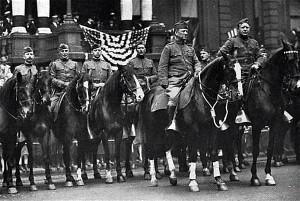 
The 28th Division returned to America in
May, 1919, and paraded through Philadelphia on May 15.

The 15th Engineers parade down Fifth
Avenue upon their return home to Pittsburgh in May 1919.
ADDENDUM D
PRISONER OF WAR EXPERIENCE

Captain William C.
Truxal
Company C, 110th Infantry
Captain William C. Truxal, of
Somerset, was the commander of Company C, 110th Infantry Regiment, of the
Pennsylvania National Guard 28th Division, at the Second Battle of the Marne.
It was the first day of the German Offensive and Captain Truxal's Company
was in the front line as the waves of enemy storm troopers
attacked. The following is his story:
We had been fighting with our backs to
the Marne for approximately four hours. We knew that we were surrounded and
that only good luck would get us out of our predicament.
There were about ten Americans left
and approximately fifty Frenchmen. Our formation was somewhat in a V shape,
Americans back to back with the French. The French were protecting our rear,
facing the village of Courthiezy. We were facing the opposite direction.
We were standing behind trees and stumps and using whatever cover was
available along the road leading from Dormans through Chateau-Thierry to
Paris.
THE FRENCH SURRENDER
Suddenly the German machine guns and
automatic rifles ceased firing. I was standing behind a tree. When the
firing ceased I turned quickly to the left and saw a German officer tapping
the sergeant on the shoulder just as he was in the act of firing at some
Germans and heard him say, "Finish." I turned a little further and saw within
five paces the head of a German column marching on the road in close order
with rifles slung across their backs. The French had surrendered without
notice to me.
I turned a little further and saw
proceeding up the hill a thousand yards to my rear and to the right, the
German artillery. The column proceeded along the road, separating the
remaining Americans standing on both sides of the road. I had my automatic
pistol in hand, turned and walked through the advancing column without
having a word spoken to me.
I went down over the side of the road
into the culvert to French Headquarters and there it was that the French
officer had surrendered in writing to a German officer. They both walked
out leaving me behind in the culvert under the road.
I took my pistol, unloaded it, broke
it and threw it in the mud and water underneath a plank. I took my orders
and tore them up, throwing the fragments also under the plank. My compass,
map, money, a large penknife with a saw on it, and a few other small
trinkets I hid in my leggings and trouser legs. I had scarcely finished
this when a German appeared at the mouth of the culvert and ordered me
out.
I walked out on top of the road, and
under a guard together with the other prisoners was made to cross the Marne
River. Our artillery was pounding away heavily. The Allied airplanes were
busy ground strafing and attempting to hinder the advance of the Germans.
It was impossible for them to distinguish prisoners from the enemy, and
we were therefore subjected to our own fire.
FRIGHTFUL EXECUTION
They led us back about three
kilometers, marching along side their advancing troops, to their heavy
artillery. We remained there approximately an hour when we were again
taken out and led by the side of their advancing transport back toward the
Marne to the village of Treloup, which was then being shelled by our
artillery and bombed by our airplanes. They kept us there probably an hour
and then, with a large number of French prisoners, we were moved back again
to the heavy artillery, marching as before, along side their advancing
transport.
During this time I was able to see
the frightful execution of our automatic rifles and machine guns on the
riverfront, as well as the execution of our artillery and aviators during
the German advance. Luck seems to have been with the Allied prisoners
during this forenoon, as, while the enemy fell by the dozen all around and
close by our side, none of the captives were killed.
When I crossed the Marne I saw in
echelon, beginning within fifteen yards of the riverbank, machine gun after
machine gun, trench mortar battery after trench mortar battery wheel to
wheel, graduated back to the light artillery, and then to the heavy
artillery. The entire ground on the north side of the Marne was completely
covered with German light and heavy artillery.
I saw piled up on the riverbank
hundreds of Germans killed by our automatic rifles from the other side
of the river. I saw the bodies of Germans floating in the Marne, and as
I went back through our barrage three times I saw hundreds upon hundreds
of Germans killed, and as many wagons and horses of their transport blown
up by artillery and bombs.
NOT A SCRATCH
I well remember a German officer
riding within fifty yards of our column. He wore large tortoise shell
glasses and sat a horse only as a trained German officer knows how. A
shell struck directly underneath horse and rider, and the picture came to
my mind of a boy making mud balls and throwing them into the air. As the
mud ball gains in momentum a piece flies off here and there until there is
practically nothing left of the ball. That is what happened to the German
officer and horse.
Again, a company or two of Germans
were hiding in a small French graveyard near Courcells. The graveyard was
surrounded by a stone wall. One of our aviators saw them, gave their target
to a battery of 75s, and they dropped sixty to seventy-five shells in the
graveyard in as many seconds. Boche heads, arms and legs and tombstones
came out together. A number of us laughed at this, which almost proved our
undoing, as the Germans marching by our side began to mutter and curse and
act in a very threatening manner.
Again, we were marching along side
the transport going toward Treloup, when a German driving two horses with
a heavily loaded wagon, without warning, with a fiendish grin on his face,
pulled his team sharply to the right for no other purpose than to run us
down or see us jump. In order to save ourselves from being run over three
of us who were at the head of the column had to throw ourselves forward,
while the men behind us were compelled to throw themselves back on the
ground.
At this identical moment an Allied
aviator dived and dropped a bomb, which was unquestionable aimed at us,
thinking we were Germans. The bomb landed between the two horses, and as
I slid forward rolling over on my back, (it all happened in a split-second),
the horses had reared above me, completely disemboweled, and the German,
with part of his head blown off was falling between the horses. And not
an Allied prisoner of war was scratched!
I saw eight Germans at almost equal
intervals around a shell hole, just as if they had been placed there, each
one with his head at the edge of the hole as if taking a drink of water, and
all of them dead. We saw transport after transport blown to pieces lying
along the side of the road; hundreds of horses killed, and a frequent sight
was a German still astride his horse, both horse and man
killed.
I saw lying along the edge of the
road German after German who had been almost blown to pieces. Part of the
body still remained on the road. Evidently as their men were killed they
pulled them to the side of the road, and if the leg or part of the body
remained on the road afterwards, they did not take the time or trouble of
removing it, but drove their transport over the piece of human flesh
tramping and grinding it into the mud and ground. Such was their haste
to reach Paris.
THE GERMAN IN GERMANY
One question that has been asked
me probably more frequently than any other since my return to America has
been "How did they treat you?" In order that our treatment may be fully
understood it is necessary first of all that the German character or the
German at war be properly understood. And it must be remembered that in
my statements I refer only to the German at war, to the German in
Germany.
Probably eighty of the members of
my Company including myself are of German descent. During the five years
that I was connected with the Army my Company was always called the "Dutch
Company." But the German in Germany and the German-American are two
entirely different persons. In my opinion the German, and particularly the
German officer, is the biggest bluffer, the biggest faker, the biggest
braggart, the biggest liar and the most gullible man I have ever known.
He thinks that he can lie and that everybody believes him, and that no
person would ever think of lying to him; while the fact is that he is the
poorest liar it has every been my misfortune to meet.
Shortly after being taken prisoner
I saw a German officer reprimand a soldier. This officer was a Prussian
and reprimanded him for not having me, an officer, at the head of the line
instead of back where I was, marching with my men. For various reasons I
kept away from the French and stayed back with my own boys, many of whom
were wounded.
This German officer, over six feet
in height and weighing over two hundred pounds, thrust his face within six
inches of the face of the boy he was reprimanding, who was no more than
eighteen years of age, about five feet in height and weighing about one
hundred and thirty pounds, purple with rage, and he yelled at the top of
his voice, waving his hands frantically, spitting as he talked, and cursed
the boy from head to foot, calling him everything he could think
of.
I made up my mind, as did every
other American who heard this, that this German officer was a great big
bluffer, that he was all wind or he would not need to talk in such a manner
or act in such a way in reprimanding one of his men. Shortly afterwards
when he was within a few steps of me he yelled at me at the top of his
voice. I turned around, and though I did not know what he said to me and
he did not know what I said to him, I yelled back just as loud as he had
yelled. He came up and apologized saying that he did not know I was an
officer. However, a few minutes later he did the same thing to a boy from
the 109th Infantry from Philadelphia, and as this boy saw what I had done,
so he turned around and yelled back at him just as loud as he had yelled.
He apologized to the boy.
As our column moved back through
the German lines and passed the artillery, the Germans called us names
such as "Schweinhund." We laughed at them because at the same time, again
and again, they exhibited their true feelings by yelling "You thought you
were better than us, now here you are a prisoner, 'uh-huh.'" Every time
a German yelled this you would hear an American doughboy somewhere in the
line answer back "ja." The mere fact that this was on their minds was
sufficient evidence to every American prisoner that we actually were better
than they and that they admitted it.
We were beginning to understand the
German better and better. Again, a German boy came up and attempted to
take a raincoat I was wearing. I yelled at him to go away, I was an officer.
He clicked his heels together and saluted and went on. Later I gave this
raincoat to one of my boys who had been wounded. Two Germans came after
the coat. I had a short struggle with them to save the boy, but they
started in with their bayonets and got the coat.
A CAN OF SOUP
The next question that has been
asked me again and again is "What did they give you to eat?" I am fully
convinced that all of the American prisoners of war owe their lives to
the American Red Cross. True, the Germans gave us something to eat, but
they did not give us enough to sustain life should any of us become
ill.
I was taken prisoner on July 15th.
On that day I received nothing to ear, but on the 16th we were told that
we could get some rations. We did not have a knife, fork, spoon, mess-pan
or tin cup. (One of the things that had stuck us all as rather strange was
the fact that when the French were taken prisoner they came over with two
or three days rations, plenty of tobacco and cigarettes and a complete mess
outfit and toilet articles. In other words, they were prepared. The
Americans, when they were taken prisoner, came in dirty, bloody, without
blouses and sleeves rolled up and with the appearance of having put up a
hard fight. The French were immaculate, or at least, as clean as they were
before they were taken prisoner.)
We went out to the garbage pile and
there hunted out the best looking tin can we could find, scrubbed and washed
and scoured it with mud and water, and were ready for mess. About five of
six o'clock we went up to the barnyard and there received our first German
meal, consisting of one can of soup made with dried cherries and water
boiled together, no fat, and a piece of bread. The morning of the 17th
we got nothing to eat, and were lined up along with a lot of French officers
and moved out about eight o'clock back toward Fismes.
All day long we marched, stopping
now and then for rest and once for a drink of water. About five o'clock
in the evening we arrived at Fismes, and there, after a rest of an hour,
received our first big meal, at German hands, consisting of a tin can of
barley soup, (barley and water boiled together without fat), a can of
imitation coffee, a piece of bread and a small piece of Limburger cheese
about one inch and a half square. We did not bother skinning the cheese.
We ate it rind and all.
We then left and started again on
the road. It got dark, and I do not remember where we marched to that
night. About twelve o'clock midnight I turned to one of the officers and
said, "I don't believe I can make it any further, I am all in." He replied,
"Stick to it. I believe we have only about a hundred yards more." We
started to move again. I became feint and dropped to my knees. They helped
me up, and it started to rain.
The heavens seemed to open, it came
down in torrents. We struggled on about a hundred yards into a corral, a
low-lying field. There was about an inch of water covering the field. We
were exhausted. We took our steel helmets, put them on the ground as pillows
and lay down in the water, wrapped our arms and legs around each other and
slept. We rested this way for probably two hours and then got up and walked
to keep warm. It was still raining torrents. About nine o'clock in the
morning it stopped raining. We took off our blouses and wrung the water
out of them, put them back on, started a small fire and tried to get
warm.
Shortly afterwards we were driven
over into a barn. Here we found an imitation cot and some excelsior.
Using the excelsior for cover we lay down and slept that day until our
clothing dried on us, and it didn’t hurt a single one. The next morning
we got up and got another can of soup. This time the soup had some
nourishment in it. I think it was made of corn meal and water, there may
have been a little fat in it, I do not know.
We started again and marched all
that day, arriving at Laon in the late afternoon. We were exhausted and
if my recollection serves me right we did not have a drink of water all
that day until arriving at the outskirts of Laon.
THE FRENCH CHAPLAIN
An incident occurred on our trip to
Laon, which will be long remembered by all the American prisoners of war.
When we moved out in the early morning I noticed an old French priest with
the French officers. He was a big, fine looking man with a long grey beard.
He wore a heavy black robe reaching to the ground. He was between
seventy-five and eighty years of age, and I wondered at the time whether
this feeble old man would be able to march far or whether the Germans intended
to haul him part of the way.
He carried a large staff to aid him
on the march, and smiling he trudged along speaking words of encouragement
to the men. The heat was terrific. As we moved along mile after mile I
noticed a haggard expression gradually creeping over his face, yet without
a complaint and smiling pleasantly when anyone spoke to him, he marched on.
How long would he be able to stand it? How long would these German guards
insist on making this old man march, was the question uppermost in the minds
of the Americans.
We learned to love him for his pluck,
endurance and cheerfulness, and yet we knew that it was only a matter of a
few more steps before he would be entirely exhausted. A number of times we
talked among ourselves, having in view making a request of the German guard
to get some sort of transportation for him. Finally when within sight of
the city of Laon, probably five miles distant, the old man sat down and said
he could go no further. I have never seen such an expression of suffering
and agony on the face of any human before. He had stuck to the march until
almost the end before making any complaint.
I discovered a Frenchman who could
speak German, and called his attention to the condition of the old man and
suggested that he talk to the German in command of the prisoners. He said
it would be no use, but I insisted, and the two of us went to the German
and told him that this old man could go no further, and that it was not right
to treat a non-combatant, a Chaplain, the same way that combatants were
treated. At first the German was angry, talked loud and waved his hands as
all Germans do.
As we were talking two Germans came
by driving two horses in a sort of buckboard. As they came by I held up my
hand and the German driving the horses stopped. I then called the attention
of the German guard to this team and without saying a word he walked across
the road and beckoned the old man to follow him. He brought him over and
we helped him into the buckboard.
Later that evening the old man was
awaiting our arrival in the city of Laon. We came marching slowly into the
town and were met by this old priest smiling pleasantly to everyone as he
had done during the march. After hunting the German guard and myself out
he thanked us profusely for the interest we had taken in him. This incident
and many others of a similar character that I experienced taught me that
the German was practically devoid of all the finer sensibilities and seemed
to be blind to the sufferings of others.
KANN ICH NICHT SOME BEER HABEN?
We received nothing further to eat
that day, but the next day we were introduced to a new dish, and near
starvation as we were, it was too much for the majority of the men. It was
a soup made of large cow beets chopped in chunks, some as large as a fist,
boiled with water and no fat. It was a purplish-greenish slime, with a
bitter flavor. Some of us succeeded in eating some of it by dipping the
black German bread into it, but the majority of men were nauseated from the
odor alone.
It was at Laon that I came to the
conclusion that the treatment of the prisoners depended largely upon the
particular German with whom we came in contact. It was there that I saw
two "English Tommies," half starved from lack of food and feint with fatigue,
eyes protruding, faces haggard, ask a German sergeant permission to "lick
out" a bucket from which they had been serving German marmalade. The German
said "Ja," but as they hastily stepped forward to grab the bucket the German
kicked it, and as the boys stooped over reaching for it the German kicked them
both, throwing them head first on the cobble stones; and that German and a few
others laughed heartily at the joke.
However, at that same camp they were
serving beer to the German soldiers. I went to one of the American officers
and said, "I am going to try to get some of that beer," being sure that there
would be more nourishment in the beer they were serving to their own soldiers
than all the food they had served to the prisoners. The American officer
said, "Don't do it, you will only get yourself into trouble, and probably
the rest of us. You will probably only get cursed out." I said, "I don't
believe it, I am going to take a chance."
I got my tin can and walked down into
the courtyard. A couple hundred Germans were there and they were gathering
pretty thick around the place where the beer was being issued. I looked over
the crowd carefully and finally picked out a boy about eighteen years of age,
with red cheeks. I looked at him a minute, then winked and nodded my head
backward as if I wanted to talk to him. He looked at me and then turning
around to see if anyone was watching him, he stepped out cautiously to my
side.
I could not speak German, but I said,
"Kann ich nicht some Beer haben?" He looked at me about a minute and again
very cautiously turned around as if he was afraid some person had heard or
seen, and said, "Jawohl," jerked his head beckoning me to follow him, and we
went pitter patter up three flights of stairs. When we got to the third
floor, he motioned me to stand still, went into a room and came out with a
bucket of beer. He filled my can.
He then said something to me which I
understood to mean "your can is not large enough." It was "nicht zu fuhl"
or something like that. I immediately ran to my room and said to the
fellows, "For Heavens sake, give me another can, the biggest one you have
got." One of the fellows threw one at me, not knowing what I meant or was
about, but in those days questions were not asked, and it was nothing
startling to see any particular fellow acting rather strangely. I ran
back to the German and he filled this can. I offered to pay him for it
and he looked up at me and said, "Nein, nein, kamerad."
FROM LAON TO KARLSRHUE
We remained at Laon, I believe, about
three days. Every night we were there the Allied airplanes came over. We
were on the third floor next to the roof of what I suppose had been a large
warehouse. As soon as our airplanes were sighted, we were locked and barred
in while "Jerry" ran for his dugout. The station was about five hundred
yards away. This was the target, and I assure you that every Allied prisoner
fervently prayed that our airplanes might not miss the station.
At Laon we were loaded in boxcars.
Prisoners had been brought in from the different fronts, and fifty-two of
us were packed in one of the small French boxcars marked "36 Hommes" or "8
Chevaux." There was rather a heterogenous crowd in our car; thirty-nine
Italian officers, thirteen Americans and a couple German guards. From time
to time wounded German soldiers would crawl into our car for the purpose of
talking with the Americans. We were in this car for four days and nights.
It was too crowded for us all to lie down at the same time. It rained
every day and the boxcar roof leaked. I believe it was three times in
this journey that the train stopped and we were permitted to buy a bowl of
some kind of soup and a piece of bread. We paid for it in French
money.
We arrived at Rastatt in the morning
about seven o'clock and were taken over to what was a German barracks.
Most of the buildings were round, with exceedingly thick walls, covered
with earth. The windows were barred as a jail, and the entire barracks
surrounded by a high wall excepting where the outside of the buildings ran
even with the street. We remained there about five days and met a large
number of French officers and some American officers who had been assigned
to the British and had been taken prisoners some months before.
It was there that we first learned
that we could get in communication with the people at home through the
International Red Cross, and that in the course of time the Red Cross
would send us parcels of food. From Rastatt we were taken to Karlsrhue,
and there placed in what had formerly been a hotel. Anywhere from one
to six of us were placed in a room. They refused to allow any windows
to be opened either at the top or the bottom; thus we could not secure
any fresh air. However, a large padlock on one of the windows had been
pushed up, but had not locked. As soon as we were left alone we unlocked
the padlock and opened the window. Whenever we would hear the guard
rattling with his key at the door we would quickly close the window and
put on the lock and close it. Thus we were able to secure a little
fresh air. All of us were dirty and lousy. We had no way to bathe or
wash our clothes, so we spent the time "cootie hunting."
THE GERMAN SECRET SERVICE
Much has been said about the German
Intelligence Department, and we had been led to believe that the Germans
had the finest and most complete intelligence department in the world. I
believe that every officer dreaded the time when he would be brought before
the department to be quizzed. It was about the first of August, and up to
that time we had not had a single question asked us except by the German
people along our line-of-march.
One day we were sitting in our room
and a guard came in and asked for me. I went out with him, down to the
office on the first floor of the building and there was met at the door
by a tall German officer immaculately dressed. He bowed almost to the
floor and spoke in perfect English, "Captain, I am glad to meet you. I
am sorry to meet you under such circumstances and conditions, but it is
the war. The war is awfully, awfully bad, do you not think
so?"
I replied, "It is bad enough for me
at the present time, I can assure you."
"Ah, that is true, but you must
remember we cannot give you what we do not have."
The thought flashed in my mind for
the first time that I was at last before the German Secret Service. He
walked over to the table, and again bowing, he held a chair out for me as
a waiter at a hotel would do, and said, "Captain, won't you please have a
chair and make yourself as comfortable as possible? There are a few
questions that I want to ask you and you can be perfectly free to tell me
anything and everything about the war and how you were taken prisoner, and
you can rest assured that I will never tell a single soul what you say.
Everything that you say will be put away in what you call in your language,
the archives, and nobody will ever see them again, so you must have no
hesitancy and just tell me everything that I ask you."
I glanced at him just a moment to
see whether or not he was joking. I saw that he was very sincere, and so
looking as sincere as possible myself, I said, "Certainly, I believe I
can trust you. Go ahead and ask me everything you care to ask and I will
tell you all I know."
INTERROGATION WAS A JOKE
He sat down at the other side of
the table, and said, "You are Captain …, in command of Company C, 110th
Infantry?"
"Yes."
"You arrived at Calais, France, on
the 17th of May, 1918?"
This question almost floored me. He
was exactly right, but inasmuch as he had made a statement I did not answer
the question, but waited a moment when he looked up and said, "Is that not
so?"
"No sir."
"Well, when did you
land?"
"I do not remember the date of the
month, but it was some time before this."
"Well, where did you
land?"
I said, "Boulogne," and was
frightened because I was not sure that any ships landed
there.
"Did you not come over with your
own Division and Company?"
"No sir."
"Who did you come over
with?"
"Oh, a lot of troops not assigned
to any Division."
"Oh, I see," he replied, and
carefully wrote it down.
I was beginning to feel much easier
and was ready for any question that he might ask. He then said, "Did you
not know these men before?"
"No, I never saw them
before."
"Where did you join
them?"
"In the front
line."
"Where was the rest of your
Battalion?"
"I don't know. I never saw
them."
"How many ships were in your
convoy?"
I said, "Sixty." (There were
sixteen.)
"How were you
guarded?"
"Do you think that the United
States would send over such a large convoy without guarding them to
the utmost?"
"Certainly not."
"Well, we were guarded by the
entire American Battle Fleet."
As a matter of fact we had one
Battle cruiser part of the way across, part of the journey without any
protection whatever, and were met out of the Irish Sea by a number of
British submarine chasers.
"Did you see any
submarines?"
"No, I don't believe you have
any. I think it is all a bluff."
"What kind of machine guns did
you use?"
"Any kind we could get hold
of."
"Do you mean to tell me that the
Americans can shoot any kind of a machine gun?"
"I mean to say, that give any
American any gun and he will know more about that gun and be able to
shoot and handle it in one hour better than any German would in a
month."
"Well, what kind of guns did
you actually use?"
I told him we had the Lewis,
Chauchot, the Vickers and some of the German automatic rifles and
machine guns.
"How did you get the ammunition
for all these different guns?"
I told him I didn't know, it
was brought up to us. He then moved a map over in front of him and
said, "How did you go from Boulogne?"
"We marched."
"Where did you stop the first
night?"
I looked on his map, picked out
a town and put my finger on the name. He looked again and said, "That
would be impossible, that is sixty or eighty miles."
"Oh, wait a minute," I said,
"I made a mistake."
And then using more care I hunted
out some town closer to Boulogne. He then traced my movements to some
town where I told him I left the men. From there I told him I was sent
by train to a station, the name of which I did not remember, and finally
sent up to the line without knowing anything else. He asked me how many
Machine Gun Battalions were in our Division.
I replied, "Oh, I don't
know."
"I will show
you."
He reached down on the desk and
pulled out a large pasteboard card, about fourteen inches wide by
twenty-four to thirty inches long. It was dirty, showing that it had
been printed a long time before and had been in use. On the pasteboard
card was printed the complete organization of the American Army showing
the Divisions, the number of Infantry, Artillery, Engineer and other
units composing the same, with the number of men. When he showed me
this, I said, "Why bother asking me questions? You know more about
these things than I do."
"Where is your artillery?" he
asked.
"Oh there you go again. You
know very well where our artillery is."
"I mean your American
artillery."
"Do you mean to tell me that you
don't know where it is?"
He laughed and said, "Yes, your
artillery units have not come across. The French artillery is backing
you."
"That is right."
WE DON’T HATE YOU
A few days later a lieutenant of
the 10th Field Artillery, who had been taken prisoner on July 15th, was
brought before him. I have often wondered what he thought of my story
after meeting this artillery officer. After rather a long conversation
he finally asked me the question, the one that's been asked hundreds of
times. I felt I knew this German thoroughly, and had no reason to fear
anything at his hands. So when he finally asked the question, "Why are
you at war with Germany?" I turned to him and said, "What would be the
sense of my attempting to tell you the reason we are at war against
Germany?”
“You people cannot understand any
nation having ideals,” I continued. “You are all materialists and the
only way you can reckon anything is by measuring it in dollars and cents.
You shrug your shoulders at the sinking of the Lusitania, and the rape
of Belgium was a military necessity, but did you ever stop to think that
the balance of the world might possibly be right and that the single
nation of Germany might be wrong? No. Your minds do not work along those
lines, so that it would be useless for me to attempt to say anything or
give you any reason, but since you asked the question, I will tell you
the real reason. We are at war with Germany to defeat
Germany."
He jumped up from his chair and
turning to me said, "Do you think that a nation that has for years
withstood practically the entire world, a nation which has given all of
its manpower, a nation which has practically starved itself, could be
defeated? No. You will win the decision, but you will never defeat us.
Of course, you know the last German drive was a failure, thanks to you
Americans."
It was the first information of
any kind whatever that I had gotten of the result of their attack on July
15th. We had heard rumors that all was not going well at the front for
Germany, but that German evidently saw the pleased expression upon my
face, and foolishly, instead of waiting, I asked, "How far did you
get?"
He replied, "We don't tell
prisoners that." Later on he said, "Why do you hate us so?"
"We don't hate you. We pity
you."
Then after a conversation which
lasted five or ten minutes in which I had told him that unless he were
the exception, he would be the first German officer whom I had met who
had the slightest conception of the meaning of the work "gentleman." Then
proving the assertion made in the first part of this story, that the German
is the most gullible man I have ever known, he turned to me and
said:
"Captain, I am going to tell you
something. I do not want you to tell what I say to you. Of course, it
would not matter so much if you did, because if you did, I would say that
you were a liar, and they would believe me. But, Captain, I am going to
tell you that you are the first American officer who has come before me
who had been willing to tell me the truth from beginning to
end."
That is my experience with the
famous German Intelligence or Secret Service.
THE SPIRIT OF THE FRENCH
From Karlsrhue the officers were
taken by train to the prison camp at Villengine, Baden, and on this trip
had an experience which will never be forgotten by them, and, I believe,
shows the true feeling and spirit of the French officers who had been in
the war in the early years. At Offenburg we changed cars and were taken
to a small camp and given permission to buy some soup, and there we
received our first meat, a piece of bologna.
A trainload of French officers, all
of whom had been prisoners for four years and were about to be interned
in Switzerland, met us. Some of them had chocolate and different kinds
of food, which had been furnished by the French Red Cross. They simply
turned their pockets and bags inside out and gave to us, who had just been
taken prisoner, the food which they knew we would need so badly. The
thoughtfulness and the kindness shown to the Americans by these French
officers was one of the bright spots in my experience in
Germany.
PRISON LIFE
On arriving at Villengine, we
found a camp consisting of a number of low buildings, of barracks, an
office, a kitchen, and a sort of assembly room. The entire camp was
surrounded by a pair of high, barbed wire fences. A ditch ran between
the two fences and barbed wire was stretched along the ditch. On the
outside, at intervals of about twenty-five yards was a sentinel box and
sentinels day and night walked up and down outside the wires, while at
the same time three inner guards patrolled the area within the
enclosure.
About twenty-two American
officers and a hundred of more Russian officers with fifty to seventy-five
non-commissioned Russian officers were in this camp, and it was there that
we received our first food of any consequence. We had been about three
weeks with practically nothing to eat. The American officers had been
in touch with the Red Cross for some time and had saved a quantity of
food for incoming American prisoners.
Our treatment there was probably
as good as we could expect. We were allowed to take a bath once a week.
The Russians had a piano in a small room, which they called the Music
Room. Finally we received some athletic equipment, and a few books from
the Y.M.C.A. We received a baseball and volleyball with a net, and these
things furnished us with a great deal of amusement.
The day's routine began about eight
o'clock in the morning. Approximately twenty men were assigned to a
barrack. Each barrack had a small kitchen stove in which we burned wood
brought from the Germans. The twenty men in the room would divide up
into families of four or five and run four or five messes. Taking the
canned food furnished us by the Red Cross we would make all kinds of
mixtures.
Breakfast was some time prior to
nine o'clock. At nine o'clock we had a roll call, and from then on
nothing until about six o'clock and then another roll call. By signing
a parole card we got permission to take walks, under guard, through the
Black Mountains (Swartzwald.) Twelve o'clock noon the Germans served
lunch consisting of a thin soup and some kind of vegetable mixture that
was hard to eat, and at six o'clock they served supper, which few of us
ever attended because we could not eat the stuff.
An incident that might prove of
interest and throw some light on the German character occurred in camp.
One of the American officers had cut a picture of the sinking of the
Lusitania out of some German propaganda. He made a frame for the picture
and had it hanging on the back of his wardrobe. A search was made by the
Germans for maps, compasses, etc., and this picture was noticed. It was
broken by the officer conducting the search. Complaint of this was made
to the Lt. Colonel, Commandant of the Camp. The commandant said, "That
is not right. I will make him apologize," and he did.

Captain William C.
Truxal and Captain Edward R. Taylor
in the German POW Camp at Villengine. Both officers
were members of the 110th Infantry Regiment.
PLANS FOR ESCAPE
All the time the men were in camp
they were constantly planning a way to escape. Finally the plans were
completed about the middle of October, and thirteen of the men decided
to make a try.
The windows of the barracks were
covered with heavy iron netting. Wire cutters had been smuggled into
camp. In three of the barracks different groups were going to make their
getaway by means of cutting the wires and then thrusting out of the window
a sort of ladder made from bed slats and pieces of board cut from the Red
Cross boxes. Small strips were nailed across the board making a sort of
chicken run. These ladders or runs were long enough to reach from the
barracks across both fences where they would then jump down to the ground
and run.
Electric lights were in the barracks
and surrounded the outside and inside of the camp. Those on the outside of
the camp and outside of the buildings were kept burning all night. The
next part of the plan was to put out, by short circuiting, all the lights
in and about the camp and then at a given signal all were to make their
escape at once.
PUT OUT THE LIGHTS
About ten o'clock the lights in the
barracks were turned out. Five minutes were then to elapse and those
selected to put out the lights were to act. As soon as the lights were
out their escape was to be made. I was one of those selected to put out
the lights. This necessitated a long iron chain to be made.
Someone had gathered together a lot
of wire. From this wire they made chains with links about twelve inches
long. I took a pair of socks, filled each of them with stones, and tied
them carefully with strings and bound one sock on each end of the chain.
The reason for this was, first, it would give me something to throw and
second, the weight at the other end of the wire would act as a protection,
for I thought I might in the excitement throw too far, and thus miss the
wire.
All was ready at ten o'clock.
Before that time I had taken my chain and hid it in a dark corner where
I was going to do my work. The two wires ran around the outside of the
fence about twenty feet from the ground. Over these two wires I wanted
to throw my chain, so that it would come in contact with both wires. As
the lights went out I put on my hat and walked up to the place I had the
chain hidden.
A German guard was standing within
five steps. He did not suspect anything so I walked right past him, and
picked up the one sock filled with stones, took a step back and threw it.
As the chain came in contact with the wire it did not short circuit at
first and, as the wire swung out and touched the chain, fire flew in all
directions.
The Germans yelled "Achtung!
Achtung!"
The third time the chain swung the
lights over the camp were extinguished. By the time it took me to run back
to my barrack, probably fifty steps away, we heard shots fired, and the men
were on their way. From all directions we heard the Germans yell and shots
fired, and we all simply waited and hoped.
THREE MAKE IT TO SAFETY
Three of the men, and probably the
more spectacular escape, were at the other side of the camp. They had
calculated that when the other men made their escape along the one side of
the camp, the inside guard would be called out. They would then run down
along the side of the camp with the guard and out of the
prison.
These three boys dressed themselves
like German soldiers. They made wooden guns or something that in the
darkness would look like guns. One of the boys could talk German. It
worked out according to plan, only the German guard was so slow in getting
out that only one of them succeeded. He cut his way through the fence
and started down, hoping to meet the guard and run out of the barracks with
him.
Unfortunately the first man got
there before the guard. Undaunted, he ran on to the gate, with the key
to the lock in his hand. He ordered in German in a loud voice, "Open the
gate," and the German guard unconsciously pulled the gate open and let
him out. He was so far in advance of the other two men that it was
impossible for them to proceed further and they had to come back without
escaping.
Five out of the thirteen got out
of the camp, with three escaping to safety in Switzerland and two
re-captured, brought back to camp, and placed in confinement in a cell.
After they served their time they were ordered to some dungeon in Berlin.
The guard took them away about the first week in November. They got as
far as Cassel, where the guard was disarmed by some of the German
revolutionists and the men turned loose. They had no money, no food
and did not know how to get out of Germany, so they got on a train and
came back to prison camp.
THE WAR DRAWS TO A CLOSE
As the German situation
deteriorated at the front line, censorship of the German Press was
gradually lifted and from then on we began to receive, I believe, more
information than the people on the other side. We purchased maps from
the Germans and traced the progress of the troops. At night when the
lights were turned out we would lie on our bunks and sing to the German
guards, "Ach due Lieber Hindenburg, Alles gebut."
After the armistice was signed
we were given permission to go as we pleased through the city of
Villengine, and there met the German people. Their one dread seemed
to be that we hated them and did not respect them.
As a whole they looked up to the
Americans and envied them. One German officer stated to me that "We are
glad we lost the war because we lost the Kaiser. Had we won the war
things would be worse than they ever were before, and now we can have
peace and our own Government." He laughed very heartily and said, "If
we won the war we would have to be in the Army of Occupation and would
not get back home for a long time. Now you have to go in the Army of
Occupation and you won't get back home for a long while."
HAPPY RETURNS
On the day before Thanksgiving we
were taken out of the prison camp. It was about four o'clock in the
morning. Snow was on the ground and it was cold. We were lined up ready
to move when the German Commandant came out and made the following
address. We listened patiently. At its conclusion there was a moment
of silence as if he was awaiting a reply. The only reply was a sharp
command "Squads right," and we left the camp. The address was as
follows:
"Sooner than you expected, your day
of liberation has arrived. In a short time you will be back again with
your own dear folks in American and England. Tell them that the German
people have no more grievances against them. It does not consider itself
as conquered, but as conquering as you can see by the troops coming back
from the front; because it has won its own liberty.”
"Now it is your turn to give the
German people a just place in the peace terms which will give them the
liberty to live quietly and peacefully with the world at large, and which
will leave no hate to again disturb the peace of the world. We all hope
that you may reach your home safely and find everyone in good
health."
“I again request you not to part
from Germany with hatred against us, and to influence your people to look
upon Germany as it is now, not as it has been judged, perhaps justly, up
to the present time. The new Germany has a desire to live at perfect
peace with the recent thirty enemies, but in the same manner claims an
honorable peace, which will give her the possibility to live as promised
by President Wilson. Again, happy returns."
This, I believe, illustrates very
clearly the position held by the majority of the German
people.
We arrived in Konstanz about noon
and remained over Thanksgiving. Here we were taken through the city by
guides and shown all the places of interest, and the next day we rode
through the mountains of Switzerland to France.
All of our soldiers who were in
the trenches and fought in the battles with the Germans had terrible
experiences and know that the late war was the most frightful ever waged.
Those taken prisoners did not expect mild treatment at the hands of the
enemy. Their fears were realized but they were determined to endure
their privations and hardships patiently and heroically. Their
sympathies were with their comrades who were bravely waging the bloody
warfare in the front lines.
ADDENDUM E
Sgt. Raymond P. Cronin - United States Marine Corps
American Expeditionary Force (1917-1918)

"Brookline's Most Decorated Soldier"
Raymond Paul Cronin was born on
September 6, 1893, the son of John W. and Edna A. Cronin of 1503 Berkshire
Avenue. The Cronin family was part of the initial wave of new homeowners in
the up-and-coming community of Brookline. They were also some of the original
members of Resurrection Parish. In March 1917, Raymond had recently returned
home after a four-year enlistment as a United States Marine and was an
employee of the Postal Service.
On April 6, 1917, the United States
of America declared war on the Empire of Germany and entered into the
global conflict that had been raging abroad for the past three years. Two
days later, while many of Brookline’s young men were joining the call to
arms, twenty-three year old Raymond re-enlisted in the United States Marine
Corps. On April 28th he was assigned to the USS New Hampshire, based in
Norfolk, Virginia, and promoted to Corporal.
The Secretary of War made a formal
request to President Woodrow Wilson that a regiment of Marines be included
in the first contingent of troops sent to France. On May 27, the
President directed the Secretary of the Navy "to issue the necessary orders
detaching for service with the Army a force of Marines to be known as the
Fifth Regiment of Marines."

This unit was rapidly organized in
Quantico, Virginia with Marines stationed in the U.S., Cuba, Santo Domingo,
Haiti, and from various shipboard detachments. Added to this contingent of
veteran soldiers was a liberal amount of raw recruits necessary to bring the
regiment up to strength. Among the veteran Marines was Cpl. Raymond Cronin,
who was assigned to the 49th Company, 1st Battalion, 5th Regiment
(1/5).
CROSSING THE POND
The 1st Battalion arrived in
Philadelphia on June 11 and boarded the USS DeKalb, a former German mail
ship once called Prinz Eitel Friedrich that was interned in 1915. The
DeKalb embarked for New York Harbor the following day. When the DeKalb
arrived outside New York, it anchored next to the Statue of
Liberty.
Two days later, a convoy of ships
set sail for St. Nazaire, France. During the two-week voyage, Cpl. Cronin
was kept busy with compulsory shipboard drills, guard mount, frequent
inspections, target practice, maintenance of clothing and equipment,
lookout duties and details as a gun crew member.

Marines boarding The USS DeKalb,
on June 12, 1917. The ship set sail that day from Philadelphia
harbor.
The trip across the Atlantic was
accomplished without loss of life from enemy causes, despite a pair of
encounters with German U-Boats. The 1st Battalion arrived at St. Nazaire
in western France on June 26. President Wilson directed that the 5th Marine
Regiment was to serve as part of an Army force, and the regiment was
assigned to the U.S. 1st Division.
Cpl. Cronin’s battalion disembarked
with little fanfare on the same day and marched five miles to the western
outskirts of the city, to a British campground known as Base Camp #1. This
was to be their home for the next couple of weeks. The Marines primarily
busied themselves with marches and close order drills, sometimes marching
back to the docks to spend time unloading ships.

U.S. Marines at Base
Camp #1 in early-July 1917.
TRAINING FOR WAR
On July 15, the regiment moved to
the vicinity of Gondrecourt in eastern France for its initial training as
a part of the U.S. 1st Division. On the 21st, units of the 6th Groupe de
Chasseurs Alpines, considered by the French to be among the finest units
in their Army, were assigned as instructors for the regiment.
Instruction centered around the
various phases of offensive and defensive trench warfare, including trench
construction, grenade throwing, bayonet fighting, gas mask drill, weapons
firing at land targets and airplanes, artillery and artillery-infantry
demonstrations.
During this time they were visited
by many military dignitaries, including General Pershing, Commanding
General of the American Expeditionary Force, the U.S. 1st Division
Commander, and General Philippe Petain, the Commander-in-Chief of all
French Forces.
In September 1917, the 5th Regiment
was reassigned to serve with the U.S. 2nd Division and moved south
twenty-two miles to Bourmont. A month later, the regiment became part of
the 4th Brigade of United States Marines, one of the two infantry brigades
in the 2nd Division. In December, regimental maneuvers were conducted after
the battalions had been trained in the relief of units in trenches and had
held joint maneuvers with French troops.
It was during the early days of 1918
that Cpl. Raymond Cronin distinguished himself as a fine soldier and a
competent leader. On February 12, he was promoted to Sergeant and assigned
as one of the Section Leaders in the 49th Company.
On March 8, the 2nd Division was
ordered to the front. They entered the frontline trenches in the Toulon
Sector. Initially the 5th Regiment occupied the trenches centered near
Les Esparges, in a quiet area twelve miles southeast of Verdun. In these
areas Marines put to use against a live enemy the lessons they had learned
in Bourmont against a simulated or an imaginary foe.
The procedure each regiment used
was to have one battalion enter the trenches, opposite the German lines,
remain for a specified time, then take relief from one of the two reserve
battalions. Reserve troops, meanwhile, kept busy improving and repairing
existing trenches and dugouts, digging new trenches, and stringing and
repairing barbed wire entanglements.
Although some units in the division
saw real action against the Germans, for Sgt. Raymond Cronin and the 49th
Company, things were much quieter. They saw no enemy contact while in the
trenches, and only sporadic shelling. In their area, the German trenches
were quite distant, so far that they were difficult to see, even with
field glasses.

U.S. Marines gathered in a French
town during training exercises in May 1918.
The 5th Regiment departed the Toulon
Sector in mid-May, and proceeded to the Gizors training area, thirty-eight
miles northwest of Paris. Here, the regiment engaged in ten days of open
warfare training under the most hospitable conditions. The terrain was
adequate, the surroundings beautiful, the weather enjoyable, liberty was
available, and their spirits were high. Things would change dramatically
very soon.
THE GERMAN SPRING OFFENSIVE
In March 1918, with nearly fifty
additional divisions freed by the Russian surrender on the Eastern Front,
the Imperial German Army launched a series of large-scale offensives
(The Spring Offensive of 1918) along the Western Front, hoping to
decisively defeat the Allies before the U.S. forces could be fully
deployed. It began with the Somme Offensive on March 21, then the Lys Offensive on April 9. Both offensives gained ground in
ways that threatened to break the back of the English defenses.
While the English struggled to meet
the demands of these two breakthroughs, the Germans launched the Aisne Offensive on May 27. This third offensive, launched
against the war-weary French between Soissons and Reims saw the Germans
quickly reach the north bank of the Marne River at Château-Thierry, only
forty miles northeast of Paris. The pivotal engagements that followed are
often referred to as the Second Battle of the Marne.
The enemy advance was held at
Château-Thierry and the Germans turned right towards Vaux and Belleau
Wood. The situation had become desperate. The French and English
commands were stretched to the breaking point. It was feared that if
the Germans captured Paris then the French troops would lay down their
arms and the entire western front could collapse.
Because of this, the sense of
urgency was keen among both the attacking Germans and the defending
French. It appeared that the climactic moment in the four year Great
War was at hand, and it might take a miracle to save the day. That
miracle would come in the form of the United States Marine Corps
Leatherneck.
MARINES CALLED TO ACTION
Suddenly, on May 30, the 2nd
Division, now assigned to the French XXI Corps, French Sixth Army,
received orders for movement eastward to stem the flow of onrushing
Germans. What was supposed to be a day of rest in observance of the
United States Decoration Day (Memorial Day) for the Americans quickly
became one of frenzied activity.
Artillery, horses and supplies were
jammed into railroad cars, then the Marines of Sgt. Cronin’s 49th Company
ate a healthy breakfast, their last hot meal for several days. At 06:00
they left the Gizors area in trucks loaded with 18 to 24 men each, destined
for the front lines. The ride was bumpy and uncomfortable.
A convoy of trucks carrying
soldiers to the front line.
As part of a sixteen mile long
convoy of trucks, the 49th Company rode for thirty hours to reach its
destination. Along the way the company passed through several quaint
villages where the locals waved enthusiastically and threw flowers into
the trucks.
Retreating Allied soldiers and
fleeing civilians choked the suburban Paris roads on which the convoy
passed. After reaching Meaux, twenty-five miles northeast of Paris, the
regiment continued on foot. Marching was made most difficult by the heavy
loads on the backs of the Marines, the long grades over the dusty roads,
the intolerably hot weather, and the sight of the physically tired and
visibly dejected French soldiers who were in general
retreat.
As the Marines came closer to the
battle front, the sounds of war became louder and louder. The steady
drum beat of the distant artillery was a constant reminder of what lie
ahead. Every so often they would hear a thunderous boom. There was also
a dirty haze visible on the horizon from the rising plumes of
smoke.
Another interesting sight was
occurring overhead in the form of the bright multi-colored planes of the
German Air Force, all adorned with the Black Cross on their fuselage.
Most were bi-planes and a few were tri-planes. Once commanded by the
late-Baron von Richtofen, the "Flying Circus" had almost free reign in
the skies over the battlefield due to the lack of Allied planes in this
sector of the front.
THE BATTLE OF BELLEAU WOOD
On June 1, Chateau-Thierry and
Vaux fell, and German troops moved into Belleau Wood. The U.S. 2nd Division,
with the 4th Brigade of U.S. Marines, was brought up along the Paris-Metz
highway. The 9th U.S. Army Infantry Regiment was placed between the highway
and the Marne, while the 6th Marine Regiment was deployed to their left.
The 5th Marine and 23rd U.S. Army Infantry regiments were placed in
reserve.
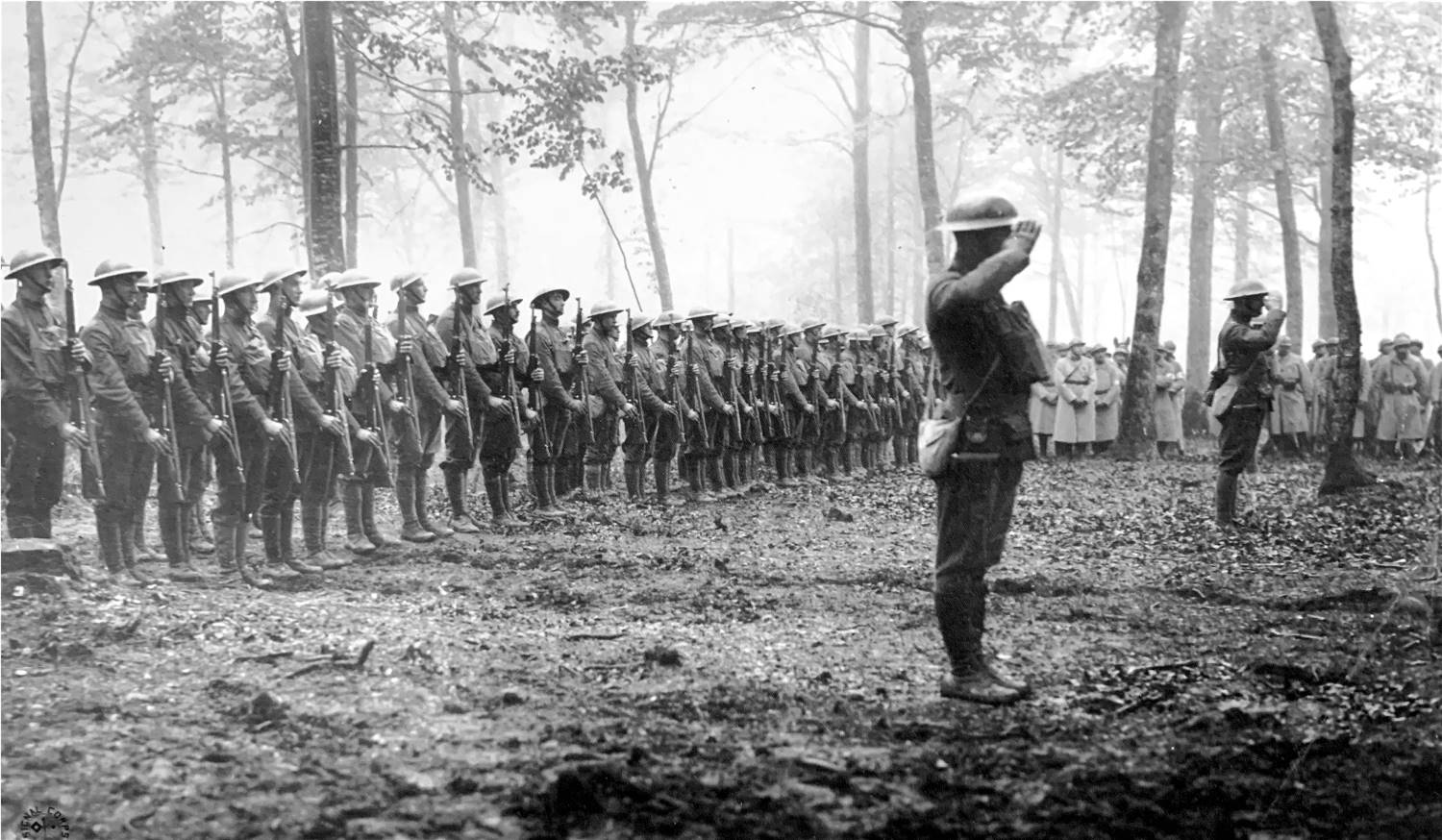
Sergeants saluting, U.S Marines stand
in review alongside French soldiers before moving to the front lines.
Before dawn on June 2, the 1st
Battalion was ordered to the front to assist the French in holding back
the enemy and covering the withdrawal of French units still engaged.
They began a six mile hike northwest through several eerily deserted
villages, ending at the small town of Bois de Veuilly. Finally, in the
early daylight they filled a gap in the French line and began taking
selected aimed shots at the enemy.
When the sun set that evening, the
American forces held a twelve mile front line north of the Paris-Metz
Highway, running through grain fields and scattered woods, from Triangle
Farm west to Lucy and then north to Hill 142. The German line opposite
them ran from Vaux to Bouresches to Belleau.
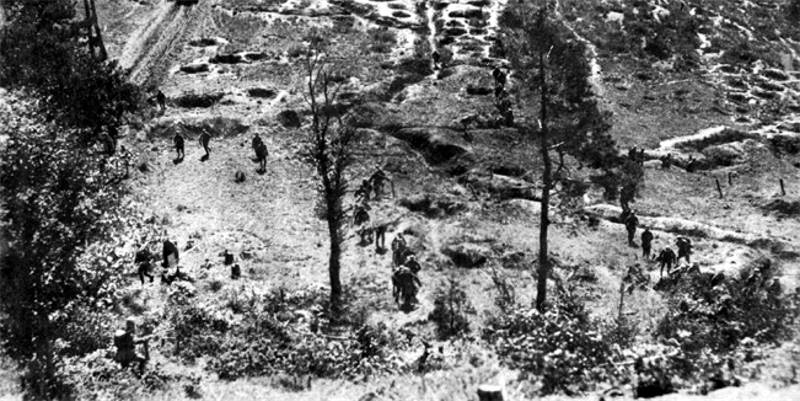
German stormtroopers filter into
the area around Belleau Wood in early-June 1918.
The Germans were unaware that the
Americans had entered the fight and were perplexed as to how their men
were being shot and killed up to 800 yards from the front. This was unlike
anything they had ever witnessed from the French snipers. By mid-afternoon,
the 49th Company and the rest of the 1st Battalion were called back into
reserve.
By the next morning, the last of the
withdrawing French elements had passed through the Marine lines. Fortunately
for the Allies, the German advance had been so swift that their support
artillery, food and ammunition trains were lagging far behind the front
line troops. They needed to regroup for the final thrust on Paris. Despite
these logistical difficulties, the veteran vanguard units were ordered to
continue probing forward against the weak and demoralized French
defenders.
GERMAN DRIVE HALTED
In the afternoon of June 3, expecting
token French resistance, the elite stormtroopers of the Prussian Guard
attacked through the grain fields with bayonets fixed. The Marine riflemen
waited until the Germans were within 100 yards before opening a deadly hail
of accurate fire which mowed down several waves of German infantry and
forced the survivors to retreat into the woods.
Having suffered heavy casualties,
shocked by the unexpected presence of the American forces, and in overall
need of reorganization, the Germans halted their drive on June 4 and dug
in along a defensive perimeter from that extended from Hill 204, just east
of Vaux, to Le Thiolet on the Paris-Metz Highway and northward through
Belleau Wood to Torcy.
On June 5, Sgt. Cronin and the 49th
Company found themselves in thick woods on an elevated ridge known as Hill
176. From this vantage point they could look down upon the enemy activity
along Hill 142. The dug-in Germans continued mounting brief probing
activities and pounded the Allied positions with long-range high explosive
artillery. Called "sea bags," the sound of these approaching nine-inch
shells tested the nerves of even the most hardened Marine.
With the rolling kitchens stationed
five miles to the rear, the men of the 49th Company had eaten little but
bread and hard-tack bacon for several days. The lack of food and incessant
artillery were causing extreme agitation. Sgt. Cronin and his fellow Marines
were itching for a fight, and that is exactly what they got.
BATTLE PLANS ARE DRAWN
The French Sixth Army command
ordered the XXI Corps to make two attacks on June 6. The first, in which
the 5th Regiment's 2nd Battalion took part, was intended to straighten the
corps front. The second was planned to reduce the German salient, which
now extended to Hill 142, Bois de Belleau (Belleau Wood), and the town of
Bouresches.

The 1st Battalion 5th Regiment was
assigned to clear Hill 142 of Germans and then join a coordinated thrust
towards the town of Torcy. The other regiments of the 2nd Division were to
advance through Belleau Wood and Bouresches. The die was cast, and soon
Sgt. Raymond P. Cronin of the 49th Company were about to enter into one of
the United States Marine Corps' most famous fights.
Facing the Marines in Belleau Wood
and the surrounding area were some of the best fighting units Germany had
to offer. These highly respected and proven warriors maintained professional
pride and instilled fear in anyone who opposed them. Defending Hill 142
were the German 273rd and 460th Regiments, with the 192nd and 193rd
Regiments in reserve.
The 1st Battalion attack was to
be launched at 03:45am on June 6, 1918. Captain George W. Hamilton,
commander of the 49th Company, woke his men early to ready them for battle.
Sgt. Cronin and the men were apprised of the plan and instructed to secure
their lighter twenty-pound combat packs, check their rifles, fix bayonets, add
an extra bandolier of ammunition, and get their minds straight.
To their front, the scattered wheat
of early summer was roughly thigh high, lush green and intermingled with
occasional clusters of blood-red poppies. Beyond the expanse of open
territory were elevated dense woods with many conifer trees that had been
well-maintained with selective cutting. There was very little distance
between each tree, and one could see only about fifteen to twenty feet
ahead.

The terrain around Belleau Wood was
open wheatfields and dense thickets of trees.
Around these woods were many thickets,
hollows and underbrush, as well as boulders and woodpiles that provided
perfect places to hide machine gun nests. This was the terrain that awaited
the men of the 49th Company as they moved against the German’s well-prepared
defensive positions.
ATTACK ON HILL 142
At shortly after 3 a.m. on June 6th,
Marines of the 49th and 67th Companies, both of the 1st Battalion, lay
hidden in position on either side of Hill 142 southwest of Belleau Wood.
According to the original plan, two additional companies, the 17th and 66th,
should have been in position to join the assault, but these units had not
yet been relieved by the French and were still deployed near Les Mares
Farm.
The assault was also to have been
supported by barrage fire from two companies of artillery and the 6th Machine
Gun Battalion. However, the majority of these units were also tied up elsewhere,
awaiting relief from the French. This meant that the two infantry companies
of the 1st Battalion were supported by just ten field guns of 15th Company
dug in behind them, between Champillon and Bois St. Martin.
At the designated time, there were
a few moments of light artillery fire in advance of the jump-off, which was
not very effective other than causing a commotion. When H-hour came, the
Marines were to have a French unit to their left in support, but they also
were not in position. At 03:50, without proper artillery or machine gun support,
and missing the French units to their left, the 49th Company began their
assault, as ordered, on Hill 142.
The plan was for the men to set off
in ranked straight line formation across the wheat field towards a ravine
and wooded tree line, as in military battles of old. The line formation in
waves was used in the Civil War and recently taught to a limited degree by
the French Chasseurs. The German defenders, used to facing weary French units,
did not expect a determined assault, especially by U.S. Marines eager for a
fight. It did not take long for this shock to wear off. The Germans soon
let loose a deadly hail of machine gun fire.
ADVANCING INTO A HAIL OF FIRE
Platoon leaders like Sgt. Raymond
Cronin, wearing their Sam Browne belts, were leading the way. This prominent
identification along with their forward movement was a special target for
German snipers, as well as the machine-gunners, therefore they were often
the first to fall as casualties. The advancing men hit the ground and hugged
the earth. The Germans aimed their gun barrels low. The men could feel their
backpacks being hit with bullets.
German machine gun nests brought a
hail of fire onto the advancing Marines.
German machine guns were everywhere.
They were positioned in trees, behind boulders and woodpiles, and in trenches.
Their deadly fire was tearing into the Marines. With men being shot and killed
all around him, 49th Company Commander, Captain Hamilton, rose and began running
through the field, encouraging each of his men to get up and make a dash for
the wooded objective.
The Marines had not equipped themselves
with mortars and grenades for this mission, and their best chance for survival
was in the woods. Their mad rush caught the German defenders by surprise.
When the Marines made contact with the enemy there appeared to be mass
confusion. However, in reality, this is what the Marines had been prepared
for.

U.S. Marines and German troops engage
in close combat during the Battle of Belleau Wood.
Undeterred by the deadly fire, the
Marines close-combat skills shocked even the battle-hardened Germans. A
few enemy leaped to their feet and ran. Those that did were usually fired
upon and killed. Some manned their machine guns until overcome by the
Marines. Others instantly surrendered, shouting “Kamarad!”
DEVIL DOGS
This was the type of rugged combat
where natural instincts and the survival of the fittest mentality took control
of the fight. It was every man for himself, kill or be killed. The Marines
continuous charge, audacity and fierce determination under such horrific
conditions, gave the Germans reason to call them “Teufel Hunden,”
translated to “Devil Dog.” One personal letter that was later retrieved from
the corpse of a German soldier, said, “These Americans are savages. They kill
everything that moves.”
Sgt. Cronin and the men of the 49th
Company performed admirably in the woods. Once the area was in control, it
was time to pursuing their next objective. They now had to venture out of
the trees and into the open again to close on the wooded Hill 142. Again
the Marines rushed through the open field. Three German machine gun companies
(the 9th, 10th, and 11th Companies of the 460th Regiment) and infantry
awaited the onrushing Americans.

U.S. Marines rout the German defenders
around Belleau Wood, earning the nickname "Devil Dogs."
As before, the German defenders were
overwhelmed and routed, but at a horrendous cost in life and limb. With the
main objective now in hand, the remaining men of the 49th Company, including
Sgt. Cronin, continued their advance to the outskirts of Torcy. Captain Hamilton,
still leading from the front, soon realized that adrenaline had taken them too
far. He ordered his Marines to fall back to the hill to regroup and establish
a defensive position in expectation of a German counterattack.
Still suffering from a deadly stream
of German defensive fire, Captain Hamilton organized the remaining men of the
two attacking Marine companies. Uncertain of where the supporting French
units were to his left, he sent out parties who attempted to establish
contact.
Two of these brave men that set out
under heavy fire to establish liaison with the nearby French units were Sgt.
Raymond P. Cronin and Sgt. Arthur F. Ware. Both of these soldiers, who had up
to now survived some of the most hellish wartime conditions, were shot dead
attempting to make contact with their allies. They were among the 333 killed,
wounded, and missing during the day’s battle for Hill 142.
The Germans launched five counterattacks
against the Marine positions on Hill 142. Each was repulsed. After each attack,
the Marines resumed digging in and awaiting further orders. Without word from
Sgt. Cronin or Sgt. Ware on the whereabouts of the French units, Captain
Hamilton spent that evening most concerned about his left flank. Luckily, the
Germans were also suffering symptoms of nervousness. They drew back into their
own hastily prepared defensive positions to await another mad rush from the
American Devil Dogs.
BLOODIEST BATTLE IN MARINE CORPS HISTORY
When the day of June 6, 1918 was over,
Hill 142 had been secured to a degree, and the Marines had established a firm
foothold in Belleau Wood. The casualty count (including all engagements around
Bois de Belleau), consisting of both wounded and killed was 31 officers and
1,056 men for a total of 1,087. This figure was more than the sum total of all
Marine casualties over their past 143-year history.
Despite all the tragic details there
was good news in that the Marines, in true fashion, had carried the day.
Their message was clear to the Germans, and the news reverberated back home
to America, and also east to Germany. The Marines had earned a measure of
respect from both friend and foe. Much of the credit for the day’s success
was owed to the basic training, grit and aggressiveness of each Marine
Leatherneck and his Springfield rifle.
The Germans may have lost control of
the elevated ridge, but they were not about to retreat or give up the thought
of retaking the Hill 142. It would take several more days of action before the
hill was finally secured. Claiming ultimate control of the Belleau Wood
territory was a separate issue.

U.S. Marine "Devil Dogs" and French
Poilus at the Battle of Belleau Wood.
Over the next twenty days the battle
for possession of the entire Belleau Wood landscape was ceded back and forth
several times. During this time, men from other battalions and companies
within the Marine Brigade performed admirably. Even so, German long-range
artillery persisted in harassing the Marines and the free-roaming planes of
the “Flying Circus” continually dropped bombs at the worst possible
moments.
On the morning of June 26, after
repulsing a few final half-hearted German thrusts at their lines, the Marines
succeeded in pushing the enemy from the area. For nearly a month, the
leathernecks had fought a tenacious foe and, when the guns fell silent,
had prevailed.
For the Americans, the cost to capture
Belleau Wood was terrible. Casualties totaled 9,777, including 1,811 killed.
Of that, the Marines suffered 4,298 dead, wounded or missing. Many of the dead
are buried in the nearby Aisne-Marne American Cemetery. No accurate count of
German fatalities was ever made. For the Community of Brookline, the count was
one dead: Devil Dog Sergeant Raymond P. Cronin.
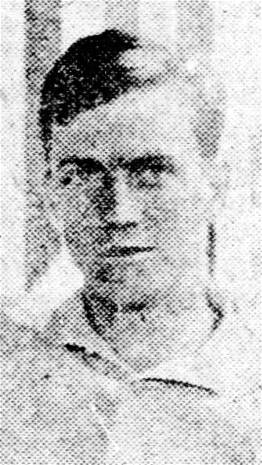
THE ALTARS OF PATRIOTISM
Ecstatic that their capital had been
saved from the Germans, the French High Command lauded the Marines
with numerous awards and accolades. Belleau Wood itself was given the
sobriquet Bois de la Brigade de Marine, or “Wood of the Marine
Brigade.”
American commanders were also eager to
award the valiant Marines who suffered and sacrificed so much. One of those
recipients was Brookline’s Sgt. Raymond P. Cronin, who was awarded the
Distinguished Service Cross, the Navy Cross and the Silver Star Citation
(the second - Army, second - Navy and third highest medals awarded in the
U.S. Armed Forces).

Generals Petain and Pershing at
the dedication of a
war memorial near Belleau Wood in 1923.
Five years later, a monument was
dedicated to the fallen near the battle site. The commander of the Marine
Brigade, Army General James Harbord, spoke at the event. “Now and then, a
veteran will come here to live again the brave days of that distant June,”
he said. “Here will be raised the altars of patriotism; here will be renewed
the vows of sacrifice and consecration to country. Hither will come our
countrymen in hours of depression, and even of failure, and take new
courage from this shrine of great deeds.”
General Pershing, Commanding General
of the American Expeditionary Forces, referring to the events of June 1918,
said, "The deadliest weapon in the world is a United States Marine and his
rifle." Pershing also said "the Battle of Belleau Wood was for the United
States the biggest battle since Appomattox and the most considerable engagement
American troops had ever had with a foreign enemy."
As for the Marines being called
“Teufel Hunden” by the defending Germans; since the term is not commonly
known in contemporary German, the more accurate German term would be
"Höllenhunde" which means "hellhound." For the Americans who lived through
the hell of the Battle of Belleau Wood, the term “Devil Dogs” would do just
fine. The term was used for many years on recruiting posters and, to this day,
is a common phrase used to describe a member of the United States Marine
Corps.
PFC. GUIDO C. BOECKING
When the initial rush of enlistments
happened back in April 1917, another Brookline boy who joined the United
States Marine Corps was Guido C. Boecking, an acquaitance of Raymond Cronin
who lived at 1007 Brookline Boulevard. Guido was assigned to the 43rd Company,
2nd Battalion, 5th Marine Regiment.
Guido's and Raymond's paths through France
were nearly identical, and both ended up facing the Germans in the Battle of
Belleau Wood. While Raymond lost his life in the Battle for Hill 142, Guido
was wounded in the fight for the Bouresches and the main woods.
While in the hospital, Guido learned
of Raymond's death and wrote home to his parents. It was the Boeckings who
first informed the Cronins of their son's death. Raymond's father immediately
cabled Major General Barnett in Washington, who in turn cabled General Pershing's
headquarters.
The return message from France, received
by the Cronins on August 15, 1918, confirmed that Raymond was killed in action.
Two weeks later Sgt. Raymond P. Cronin's name appeared in the casualty list
published daily by the Pittsburgh Press.
Marine Pfc. Guido C. Boecking survived
went on to participate in the Battle of Soisson and the Meuse-Argonne Campaign.
The 2nd Battalion, 5th Marine Regiment participated in the post-war occupation
of Germany and returned to the United States in August 1919.
A DECORATED HERO RETURNS HOME TO BROOKLINE
After a brief interment in France,
the remains of Sergeant Raymond P. Cronin were returned to his family in
Brookline. The highly decorated war hero was afforded a Military Funeral at
his parent’s home at 1503 Berkshire Avenue and a blessing by Father Quinn at
Resurrection Church on September 4, 1918. Raymond was buried at St. Mary’s
Roman Catholic Cemetery, located at 45th Street and Penn Avenue in Central
Lawrenceville.
Based on the medals that Sgt. Cronin
received for his heroism at the Battle of Belleau Wood, he is officially
the most decorated soldier in the Community of Brookline.
<><><><> <><><><>
<><><><> <><><><>
<><><><> <><><><>
The text of Sgt. Raymond P. Cronin’s Distinguished Service
Cross citation:
The President of the United States of
America, authorized by Act of Congress, July 9, 1918 takes pride in presenting
the Distinguished Service Cross (Posthumously) to Sergeant Raymond P. Cronin
(MCSN: 81742), United States Marine Corps, for extraordinary heroism while serving
with the Forty-Ninth Company, Fifth Regiment (Marines), 2d Division, A.E.F., in
action near Chateau-Thierry, France, 6 June 1918. Under heavy machine-gun fire,
Sergeant Cronin attempted to establish liaison with an adjoining French unit,
during which he was killed. War Department General Orders No. 101
(1918).

 
Sources And References
THE PITTSBURGH PRESS -
SUNDAY EDITIONS
(December 29, 1918 through
July 20, 1919)
|

December 29, 1918
|

December 29, 1918
|

January 5, 1919
|
|

January 5, 1919
|

January 12, 1919
|

January 19, 1919
|
|

January 26, 1919
|

February 2, 1919
|

February 9, 1919
|
|

February 16, 1919
|

February 23, 1919
|

March 2, 1919
|
|

March 9, 1919
|

March 16, 1919
|

March 23, 1919
|
|

March 30, 1919
|

April 6, 1919
|

April 13, 1919
|
|

April 20, 1919
|

April 27, 1919
|

May 4, 1919
|
|

May 11, 1919
|

May 18, 1919
|

May 25, 1919
|
|

June 1, 1919
|

June 8, 1919
|

June 15, 1919
|
|

June 22, 1919
|

June 29, 1919
|

July 6, 1919
|
|

July 13, 1919
|
|

July 20, 1919
|
The copies of the
Pittsburgh Press used to create this page were found at the Google News Archive. There were four missing editions: May 4,
1919, May 11, 1919, July 6, 1919 and July 13, 1919. These editions were
later found at Newspapers.Com. The information on
Red Cross Nurse Helen Burrey, of University of Pittsburgh Base Hospital
#27, was found at My Mother's War - Mementos of WWI. The information on Captain William Truxal
was found in the book "History of the 110th Infantry (10th PA) of the
28th Division (1917-1919)". Other sources include www.historynet.com, www.wikipedia.org, www.army.mil and Google image searches. The image below shows
the WWI Memorial in Washington D.C.

|