Westinghouse Transit Expressway
Skybus in South Park

(Revolutionizing People-Mover Technology)

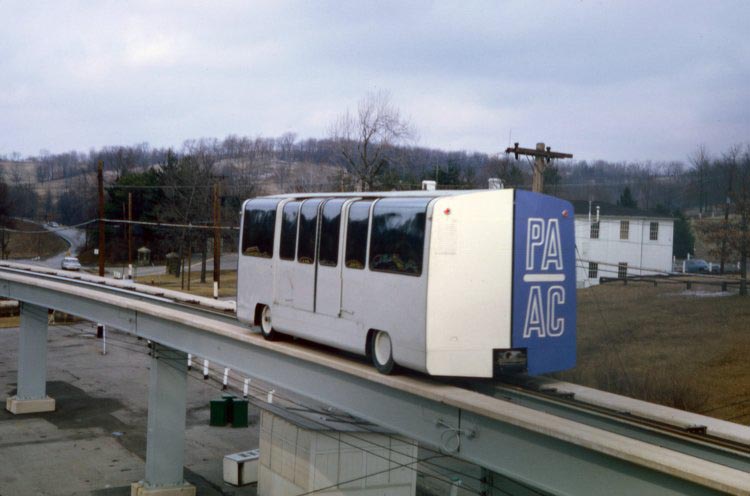
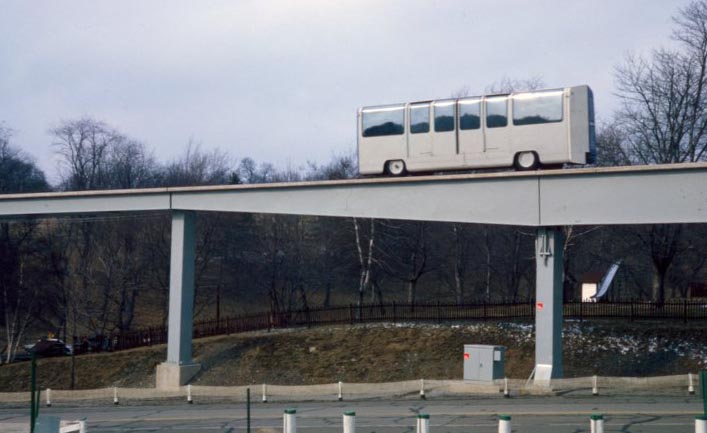
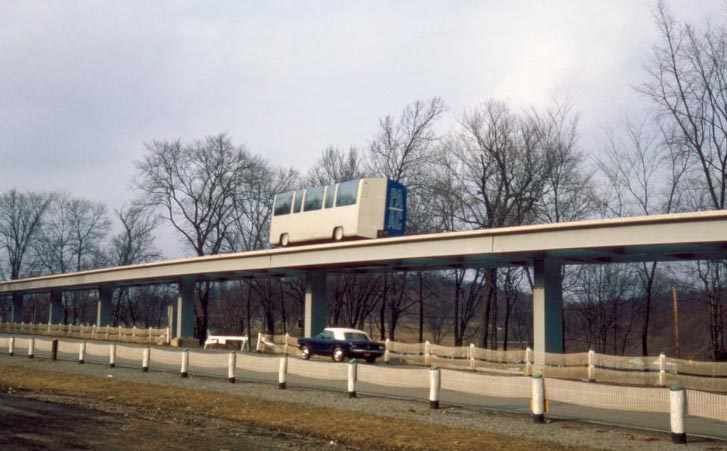
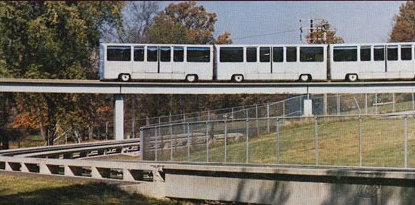
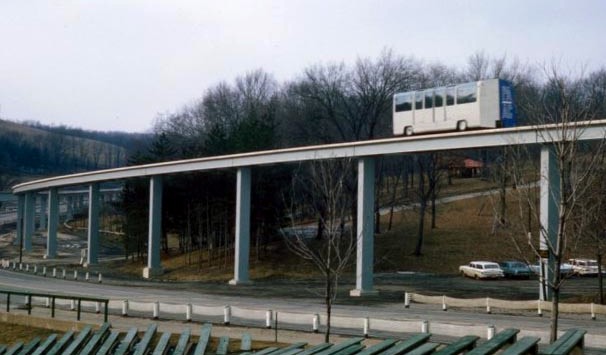
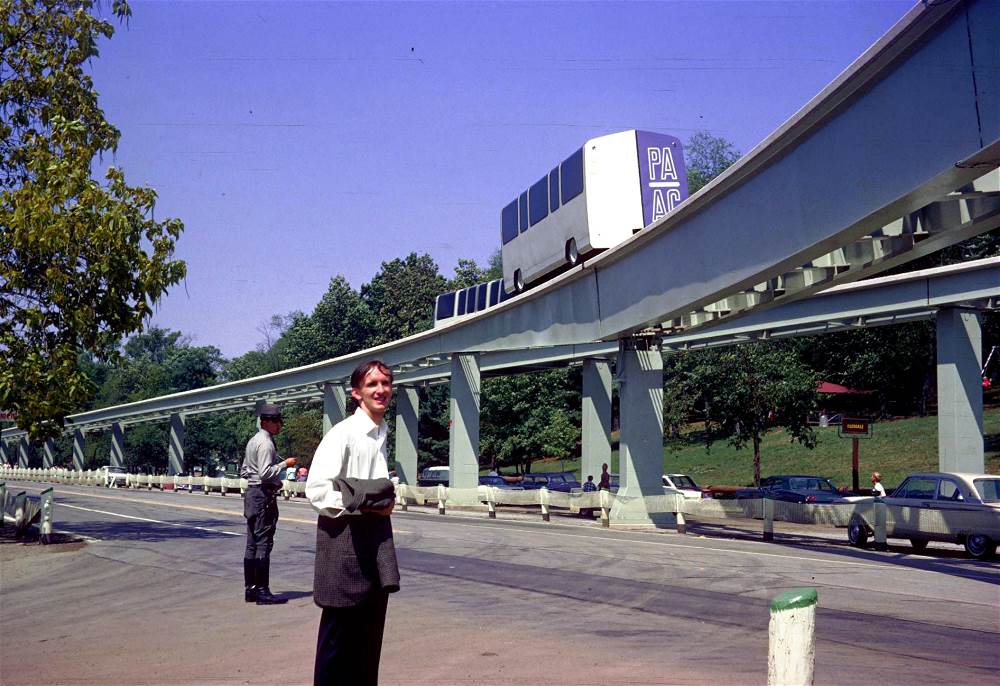
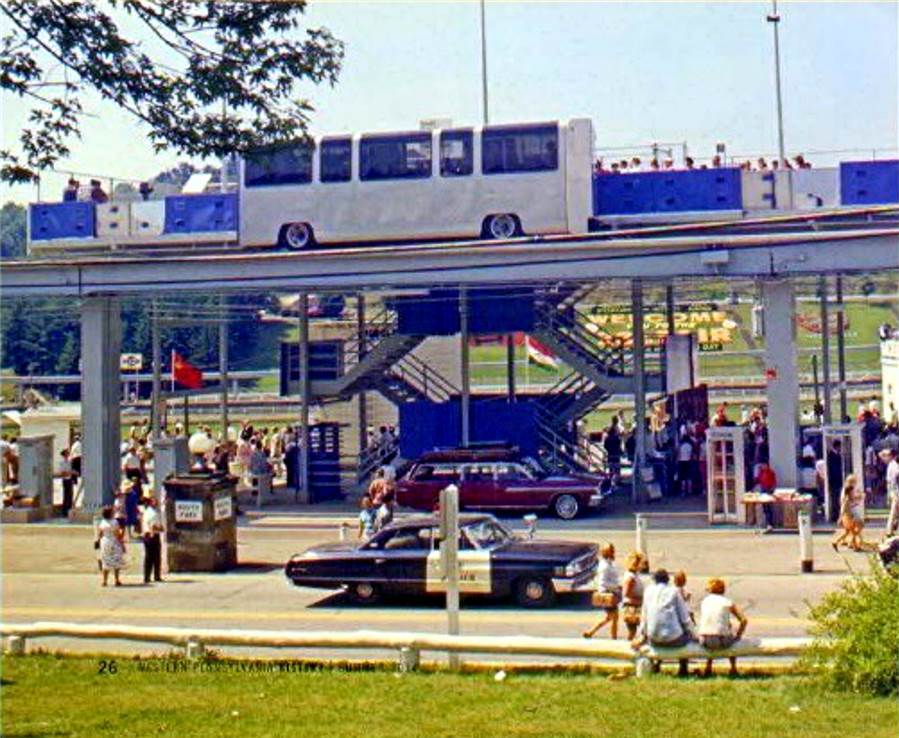
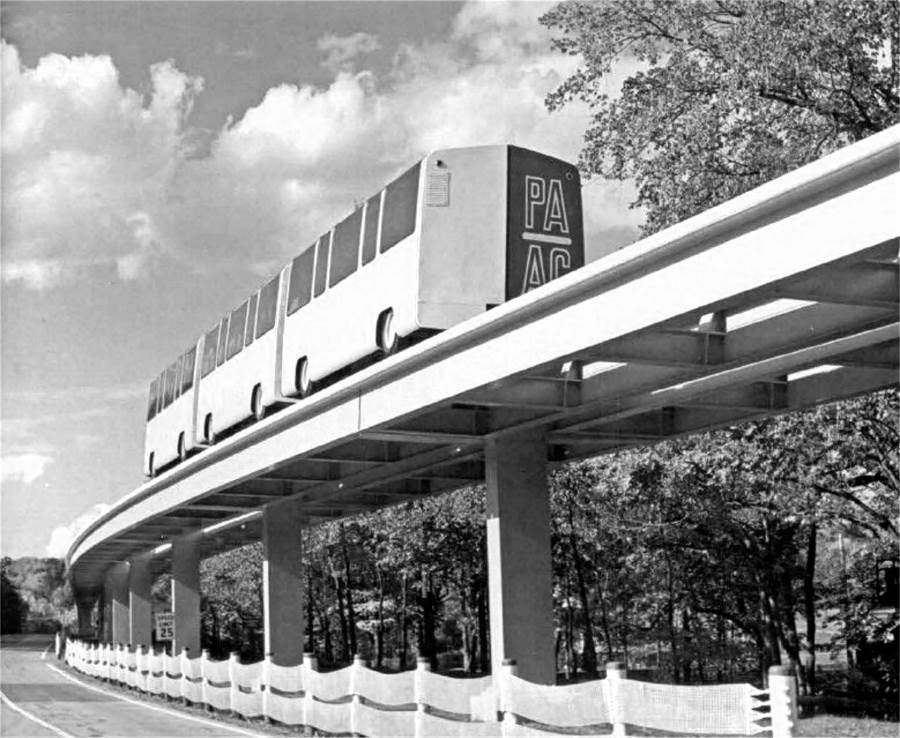
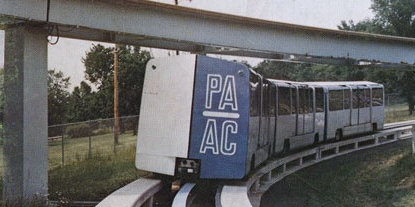
The Skybus train works its
way through South Park. The
guideway ran from the County
Fairgrounds along Corrigan
Drive to Maple Street and back.

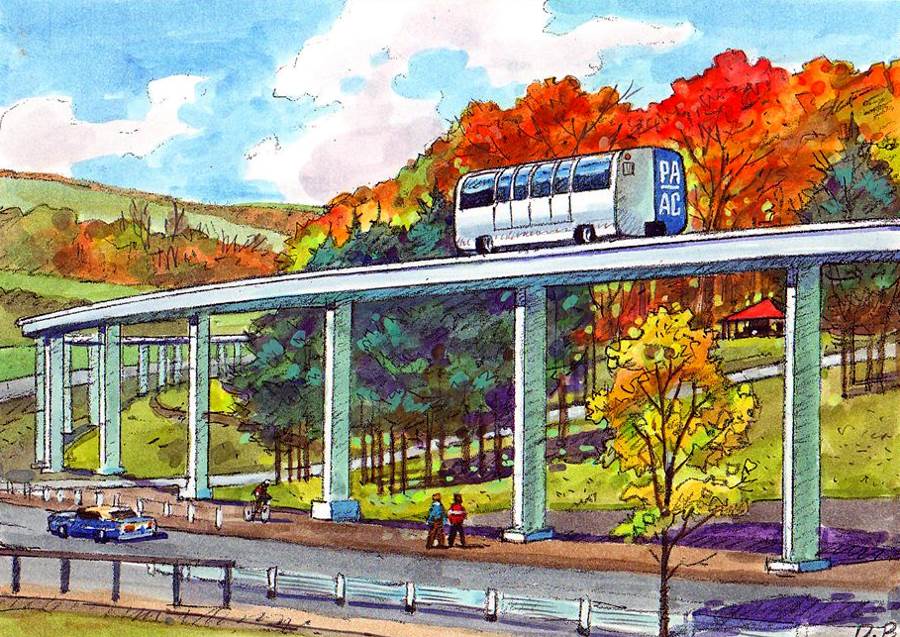
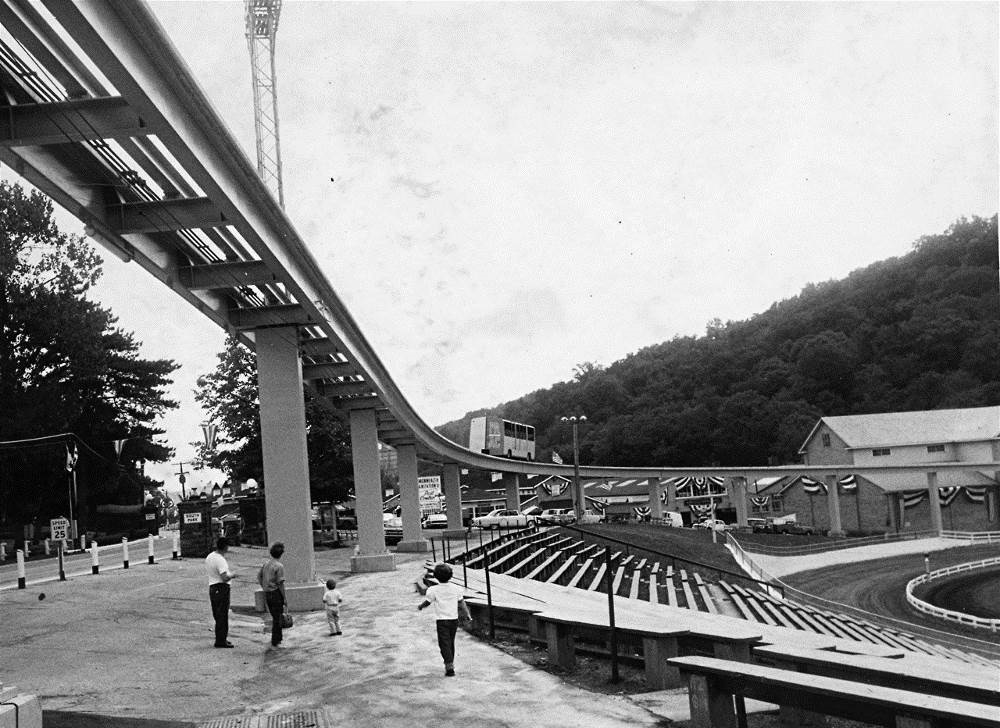
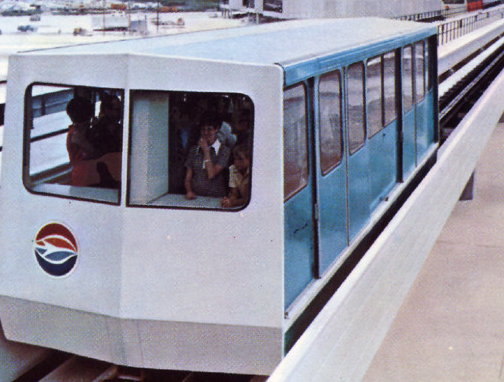
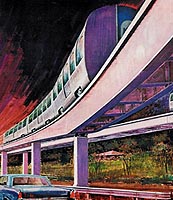
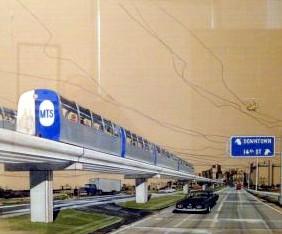
The Westinghouse Transit Expressway, or "Skybus", was one of Pittsburgh's public transportation initiatives from the 1960s that became what some might refer to as "the stuff of legends." Concieved during Renaissance I in the late-1950s as an alternative to overcrowding on the city's streets, Skybus was a fully automated, rubber-wheeled, electric vehicle that rode on a steel and concrete guideway. The vehicles could operate on an elevated guideway, at ground level or below street level. If approved, the Port Authority planned to replace the existing light rail trolley routes with a 92-mile, 460 car transit system linking the urban and suburban populations with downtown Pittsburgh at a cost of approximately $740 million.

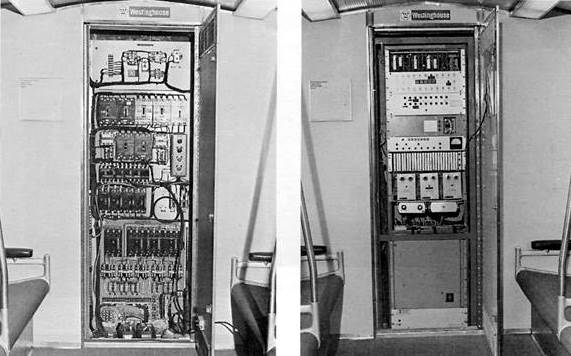
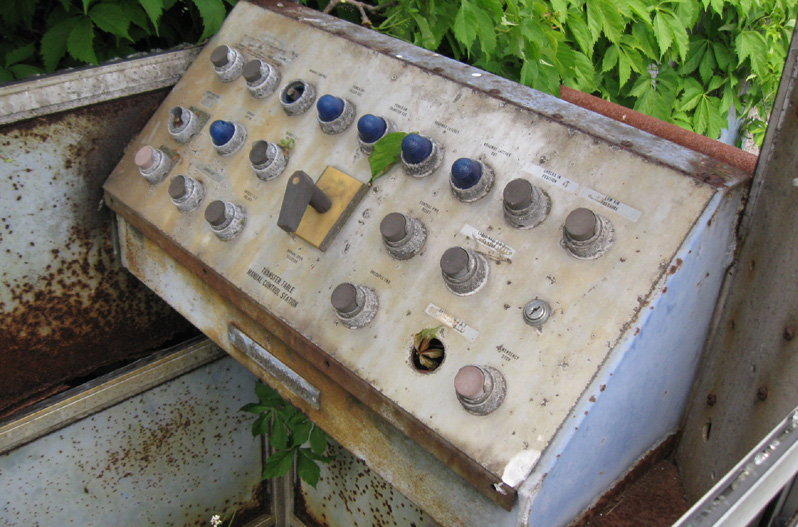
The Control Board that operated the Skybus
System, located in the North Station.
The Westinghouse Transit-Expressway's automated control system, located at the North Station.

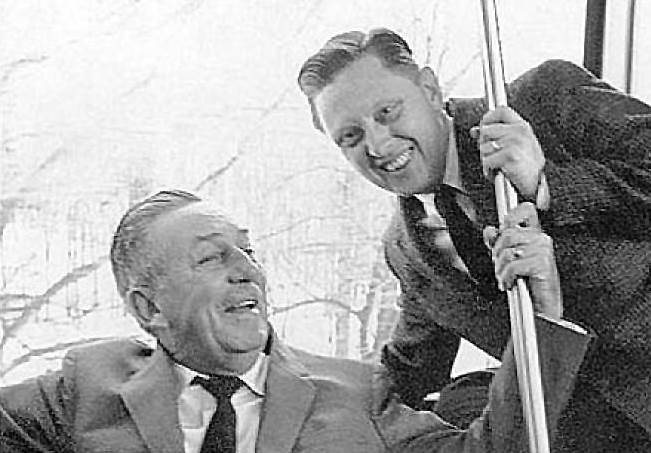
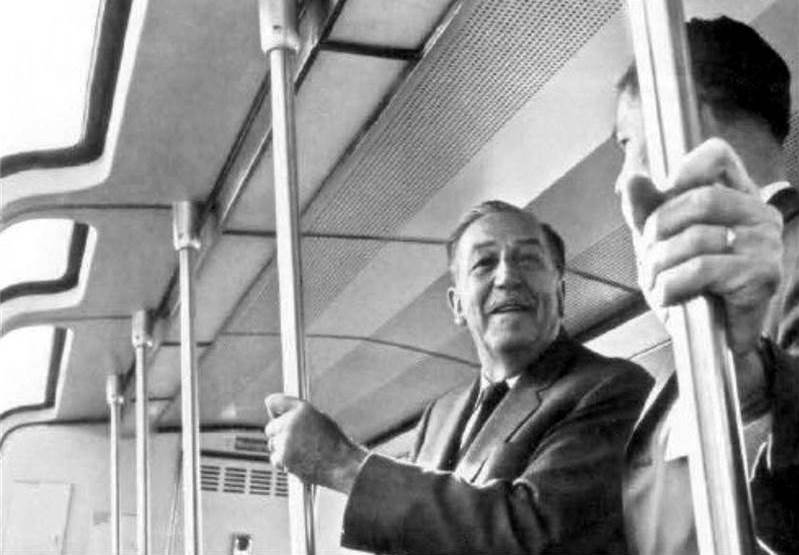
Pittsburgh's fascination with Skybus reached its zenith in the mid-1960s, when federal dollars were allotted to build a 1.77 mile test track in South Park. Construction of the South Park loop began in the fall of 1964 and was completed the following spring. This was an exciting time for Westinghouse engineers, who were breaking new ground in people-moving technology. Walt Disney himself visited Pittsburgh in 1965 to meet with Skybus engineers, discussing options for his newest entertainment complex - Walt Disney World.

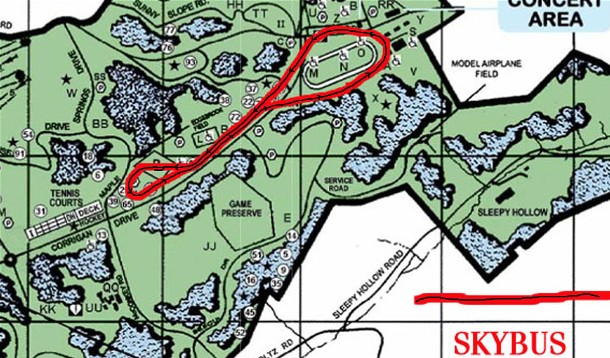
A rough outline of the Skybus Track
Map showing the route of the Skybus test guideway in South Park.

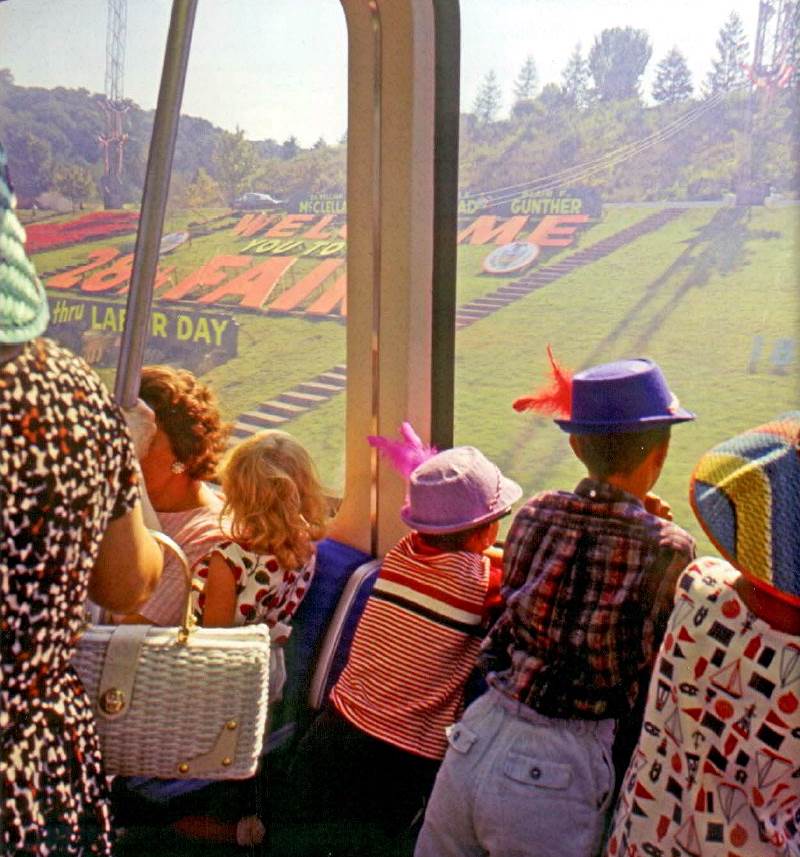
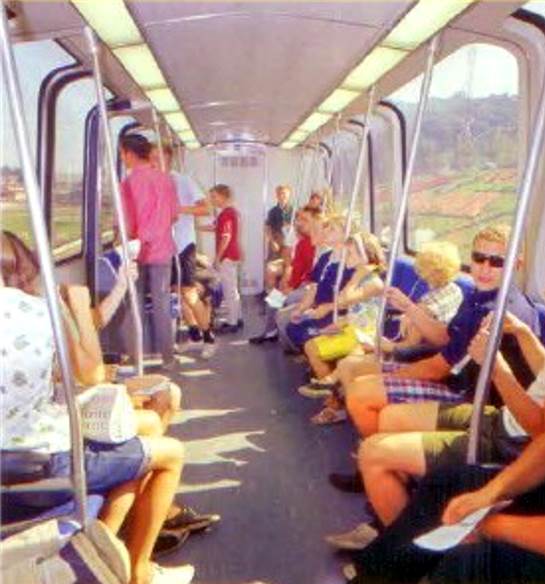
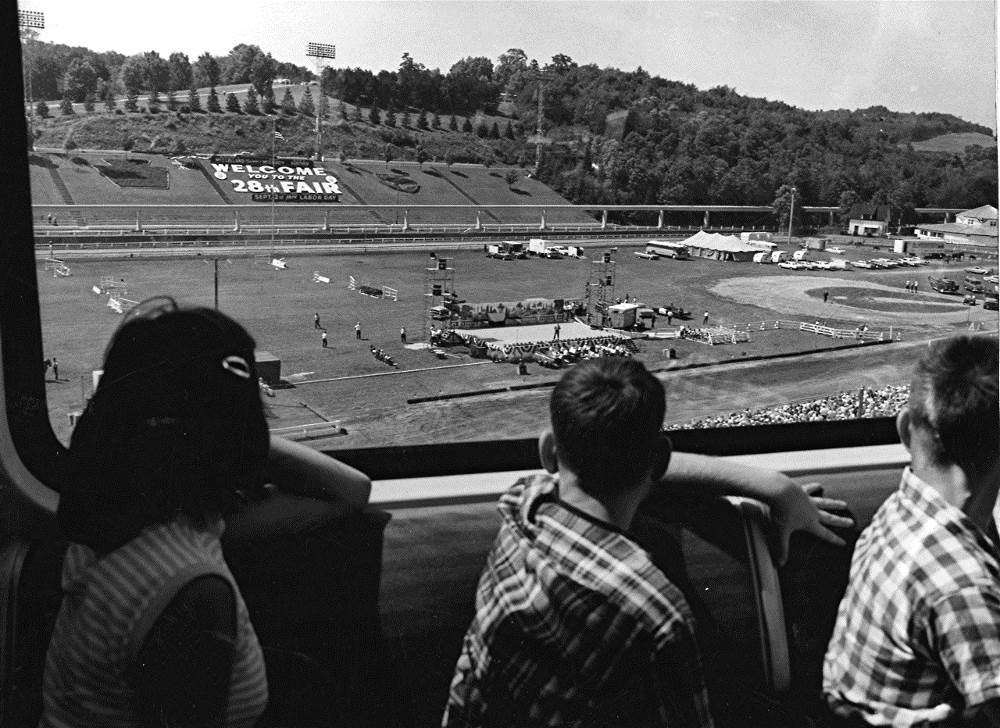
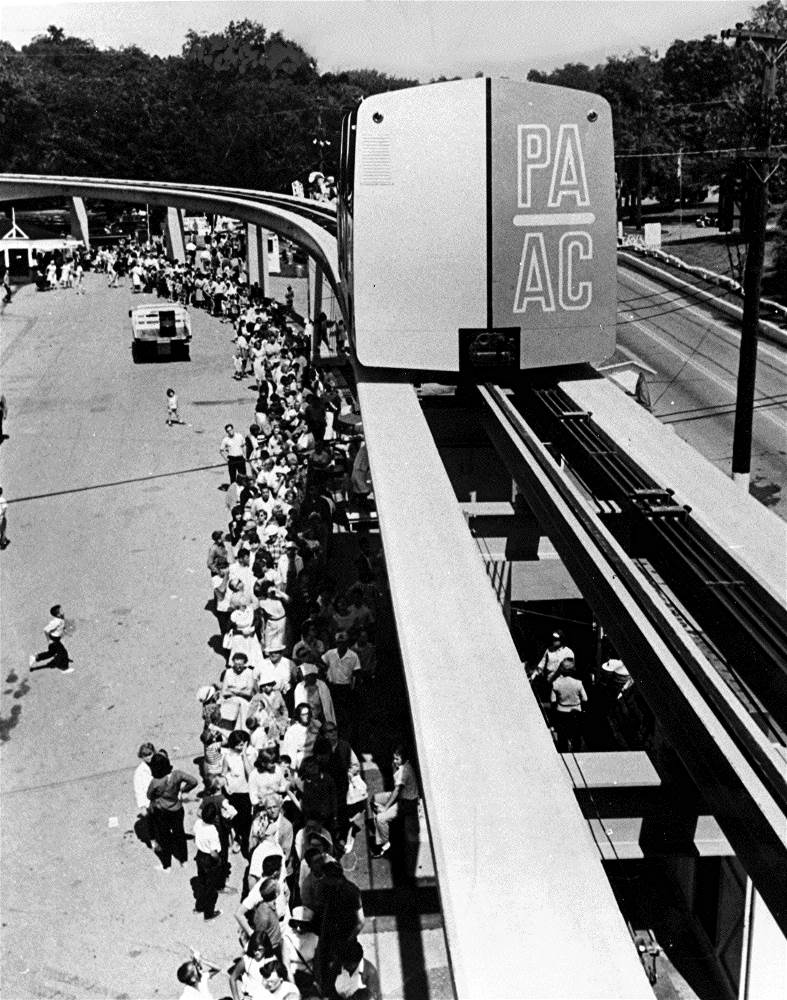
The South Park track opened for a public demonstration in August, 1965, during the four days of the Allegheny County Fair. The unmanned*, rubber wheeled electric vehicles, operating individually and in multi-car trains, circled the park at speeds as high as 50 mph on the elevated roadway. The futuristic Skybus system was quite a hit at the fair. Over 30,000 people paid the ten cent fair for an air-conditioned ride around the loop. The Phase I testing covered 21,000 vehicle miles and was widely considered a success.

* Note: During the initial Skybus demonstration at the 1965 County Fair, the vehicles were manned. The electronic control system had yet to be brought online.

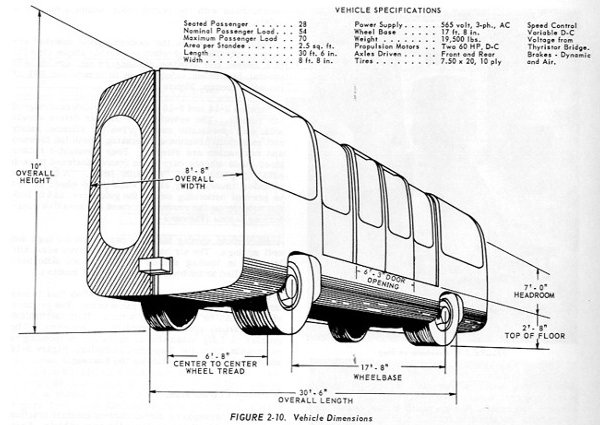
Skybus Vehicle Specs

Several years of testing and modifications followed until the technology was proven reliable. Skybus continued to be a unique and popular attraction at the County Fair through 1971. Eager to implement the new technology into its transit plan, the Port Authority began acquiring land for the proposed routes. Construction began on modifications to the Wabash Tunnel, the projected gateway for the Skybus link to downtown Pittsburgh.

The early-1970s were a difficult time. Despite strong support within the Port Authority, the Skybus proposal faced heated political opposition within the City and County governments. Eventually, support dwindled among politicians, and the Skybus initiative was shelved in favor of more practical solutions. Dedicated bus lanes were installed in high traffic corridors. The South, East and Airport busways were constructed. Finally, the completion of the "T" light rail and subway system in the mid-1980s brought Pittsburgh's urban transportation nightmare to an end.

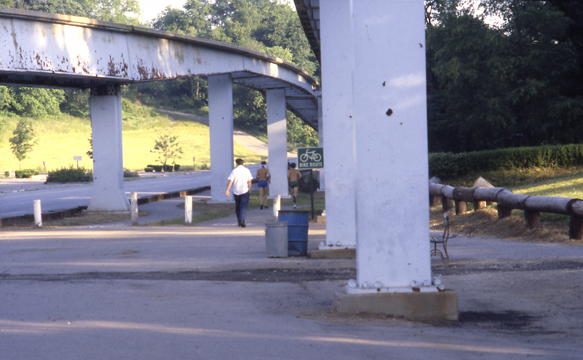
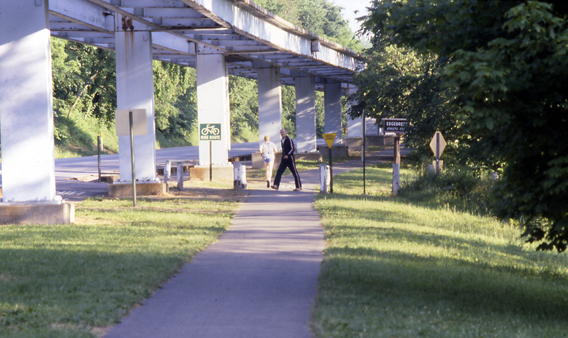
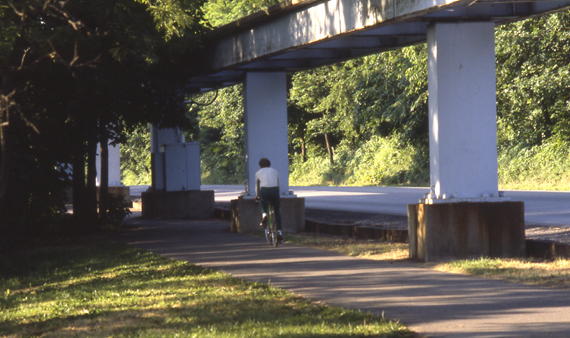
Skybus tracks in the late-1970s
before they were dismantled.
The Skybus test track near the South Park fairgrounds, in the late-1970s, after the
abandonment of the program. The rusting guideway was removed in the mid-1980s.

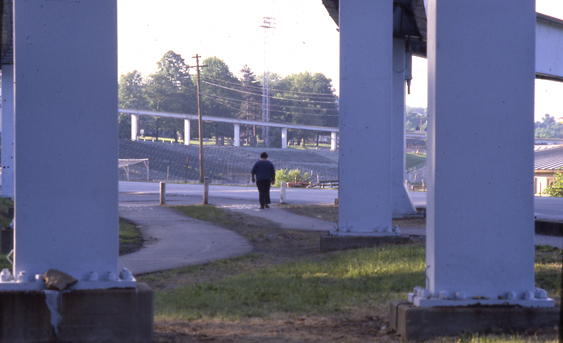
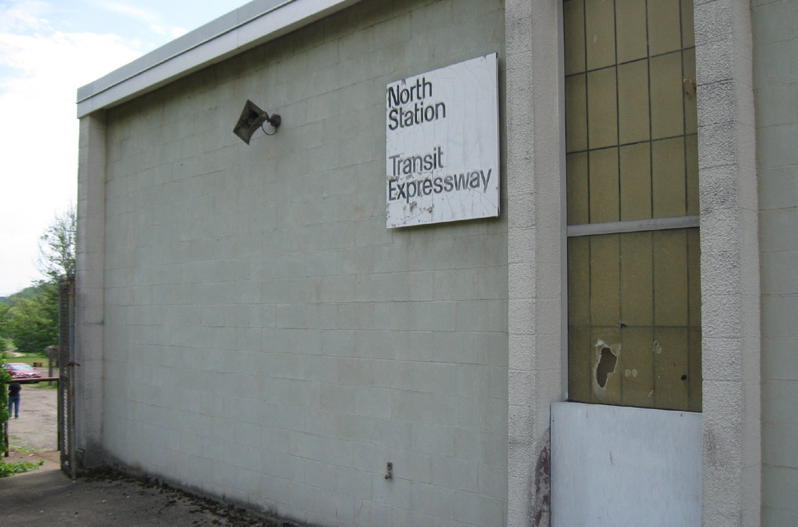
As for Skybus' fate here in the Pittsburgh area, it's doom was sealed when the Governor of Pennsylvania withdrew support, and funding, in 1975. The Wabash Tunnel work was discontinued and the elevated guideway at the South Park test site was left to rust. In the mid-1980s, after a decade of inactivity, the Skybus guideway was removed from South Park and the Pittsburgh chapter of the Skybus initiative laid to rest forever. Today, only the North Station station remains. The building that once housed the maintenance and control center is now used as a County storage facility. You can also find a few scattered concrete foundations near the fairgrounds.

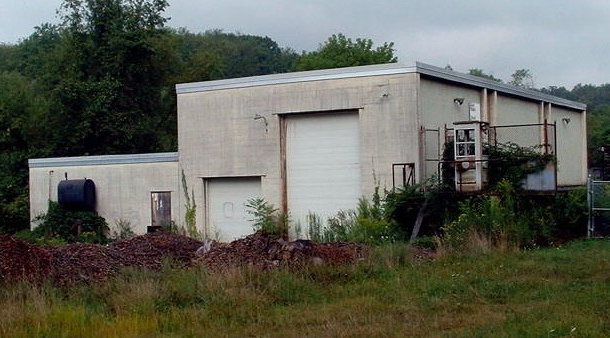
The Transit Expressway North Station in 2008.
The building is now a County storage facility.
The Transit-Expressway North Station in 2008. It is now used as a County storage facility.

The overall fate of the Skybus initiative was far different than the outcome here in Pittsburgh. Although Skybus did not take hold locally, the advancements in People-Mover technology developed as part of the Skybus program gained acceptance in other specialized locations. Many of the innovations were revolutionary. Versions of the system are still in use today at several major airports around the world, including Pittsburgh International. In San Francisco, a fully automated version of the Skybus system serves the Bay Area Rapid Transit Authority.

The following article details the success of West Mifflin-based Adtranz North America, successor to the Westinghouse Transit Group: "Adtranz is World Leader in People Moving."

Skybus      Skybus

** Links to Skybus Information and Videos **

<Photos of the Skybus System in South Park>

<Solution To Pittsburgh's Traffic Nightmares>

<Port Authority Early Action Program>

<Take A Ride Aboard Pittsburgh's Skybus in 1967>

<Allegheny County Rapid Transit Study - 1967>
(The Skybus Study - wordy but interesting)

<The Skybus Story - Technology vs Politics>

<The Saga of Skybus - by Morton Coleman>

<The Skybus Guideway in the late-1970s>

<My Brief History with Skybus - by Ed Appleby>

<Return to Skybus - May 2009>
(discovery of the lost vehicle)

<The Final Chapter - Skybus 2010>
(restoration and museum display)

<Whatever Happened to Skybus - Video Presentation>
(click on either of two full-length videos - Quicktime software required)

Thanks to the following individuals for their contributions to this Skybus webpage:
Doug Brendel, Bill Segar, Ed Appleby, Arthur Bisig, Harold Hall, Dr. Michael Brendel and Joseph Brendel.

Photos of Skybus Operations During the 1960s
Click on images for larger photos

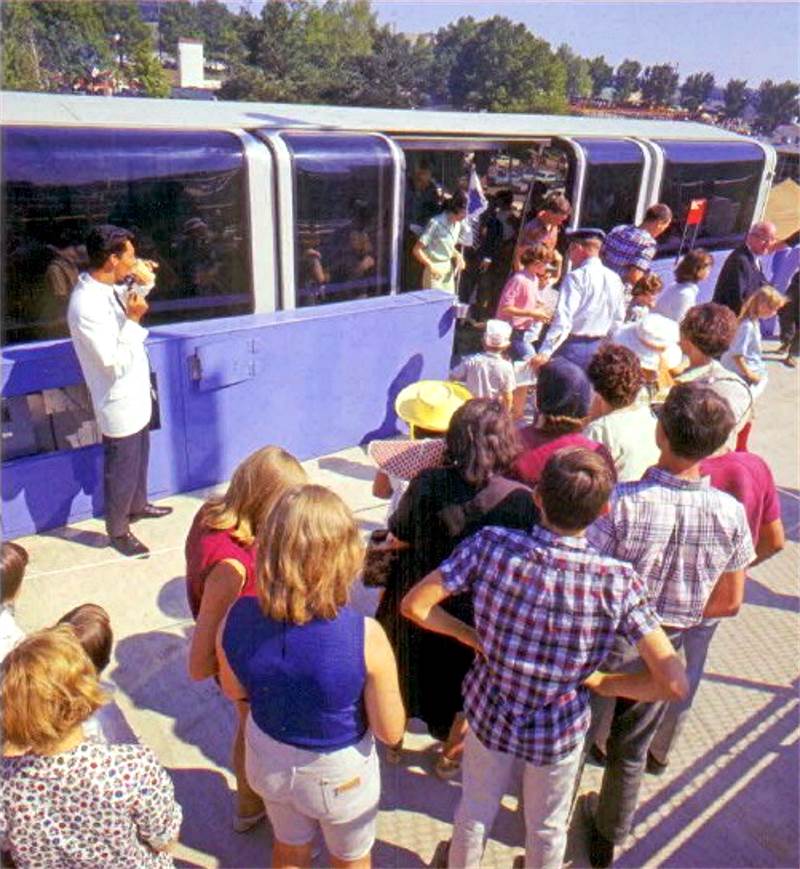
Passenger loading platform
at the South Station.

Passenger loading platform
at the South Station.

Skybus car leaves the loading
platform near the fairgrounds
parking lot and heads towards
the intersection at Corrigan.

Skybus car approaches the loading
platform at the County fairgrounds.

Skybus car begins its trip down
Corrigan Drive towards the North
Station and loop at Maple Street.

Skybus car makes its way
along Corrigan Drive.

Skybus train at the North Station.
Note the graded test track underneath
the elevated track. The spur line was
used to test operations on hills.

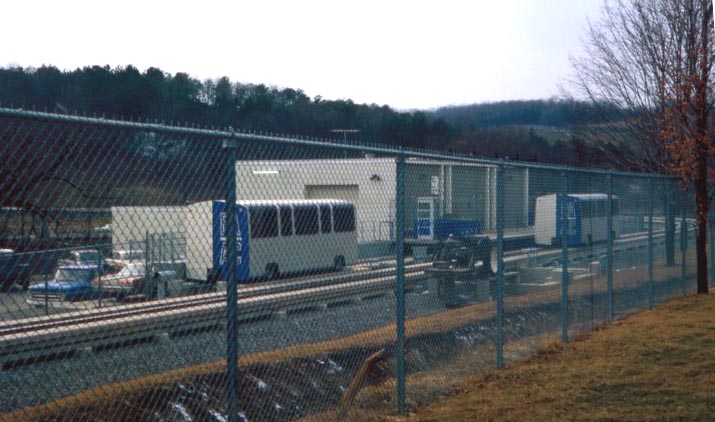
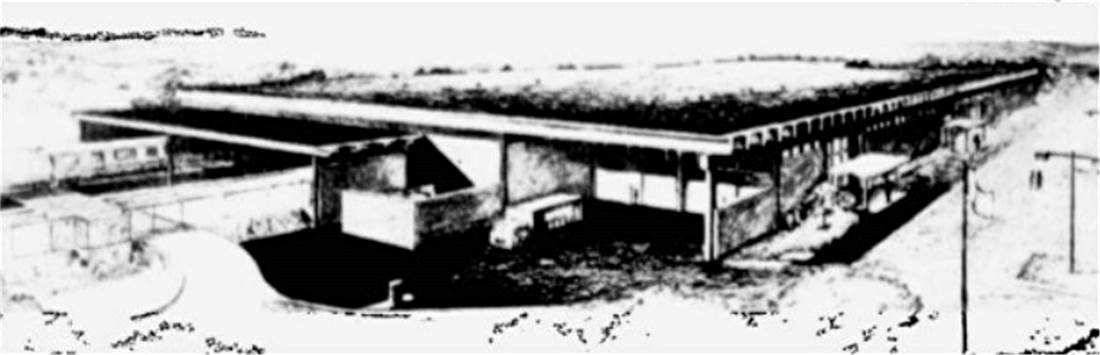
Skybus cars at the North Station
repair facility and control center.

Skybus car on Corrigan Drive
across from the fairgrounds stables.

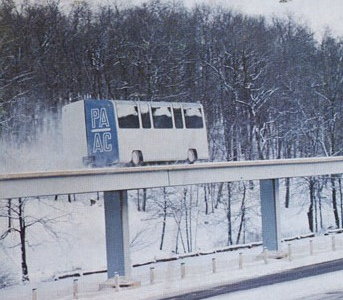
Skybus cars could run in all
weather conditions. Here, a car
heads along snowy Corrigan Drive.

View from atop the tracks.

The inside of the North
Station where the Skybus
vehicles were maintained.

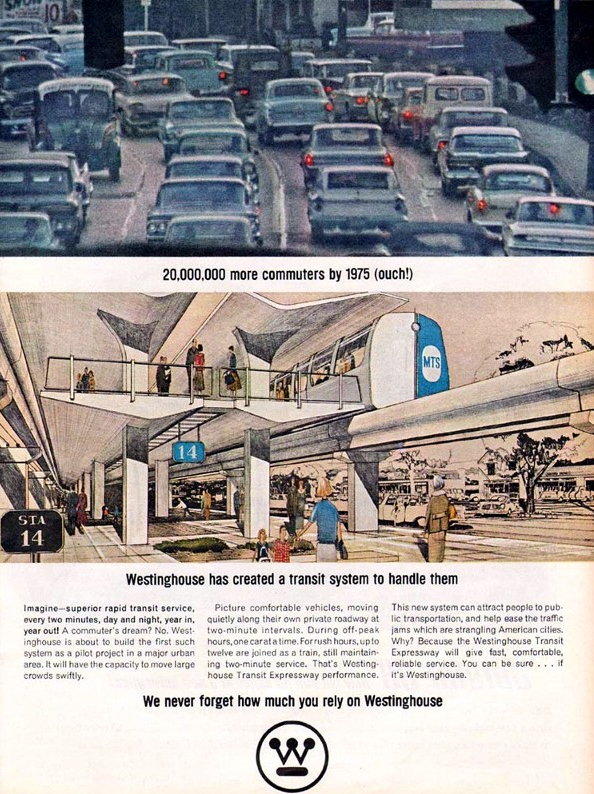
A Solution To Pittsburgh's Traffic Nightmares

A Westinghouse advertisement
from July 1963 introducing their
new urban transportation system.

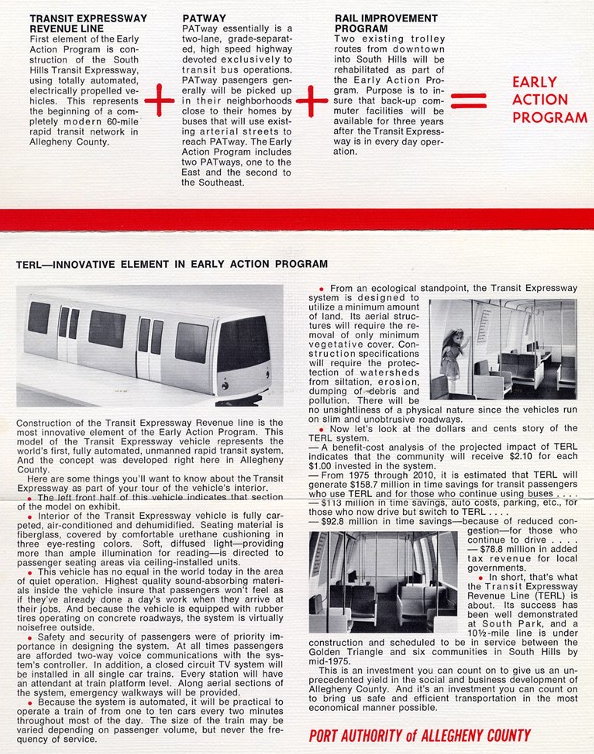
Early Action Program
(Port Authority Transit Proposal)

Brochure from the early 1970s
explaining the Skybus system
and transportation benefits.

Children play in the creek below
Corrigan Drive. The new Skybus tracks
stand in the background - Fall 1966.

The Skybus Story
(Technology versus Politics)

It was once the most divisive word in Pittsburgh transit and political circles, conjuring up images of scrapped trolleys, excessive spending, political fights and resignations. Skybus polarized both Democrats and Republicans in the fight to either support or oppose the project. In the end, it became a lost opportunity for the city of Pittsburgh to become the model for future transit systems to follow.

Skybus was a futuristic, fully automated rubber-wheeled rapid transit solution proposed by Westinghouse Electric Corporation and fully supported by the Port Authority of Allegheny County in the early 1970s. Skybus was the backbone of the Port Authority's master transportation plan, known as the Early Action Program, for improving transit service in Allegheny County. The Early Action Program included Skybus, two busways and improvements in a network of main corridor roadways.

The official name for Skybus was the Transit Expressway Revenue Line, or TERL. Skybus was a nickname that the media coined for the project. Developed in the early 1960s by Westinghouse engineers, Skybus found a willing sponsor with the Port Authority. PAT was looking for a futuristic mode of transit to begin building a system of countywide transit improvements. The Port Authority was approached in 1962 regarding the new concept which was still on the drawing board. After months of discussions, an agreement was reached on June 21, 1963 to build and test the new concept at Allegheny County's South Park.

The South Park location was chosen for several reasons. First, it was within the county and and only 11 miles from downtown Pittsburgh, yet far enough from the city that population levels were low. Second, it offered a variety of terrains in a compact area that was free of interfering structures. This option significantly reduced costs. Third, the Allegheny County Fair was held yearly at South Park and this would easily provide the numbers of people needed to test the project in a real-time environment.

The South Park test site was a temporary structure, and not part of PAT's proposed Skybus system. The actual Skybus line to the Southern suburbs was to follow the present-day light rail line. The South Park Skybus line was designed only for testing purposes. Although Port Authority and other public monies were invested in the test loop and the cars carried the PAAC lettering, the Skybus cars and the test guideway were wholly owned by Westinghouse.

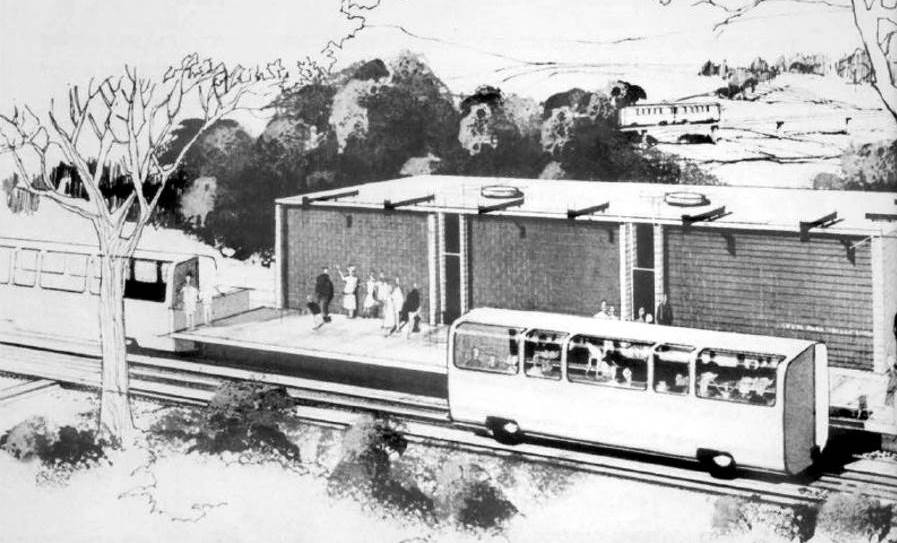
Construction of the 9,340 foot guideway began on July 7, 1964. Bethlehem Steel built the structural guideway. Two stations were placed along the test route. The South Station was an elevated loading platform at the Fairgrounds. The North Station was a ground level maintenance and control facility. The guideway was initially designed for both low speed and high speed curves, a long straight stretch and a transfer table. Of the 9,340 foot length, 8.800 feet were elevated from 15 to 35 feet above ground. Later modifications included a switch and a 1,000 foot long spur line slightly graded to test operations on a hill. The spur line and switch were located at the North Station control facility.
A 1,000 foot spur line was built to
test operations on a 10% graded hill.
The 1000 foot spur line used for testing operations on a 10% grade.

Prior to the roadway construction, an order was awarded to the St. Louis Car Company on March 4, 1964 to build three Skybus vehicles. The car was designed so that it was a fully automated and self-propelled vehicle that was capable of being coupled together with other cars to form a train. Each car was 30.5 feet long, 102 inches wide and seated 28 passengers with room for 26 additional standing comfortably. The maximum capacity per car was seventy. The cars were air conditioned (a novelty at the time), rode on sets of dual rubber tires, had air suspension and air brakes.

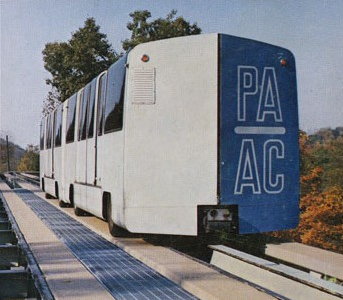
The Skybus cars were powered by two 60-horsepower DC traction motors. Top speed was approximately 50 mph. The traction motors were coupled to two traditional automotive style differential axles through a drive shaft. The cars were secured to the guideway by a complex system of horizontal rubber tires that attached the vehicle on either side of a center I-beam. The guideway structure that the four sets of dual tires rode on was a concrete road formed on top of outer I-beams.

The cars were originally to be a brushed aluminum finish. A problem developed due to the specifications that all rivets were to be ground down flush with the body surface. This resulted in a marred finish that St. Louis Car Company tried unsuccessfully several times to repair. A decision was then made to paint the cars in the Westinghouse blue and white colors. The three Skybus cars were delivered to Westinghouse between March 15, 1965 and May 24, 1965.

There was one other Skybus car manufactured. It was a full sized mock-up with the ends painted like the production cars but the brushed aluminum finish on the sides was as originally specified in the contract. This mock-up car had noticable differences from the production cars, and it is assumed that it was built in-shop by Westinghouse itself.

The 4th Skybus vehicle. It was a
mock-up designed to the original
specs with brushed aluminum finish
The first Skybus vehicle was a prototype built at Westinghouse
designed with the originally specified brushed-aluminum finish.

Initial operations of Skybus were performed under manual operation with the first complete round trip being make on August 4, 1965. The first public operation was at the 1965 Allegheny Couty Fair between September 2 and September 5. These were also performed under manual control. During these initial tests, Skybus operated in a two-car or single car configuration. The first fully automated trial did not occur until later that year.

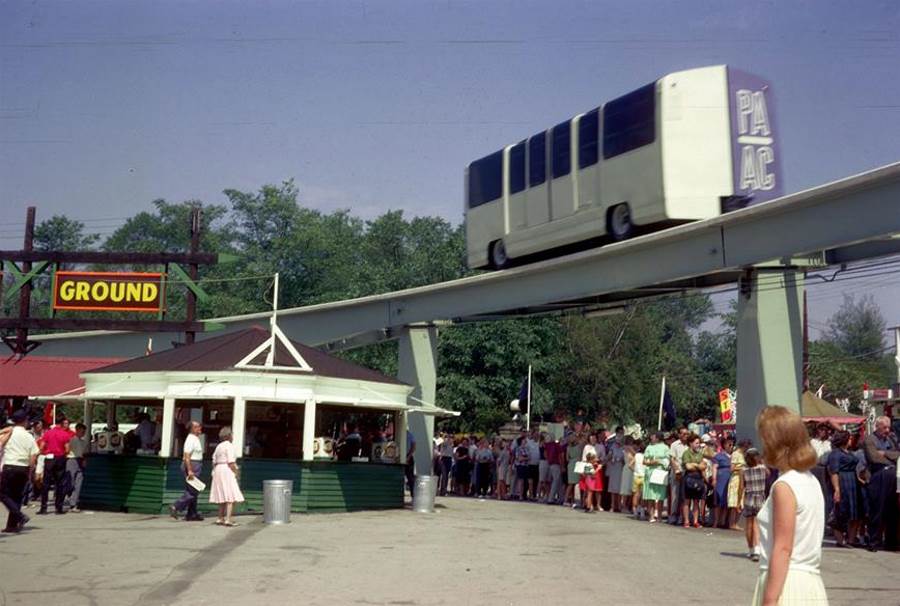
While the initial testing was underway, growing resistance to the project was already brewing. This resistance was primarily due to the fact that the Skybus line PAT was proposing was to be fully automated with no driver or attendant. Safety and security concerns that were addressed through talk of security cameras and phones did little to reassure people that the line would be safe. The high costs to build Skybus also drove opposition to the project. Skybus was one of the most expensive demonstration projects of its kind in the United States during the 1960s. Even with the concerns and opposition, the test line at South Park was a very popular attraction during the County Fairs from 1965 through 1971. More than 30,000 people paid 10 cents each to take a ride.
During 1965 and the initial testing during the County Fair, questionnaires were passed out and collected, asking several questions regarding Skybus. Overall the responses were positive, but critics argued that the carnival atmosphere during the fair invalidated the responses. The majority of riders during the 1965 test were mothers that had their children in tow. Extremely long lines with one to three hours waiting to ride were common during the fair and indications suggested that the children were the main reason the parents waited in line. Opponents suggested that although the questionaire results were positive, a normal sample of opinions did not occur and therefore the results were invalid. Even Westinghouse and PAT officials eventually, but unofficially, conceded that the County Fair operation was not a true cross sector of the public.
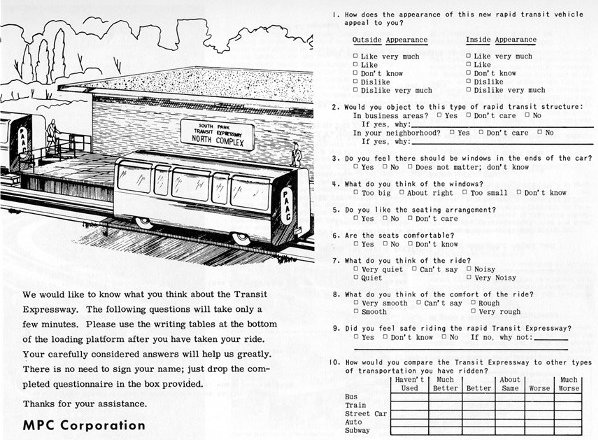
Front page of Skybus questionaire passed
out at the 1965 Allegheny County Fair.
Skybus questionaire distributed at the 1965 Allegheny County Fair.

The initial testing of Skybus was completed on June 7, 1966. There were some problems with the line that needed corrected and questions still needed to be answered. Work continued on the project by Westinghouse engineers to solve technical issues and PAT worked with the Department of Transportation to provide additional funding to continue further testing and development under what became known as Phase II.

Phase II added some new items that earlier testing could not answer. Items such as a spur line at a 10% grade to test hill climbing abilities, a track switch and emergency walkway to help calm concerns of becoming stranded if a train broke down. These were some of the concerns shared by Westinghouse engineers, PAT officials and the opponents alike. Also, much of the automatic train control circuitry was upgraded to then current standards.

Prior to Phase II, disabled cars were retrieved by an ordinary farm tractor that was modified to run on the Skybus guideway. It was an odd signal and not very reassuring to the general public. The emergency walkways installed during Phase II worked to relieve some of the concerns about being trapped on a disabled car but the tractor remained the only recovery vehicle. If Skybus had made it to production, there would have most likely been a specialized recovery vehicle designed that was a bit more substantial than the old farm tractor. Another odd sight along the line was the converted 1950s style enclosed telephone booth that was used for the transfer table control facility.
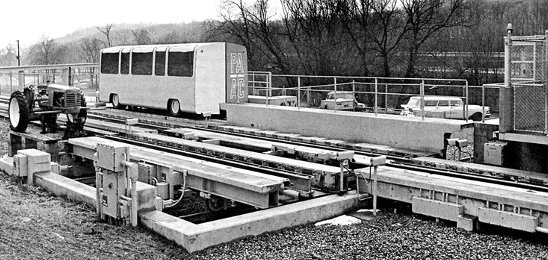
The old farm tractor used to retrieve
disabled cars sits at the North Station.
The converted phone booth to the right
controlled the vehicle transfer table.
The farm tractor used to retrieve disabled cars sits at the North Station.

Most of the problems from Phase I were corrected and many of the unanswered questions had been answered when Phase II testing was completed on November 2, 1971. There were still some issues which resulted from pushing the technological limit of the era. Issues such as having the car stop precisely as the same spot each time was extremely difficult as the automatic train controls of the day were much harder to program than the contemporary versions used today. One report indicated that the cars were stopping short 1/8" to 1/4" each loop and eventually would miss the platform completely unless they were manually moved up every few trips around the track.

Opponents of Skybus found any reason, real of fictional, to try to support their arguments against Skybus. Weather was one such issue that was factual but also bordered on fictional. The initial testing proved that Skybus could operate in any weather condition and Phase II proved again that Skybus could "go in the snow" with no problems. Initial fears were that Skybus would become stranded in the winter and Phase I disproved this. Opponents then suggested that Skybus would become stranded in the the snow having to go up grades. Phase II disproved this. Another fear involved accidents from faulty automatic train controls yet not one vehicle collision occured during the testing. During the over 125,000 miles of hard testing, Skybus and the technology proved itself time and again to be safe.

Although there were many opponents of Skybus, the real fight on Skybus began heating up on the political side by 1968. Technical, economic as well as security issues inflamed the anti-Skybus side and PAT's arrogance in its desire to have Skybus be the focal point of its Early Action Plan didn't help matters. PAT's intention to eliminate the last of the trolley lines in Pittsburgh and replace them with the new and still unproven in the real world technology led to a complete polarization of both the citizens and politicians.

The County Commissioners were split on Skybus, politicians throughout the county were split and citizens were also split. PAT, however, was fully behind the line even though questions and problems with the testing remained. PAT went on an all out effort to promote the new technology and the entire rapid transit plan by holding many meetings, having operating dioramas showing what it would look like and passing out literature promoting the positives. The opposition was also busy holding meetings and passing out information that questioned why PAT was pushing Skybus when it still had technical problems and questionable safety precautions.
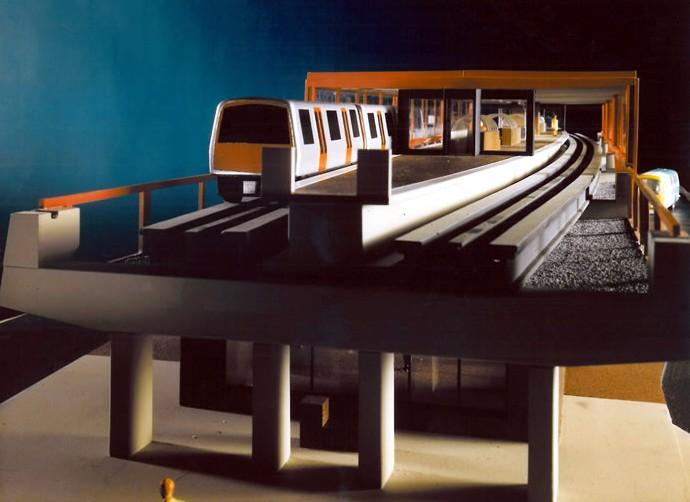
Lawsuits began to be filed in an attempt to block PAT from building Skybus and to save the remaining private right-of-way trolleys during the late-1960s. An agreement was reached in part where PAT would rehabilitate the trolley lines and keep the Library line once Skybus was built. The push against Skybus was strong even after the agreement and resulted in continued delays in implementing the first stage of PAT's Early Action Program. The situation got to the point that the Urban Mass Transit Administration threatened to pull funding for the project due to the constant bickering that was occuring.

The important focus points of the opposition against Skybus involved the troubles and the costs of Skybus. A very sound and logical argument was presented as to why replace a popular, reliable and time tested technology with an unproven technology at a much greater price. Allegheny County Commissioner Ron Hunt, who was a leading critic of Skybus, characterized the project by saying that "Skybus technology has an awesome capability for swallowing vast sums of money and producing very little in the way of a better, safer or more usable product."

The important focus points for the proponents were that Skybus involved the future of mass transit in the county and the money already spent on the project had created a way to achieve that future. Persuasive arguments were made as to why Skybus was needed as the focal point of the Early Action Program. Using items such as a long list showing the dwindling ridership numbers on both PAT and Pittsburgh Railways under the trolley system and highlighting the long lines of people wanting to ride the demonstration loop at the County Fair and various reports showing the project would work, proponents could prove the critics wrong on many points and show people did want Skybus. Proponents also pointed out, correctly or not, that those opposed to Skybus were opposed to any forward progress in public transportation.

In 1972 construction work began. A lot which is now occupied by the Castle Shannon "T" station was acquired and graded for the Skybus station. Additional property was acquired and graded at the site of the current South Hills Village Car Shop which was to be used for the Skybus storage and maintenance facility. The old Wabash Tunnel was also extensively rehabilitated to be the Skybus gateway to the downtown area. These three items were the only physical construction done on PAT's Skybus route.
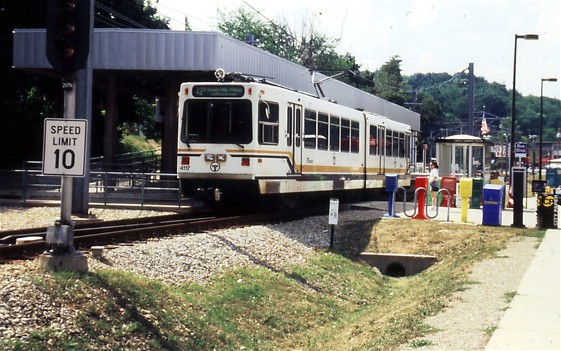
This Castle Shannon light rail stop was
originally to be used as a Skybus stop.
After years of political wrangling, the
light rail system won out over Skybus.
The Castle Shannon light rail stop was originally designed as a Skybus transit station.

1974 was the critical year for Skybus. UMTA ordered the re-evaluation of the entire proposal based on the strong opposition to the project. The project's outside consultant, MPC Corporation, which was affiliated with the Carnegie Mellon University, reviewed every aspect and determined that the technology was in fact feasible and had matured to the point that it was no longer unsafe and untested. Undetered by this positive appraisal, opponents simply stepped up their efforts to kill the Skybus initiative.

In October of 1974, with the re-evaluation complete and a favorable result achieved, UMTA added one important provision to their support of the project. A decision had to be reached within 120 days of the report or all funding would be cut off. Even the newspapers finally sided with PAT and urged opponents to back down or risk losing everything. The opposition, however, did not back down. A consensus between the two sides was finally reached within the 120 days time frame where yet another outside consultant would review other possible alternatives to Skybus. UMTA, tired of the squabbles, also agreed to having all options reviewed in hopes of finally getting both sides to agree to something.

The DeLeuw Cather Report issued in late 1975 spelled the end to Skybus. The report cited costs, environmental factors and the availability of the long proven light rail technology as factors for dropping Skybus. PAT reluctantly agreed. Had the Port Authority not agreed, they risked losing millions of dollars in future funding for the South and East Busways. Just like that, Skybus was dropped from their plans and the "T" light rail system was inserted in its place. Skybus was now officially a dead issue and would never be built in Pittsburgh as a mass transit mode.

Looking back at Skybus, it was ahead of its time in most all respects. Although the technology matured as the testing progressed, it was still a relatively unproven technology when combined together into a single package. Although it used much of the same technology as the Bay Area Rapid Transit trains in San Francisco which ran on rails, Skybus was a unique mode of transportation that required new technology.

The final years of Skybus were relatively uneventful after PAT dropped it from the transportation plan. The original Skybus test facility sat virtually unused from 1973 through the mid-1980s. The three Skybus cars, one single and one two-car train, sat at the North Station, badly faded but appearing ready to roll on another test. Power transformers for the line also still hummed indicating that power was still available right up until the line was dismantled. The guideway structure was torn down in the mid-1980s.
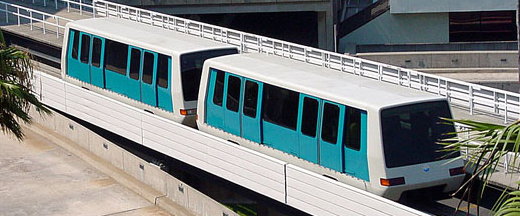
Skybus has evolved into the premier People-Moving System
in the world. Here is a modern version of a Skybus
train operated by the Tampa Airport Authority, one
of the original Westinghouse customers back in 1970.
A modern version of a Skybus train operated by the Tampa Airport Authority.

Skybus is still alive and well under a new name in many locations. Now called a People-Mover, the original Skybus evolved into a means of moving people in from the terminal and boarding areas at airports and as a tourist attraction at Busch Gardens. Tampa, Florida became the first city to use Skybus technology in a true public application. Although Skybus polarized the entire area, it did help PAT achieve its goal of improving public transit in Allegheny County as the "T" and downtown subway, as well as the busways, may never have been built if it weren't for Skybus and the Early Action Plan.

Pittsburgh finally did get Skybus in the 1990s. The People-Mover at the Pittsburgh International Airport is a current version of what PAT's Skybus would have looked like. Although at ground level. in a tunnel and traveling a short distance, it moves people who had never ridden Skybus during the South Park testing or got a chance to see what almost became PAT's ultimate mode of rapid transit.

Interestingly, controversy over rapid transit seems to have a home here in Pittsburgh. During the first decade of the 21st century, the Maglev proposal for a line between downtown and Oakland, and the extension of the subway system under the Allegheny River to the North Shore has opponents and proponents chomping at the bit. The Maglev system seems to have been buried by the opposition, but the subway extension looks like it will become a reality. Tunnels have been bored under the river and it looks like Pirate and Steeler fans will be able to ride in comfort directly to the gates of their prefered sports stadium on game days.

* Copied mostly from an Antique Motor Coaches Association of Pennsylvania article *

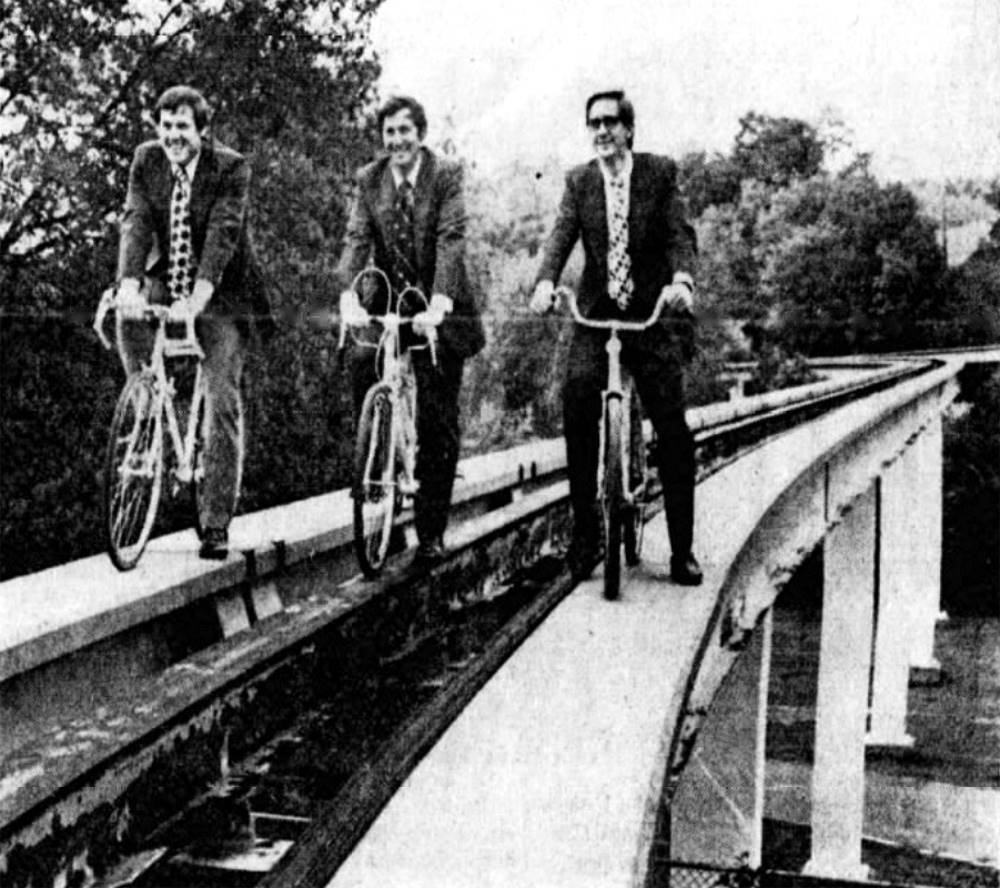
The Skybus Guideway in the late-1970s
Shortly Before Demolition

Across from the stables
on Corrigan Drive near
the county fairgrounds.

Near the North Station
loop by Maple Drive.

Along Corrigan Drive.

Along Corrigan Drive.

Along Corrigan Drive.

My Brief History With Skybus
by Ed Appleby (Director of Vehicle Development)

The very nice article in the Post-Gazette on March 16 about the People-Mover cars brought back many memories. The following is a brief history of this development.

It began in 1960 with a Pittsburgh Area Transportation Study (PATS). A PATS report was issued that came to an applications group at the Westinghouse (W) East Pittsburgh plant. This group engineered equipment for customer applications including equipment manufactured by the Westinghouse Transportation Division (WTD), but this group was not a part of WTD. My only remembrance of this group, in regard to this new system, was one of the engineers who remarked that this system must "get you there more comfortably, in less time and less cost than if you were in your own Cadillac." I do not know what transpired after the issuance of the PATS report and subsequent involvement with the East Pittsburgh applications group, but at WTD we learned, probably in 1962, that an application was being submitted to the federal government to develop a new concept system in which WTD would be involved. At the time we did not know what the concept was, except that it would have its own right-of-way.

The project was handled at W headquarters by George Jernstedt, who was the person our general manager reported to. I had become a manager in 1962 and in late 1963, or early 1964, I was called into the general manager's office, where Mr. Jernstedt was present, and was informed that funding had been approved by the federal government for W to develop this new concept transit system. The general manager informed me that I was to be in charge of the development of the car and that we could not hire any additional personnel for this job.

I realized this was an exceptional challenge, since there was no precedent and no opportunity for prototype testing. We were only designers and manufacturers of propulsion equipment. I was familiar with rail transit cars and automobiles but soon found this knowledge was of limited value for the new concept. At some early stage it was established this would be a two-axle vehicle using automotive truck axles. I don't remember how this came about - perhaps from the Cadillac concept. I also don't remember where the basic guideway of two running surfaces, with a guide beam in between, came from.

About this time Mr. Jernstedt established another group named the Transportation Systems Group (TSG), which was completely independent of WTD and was located at the then new R&D Center. TSG was responsible for the guideway, train control, current collection and marketing. The car body styling was done by a company in Connecticut, Eliot-Noyes Associates. This came about as a directive from Don Burnham (W president at the time) who did business with this company when he was with General Motors Corp. prior to coming to W. A Mock-up of the car was made at Eliot Noyes. I only remember being there with some St. Louis Car Co. representatives.

A portion of the car side had a very slight curvature, barely noticeable, and the St. Louis Car representative asked if it could be made straight for easy manufacturing, to which the answer from Eliot-Noyes was a quick flat out "No." The car was sized to accommodate a maximum of seventy people. There was plenty of discussion about providing doors at the ends of the car, as done on multi-car rail transportation systems, but it was finally decided not to have end doors on this three car development program. These three cars had solid ends with a full size inside cabinet at each end, one end housing the train control equipment and the other the auxiliary control equipment. Eliot-Noyes originally specified individual seats facing inward but that was later changed to bench seats.

Since the concept related more to the automobile than to steel rail cars, TSG wanted a low floor height and told us it should be thirty inches. By this time I had a concept for a possible suspension system, but told TSG that 30 inches was impossible and they agreed to 32 inches. I then proceeded to personally design the suspension system, which was very unique, to provide swivel action for the single axles. However, this suspension was limited to the 150 foot radius of the guideway at South Park.

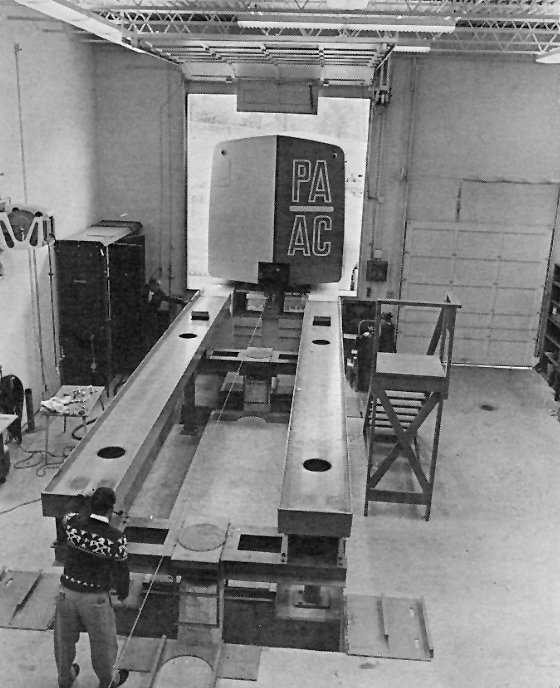
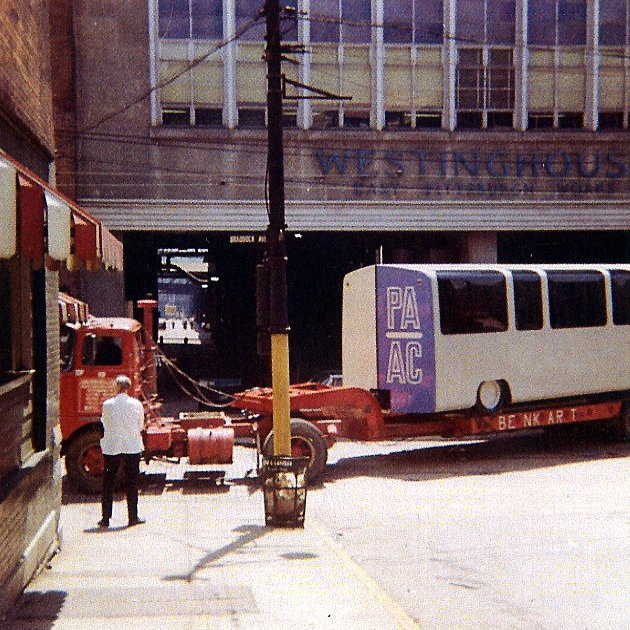
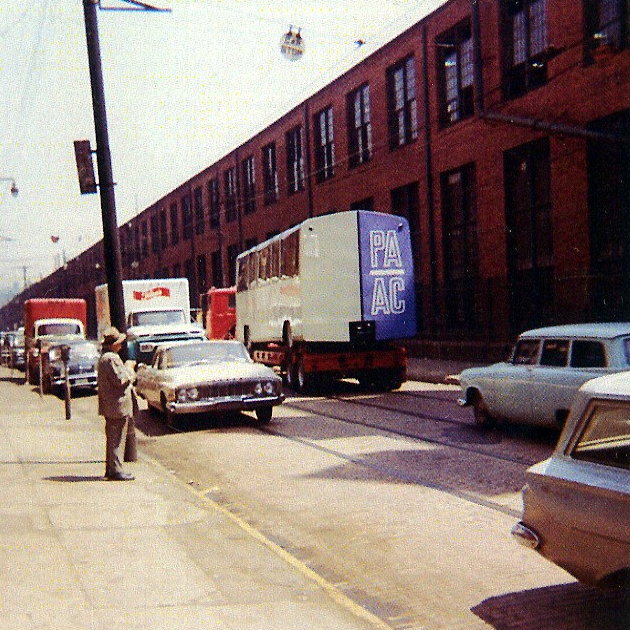
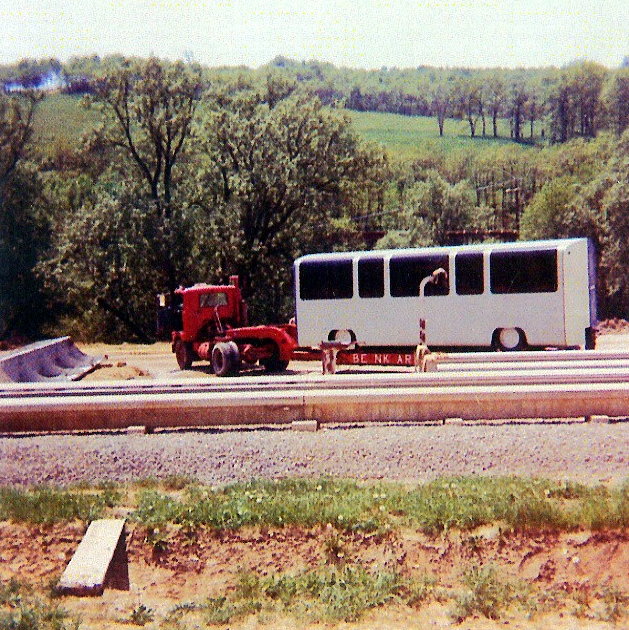
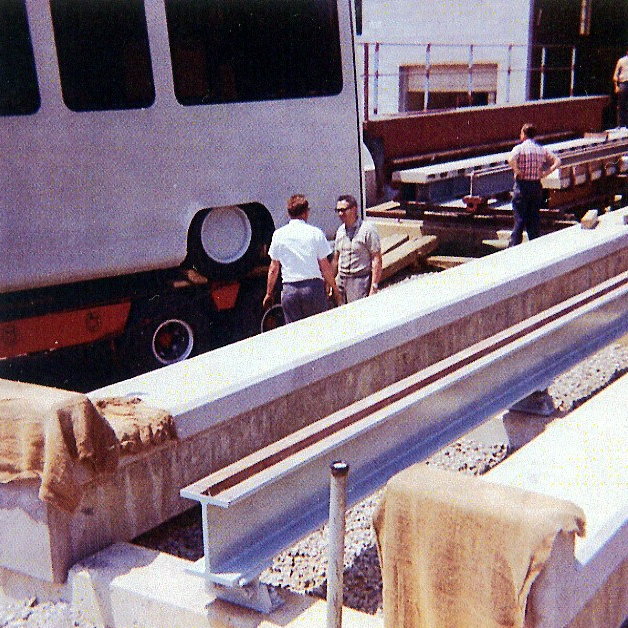
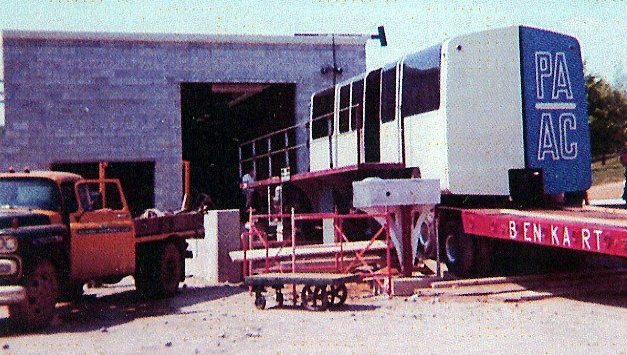
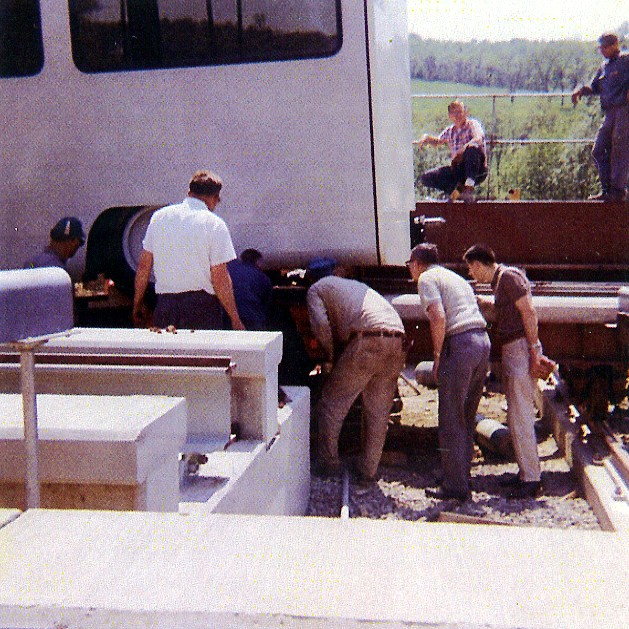
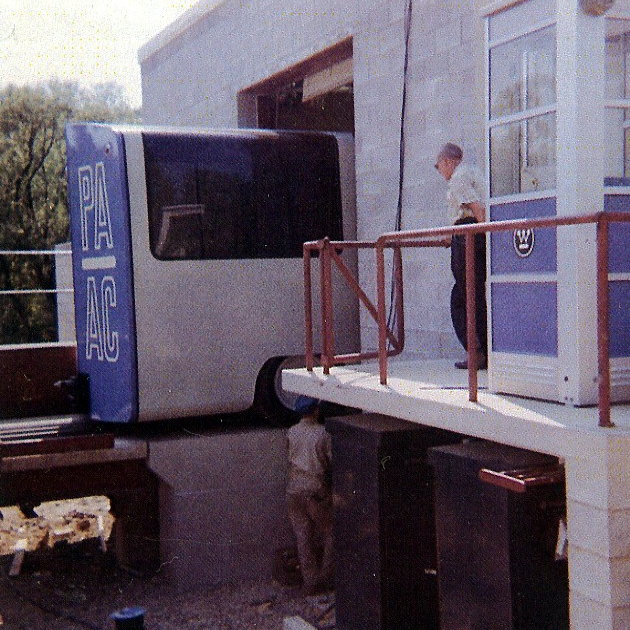
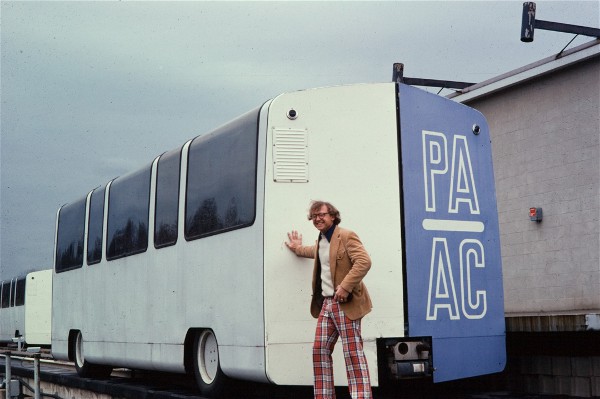
The three original car bodies were made by the St. Louis Car Co. and brought into the East Pittsburgh plant in early 1965 where they were fully equipped. The photos below show the first car, made in the development of the People-Mover system, as it leaves East Pittsburgh and arrives at the South Park site.


The original production Skybus vehicle enroute from the Westinghouse plant to the South Park testing ground.

TSG contracted the guideway to the civil engineering form of Richardson Gordon Associates in downtown Pittsburgh. They did the guideway design for many subsequent installations. The two mile elevated guideway erected at the South Park test site began in the fall of 1964 and was completed in June or July of 1965. I believe TSG engineered the train control in-house. They had trouble and finally brought in an engineer from outside to make the system viable which ultimately led to WTD receiving the train control contract at BART (Bay Area Rapid Transit), the first and last for WTD. I don't know where the train control equipment for the South Park test site was manufactured - probably at the R&D Center. TSG was also the project manager for all of W and I believe they reported to the Allegheny County Port Authority who was the US government designated sponsor for this project.

TSG got the system in operation in time for the 1965 County Fair at which the public first rode on the system during the several days of the fair. The cars were run manually because the automatic train control system was not yet operational. It was a very successful demonstration. Afterwards, an independent engineering firm was hired to fully test and evaluate the system. We, at WTD, did not participate in this. The independent firm did extensive testing on all subsystems and, in 1966, issued a half-inch thick report which lauded all aspects of the system with a few suggestions for improvements.

Skybus miniature models
Miniature scale models of the Skybus cars located at the Westinghouse Museum in Wilmerding.

The Marketing portion of TSG created all the publicity. They had three miniature car models professionally made early in the project. If you look closely at the enclosed photo of the models you can see the individual seats inside the model car. Somehow I wound up with two of the models. When I retired I tried to give them to someone at WTD but nobody wanted them, so I took them with me. I gave them to the W Museum in Wilmerding. The museum has a small display about the Transit Expressway system. TSG also had a quarter scale model of the suspension system made but I do not know what became of it.

An interesting footnote about the Marketing photo showing the three cars on the guideway at South Park. I was told it was made by using only the first car by positioning the car on the guideway at three different positions, with a seperate photo at each position, which was then made into a composite photo showing three cars. I believe the original car was saved and for some time was on display at Station Square. I never saw it there. I also believe this was the car in which I had a four foot square floor section made to be removable, over the suspension area, so that we could observe the suspension while running. The car was later taken to LCS and put under canvas, outside. I do not know it's ultimate fate*.

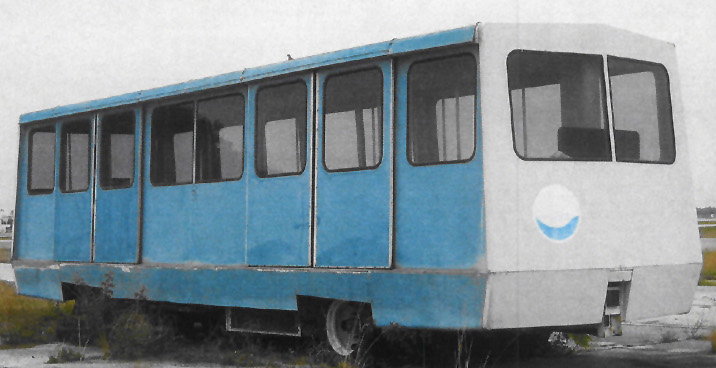
* The original car refered to was located in 2009. It is owned by a private collector in Ellwood City and shown in the photos below, taken in May 2009.

In 1965 Walt Disney came to South Park to evalute our system, probably for Disney World. Also the Newark Airport people came several times to evalute our system for their new buildings. We did not receive an order from either one possibly because it was a brand new, totally different concept and unproven as a viable transportation system. In 1969 we received our first order from the Tampa Airport Authority. It was the South Park system but with larger car bodies and double doors. The Tampa cars were larger to accomodate more passengers. This was followed by an order from the Seattle-Tacoma Airpot Authority in the early 1970s. In subsequent years many more orders were received for this system. Around 1967 the TSG group was merged into the WTD.

One of the original two vehicles purchased
by the Tampa Airport Authority - 1972.
One of the original people-movers purchased by the Tampa Airport Authority in 1970.

The Sea-Tac order brought about a completely new suspension. Sometime, prior to the order, a new engineer was hired from a bus company in Ohio and he created a new suspension system using a large flat anti-friction bearing to permit adequate swiveling of the axle for the 90 foot radius of the Sea-Tac guideway. The new suspension raised the floor height to 42 inches.

The system was originally named Skybus until it was discovered that Skybus was a trademark for one of the airlines. The name was then changed to Transit-Expressway and later to People-Mover when it finally evolved into a special purpose transportation system.

One last historical event occurred in the early-1970s. Some politicians and the Port Authority launched an attempt to have our system installed in the city of Pittsburgh. It became a very public controversy between proponents and opponents which lasted a long time. A ten page analysis of why Skybus never became a reality in Pittsburgh appeared on the internet. It was posted by the Antique Motor Coach Association of PA in regard to preserving PA transit history. One of the interesting considerations was that the system was considered ahead of its time.

I may be the only W person remaining that was in on this development from the very beginning. There are other side stories about the development but they are not pertinent to this abbreviated history. As best as I can recall this is the basic history, mostly related to WTD. I have always maintained that everything is a process of evolution and this People-Mover was no exception. If I looked under the car today I'm sure I wouldn't recognize even one piece of equipment, but this has led to the premier People-Mover system in the whole world.

<Whatever Happened to Skybus - Video Presentations>
(click on either of two full-length videos - Quicktime software required)

* Special thanks to Ed Appleby for sharing his story and photos *

Skybus model built by Michael Brendel - May 2009

Return to Skybus - May 2009
(Discovery of the Lost Vehicle and a Time for Reflection)

The Skybus train works its way
through South Park. Here it begins
the loop at Maple Street heading
towards the North Station. After
looping the train heads back up
Corrigan Drive for the trip back
to the loading platform near the
County fairgrounds.

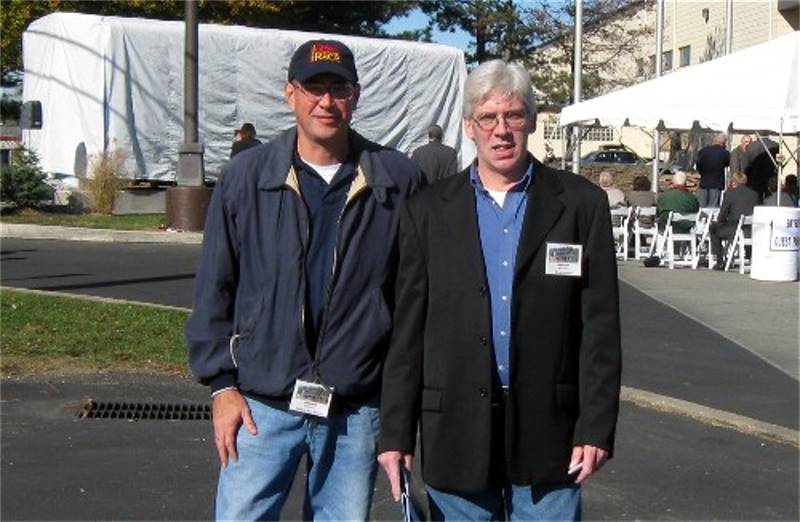
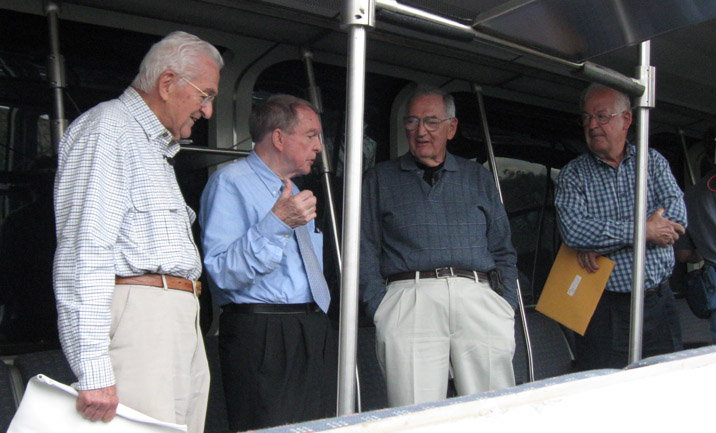
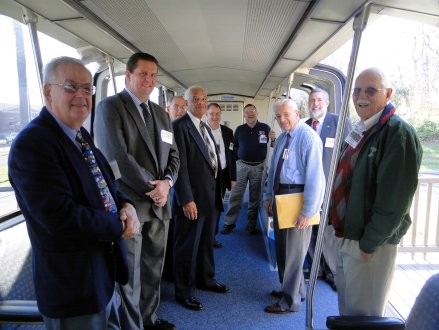
On May 1, 2009, former Westinghouse engineers who were involved in the Skybus project, along with KDKA investigative reporter Dave Crawley, gathered to inspect the last of the original Skybus cars. The vehicle is owned by a private collector in Ellwood City (Harold Hall, owner of Hall Industries). The meeting was arranged by Doug Brendel, a local Skybus enthusiast. Brendel had spent the past two years researching Skybus history. A short KD Country video segment was filmed on the day of the reunion and broadcast on May 8, 2009.

<View the KD Country Video Segment from May 8, 2009>

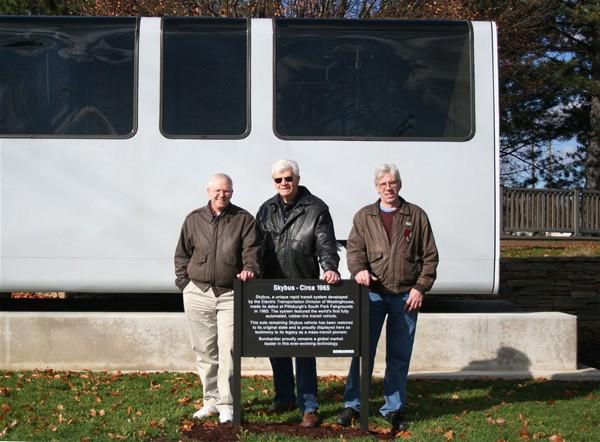
Ed Appleby, Harold Hall, Bill Segar and Arthur Bistig
Distinguished guests Ed Appleby (Director of Vehicle Development), Harold Hall (Hall Industries)
Bill Segar (Skybus Project Director) and Arthur Bistig (Project Engineer.)

Former Westinghouse Skybus engineers gather to inspect
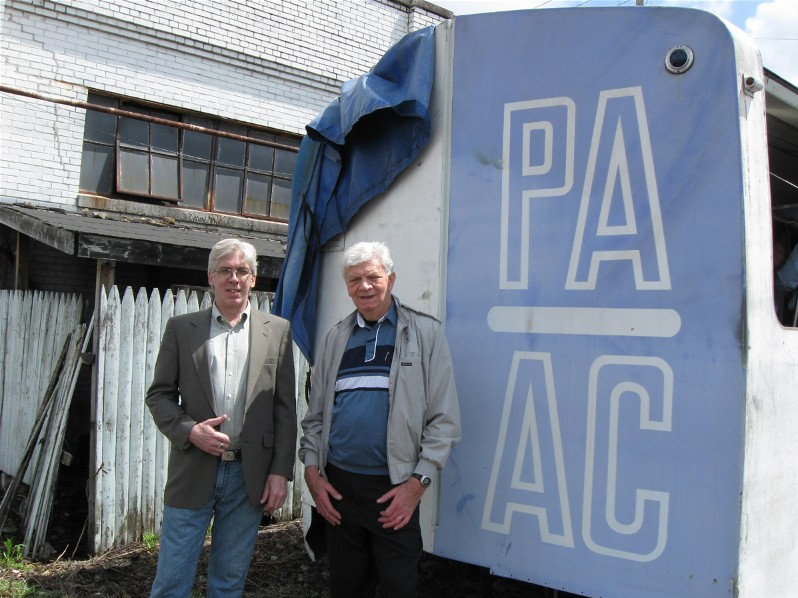
the last remaining vehicle from the 1960s project.    Doug Brendel and his father Joe Brendel
have led the movement to have the Skybus
story told, and remembered as a part of
Pittsburgh's transportation history.

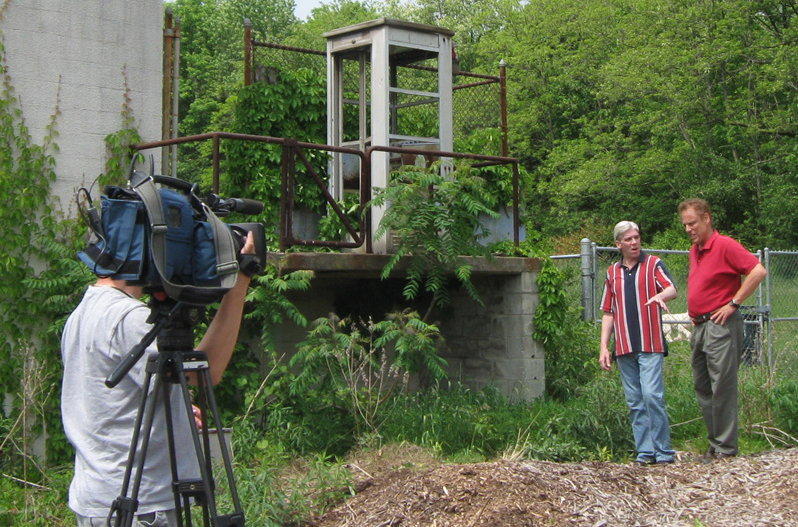
On May 23, 2009, Dave Crawley and his cameraman returned, this time to the old North Station in South Park to meet with Doug Brendel. Crawley shot some followup video for a longer Skybus special to be aired on WQED's OnQDemand on June 4, 2009. Brendel is leading a grass roots effort to restore the Skybus vehicle and find it a permanent museum home.

<View the OnQDemand Video Segment from June 4, 2009>

North Station - Transit Expressway    The North Station

The control panel at the North
Station switching terminal.    KDKA investigative reporter Dave Crawley
interviews Doug Brendel on May 23, 2009.
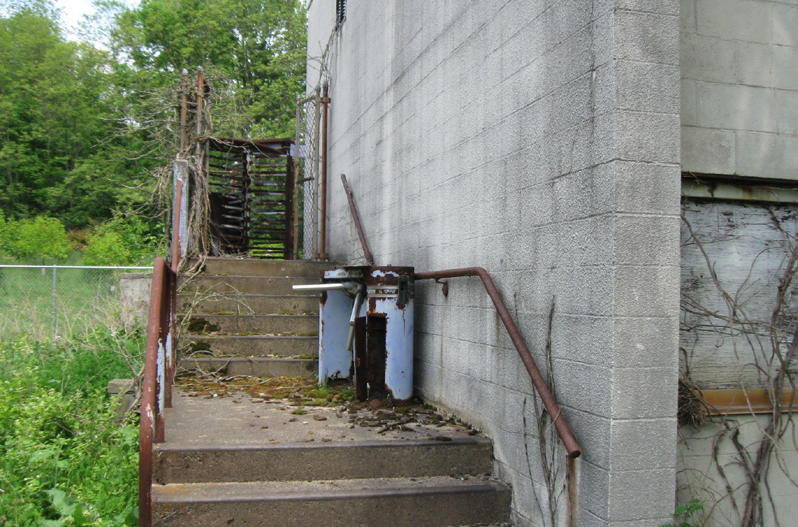
Clockwise from upper left - The North Station loading platform; Steps leading to the loading platform;
KDKA's Dave Crawley (right) interviews restoration consultant Doug Brendel; Vehicle transfer control.

Skybus on Canvas

The Final Chapter - Skybus 2010
(Restoration and Museum Display)

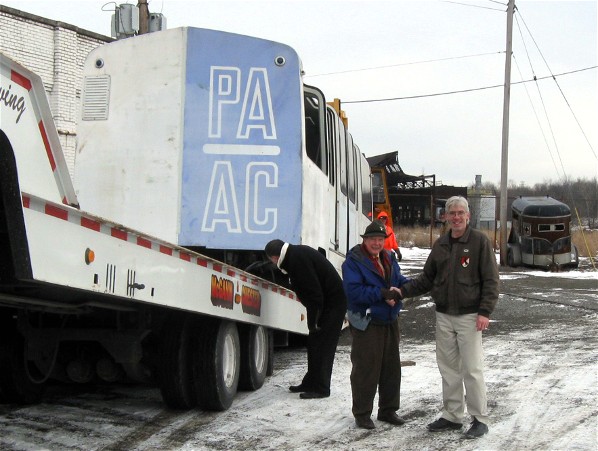
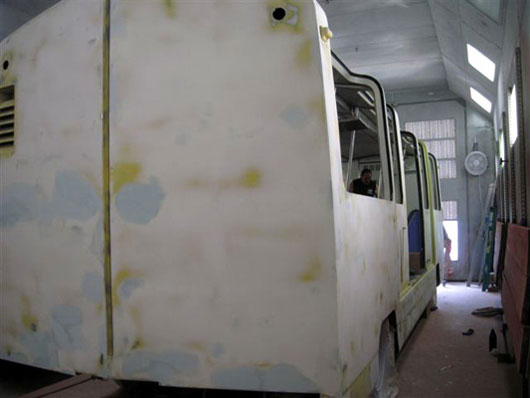
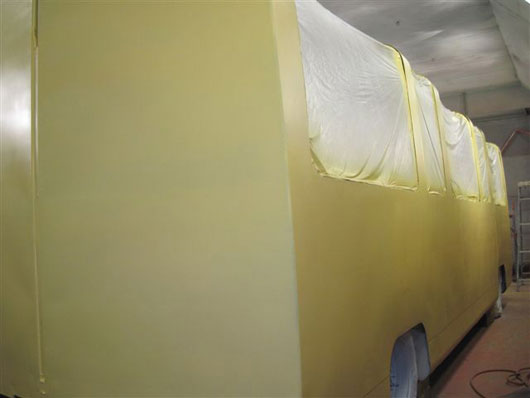
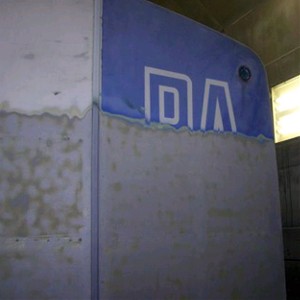
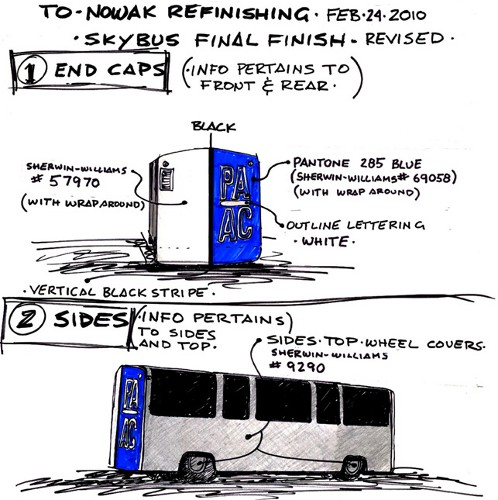
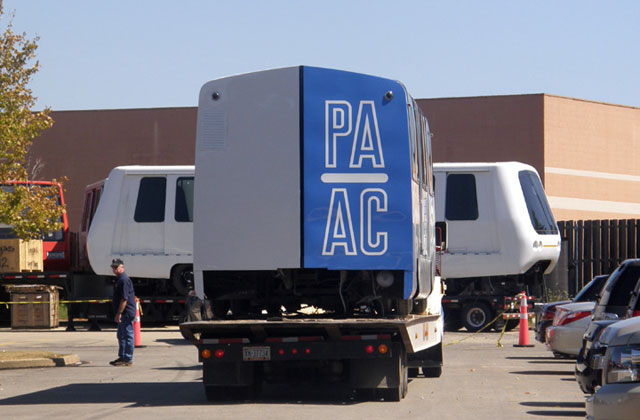
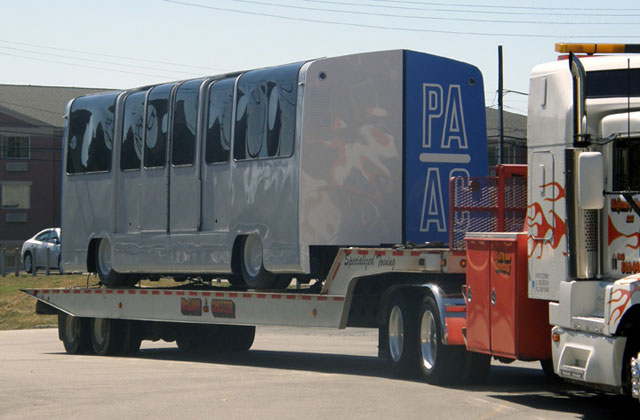
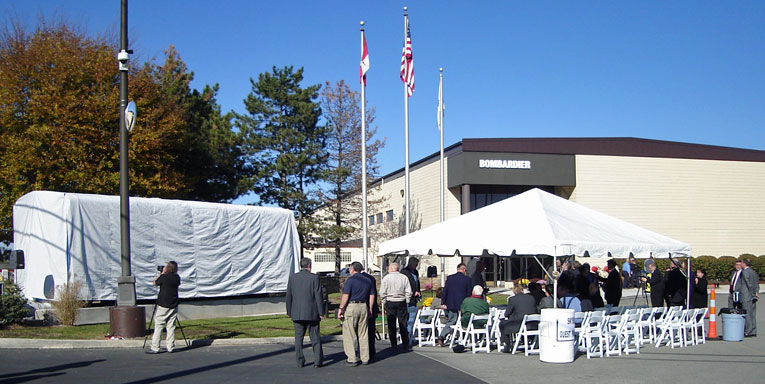
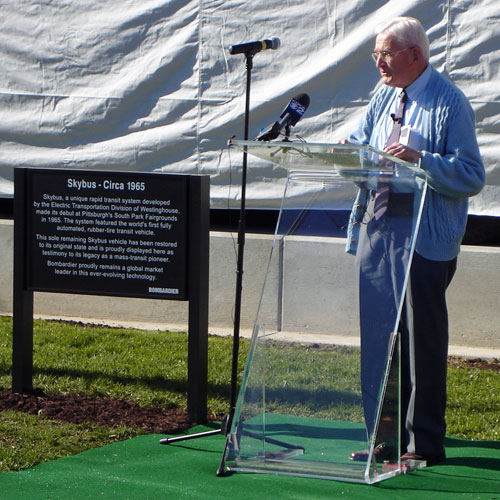
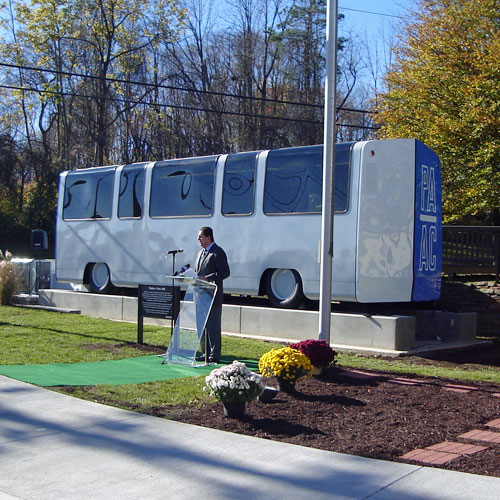
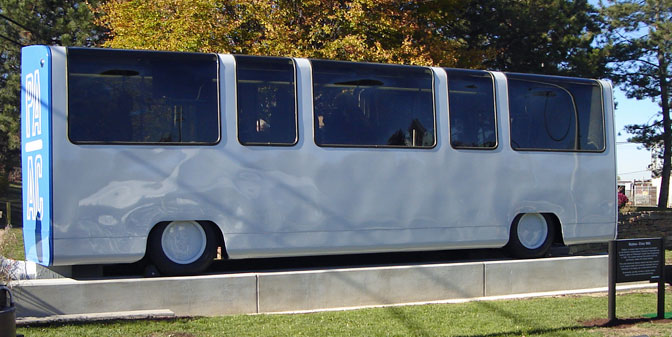
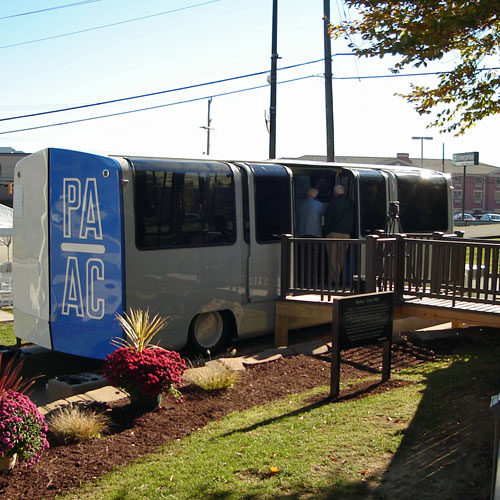
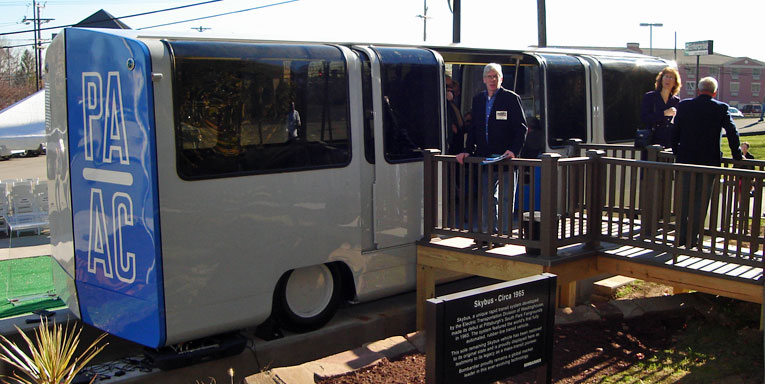
In November, 2009, led by Brookline resident Doug Brendel, Bombardier, Inc. entered into negotiations with Hall Industries to purchase the Skybus vehicle and restore it to it's original luster. In December the deal was completed and the vehicle was moved to Nowak Commercial in Amity, Pa. for a make-over. When restoration is complete, the car will be transported to Bombardier for permanent display at it's West Mifflin headquarters. If all goes as planned, the vehicle should be ready for unveiling by the Fall of 2010. KDKA's Dave Crawley, who has been following the Skybus story since May of 2009, was again on hand to document the move.

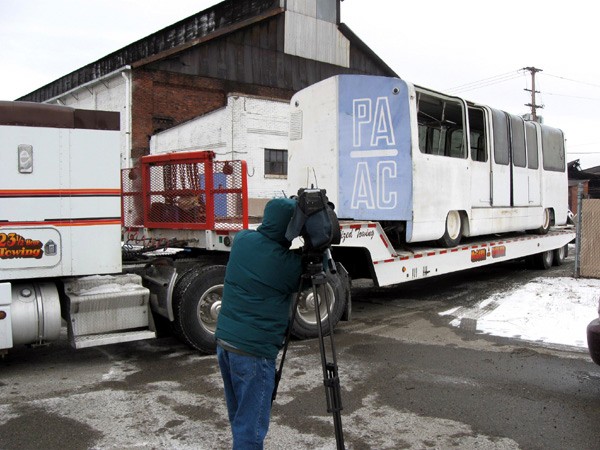
Harold Hall and Doug Brendel    The Skybus vehicle being towed to
Nowak Commercial in Amity, Pa for
restoration. When complete it will
be displayed at the West Mifflin
headquarters of Bombardier, Inc.
Harold Hall and Doug Brendel seal the deal as the original Pittsburgh Skybus vehicle is transported
to Nowak Commercial for restoration in December 2009. The event was documented by KDKA TV.

<View the KD Country Video Segment from December 30, 2009>

<View Photos of the Restoration Work - January 29, 2010>

One of the original Tampa Airport vehicles to be
restored along with the Skybus car - April 2010.
One of the original 1970 Tampa Airport people-mover vehicles awaiting restoration in April 2010.

In addition to the original South Park Skybus vehicle, Mr. Brendel is also involved in the restoration of the original Tampa Airport Authority vehicles. These two People-Mover cars were designed and built in Pittsburgh by the same Westinghouse engineers that worked on the Skybus project. The cars are currently owned by Bombardier, Inc. and are in the process of rehabilitation by Nowak Commercial.

More information and photos to come once restoration is complete. Stay tuned!

<Historical Facts> <> <Brookline History>