|


The Independence Day Parade along
Brookline Boulevard on July 4, 1959.
The City of Pittsburgh and the
Community of Brookline have histories that date back to the pre-Revolutionary
War days of the 18th century. Since the time of the early pioneers until today,
Brookline and the surrounding area have seen many changes, evolving from a
rural farming community into the modern city neighborhood that we live in
today.
♦ Brookline - The First 265 Years (1754-2019) ♦
Brookline History, attempts
to explore the origins and history of the Brookline area. Much of this
information comes from old Brookline Journal articles, dating from the 1950s, that
detailed bits and pieces of Brookline's past.
We've enhanced that over the years with
other interesting facts and anecdotes about the neighborhood and the City of Pittsburgh.
It's all here in one long, essay with enough additional links to keep a history
buff happy for hours. That much said, with many limitations, this page provides an
interesting look back in time at the Brookline community and and the city we call
home.
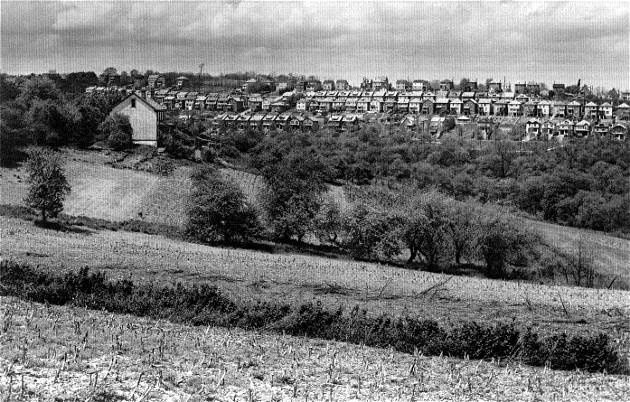
The Anderson Farm, shown in 1936, and the hillside homes in East Brookline
show the contrast between Brookline's rural roots and urban development.
Note: A large collection of Brookline
Journals dating from 1947 through 1962 has been discovered. We were able to scan
two years worth and with the help of community organizations are attempting to
obtain permanent possession of this historic community record ...
♦ 1951 Year In Review ♦ *** ♦ 1951 Brookline Journal Collection ♦
♦ 1952 Year In Review ♦ *** ♦ 1952 Brookline Journal Collection ♦

The Brookline Savings and Trust Company
was formed in 1926. It played a big part in the growth
of the community. The bank was sold in 1969 and is
currently a branch office of PNC Bank.
Brookline Churches, Schools and Recreation
The history of many of the local churches
and elementary schools (past and present), along with the origins of the public education
and recreation facilities, based on the recollections of Professor Joseph F. Moore,
recount the contributions of these institutions to Brookline's heritage.
♦ Brookline Public Education and Recreation History ♦
♦ Our Lady of Loreto Church and School History ♦
♦ St. Mark Evangelical Lutheran Church History ♦
♦ Brookline United Presbyterian Church History ♦
♦ Brookline Methodist Episcopal Church History ♦
♦ Toner Institure Church and School History ♦
♦ Episcopal Church of the Advent History ♦
♦ Resurrection Church and School History ♦
♦ St. Pius X Church and School History ♦

A Square Dance at Brookline Elementary
School in the spring of 1947.
One thing that most Brookliners can
remember from their years as youngsters, with the exception of their days
at school, is the time spent playing sports in one of the local athletic
leagues. Brookline has developed a rich tradition of Little League baseball,
Prep League football and Youth Soccer, and the activities offered at Moore
Park and the Brookline Community Center have enriched young
and old alike.
♦ Brookline Little League Baseball Team Photos ♦
♦ Brookline Knights Football Team Photos ♦
♦ Brookline Royals Sandlot Football Club ♦
♦ Brookline Recreation Center Photo Gallery ♦
♦ Moore Park Photo Gallery ♦

The 1978 Brookline Knights Mitey-Mite
championship football team.
Brookline Maps
The following maps show the transition of
Brookline from rural West Liberty Borough (1876), through the first residential growth
phase (1910) to modern-day Brookline (1997), with it's current borders and street
layout. The maps show a great deal about the development of the
community.
In the 19th century, West Liberty Borough,
which also included Beechview, was dominated by farms and mining ventures.
Scattered homes and a few commercial properties dotted the landscape. As late as
1905, Brookline Boulevard was listed as Knowlson Avenue and housing development
had only begun, with just the Paul Place, Hughey Farms and Fleming Place Plans
on the map. By 1910 the community had been annexed into the city of Pittsburgh
and the rural landscape began to take on a more urban look. This development
continued through the 1970s.
♦ Colonial Survey Maps of Land Grants
in the South Hills ♦
♦ Original Brookline Landowners
Boundary Overlay Map ♦
♦ Brookline Map
1851 ♦ ♦ Brookline Map
1862 ♦
♦ Brookline Map
1876 ♦ ♦ Brookline Map
1886 ♦
♦ Brookline Map
1896 ♦ ♦ Brookline Map
1905 ♦
♦ Brookline Map
1910 ♦ ♦ Brookline Map
1916 ♦
♦ Brookline Map
1926 ♦ ♦ Brookline Map
1934 ♦
♦ Brookline Map
1997 ♦ ♦ Brookline Map
2003 ♦

♦ Map Of 72 Brookline Developmental
Subdivisions ♦
♦ Original West Liberty Borough
Boundary Overlay ♦
♦ Map Showing Growth Of
Brookline ♦
♦ Map Showing Brookline
Voting Wards ♦
♦ Old Maps of Brookline's Oak
Mine ♦
♦ Brookline Geodetic and Topographic Maps
1927-1955 ♦
♦ The Hopkins Map Collection 1872-1939 ♦
♦ Pittsburgh Historic Maps (Interactive) ♦
The early-20th century borders of the
community were slightly different than today. Before the Fairhaven/Overbrook
land, now refered to as East Brookline, was annexed into the city, Brookline's
eastern boundary was Whited Street. In the 1920s that boundary was extended
to Jacob Street. An interesting feature of the 1910 map is the peculiar street
names.
In 1908, when West Liberty Borough was
annexed into the City of Pittsburgh, many of the road designations had to be
changed due to conflicts with existing city street names. Many of these
changes and not had yet to be incorporated into the books. The 1916 map often
shows the new name along with the old name in parenthesis.

A long-forgotten subplot
named Brookdale, located
in East Brookline. It was vacated in 1982.
Another point of interest is how many
different subdivisons there are within the boundaries of the present-day
community. As large parcels of land were made available for development, the
plots were given an official designation by the improvement company.
In addition to
the Paul Place, Hughey Farms, Fleming Place plans along the hillside bordering
West Liberty Avenue, there are the King Place Plan, the Robinson Place Plan
and the Andrew Cullen Plan, each with a distinctive border. Throughout the
Brookline community there are over seventy separate subdivisions.
Along with development comes the
loss of old homes and buildings that
were once a vital part of the fabric of the community. To see many
of these forgotten images visit our feature page: Lost Brookline.

Brookline Aerial Views
The following images give a
bird's eye view of Brookline from 1939 through 2006,
showing how the community developed over that sixty-eight year
time frame.
♦ 1939 ♦ 1957 1967
♦ 1993 2005 2006 2015 ♦
♦ Brookline As Seen From Above -
Fall 2014 ♦
* Photos and Short Video by Matt Lackner *

A 2011 satellite image of the intersection
of Brookline Boulevard and Pioneer Avenue.
♦ Google Brookline - 2014 Satellite
Images ♦
Real Estate Advertisements
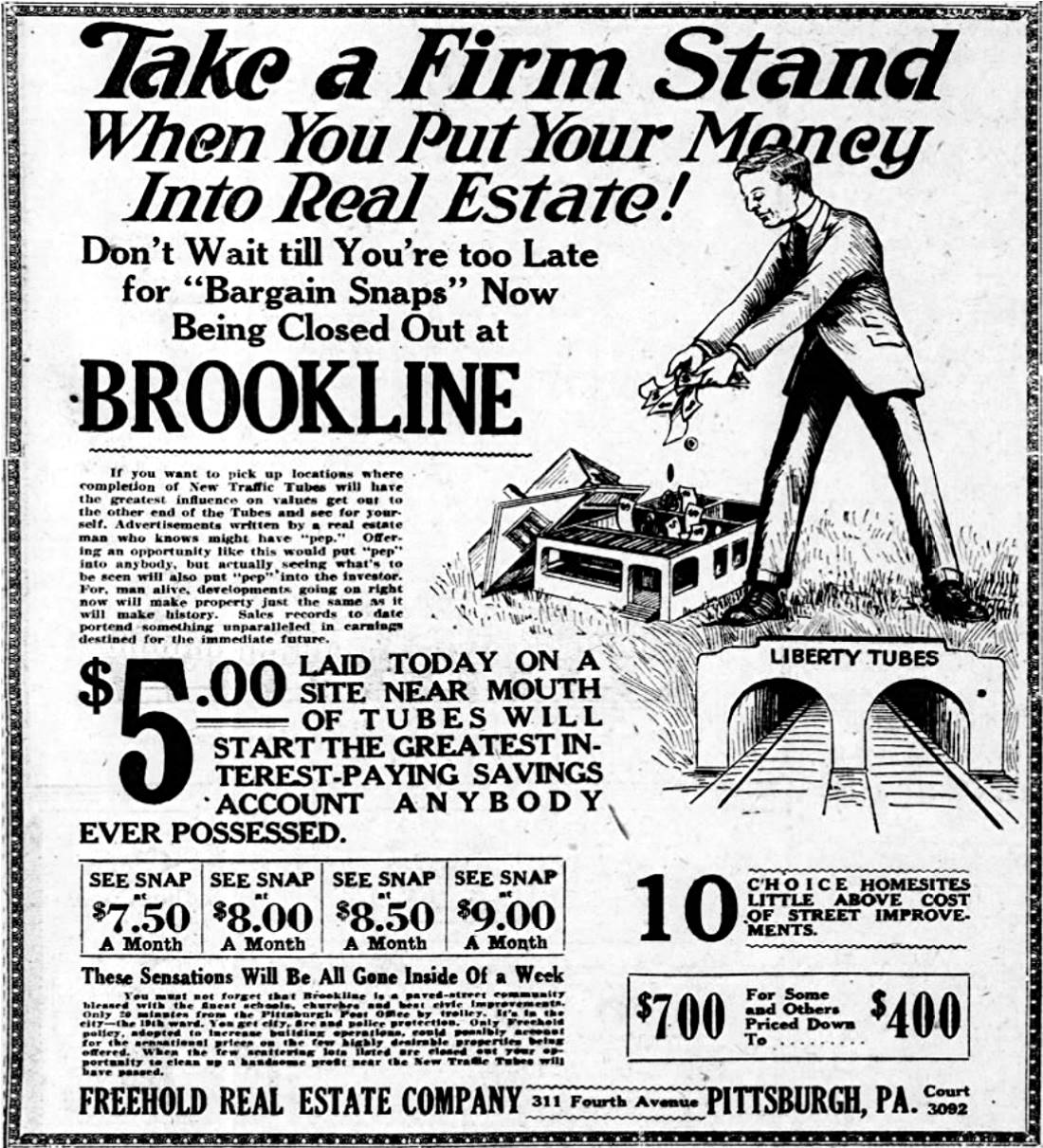
♦ Fleming Place/Hughey Farms Real
Estate Advertisements (1902) ♦
♦ Freehold Real
Estate Advertisements (1904-1916) ♦
♦ Freehold Real
Estate Brochures (1921-1926) ♦
♦ Freehold Real
Estate Advertisements (1930) ♦
♦ Beechview/Dormont Real Estate Ads
(1901-1917) ♦
Pittsburghese and Brooklinese
Pittsburghese is a term that represents
the rather unique vocabulary that has evolved over the years in Pittsburgh and
the surrounding area. From phonology to vocabulary, grammar to intonation, the
language of the 'Burgh is something that only a true Yinzer can
appreciate.
Growing up in Pittsburgh, foods like
chipped ham, dippy eggs, jumbo, hoagies and pierogies were often on the menu.
Driving up and dahn slippy roads can be rough, and running the sweeper at
home is part of reddin' up.
Getting jagged by jaggers, annoyed by jagoffs,
and caught just jaggin' aroun' was part of growin' up. While doin'is and
doin'at, Pittsburghers have developed quite a way of expressing themselves.
It's a 'Burgh thing.

Wikipedia: Pittsburghese
Brookliners are well-versed in
Pittsburghese, and have coined some unique words and phrases of their own
that might be considered Brooklinese. Generations of students
went to Rezzi. Many walked the boulavard to get to school
and others took the bus.
After school, kids would take the cuts
through the neighbor's yards and hoy their friends. They'd then
go dahn the park, or cross the pipe to get to the Center.
Buying penny candy at the little store, getting a comic book
at Newsies, or enjoying an iceball at
the Little League games was always a treat. At night, it was time to get
home when the lights came on. It's a B-line thing.

Pittsburgh and Brookline Population
According to 2010 census results,
the population in the neighborhood of Brookline now stands at 13,214,
down over 7,000 since residency peaked at 20,381 in 1960. Brookline
now ranks as the third most populous community in the City of Pittsburgh,
behind Squirrel Hill South (15,110) and Shadyside (13,915).
The City of
Pittsburgh's total population was recorded at 305,704 in 2010, ranking
59th on the list of United States cities, down over 50% from it's peak
number of 676,806 in 1950.

|
Pittsburgh
2018 - 305305
2010 - 305704
2000 - 334563
1990 - 369879
1980 - 423938
1970 - 520117
1960 - 604332
1950 - 676806
1940 - 671659 |
Brookline
2018 - 13225
2010 - 13214
2000 - 14316
1990 - 15488
1980 - 17231
1970 - 20336
1960 - 20381
1950 - 16559
1940 - 14721 |
<The Growth of Pittsburgh - Annexation and Population>
Wikipedia: United States Cities By Population.

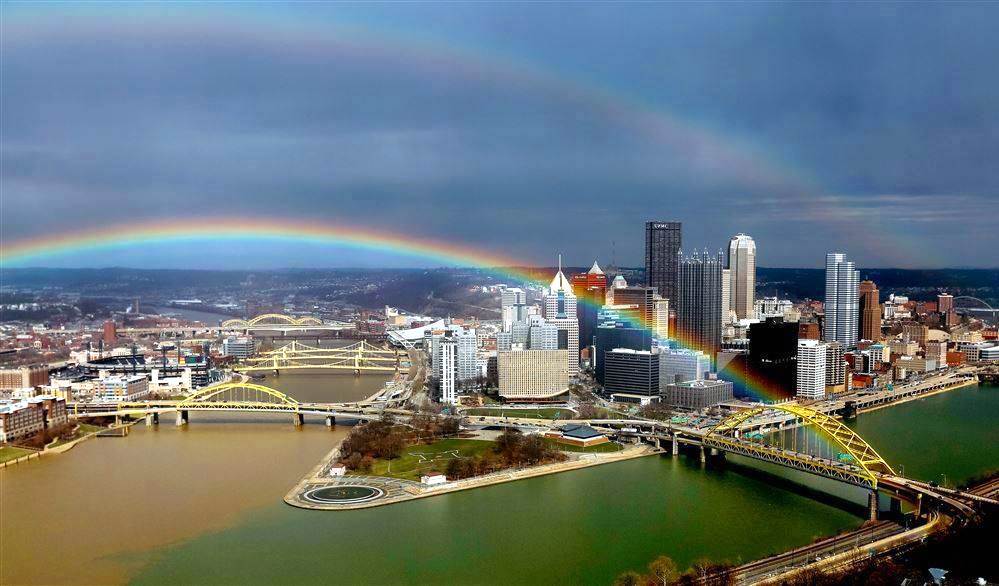
Pittsburgh framed in a double rainbow
at sunset in this May 29, 2020, Dave Dicello photo.
What's the Spelling - Pittsburg or Pittsburgh?
Believe it or not, Pittsburgh is the most
misspelled city in America, according to a study by ePodunk. The most common
misspelling is the word Pittsburgh spelled without its 'h.'
Pittsburgh, named by General John Forbes
in honor of Sir William Pitt, has officially ended in an 'h' since its founding
in 1758. Documents throughout the late 1700s and early 1800s refer to the area
as the 'Manor of Pittsburgh,' the 'Town of Pittsburgh' or the 'Borough of
Pittsburgh. The 'h' is firmly intact in all referrals. The only exception to
this standard occurred during the time period from 1890-1911.
On a federal level, with regards to the
official naming of locations and things, as the country expanded and technology
evolved, the need for standardization arose. In 1890, President Benjamin Harrison
established the U.S. Board on Geographic Names to help restore order to the
naming of cities, towns, rivers, lakes, mountains and other places throughout
the United States.
At that time, some states actually had as
many as five different towns with the same name which, understandably, caused
confusion. In Pittsburgh's case, although the name of the municipality was always
intended to have an 'h', a simple typographical error in 1816 had some not so
simple consequences.
When Pittsburgh was being incorporated as
a city in 1816, a printer s error dropped the 'h' from the end, even though the
original city charter included it. Throughout the rest of the 1800s 'Pittsburg'
without the 'h' turned up here and there in newspapers and other printed material,
but official documents always retained the 'h'. Pittsburgh with the 'h' was the
most common spelling. It seemed no one much cared about the occasional
misspelling, for a while.
Seventy-four years after the typo, as the
Board announced their decision on the naming issue, they went to so far as to
insert a special section in their report citing Pittsburg s erroneously printed
charter documents of 1816 as being correct, stating that the h had been added
unofficially added by the post office.
With this in mind, one of the first codes
established by the new Board was that the final 'h' should be dropped from the
names of all cities and towns ending in 'burgh' in the spirit of
uniformity.

Some residents were pleased with the
decision, but the majority were not. Those who liked the Pittsburgh without the
'h' reasoned that it seemed more modern. Those who disliked the ruling argued
that the city would no longer be unique, making it as commonplace as the many
other Pittsburgs throughout the land.
The proud citizens of Pittsburgh who
disliked the ruling and consider their 'Burgh an obvious historical exception,
refused to give in to the Board's ruling. A campaign was mounted to keep the
traditional spelling. Ironically, William 'H.' Davis spearheaded the effort,
enlisting the backing of Pennsylvania's U.S. Senator George T. Oliver in the
battle.
Twenty years later, in 1911, the Board
finally relented and restored the 'h' to Pittsburgh. The official decision to
restore the 'h' was handed down by the Board on July 19, 1911. In a letter to
Senator Oliver, Board Secretary C.S. Sloan stated:
"At a special meeting of the United
States Geographic Board, the previous decision with regard to the spelling of
Pittsburg without a final 'H' was reconsidered and the form given below was
adopted: Pittsburgh, a city in Pennsylvania (not Pittsburg)."
To this day, many people remain confused.
There are nineteen other cities or towns in the United States with the same
name. There are two in the state of Illinois alone. Of those nineteen, only one,
a tiny town in North Dakota, spells it "Pittsburgh," like a true
'Burgher.
With pride in Pittsburgh, and firm in
the belief that our city is better with the 'h' than without it, July 19 is
commonly referred to as 'H' Day in the city of Pittsburgh.
|
Pittsburgh, Pennsylvania
Pittsburg, California
Pittsburg, Colorado
Pittsburg, Florida
Pittsburg, Georgia
Pittsburg, Illinois
Pittsburg, Illinois
Pittsburg, Indiana
Pittsburg, Iowa
Pittsburg, South Carolina |
Pittsburg, New Hampshire
Pittsburg, Michigan
Pittsburg, Missouri
Pittsburg, Kentucky
Pittsburg, Oklahoma
Pittsburg, Oregon
Pittsburg, Kansas
Pittsburg, Texas
Pittsburg, Utah
Pittsburgh, North Dakota |
 
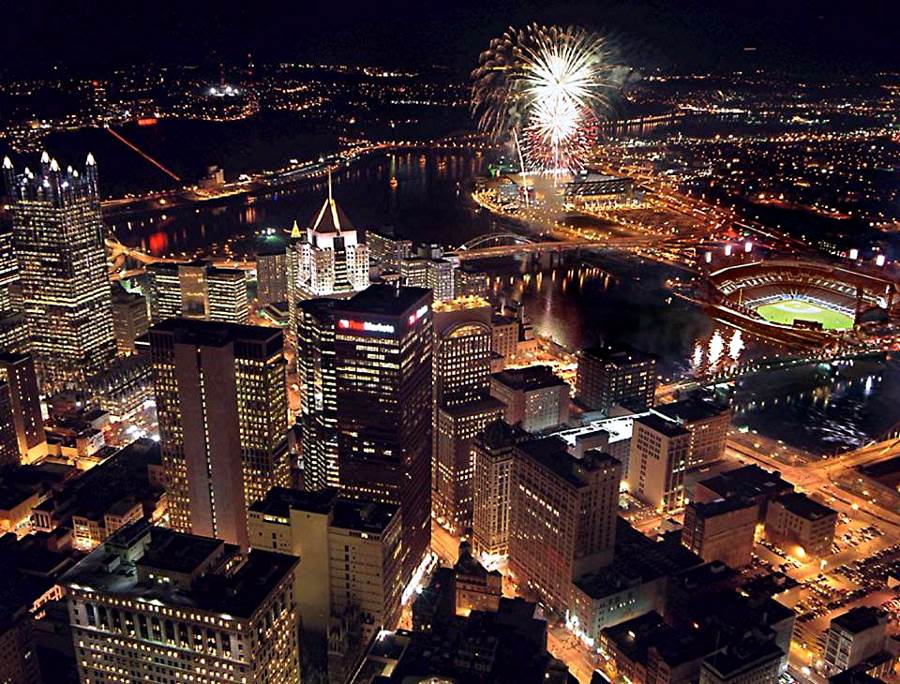
A steamy Pittsburgh sunrise on a frigid
morning (02/17/2014) and a heavenly Pittsburgh fireworks display
(07/04/2013).

The Sister City movement in the United
States was launched by President Eisenhower in 1956 as the "People-to-People
Program," whose purpose was to establish friendship and deepen understanding
between the people of the United States and the peoples of other nations through
direct contact. Founded in 1956 as a direct outgrowth of President Eisenhower's
initiative, Sister Cities International was formed. It is a nonpartisan,
nonprofit organization that serves as the national membership organization for
individual Sister Cities, counties, and states across the United States. This
network unites tens of thousands of citizen diplomats and volunteers in 140
countries on six continents.
In the United States, "Sister Cities"
denotes the formal relationship between two communities consummated by the
signature of the mayors of both cities and recognized by Sister Cities
International. "Friendship City" relationships refer to a partnership that is
less formal and more limited in scope. The establishment of a friendship city
relationship can be an important step in building the foundation for a long-term
vibrant and sustainable Sister City relationship.
A Sister City relationship is created when
a municipality decides to partner with a municipality in another country to deepen
global understanding, learn from each another through the exchange of "best
practices," and to develop meaningful long-term economic, educational, and
cultural exchanges. A Sister City is a sustained formal partnership between to
communities. These partnerships can serve as the foundation for a diverse range
of activities, and include every type of local government, business, professional,
educational, and cultural exchanges or projects.
Since the 1950s, the City of Pittsburgh has
established twenty-one Sister City partnerships:
|
Bilbao, Spain
Donetsk, Ukraine
Fernando de la Mora, Paraguay
Karmiel, Israel
Matanzas, Cuba
Misgav, Israel
Omiya, Japan
Ostrava, Czech Republic
Presov, Slovakia
Saarbrucken, Germany
Glasgow, Scotland |
Saitama City (Urawa), Japan
San Isidro, Nicaragua
Sheffield, United Kingdom
Sofia, Bulgaria
Wuhan, China
Zagreb, Croatia
Skopje, Macedonia
Da Nang, Vietnam
Naucalpan, Mexico
Gaziantep, Turkey |
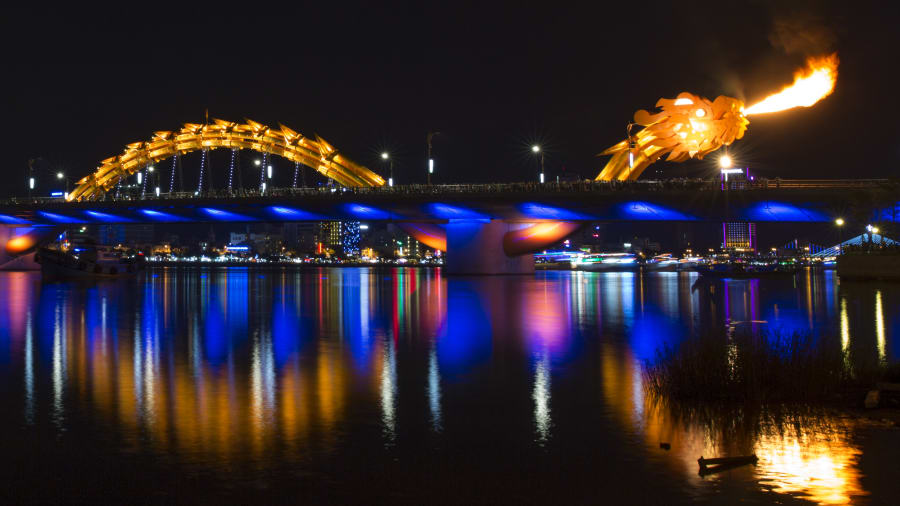 
The Dragon Bridge (left) in Da Nang, Vietnam,
and an open square in downtown Zagreb, Croatia, in January 2018.
The Five Brooklines
Just like there are twenty separate Pittsburghs,
or Pittsburgs, there are five distinct Brooklines within the borders of the United
States of America. The most well-known, and largest, of the Brooklines is located in
Massachusetts. Brookline MA is a town in Norfolk County, part of the Greater Boston
area. The town was settled as a hamlet of Boston in 1638 and chartered as an independent
municipality in 1705. Birthplace of President John Fitzgerald Kennedy, the population was
58,732 in 2010.
Brookline, New Hampshire is a town in Hillsborough
County, chartered in 1769, with a population of 4991 in 2010. Brookline, Vermont is a
town in Windham County, chartered in 1794, with a population of 467 in 2000. Brookline,
Missouri is a former village in Greene County, chartered in 1971, with a population of
326 in 2000. This small Missouri town was consolidated with the City of Republic in 2005
yet retains its distinct name of Brookline.

And then there is our Brookline, nestled in the
South Hills of Pittsburgh, Pennsylvania. Once part of West Liberty Borough, Brookline was
founded in 1905 and became a distinct city neighborhood in 1908. The population of
the Brookline community was 13214 in 2010.
What a strange feeling it would be for a
Pittsburgh Brookliner to be driving down a Massachusetts avenue and encounter a sign
that says "Entering Brookline."

Allegheny County Belt System
The Allegheny County Belt System was developed in the
late 1940s by Joseph White, an engineer with the Department of Public Works, as a wayfarer
system using a network of federal, state, and municipal roads to offer residents alternative
traffic patterns which did not lead to downtown Pittsburgh's congested Golden
Triangle.
It predates the Interstate Highway System developed
during the Eisenhower administration. From late-1951 to the spring of 1952, signs were posted
throughout the selected beltway routes, starting with the Orange route, then Blue, Yellow, Red
and Green.
These belt routes were not intended as high speed or
limited access roads, but instead as a well-defined road system away from the existing major
roadways and their congestion. They were also designed to assist lost drivers, who could follow
a belt and eventually meet a main road that would help them orient.
The construction of the interstate highway system and
regional parkways during the late-1950s through the early-1970s initially reduced the use and
need of the belt routes. As urbanization of the county spread further out from the City of
Pittsburgh, however, the Belt System helped to reduce the effects of suburban
congestion.

The Red Belt, the outermost in the system, does not make
a complete loop like the others. Instead, it runs entirely east west across the northernmost
part of the county. The current Red Belt is 33.5 miles and runs through largely rural
communities. The Orange Belt is the longest, running 91.7 miles. The Orange Belt originally
made a complete loop until a twelve mile stretch from Bethel Park to Elizabeth was
decommissioned.
The Yellow Belt is one of two belts, along with the Blue
Belt, to make a complete loop around the city, over a distance of 77.6 miles. The Green Belt
forms a half-circle around the city, with a length of 38.6 miles. The Blue Belt is the innermost
of the original belts and makes a complete 38.1-mile circle around the outskirts of the
city.
The Purple Belt is the innermost colored belt in the
system, established in 1995 by the City of Pittsburgh. It runs through downtown Pittsburgh in a
loop on four two-way streets: Stanwix Street, Fort Duquesne Boulevard/11th Street, Grant Street
and Boulevard of the Allies. It uses a different type of signage with purple coloring as part
of the Pittsburgh Wayfinder system and, unlike the other belts, is intended to assist tourists
navigating downtown.
Prior to 1980, the Gulf Oil Corporation, with headquarters
in Pittsburgh, published maps of Allegheny County prominently displaying the Belt
System.
Pittsburgh City Council Representatives
Pittsburgh's City Council is the legislative branch of government. It carries out duties in
accordance with the Home Rule Charter and the laws of the state. It is primarily
responsible for making laws which govern the City of Pittsburgh. City Council is
composed of nine members. Each member represents one council district.
Brookline is part of District 4, which also
includes the communities of Beechview, Bon Air, Overbrook, most of Carrick, and a
small portion of Mt. Washington.
District 4 City
Councilmembers since 1989:

Anthony Coghill
(present-2018)
|
Natalia Rudiak
(2018-2010)
|

Jim Motznik
(2010-2002)
|
Michael Diven
(2002-1998)
|

Joe Cusick
(1998-1994)
|

Jack Wagner
(1994-1984)
|

District 4 Councilman Anthony Coghill
being sworn in By Judge Jim Motznik on January 3, 2018.
The current makeup of City Council began in
1989, when the nine individual districts began electing their own representatives,
in an effort to insure that all Pittsburghers receive adequate representation. This
electoral process has proven effective.
List of all City Councilmembers
since 1989:
|
District 1:
Bobby Wilson (2020-present)
Darlene Harris (2006-2020)
Luke Ravenstahl (2004-2006)
Barbara Burns (2000-2004)
Dan Onorato (1992-2000)
Bernard J. Regan (1988-1992)
District 2:
Kim Salinetro (2026-present)
Theresa Kail-Smith (2009-2026)
Dan Deasy (2006-2008)
Alan Hertzberg (1994-2005)
Michelle Madoff (1978-1994)
District 3:
Bob Charland (2024-present)
Bruce Kraus (2008-2023)
Jeff Koch (2007-2008)
Gene Ricciardi (1988-2006)
District 4:
Anthony Coghill (2018-present)
Natalia Rudiak (2010-2018)
Jim Motznik (2002-2010)
Michael Diven (1998-2002) *
Joseph Cusick (1994-1998)
Jack Wagner (1984-1994) |
District 5:
Barb Warwick (2022-present)
Corey O'Connor (2012-2022)
Doug Shields (2006-2012)
Tucker Sciulli (2003-2006)
Bob O'Connor (1992-2003)
Michael Coyne (1988-1992)
District 6:
R. Daniel Lavelle (2010-present)
Tonya Payne (2006-2010)
Sala Udin (1995-2006)
Christopher Smith (1993-1994)
Jake Milliones (1990-1993)
District 7:
Deborah Gross (2013-present)
Patrick Dowd (2008-2013)
Leonard Bodack, Jr. (2002-2008)
Jim Ferlo (1988-2002)
District 8:
Erika Strassburger (2018-present)
Dan Gilman (2014-2018)
William Peduto (2002-2014)
Dan Cohen (1990-2002) |
District 9:
Khari Mosley (2024-present)
Ricky Burgess (2008-2024)
Twanda Carlisle (2002-2007)
Valerie McDonald (1994-2002)
Duane Darkins (1990-1994)

Pittsburgh City Council members meet in
Council Chambers on July 5, 2011.
The one-council-representative-per-district
system has not always been the electoral procedure for City Council. From 1911
through 1989, members were elected by way of at-large elections, where no particular
member represented any specific district. Instead, the entire council represented
the whole City of Pittsburgh and all of it's neighborhoods.
List of City Councilmembers
from 1911 to 1989:
|
Eugene DePasquale (1988-1989)
Otis Lyons, Jr. (1988-1989)
Jim Ferlo (1988-2002)
Michael Coyne (1988-1992)
Mark Pollock (1986-1989)
Steve Grabowski (1984-1987)
Jack Wagner (1984-1994)
Ben Woods (1981-1989)
Tom Flaherty (1980-1983)
Jim O'Malley (1980-1987)
Michelle Madoff (1978-1994)
William Robinson (1978-1985)
Jim Bulls (1977-1980)
Sophie Masloff (1976-1988)
Richard E. Givens (1976-1987)
James Lally (1976-1980)
Frank Lucchino (1974-1978)
William Coyne (1974-1981)
Robert Rade Stone (1973-1985)
Eugene DePasquale (1972-1984)
Richard Caligiuri (1970-1977)
Charles Leslie (1970-1972)
Amy Ballinger (1970-1976)
James Cortese (1970-1970)
George Shields (1970-1974)
John Lynch (1970-1976)
Edward Michaels (1969-1974)
Thomas Fagan (1968-1973)
Louis Mason Jr. (1967-1977)
Peter Flaherty (1966-1970)
Walter Kamyk (1963-1970)
Charles Leslie (1961-1969)
Phillip Baskin (1962-1970)
James Jordan (1960-1967)
Horner Green (1960-1961)
J. Craig Kuhn (1959-1970)
Charles McCarthy (1958-1963) *
David Olbum (1956-1961)
Irma D'Ascenzo (1956-1970)
Paul Jones (1954-1960)
Emanuel Schifano (1952-1956)
Bennett Rodgers (1952-1959)
Charles Dinan (1952-1958)
John Counahan (1952-1970)
William Davis (1951-1953)
Patrick Fagan (1950-1967) *
Frederick Weir (1947-1960)
William Alvah Stewart (1946-1951)
Joseph McArdle (1942-1949)
|
Thomas Kilgallen (1940-1951)
John Duff Jr. (1940-1952)
Edward Leonard (1939-1951)
A.L. Wolk (1938-1956)
James A. O'Toole (1936-1941)
Frederick Weir (1936-1947)
Cornelius Scully (1935-1936)
George Evans (1935-1945)
William Magee (1934-1937)
John Jane (1934-1935)
John Houston (1934-1935)
Thomas Gallagher (1934-1965) *
Walter Demmer (1934-1951)
Frank Duggan (1933-1933)
George Oliver (1933-1933)
William Soost (1932-1935)
P.J. McArdle (1932-1940)
John Phillips (1931-1932)
Michael Muldowney (1930-1933)
Clifford Connelley (1930-1933)
George J. Kambach (1929-1931)
Harry A. Little (1926-1933)
Robert J. Alderdice (1924-1932)
Joseph F. Malone (1922-1930)
Wallace Borland (1922-1925)
P.J. McArdle (1922-1930)
Charles Anderson (1920-1939)
A.K. Oliver (1919-1921)
John H. Henderson (1919-1921)
Daniel Winters (1918-1929)
William J. Burke (1918-1919)
William H. Robertson (1916-1924)
John H. Dailey (1916-1921)
P.J. McArdle (1916-1919)
Charles H. Hetzel (1914-1915)
W.Y. English (1914-1933)
John S. Herron (1914-1933)
Dr. G.A. Dillinger (1913-1917)
P.J. McArdle (1911-1913)
Robert Garland (1911-1939)
Dr. S.S. Wooburn (1911-1939)
W.G. Wilkins (1911-1913)
Enoch Rauh (1911-1919)
James P. Kerr (1911-1918)
John M. Goehring (1911-1915)
W.A. Hoeveler (1911-1914)
E.V. Babcock (1911-1913)
David P. Black (1911-1911)
A.J. Kelly (1911-1911) |
* Patrick Fagan, Charles McCarthy and Thomas Gallagher were the only councilman
during this period elected from the
community of Brookline. All three served together from 1958 to 1963. Fagan was the only
Council President
from the community. Later, Brookline's Michael Diven held the District
4 office from 1998 to 2002.
 
Pittsburgh City Council members in 1915 (left)
and in 1963.
Common Council and Select Council
from 1816 to 1910:
Prior to 1911, the City had a bicameral City
Council comprised of a Common Council and a Select Council which sat as our form of
legislative branch beginning in 1816 when the City was first incorporated.
The Select Council was comprised of nine elected
members that served in a similar role to State Senators. The Common Council was
comprised of a representative from every ward in the City, and they served in a similar
role to the State House of Representatives.

Members of each council served one-year terms.
Under this system, Ward 19 (Brookline/Beechview) would have had a representative on the
Common Council for four years, from its annexation in 1908 until 1911, and possibly a
member on the Select Council.
Before 1816 the fledgling town, known as
Pittsborough or Pittstown, was governed by an executive committee with an
elected Chief Burgess.
* Thanks to John Fournier for
helping gather information on City Council *

The Office of the Mayor
From Pittsburgh's incorporation as a city
in 1816 there have been sixty-two individuals at the head of the city's executive
branch of government. Four of these individuals are included twice on that list,
having held the post during separate, non-consecutive, terms.
 
Mayor Cornelius Scully with President Roosevelt
in 1940 (left) and Mayor David Lawrence with President Truman in 1952.
List of the Mayors of Pittsburgh
from 1816 to present:
|
Ebenezer Denny (1816-1817)
John Darraugh (1817-1825)
John M. Snowden (1825-1828)
Magnus K. Murray (1828-1830)
Matthew B. Lowrie (1830-1831)
Magnus K. Murray (1831-1832)
Samuel Pettigrew (1832-1836)
Jonas R. McClintock (1836-1839)
William Little (1839-1840)
William W. Irwin (1840-1841)
James Thomson (1841-1842)
Alexander Hay (1842-1845)
William J. Howard (1845-1846)
William Kerr MD (1846-1847)
Gabriel Adams (1847-1849)
John Herron (1849-1850)
Joseph Barker (1850-1851)
John B. Guthrie (1851-1853)
Robert M. Riddle (1853-1854)
Ferdinand E. Volz (1854-1856)
William Bingham (1856-1857)
Henry A. Weaver (1857-1860)
George Wilson (1860-1862)
Benjamin C. Sawyer (1862-1864)
James Lowry, Jr. (1964-1866)
William C. McCarthy (1866-1868)
James Blackmore (1868-1869)
Jared M. Brush (1869-1872)
James Blackmore (1872-1875)
William C. McCarthy (1875-1878)
Robert Liddell (1878-1881) |
Robert W. Lyon (1881-1884)
Andrew Fulton (1884-1887)
William McCallin (1887-1890)
Henry I. Gourley (1890-1893)
Bernard J. McKenna (1893-1896)
Henry P. Ford (1896-1899)
William J. Diehl (1899-1901)
Adam M. Brown (1901)
Joseph O. Brown (1901-1903)
William B. Hayes (1903-1906)
George W. Guthrie (1906-1909)
William A. Magee (1909-1914)
Joseph G. Armstrong (1914-1918)
Edward V. Babcock (1918-1922)
William A. Magee (1922-1926)
Charles H. Kline (1926-1933)
John S. Herron (1933-1934)
William N. McNair (1934-1936)
Cornelius D. Scully (1936-1946)
David L. Lawrence (1946-1959)
Thomas Gallagher (1959)
Joseph M. Barr (1959-1970)
Peter F. Flaherty (1970-1977)
Richard S. Caliguiri (1977-1988)
Sophie Masloff (1988-1994)
Tom Murphy (1994-2006)
Bob O'Connor (2006)
Luke Ravenstahl (2006-2014)
William Peduto (2014-2022)
Ed Gainey (2022-2026)
Corey O'Connor (2026-present) |
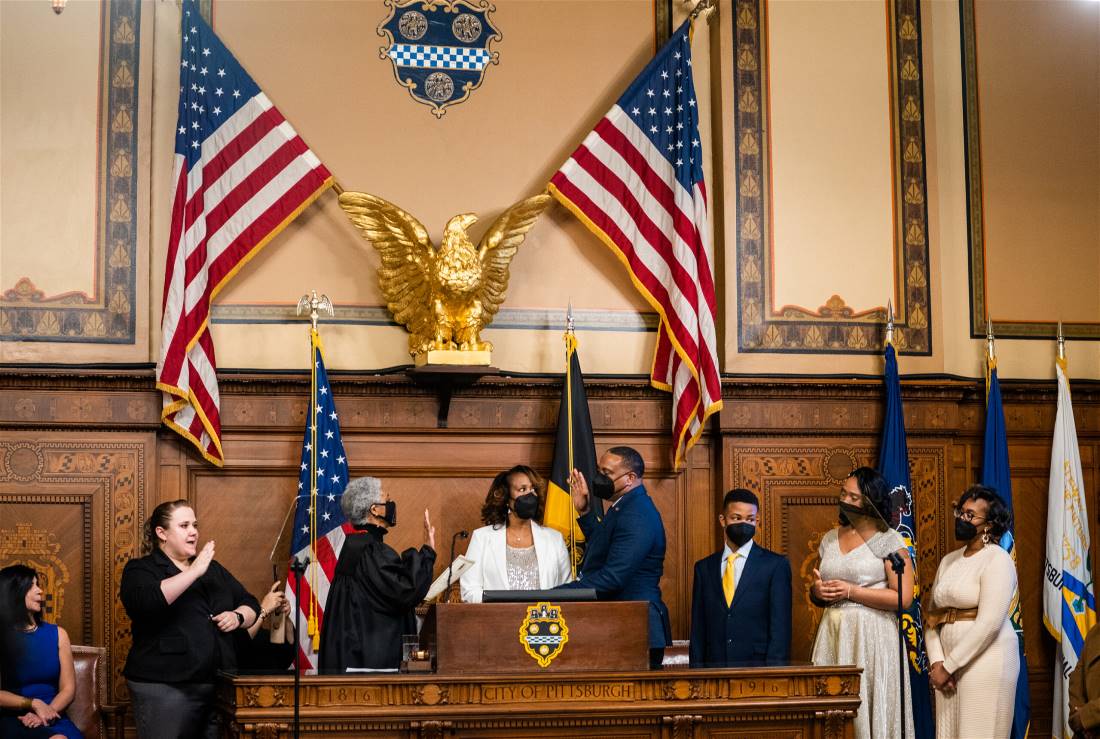
Ed Gainey, Pittsburgh's 61st Mayor,
is sworn in on January 3, 2022.
<Short History of the Mayors of Pittsburgh>

We're All Pittsburghers
Below are several links to pictures and
explanations that reveal much of Pittsburgh's past and present. We've found some
interesting vintage color postcards and photos of various landmarks throughout the
city, including several pictures of "The Golden Triangle" that document it's
evolution over the past 250-plus years. There are also links to other webpages that
offer more on Pittsburgh's history.
 
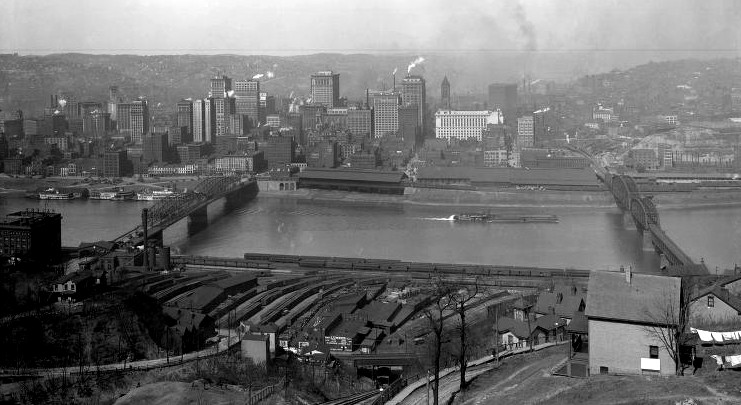
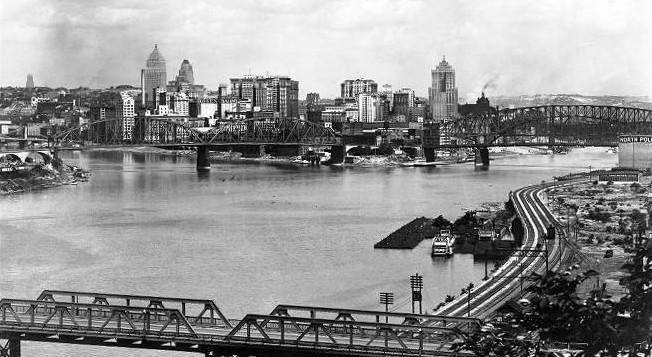
After all, Brookline may be
the community we've settled in,
but Pittsburgh, Pennsylvania is the city we call home.

|