|
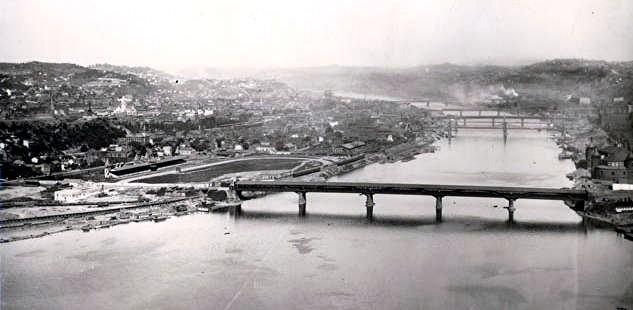
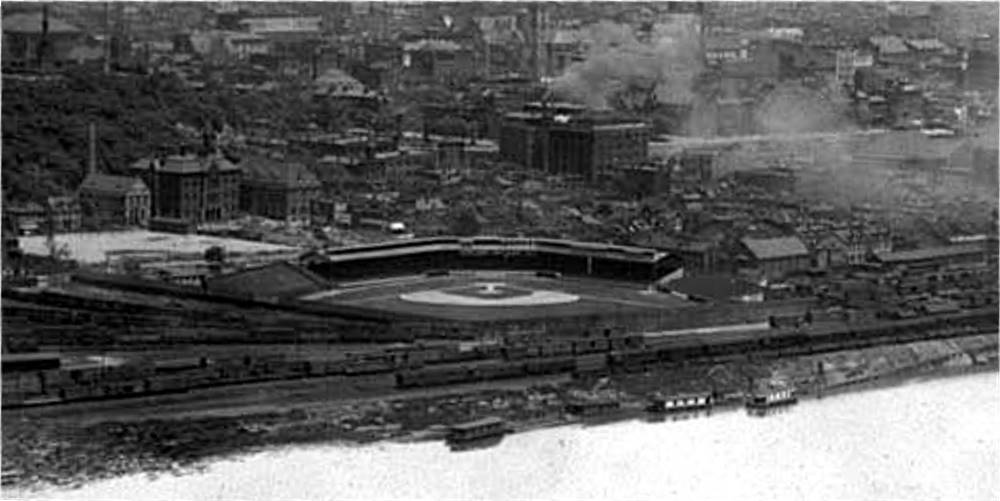
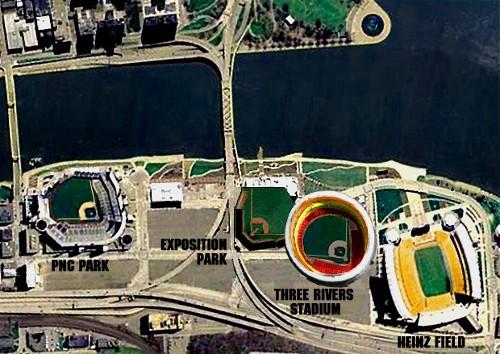
Exposition Park was located along the North Shore, in the City of Allegheny, across the Allegheny River from downtown Pittsburgh. It was built along the riverbank across from the Point, in approximately the same location as Three Rivers Stadium many years later. The stadium included a roofed wooden grandstand around the infield, and open bleacher sections extending to the right and left field corners. Total seating capacity was about 10,000 spectators. The seats faced the Allegheny River and the Point.
Exposition Park I and II There were actually three Exposition Parks built in the late-1800s, all located on or near the Allegheny riverfront and the Union Bridge. The first, referred as Exposition Park I, was built to host a variety of expositions, including horse racing and circuses. It was the original home of the Pittsburgh Alleghenies Baseball Club, who in 1900 became the Pittsburgh Pirates. In 1882, the Alleghenies began play at Exposition Park I. After one season, a fire and persistent flooding forced a second park to be built. Despite its reason for construction, Exposition Park II was constructed closer to the river.
Due to the ongoing problem with flooding, the Pittsburgh Alleghenies moved to nearby Recreation Park in 1884, which at the time was the largest sports venue in the area and located several blocks north, out of the flood plain. Exposition Park III Exposition Park III, which opened in 1890, was originally constructed as the home field for the Pittsburgh Burghers Baseball Club of the Players League, with a seating capacity of 10,000. The Burghers folded after one season and the Alleghenies moved into the new ballpark in 1891. The Alleghenies, and then the Pirates, remained at Exposition Park for nineteen years. At the turn-of-the-century, the North Shore venue was the hot spot in National League baseball. The Pittsburgh Pirates won league championships in 1901, 1902 and 1903. Exposition Park hosted games four through seven of the 1903 World Series, featuring the Pirates and the Boston Americans. Despite taking a three games to one lead, the Pirates lost four in a row to the Americans, who claimed Major League Baseball's first World Series title. Attendance at Game Seven in Pittsburgh was 17,038, a record for Exposition Park.
Exposition Park's location near the banks of the Allegheny River was a problem when the river flooded, which before flood controls were in place was quite often. Flooding sometimes covered the outfield with inches of standing water, forcing ground rules that gave any ball hit into the outfield an automatic single. During a July 4, 1902 doubleheader against Brooklyn, a flood caused the water level to rise thigh high in center and right fields, and head deep in center field. Players occasionally caught a ball and dove under the water. The Pirates won both games. That 1902 Pirate team finished their season with a 103-36-3 slate, which still stands as the highest winning percentage (.741) in club history.
The End of an Era The final Pirates game at Exposition Park was played on June 29, 1909, before 5,545 spectators. The Pirates beat the two-time defending champion Chicago Cubs, 8–1. The following day, with 30,338 fans in attendance at Pittsburgh's new $1,000,000 Forbes Field, the Cubs handed our Buccos a 3-2 defeat.
The 1909 Pirates went on to finish the season with a 110-42-2 record, the most wins and second-best winning percentage (.723) in club history. The Buccos went on to a victory over Ty Cobb and the Detroit Tigers in the 1909 World Series. Panthers on the Prowl The Western University of Pennsylvania, who changed its name to the University of Pittsburgh in 1909, also called Exposition Park home. From 1890 through 1903, the University played some of their home games there, and in 1904 began playing all home games at the North Shore venue. The 1904 W.U.P. team posted a 10–0 record in which they outscored opponents 407-5.
Prior to home games at Exposition Park, WUP students would organize parades through downtown streets prior to marching across a bridge to the game. A gong, used to announce the beginning of Pirates games, was also sounded prior to the opening kickoff of WUP football contests. Like the Pirates, the Panthers moved to Forbes Field for the 1909 season. Photos of Exposition Park
<><><><><><><><><> <><><><><><><><><> <><><><><><><><><>
|