|
Pvt. Carroll B. Westfall
United States Army (1944-1945)

The following article
and photos about Brookline resident Carroll Westfall, written by
Patricia Sheridan, appeared in the Pittsburgh Post-Gazette on
June 30, 2014:
Carroll Westfall Continues To Restore
Artwork Into His Ninth Decade
The soul of an artist, the heart of a
warrior. That best describes Carroll Westfall, a decorated World War II veteran
who used his talent as an artist to help him cope with the violence he
witnessed.
"I wasn't drafted. I enlisted because
I heard about the bad things the Nazis were doing," he recalls.
At age ninety, he continues to work but says
the memories of those long-ago battles are "as fresh as if they happened
yesterday." His work as an artist and art restoration expert gives him an
opportunity to escape the memories.
"You have to concentrate. You get lost
in the detail and if you are restoring you must learn to imitate the artist.
It has been very helpful," he says.
As an infantry scout in the Army, he
went ahead of the unit, spending most of his time behind enemy lines trying
to ensure safe passage.
"A lot of times the enemy would let me
move ahead unharmed. I remember walking us into an ambush. At the last second,
I saw a glint of metal coming from a tank hidden in the trees. I fired to let
the troops know. The next thing I know, the nearest officer to me is hit by a
shell. He was there and then he was completely gone."
The Germans may have gotten the best of
him that time, but it was his skills that usually won out. He singlehandedly
took out three machine gun nests at different times and captured fifteen German
soldiers. Reluctant to talk about the war, he continued with his story after
some persuading.
"We were pinned down behind an embankment
and the SS were dug in on the other side of the ridge. Everyone who tried to
move was shot. After two days I had all I could take so I charged the machine
gun nest. They shot the rifle out of my hands so I threw a grenade,"
he says.
Mr. Westfall fought throughout Europe
and in the Battle of the Bulge in Belgium. He says he once eliminated a machine
gun position on a knoll when he surprised fifteen sleeping German
soldiers.
"They had dug a slit trench and were so
exhausted they didn't even hear the gunfire. I woke them up and was holding a
grenade. I pulled the pin and said if anyone moves we all die."
He held that grenade for more than fifteen
minutes waiting for his unit to reach his position.
"He killed many of them during the war,"
interjects his wife, Deborah, who has worked side by side with him for thirty-one
years. She is also an artist.
"It bothers me more now than it used to,"
he confesses.
He only did one painting from his war
years titled "Unburied." It depicted a friend of his who was shot while trying
to advance over barbed wire.
"It was bought by a naval officer, but
I didn't want to sell it for a long time," he says.
"It was very strong and the eyes followed
you," his wife says.
Mr. Westfall's bravery in battle earned
him the Bronze Star, two Silver Stars and several combat infantry medals. He
suffers from post traumatic stress disorder. "Sudden noises are a problem,"
says Mrs. Westfall.
It is his art, his work, that has
delivered him from the horrors of war, he says. Not long after returning from
Europe, Mr. Westfall turned to art restoration, specializing in Old Masters.
He continues to do restoration and his own work today.

World War II veteran Carroll Westfall and
the tools of his trade, at his Brookline restoration workshop.
"I enjoy working and have been doing it
nearly sixty years," he says, sitting at the easel in his home studio in Brookline.
"I remember starting to draw and paint when I was twelve."
A pen-and-ink drawing he did in 1938
sold at Dargate Auction Galleries earlier this month, inspiring a bidding war.
At the same auction, several other paintings he did and some he restored were
also sold.
He began his professional artistic
career while still stationed overseas, attending the Wharton Technical School
in Wharton, England. He worked in London as an artist before moving to the
French Riviera, where he painted street portraits for a living in Nice and
Cannes. Finally he moved back to his hometown in Clarksburg WV, and in
1959 he made the move to Pittsburgh and settled in Brookline.
At one point, he had studios here and
in Manhattan, where he did restoration work with the big auction houses,
Christies and Sotheby's. He brings a portrait painter's eye for detail to his
restoration work. The oldest painting he has restored was one of Christ that
had been carbon-dated to the 1300s.
"I never felt intimidated by a work of
art I had to restore," he says. "Challenged and responsible, but never
intimidated."
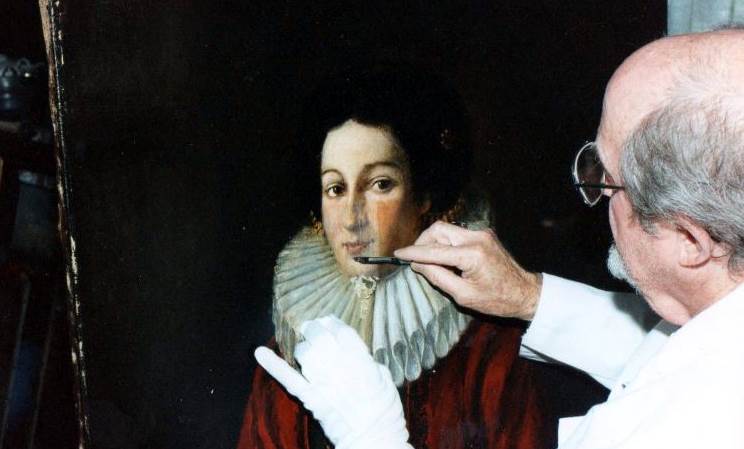 
Carroll Westfall works on a restoration
(left) while another artwork sits half completed.
Over the years his clientele have
included PNC Bank, Pittsburgh Field Club, Westmoreland Museum of American Art,
U.S. Steel and the Duquesne Club.
"When you are restoring a work, you feel
an immense responsibility to represent the piece as the artist intended it to
be seen."
He takes that same tack with the
portraits he paints:
"A portrait is a very intimate
undertaking. You have much more of an opportunity to bring out the personality
than with a photograph."
"I prefer doing my own painting,
particularly portraits, but art restoration pays the bills."
<><><><> <><><><>
<><><><> <><><><>
<><><><> <><><><>

A Short History Of The 100th
Infantry Division in World War II
Carroll Bennett Westfall was born on
November 9, 1923, the son of the Reverends Homer and Esther Westfall, of Sago,
West Virginia, in Kanawha County. He enlisted in the Army on July 5, 1943. After
training he was assigned to Company C, 1st Batallion, 398th Regiment of the 100th
Infantry Division, known as the Century Division.
The 100th Division embarked from New
York harbor on October 6, 1944, bound for the shores of France. After a short
time in Marseilles, the Division entered the front line on November 1, 1944,
near Baccarat, France, relieving the 45th Division.
The Division's baptism of fire came
only days later. Assigned as part of the U.S. Seventh Army’s VI Corps, their
mission was to penetrate the German Winter Line in the High Vosges Mountains,
on the edge of the oft-disputed province of Alsace.
The Vosges terrain was formidable
and the severe winter weather added hundreds of casualties to those inflicted
by the tenacious German defenders. Nevertheless, the 100th Division led the
attack through the Vosges Mountains.

Men of 398th Regiment advancing along
a roadway in eastern France.
For the first time in history, an
army succeeded in penetrating that vaunted terrain barrier to the Rhine Plain
and Germany. Within the first month of combat, the German Army Group G Chief
of Staff, General von Mellenthin, referred to the 100th as “a crack assault
division with daring and flexible leadership.”
While falling back toward Germany,
the enemy bitterly defended the modern Maginot fortifications around the
ancient fortress city of Bitche. After reducing these intimidating defenses,
in the last hour of 1944, the Division was attacked by elements of three
German divisions, including a full-strength SS-panzergrenadier division,
heavily supported by armor, in Operation NORDWIND, the last major German
offensive on the Western front.
As the units on the left and right
gave ground, the men of the 100th stood fast and the Division quickly became
the only unit in the Seventh Army to hold its sector in the face of the massive
enemy onslaught.
In the brutal fighting which ensued,
the Division stubbornly resisted all attempts at envelopment, and despite
heavy casualties the 100th completely disrupted the German
offensive.
Ultimately, the Division captured the
Citadel of Bitche in March 1945, and passed through the Siegfried Line into
Germany. The 100th Division was the first fighting force in 250 years to
capture the imposing Citadel, earning the victorious soldiers the title
"The Sons of Bitche."

The Division’s last major battle was
the attack on Heilbronn in April 1945, which required an assault crossing of
the Neckar River in small boats. This was done in full view of several German
artillery pieces which laid fierce direct fire upon the crossing site.
In over a week of savage urban combat,
the Division defeated elements of several German Army and Waffen-SS divisions,
seized the key industrial city, and pursued the beaten foe through Swabia
toward Stuttgart.
Pvt. Carroll B. Westfall saw action
throughout the entire 100th Division campaign. During the last Allied
drive, pursuing the enemy in the days before the German capitulation,
Westfall was awarded a Silver Star for heroism during the advance on the
town of Willsbach, Germany.


In combat for six months from November
1944 to May 1945, the Century Division advanced 186 miles, liberated dozens of
towns and cities, captured 13,351 enemy soldiers, and decisively beat elements
of five German divisions. In the process, the Division lost 916 dead, and
sustained 3,656 wounded and 180 missing in action.
<><><><> <><><><>
<><><><> <><><><>
<><><><> <><><><>
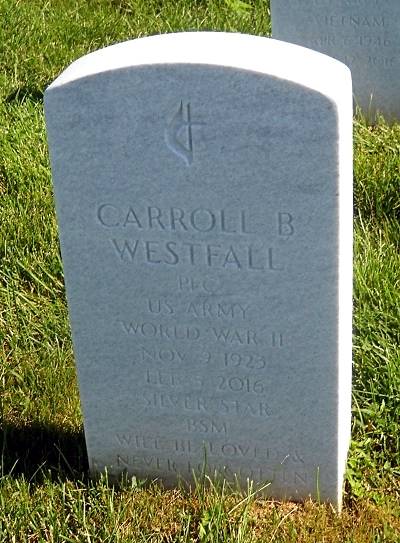
Carroll Bennett Westfall passed away
on February 5, 2016, after a brief period in the
Shock Trauma Unit at Allegheny General Hospital following an accident.
* Information gathered
from Post-Gazette article - June 30, 2014; Modified by Clint Burton -
February 9, 2016 *
<><><><> <><><><>
<><><><> <><><><>
<><><><> <><><><>

<Brookline
War Memorial> <> <Brookline
History> |