|
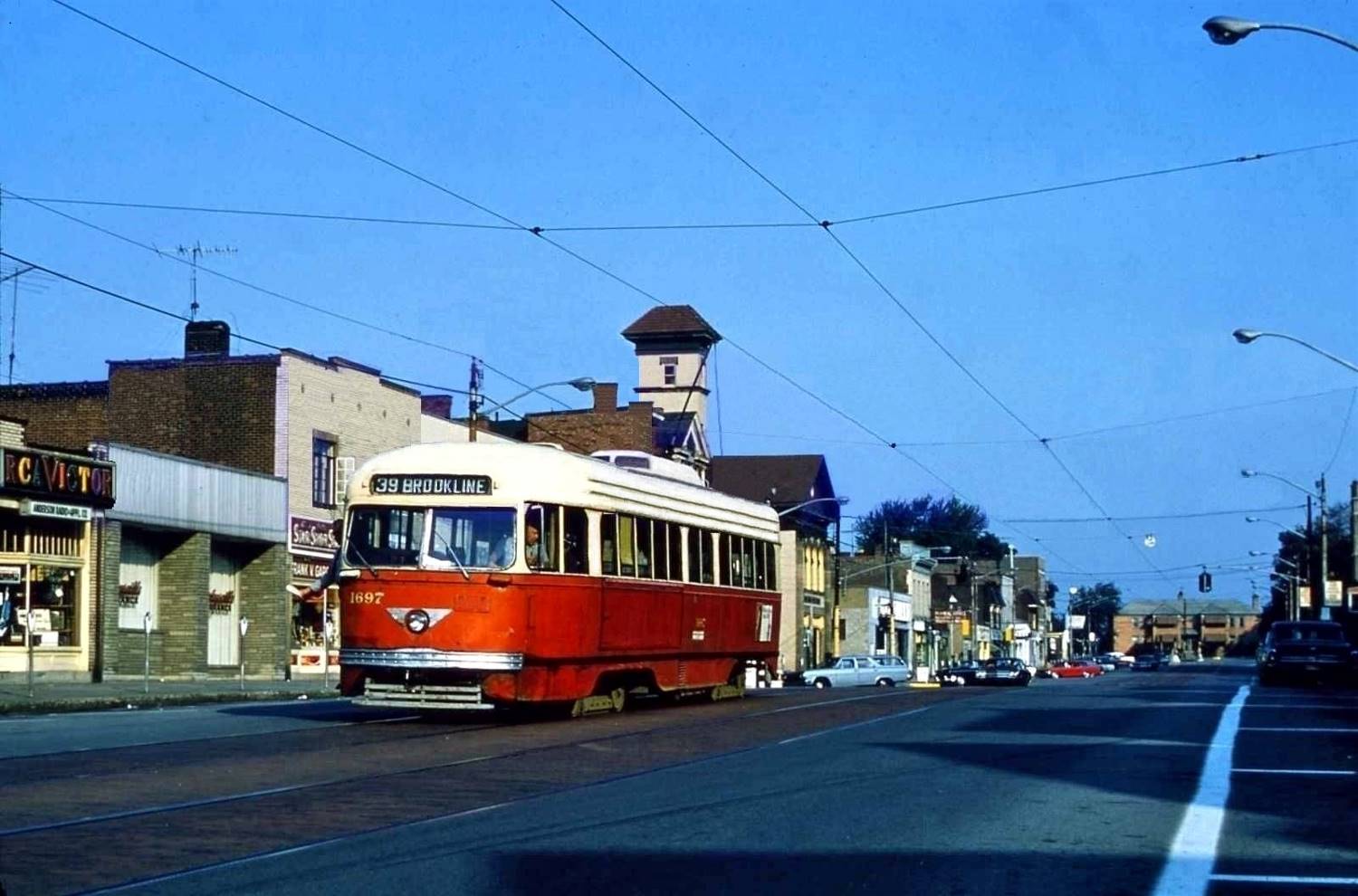
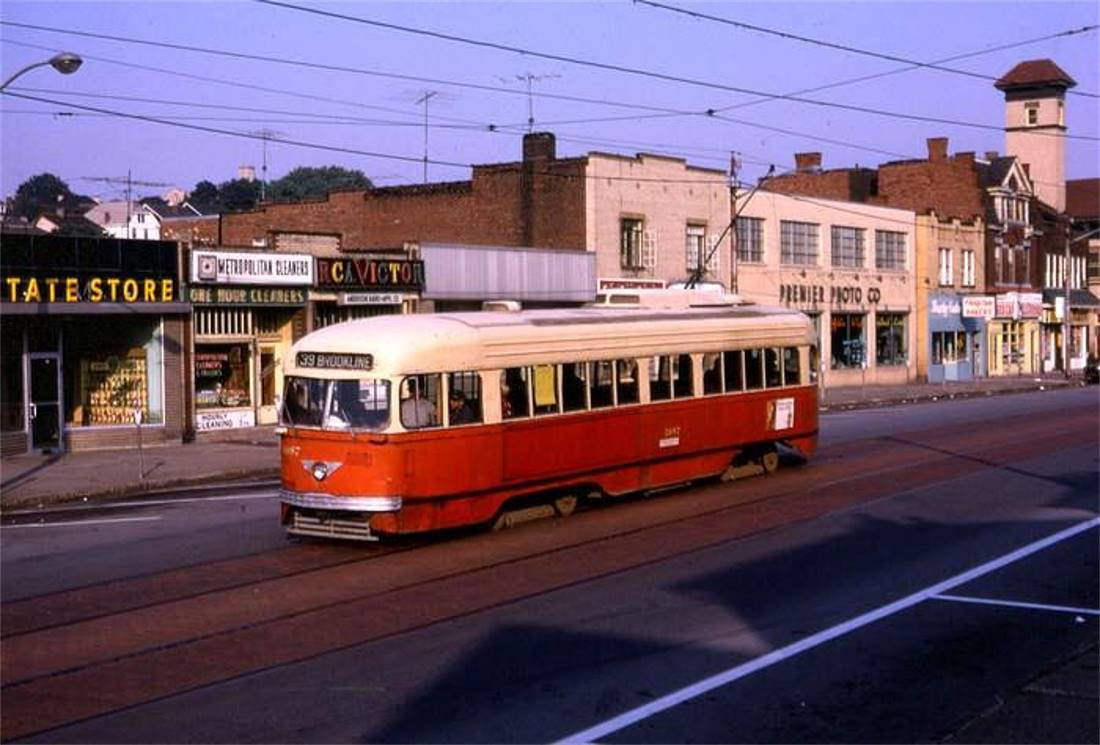
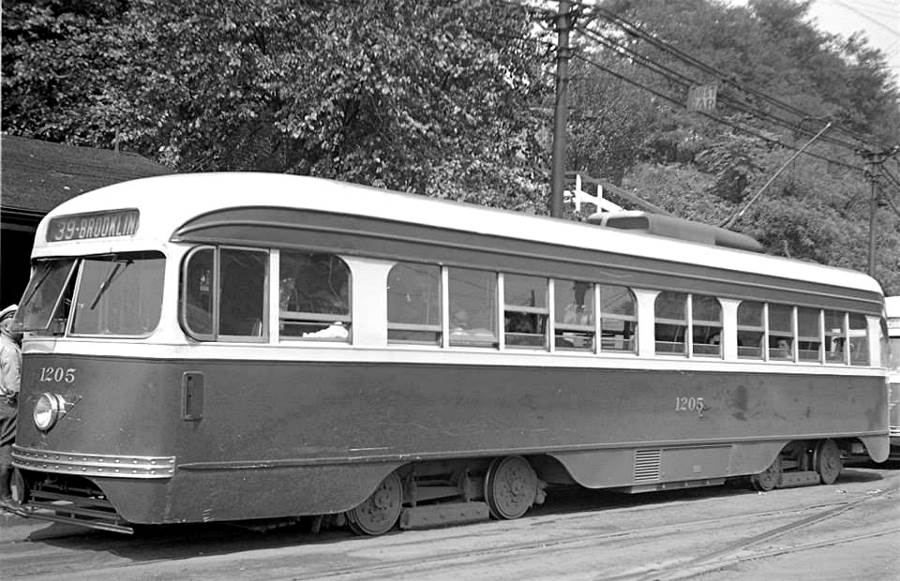
An outbound 39-Brookline moves along the
700-block of Brookline Boulevard, approaching the Flatbush Avenue Car Stop.
The History
Of Streetcar Service In Brookline
Streetcar service in Pittsburgh dates
back to the mid-1800s, when horses pulled cars along rails that ran through
some of the city's busier districts. There was a cable car service that ran
along Warrington Avenue, serving the Allentown, Knoxville, Beltzhoover and
Mount Oliver neighborhoods as early as 1859. Cable lines were in service
throughout Pittsburgh until 1897.
In the 1890s, electrified service began
in downtown Pittsburgh. Soon, there were over one hundred separate trolley
companies running within the city limits. These independent operators merged
into larger traction companies in the mid-1890s. Pennsylvania's Focht-Emery
Bill of 1901 led to a major expansion of the network and the creation of
the Pittsburgh Railways Company formed in 1902 as a consolidation of most
traction companies within the city.

♦ 39-Brookline Photo Gallery ♦
* Last Updated -
September 14, 2024 *

An outbound 39-Brookline at Cape
May Avenue heading south along West Liberty in May 1966.
South Hills Transportation
- The Early Years
Through the late-1800s, travel from
the South Hills boroughs to Pittsburgh, mostly farmers taking their products
to market, was a long and arduous journey over dirt roads that scaled what
seemed like mountains. The trip over Mount Washington alone could take over
an hour.
Beginning in the 1870s, an alternative
for some travelers was a ride on the passenger cars pulled by the narrow-gauge
steam locomotives of the Pittsburgh and Castle Shannon
Railroad, which
offered passenger and freight service from 1871 to 1912.
Boarding stations at Glenbury, Whited and
Edgebrook streets provided access to Brookliners. The train took travelers as far
as Warrington Avenue, where they transfered to a pair of inclines that scaled
Mount Washington to reach Carson Street. The Castle Shannon South and Castle Shannon No. 1, once in operation, also offered considerable
convenience for South Hills wagon, freight and pedestrian traffic.
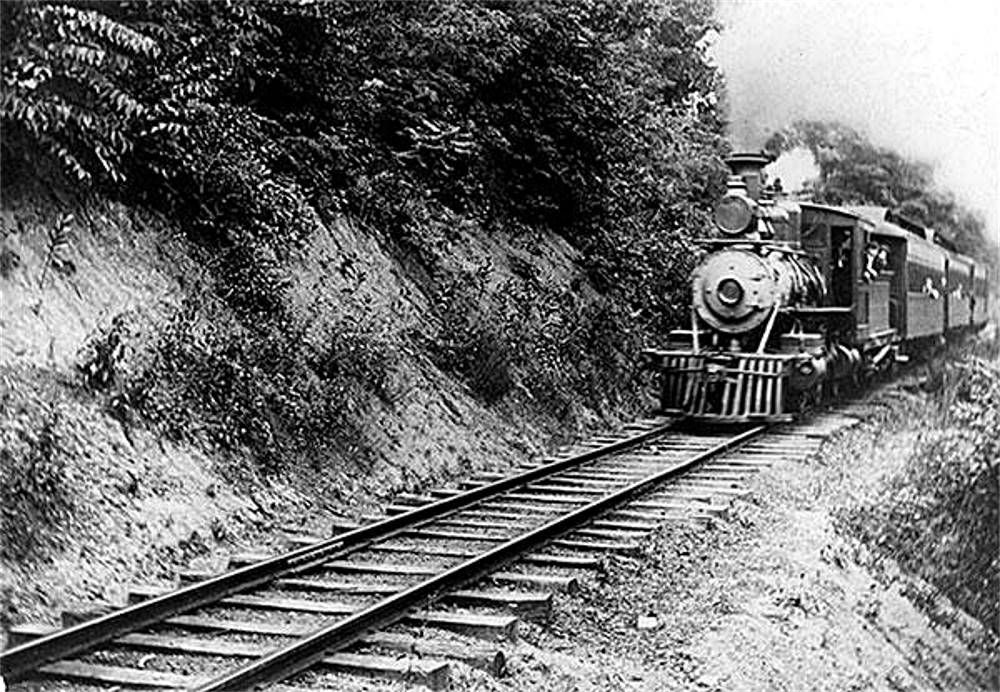
A Pittsburgh & Castle Shannon Railroad train runs
through Fairhaven in nearby Overbrook.
Focht-Emery Transit Bills
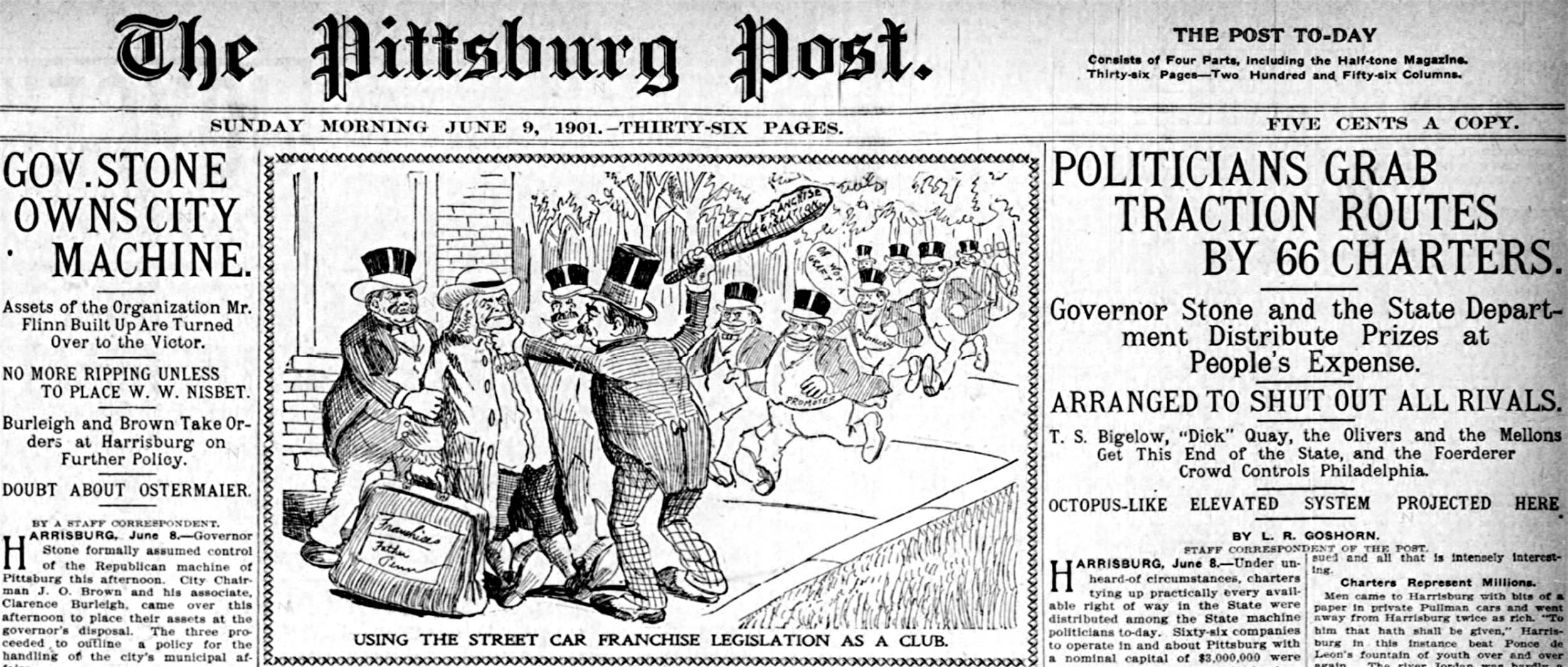
Pennsylvania's Focht-Emery Bills were signed
into law by Governor William A. Stone on June 7, 1901. The bills were the result of
ruthless transporation competition in the city of Philadelphia between corporations
like the United and Consolidated Traction Companies, and much lobbying by powerful
interests throughout the state, including the Olivers and Mellons of Pittsburgh,
wishing to construct electrified traction lines to compete with established passenger
railroads. The following day the Pittsburgh Railways Company was founded.
The Emery Bill amended the act of May 14, 1899,
which further amended the Transit Laws passed by the Pennsylvania legislature in 1895
relating to the establishment and consolidation of street railways. The bill provides
that, whenever a charter shall hereafter be granted to build a road, no other charter
to build a road on the same streets, highways, bridges, or property shall be granted
to any other company "within the time during which, by the provision of this act, the
company first securing the charter has the right to commence and complete this work."
The right was further given the companies incorporated under the act "to take, hold,
purchase, operate, lease, and convey such real and personal property, estate, and
franchises as the purposes of the corporation shall require."

The legislation outlined the conditions under
which the new companies could use the tracks of existing corporations. It gives the
former the right to use tracks and all streets for which franchises have been granted,
but which are not "in constant daily use," and not more than 25,000 feet " of the single
or double tracks of, or the streets, highways, and bridges occupied by, any other
passenger railway company or companies, incorporated under this or any general or
special act, whether the said corporation owning the said tracks shall or shall not
have the exclusive right to lay tracks in said street or highway, either by virtue of
their charter or any legislation claiming to confer such exclusive privilege," provided
that the consent of the local authorities for such use of the tracks is first
secured.
It also requires that the consent of local
authorities shall first be obtained before any company shall have the right to
construct a road, and that the route shall be continuous. Another section requires
that the application to the local authorities must be made within two years from the
date of incorporation, and that the road must be completed within five years thereafter.
The companies are given the right "to acquire property, either by purchase or otherwise,"
but are forbidden to connect their tracks with steam-railroad tracks.
The Focht Bill is entitled "An act to provide for
the incorporation and government of passenger railways either elevated or underground,
or partly elevated and partly underground, with surface rights." After providing for
the requirements of incorporation and defining the powers and privileges of companies
incorporated under it, this bill confers the right of eminent domain upon them. The act,
which is a companion to the Emery act, has similar provisions as to the consent of local
authorities, and the time within which such application must be made and within which
the work must be completed. Moreover, the franchises were to be exclusive and perpetual,
and the companies were to have unlimited powers to borrow money on bonds.
Called "Ripper" bills, the legislation led to
rampant stock fraud by numerous entities in the region as outlined by Mayor William A.
Magee a decade later. These charges were published in the Pittsburgh Post-Gazette on
December 4, 1910.
History has proven that the Focht-Emery Bills,
which were rushed through the legislature by politicians and financial magnates that
benefited greatly from the vast property and financial powers granted in the acts.
By 1906, the Pittsburgh Railways Company had grown into a consolidation of over 280 separate
corporations, either owned or
leased.

♦ The 280 Companies That Made Up Pittsburgh Railways ♦
(as of October 25, 1906)
In 1918, Pittsburgh Railways filed for bankruptcy
as interest on numerous subsidiary bond issues were in default and general mismanagement
doomed the transit giant. The Pittsburgh Railways Agreement of January 1922 between the
company and the City of Pittsburgh, which was ratified in 1924, cleared up much of the
financial and management issues, keeping the $62.5 million transit company solvent.
Another bankruptcy claim followed in 1938, and the company was eventually purchased by
the Port Authority of Allegheny County in 1964.
Despite their many flaws, the Focht-Emery Bills
did lead to the creation of a modern electrified railway system that brought public
transportation throughout the city of Pittsburgh and surrounding suburbs into the
20th century and led to unprecedented growth in the region.
Charleroi Short-Line Railway
The 39-Brookline trolley route had roots
in the Charleroi Short Line Railway. In the late-1890s, the Mellon family made
large capital expenditures in new electrified interurban traction lines. Their great
system of modern railways would feature brightly colored yellow cars that carried
a new type of braking system developed by the Westinghouse Company.
In 1901, work began on three new lines:
East Pittsburgh to Pitcairn, Wilkinsburg to Oakmont, and West Liberty to Charleroi.
The southern line would utilize the existing Pittsburgh and Birmingham Traction Company
tracks to reach Pittsburgh.
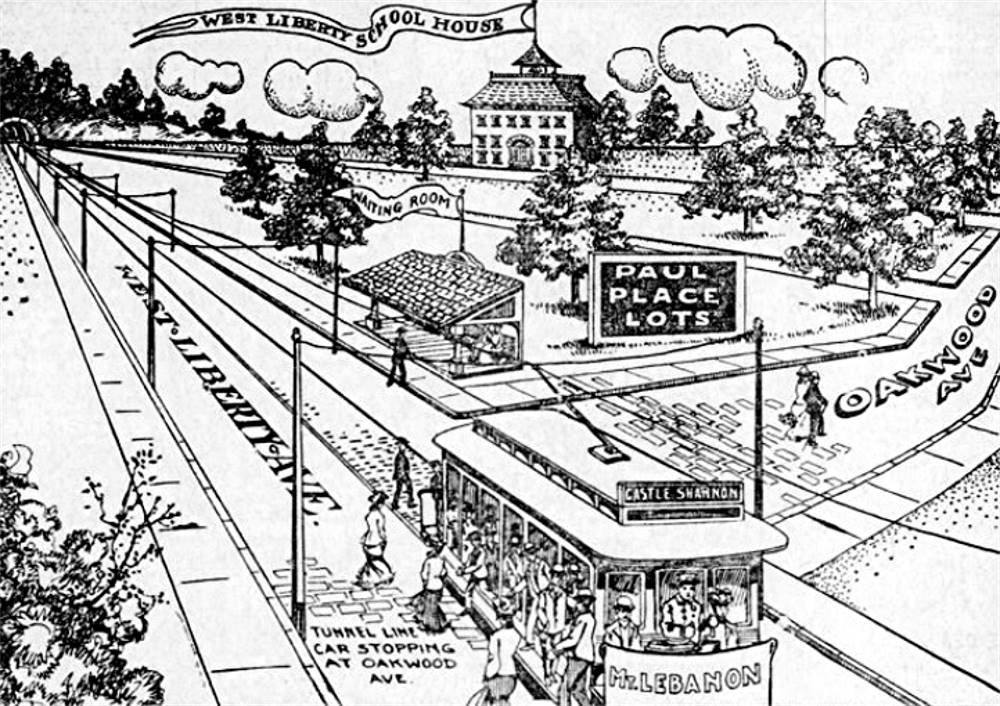
This June 18, 1904 real estate advertisement
illustration shows how vital the trolley line was to development
in Brookline. West Liberty Elementary School, atop the hill along Pioneer Avenue,
had just been enlarged.
In this image Oakwood Avenue is Capital Avenue. Paul Place was one of the original
Brookline subdivisions.
The Charleroi Short Line was a 27 1/2
mile traction line running from downtown Pittsburgh to Fayette City in Washington
County. The path chosen for this modern high-speed southern railway would be perhaps
the most significant development for the history of communities like Brookline,
Beechwood, Dormont and Mount Lebanon.
Beginning downtown at the Union Station,
single-truck cars would pass over the Smithfield Street Bridge to Carson Street, then up Brownsville Road (Arlington
Avenue) to a junction with Warrington Avenue. Once at the Knoxville Incline Station,
passengers transferred from the single-truck cars to the double-truck Mellon interurban
cars. This transfer was necessary because it was deemed unsafe to take the larger
double-truck cars along the sharp curves on Brownsville Road. From there it
was down Warrington to the South Hills Junction.

It was from the South Hills Junction that twenty-six
miles of new traction line extended to the south. The route would take the interurban
cars along West Liberty Avenue past Brookline, Beechwood and Dormont to Mount Lebanon.
The line continued on to the south, passing the P&CSRR repair yard along Castle Shannon
Boulevard on the way to Washington County.
Beginning in the spring of 1901 Pittsburgh Railways
began running traction cars along the initial single-track line to Castle Shannon and
back. It was these trolley cars that are shown in the early advertisements for homes in
Brookline's initial Fleming Place, Hughey Farms and Paul
Place housing developments.

On September 28, 1903, the Pittsburgh Daily
Post announced the formal opening of the entire traction line Pittsburgh to Charleroi.
After nearly two years and a cost of $1 million, the high-speed electrified line was
a major time saving alternative to steam locomotive travel, running exclusively on a
private right-of-way through several large boroughs.
One of the major components of the Charleroi
Short Line was the Mount Washington Transit Tunnel, which when complete would eliminate the trip over Mount Washington and
the need to switch cars, thus significantly slashing travel time even further and
fueling the first South Hills commercial and residential development
boom.

The Mount Washington Transit Tunnel opened in December 1904 and led to rapid
development in the South Hills.
West Liberty Street Railway
Company
The history of the electrified railway systems
in Pittsburgh and Allegheny really took off in the 1890s, when hundreds of traction
companies were formed, many of which were up and running when leased or acquired, then
consolidated by the Pittsburgh Railways in January 1902.
One of these was the WEST LIBERTY STREET RAILWAY
COMPANY, incorporated on October 13, 1899, to construct a line running from the intersection
of Warrington and Beltzhoover Avenues to West Liberty Avenue, then south to the Mount
Lebanon Cemetery and back. The company began with an initial stock valuation of $12,000,
which was increased in June 21, 1900, to $400,000. This was funded with a bond issue
to cover "construction of the lines and the acquisition of Rights of Ways."
On August 9, 1900 the company entered into a
consolidation agreement with the long-running Pittsburgh and Birmingham Traction Company,
a subsidiary of the state-wide United Traction Company. All were controlled by the
powerful transit conglomerate, the Philadelphia Company.

The deal consolidated their lines as part of a
continuous track system extending from Mount Lebanon to the Union Depot in downtown
Pittsburgh. This combined line would become the northern leg of the 27 1/2 mile Charleroi
Short Line Railway. Under the agreement, the West Liberty Street Railways Company became
a subsidiary of the Pittsburgh and Birmingham Traction Company.
The West Liberty Street Railway Company's tracks
were operational by the spring of 1901, spurring residential and commercial development
all along its path. The company's assets were then leased by Pittsburgh Railways Company.
The company itself remained an active corporation until 1964, when Pittsburgh Railways
was acquired by the Port Authority of Allegheny County. The West Liberty Street Railway
Company is still on the books, over 120 years after forming.

A Pittsburgh Railways Mount Lebanon
trolley car on West Liberty Avenue, just north of Brookside Avenue.
From 1901 to 1905 the new electric railway had only a single track laid
along West Liberty Avenue.
These tracks were leased to Pittsburgh Railways by the West Liberty
Street Railway Company.
<><><><> <><><><>
<><><><> <><><><>
<><><><> <><><><>
West Liberty Street and Suburban Railway
Company
Another such traction company was the WEST
LIBERTY AND SUBURBAN STREET RAILWAY COMPANY, formed on February 20, 1905. In anticipation
of the upcoming West Liberty Improvement Company development of the soon-to-be Brookline
community, investors formed this transit corporation with $6000 in capital stock to
acquire property rights for the establishment of a one-mile spur line that would branch
off of the original West Liberty Street Railway Company tracks.
The route of the proposed electrified traction
line would be as follows (reprinted verbatim from the company Articles of
Association):
Beginning on West Liberty Avenue at the
intersection with Hunter Avenue in West Liberty Borough, Allegheny County, Pennsylvania;
thence along Hunter Avenue to Lang Avenue; thence along Lang Avenue to Knowlson Avenue;
thence along Knowlson Avenue to the Hughey Road, all in West Liberty Borough; thence
continuing along Knowlson Avenue in Baldwin Township, Allegheny County, Pennsylvania,
to the township road (sometimes called Fairhaven Street) leading to Fairhaven, and
thence returning by the same route to the place of beginning, with the necessary
sidings, turnouts and switches, forming a complete circuit with its own tracks; said
road to be double track road.
Locals would know this route as:
39-BROOKLINE.
The only difference in the Brookline route as
described above and what was installed shortly afterward was that instead of running
up steep Hunter Avenue (Bodkin) to Lang Avenue (Pioneer), a looping right-of-way was
acquired that circled on a gradual grade through the Fleming Place Plan to Lang
Avenue.

The West Liberty and Suburban Street Railway
Company was acquired shortly afterwards by Pittsburgh Railways and is still on the
books, over 115 years after incorporating.
As the Pittsburgh Railways network quickly grew
to its peak in the 1920s, hundreds of these short-lived corporations were formed to
cover extensions in existing routes. Pittsburgh Railways history is a huge, interlocking
maze of mergers, leases and acquisitions.
♦ Pittsburgh Light Rail Transportation
History ♦
(including video of the Brookline Route)

<><><><> <><><><>
<><><><> <><><><>
<><><><> <><><><>
Library and West Liberty Street Railway
Company
One other traction company that established a
line significant to Brookline was the LIBRARY AND WEST LIBERTY STREET RAILWAY COMPANY,
formed on January 6, 1905. This route followed the old Pittsburgh and Castle Shannon
Railroad right of way to Castle Shannon, then continued on to Library PA. This route
was first opened to trolley traffic in July 1909 after the existing railroad line and
bridges were modified for use by electrified traction cars.
When the Shannon-Library line went into service
the larger interurban cars of the Charleroi Short Line were routed off of West Liberty
Avenue and onto this new suburban line, which intersected with the existing Charleroi
line at Willow Avenue in Castle Shannon. Like the other two local traction companies, the
Library and West Liberty Street Railway Company is still on the books as a county orphan
corporation.
<><><><> <><><><>
<><><><> <><><><>
<><><><> <><><><>

Early Electrical Issues Along
West Liberty Avenue
The Pittsburgh Daily Post, on July 10, 1901,
reported that the Postal Telegraph and Cable Company went to court with the West
Liberty Street Railway Company asking for an injunction to restrain the transit company
from interferring with the poles and lines of the telegraph company in West Liberty
Borough and Scott Township.
It was said that in grading West Liberty
Avenue for the streetcar tracks the ground was dug away from the telegraph poles
in such a manner as to endanger their safety and use.
The company was also alleged that the
traction company placed their poles and wires in such a way as to interfere with
the operations of the telegraph lines. The complaint charged that the heavy current
running the trolleys burned out the appliances of the telegraph company. It was noted
that on two seperate occasions fourteen individual telegraph lines had been completely
disabled since the traction line began operation.
The communications company agreed to remove
their poles and relocate their equipment to utility poles along streets without
traction lines. The outcome of the court case is unknown, but the Postal Telegraph
and Cable Company poles were eventually moved.

The South Hills Junction in 1906. Note the
outbound P&CSRR train on the hillside above the complex.

Freehold Real Estate Company advertisement
from June 27, 1905 highlighting Brookline's high-speed traction line.
Click on picture to see the details in a high resolution image of the
trolley scene.
In March 1905 work began on a double-track
trolley line through Brookline. To access the emerging neighborhood, an outbound
car from Pittsburgh followed the single-track Charleroi line along West Liberty
Avenue to the Brookline Junction. From there the trolley car turned left onto an
exclusive double-tracked right-of-way that wound its way along an orchard and
the Fleming Place plan of homes up a steady grade to Pioneer Avenue.
From Pioneer Avenue, the Brookline route was
double-tracked all the way along Brookline Boulevard to the city line at Edgebrook
Avenue. The two tracks continued for a short distance into Baldwin Township to
Fairhaven Road (Breining Street), where the tracks merged into a single line that
led to a loop along what is now the 1400 block of Brookline Boulevard.

An October 17, 1905 illustration depicting the
double-tracking of West Liberty Avenue.
Once at the loop the conductor had to get out
of the car and check in on a call box before beginning the 15-minute return trip to
town following the same route. Before the switches were automated, the conductor
was also responsible for manually activating a track switch at both the Brookline
Junction and Fairhaven Road. By the end of 1905, West Liberty Avenue was also
double-tracked.
Designated Route Number 39 on the Pittsburgh
Railways books, the Brookline route remained unchanged until 1966.

An inbound 39-Brookline passes Birchland Street
after the turn-around at the Brookline Loop.
Proposed Route Extension
In 1905, the Pittsburgh Railways
Company leased the Pittsburgh and Castle Shannon Railroad line with plans to convert the
steam powered line into part of the Charleroi interurban line, eliminating travel on
the increasingly congested West Liberty traffic corridor.
Early community planners envisioned two distinct
Brookline streetcar routes. One was the traditional route that ran to the loop along
the 1400 block of the boulevard and then headed back in the opposite direction. The
additional route would switch off to the right near present-day Birchland Street and
continue along a one-way single track line through the Fairhaven Valley to Saw Mill
Run along following the path of an old Pittsburgh and Castle Shannon
Railroad spur line that ran
along the valley floor.

From there the tracks would merge with the
main Pittsburgh & Castle Shannon Railroad line, the tracks of which were scheduled to
be modified for use by electified traction cars and in service by 1909. Once this
Brookline/Fairhaven extension merged onto the Castle Shannon line the trolley the
inbound route followed the Saw Mill Run corridor to the South Hills Junction. The proposed route would be a continuous wider ranging single-direction
loop from downtown to Brookline intended to serve the planned East Brookline and
Brookdale developments.
In anticipation of this alternate
Brookline/Fairhaven route, the Pittsburgh Railways Company acquired the right-of-way
through the valley. This extended route is prominently displayed on old real estate
advertisements appearing in the first few years of the community's development. The
Fairhaven extension is also shown on Hopkins Plot Maps as late as 1940.

The Overbrook Tunnel was constructed in
1909 by the West Side Belt Railway. Shown here in 2013,
the tunnel was originally built as a pass-through for the 39-Brookline.
When the West Side Belt Railway upgraded it's
Pittsburgh lines in 1909, the Overbrook trestle that carried trains over the Fairhaven
valley was replaced with the present-day Overbrook Tunnel and a solid earth abutment.
Anticipating that the trolley route would one day pass through the tunnel engineers
placed metal hooks on the tunnel walls for the trolley's electric guide lines. Some
of these pins are still visible today.
In April 1909, Pittsburgh Railways began
electrifying and converting the P&CSRR rail gauge to accommodate the light rail
traffic. Standard streetcars and the larger interurban cars began running along
that line in July of that year. The entire project, including the retrofitting of
four bridges, was completed in December 1910 at a total cost of $161,000.

It is unknown exactly why planners decided
to abandon the route through the Fairhaven Valley to Saw Mill Run, but despite
repeated efforts over the years to improve that land (known to planners as the
Brookdale development), the concept never materialized and the Brookline Loop near
Witt remained the furthest extent of the 39-Brookline route for the next half
century.
The frequent and reliable streetcar service
became, for many years, the primary mode of transportation to and from downtown
Pittsburgh, or maybe just from one end of the community to the other. Hundreds of
miles of rail lines now linked all of Pittsburgh's communities, and interurban routes
stretched far beyond the reach of the metropolitan area.
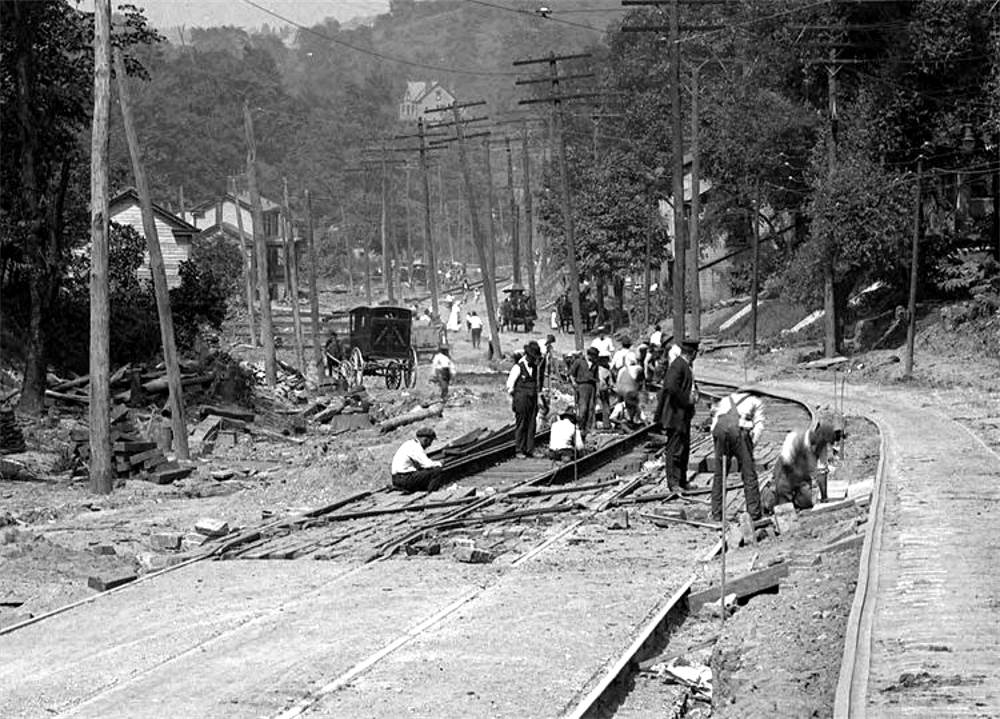
Workers installing new double-track rails
during the West Liberty Avenue reconstruction project in August 1915.
The view is looking north from near Belle Isle Avenue towards Pauline and
on to the bend leading to Capital.
A major upgrade to the Brookline route
occurred in 1915, when the entire length of the traction line was reconstructed along West Liberty Avenue. Twenty years later, in 1935, another significant
improvement was the reconstruction of Brookline Boulevard, when the exclusive trolley right-of-way from West
Liberty to Brookline Boulevard and Pioneer Avenue was expanded and paved with belgian
block. Brookline Boulevard was permanently re-routed onto the widened, looping roadway,
which would be used for both vehicular and rail traffic.
Then, in 1939, streetcars were diverted
away from the congested West Liberty Avenue/Saw Mill Run Boulevard intersection
with the construction of a trolley ramp built slightly north of Pioneer Avenue. The trolley line then merged
with the Beechview line and crossed the Palm Garden Trestle to enter the South
Hills Junction complex.

August 9, 1939 - work proceeds on
the West Liberty Avenue Trolley Ramp. In one week it would open to traffic.
Trolleys Used In Brookline
The first generation of electrified
trolley cars used here in Brookline were old wooden cars covered in steel-sheeting,
referred to as "box cars." They were built by the St. Louis Car Company at a cost
of $6000 each and introduced in Pittsburgh during the winter of 1902.
These eight-wheelers were forty-seven feet
long and powered by four fifty-horse power motors. The cars had high floors,
narrow doors and sat forty-four passengers on wooden seats. They could be driven
from either side of the vehicle by moving directional controls and electrical guide
wire from one end to the other. Although reliable, these early streetcars were deemed
uncomfortable by passengers and phased out in the early-1920s.

Two inbound 39-Brookline streetcars
on West Liberty Avenue, approaching Capital Avenue, in September 1915.
These were the original eight-wheeled "box cars" that made up the bulk
of the Pittsburgh fleet at the time.
From 1915 to 1927, Pittsburgh Railways
contracted with the Pressed Steel Company, located in McKees Rocks, for 1000
of the their new steel-framed "Jones Cars." The forty-foot, double-ended,
sixteen-wheel streetcars featured cushioned rattan seats, a lower-floor, fine
woodwork and windows that opened to let in fresh air. They were quite an upgrade
in passenger safety and comfort, and the additional seating capacity helped ease
overcrowding.
The original Jones Car color scheme was
maroon with gold trim. In 1925 the Pittsburgh fleet was painted chrome orange to
increase visibility in the "Smokey City." The elements, combined with the
ever-present pollution from surrounding industry soon faded that color to a dull,
yellowish tint. Here in Pittsburgh, this generation of trolley cars became
commonly known as "Yellow Cars." This model remained in service until phased out
in 1954. Modified Jones Cars remained in the fleet as maintenance and support
vehicles into the 1960s.

A Jones Car marked for the 39-Brookline route
stands at the South Hills Junction in 1948.
In 1936, at the request of the American
Electric Railway Association Advisory Council, the St. Louis Car Company, with
help from Pittsburgh's Westinghouse Company, introduced the sleek new vehicles.
Since the project development was overseen by the Electric Railway Presidents
Conference Committee, the design was branded with that name.
Considered revolutionary in their time,
these ultra-modern red and cream colored vehicles would soon become the standard
cars in the Pittsburgh Railways fleet. The first Presidents Conference Committee
(PCC) car arrived in Pittsburgh that year. Car #100 entered service on September
26, 1936, and was used on all routes to promote ridership around the
city.

Pittsburgh Railways ordered 666 of the
Presidents Conference Committee cars, at a price of $28,000 apiece. They entered
the fleet in 1937 and served the city and surrounding suburbs for a half
century.
On April 2, 1940, the company
took delivery of the third shipment of 100 cars, bringing the fleet total to
301. The PCC cars began running regularly on the Brookline route. By the 1990s,
only a handful of PCC cars were left in operation, running only along the
southernmost section of the Shannon-Library route. The remaining three
PCC cars were retired in September 1999.
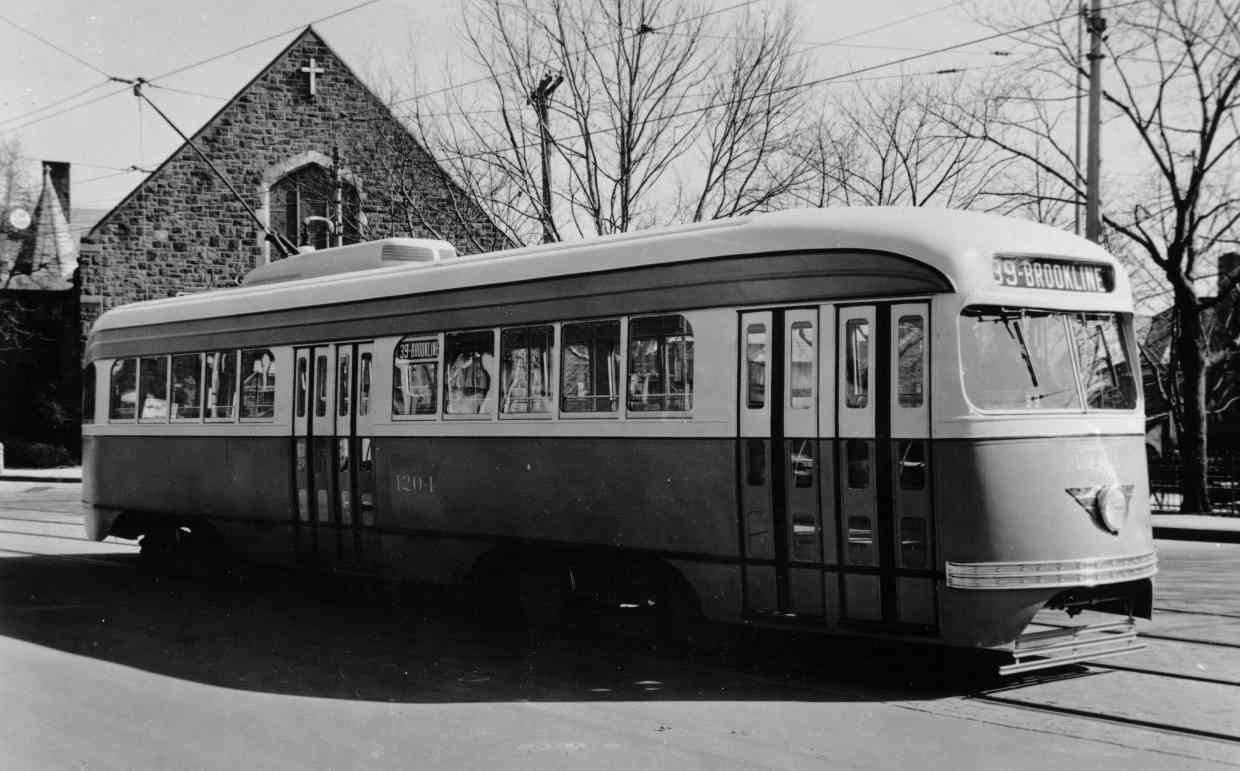 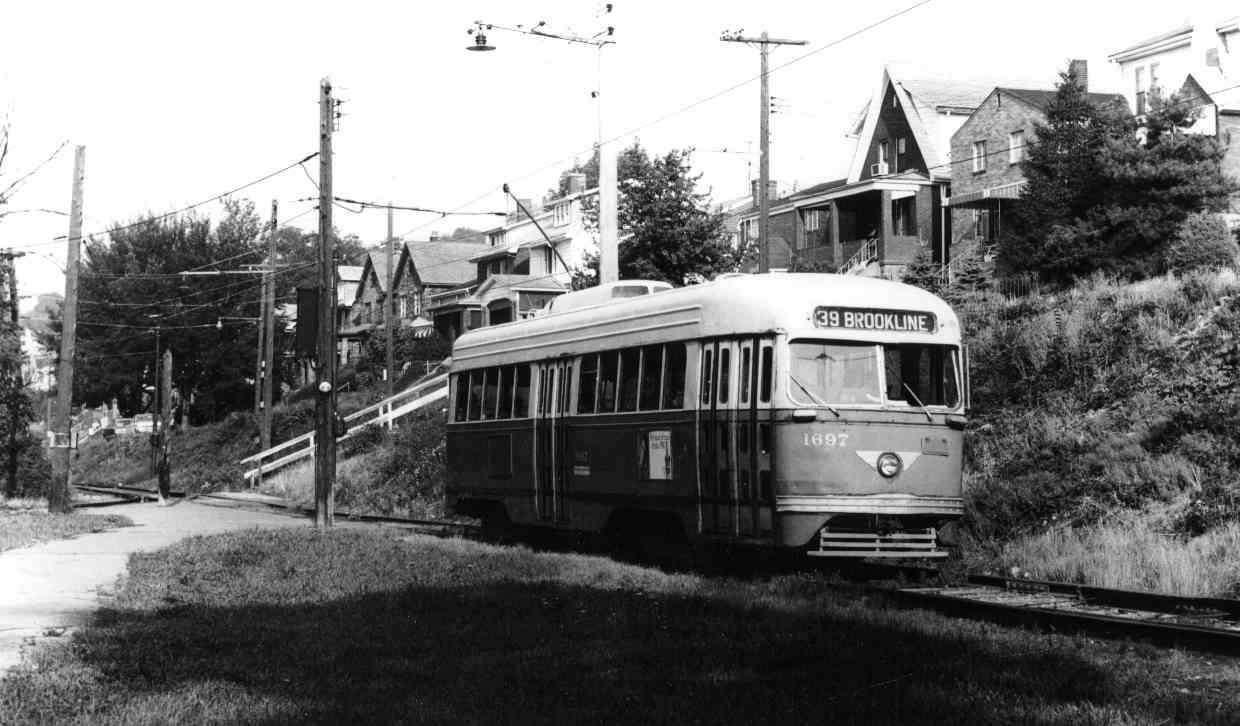
President's Conference Committee models
carried Brookline commuters for twenty-seven years.
Presidents Conference Committee
Cars
Below is a five-page feature that ran
in the Pittsburgh Press on February 2, 1937. This was the day that the first
shipment of 100 Presidents Conference Committee (PCC) cars went into service
for the Pittsburgh Railways Company.
The associated articles detail the many
technological improvements made in the new traction cars and the contributions
of Pittsburgh industry towards their development.


* Click on newspaper
images for larger readable version *

Inbound 39-Brookline rolling along Smithfield
Street, after passing the Boulevard of the Allies, on June 27, 1965.
<><><><> <><><><>
<><><><> <><><><>
<><><><> <><><><>
The following two page feature was
published in the Pittsburgh Press on April 2, 1940. This was the day that
the third installment of 100 PCC trolley cars went into service with the
Pittsburgh Railways network.
One of the articles announces the beginning
of PCC car service along the 39-Brookline route and the others detail the
many improvements made in the motor and braking systems of this latest
model. These were designed and manufactured here in Pittsburgh by the
Westinghouse Company.
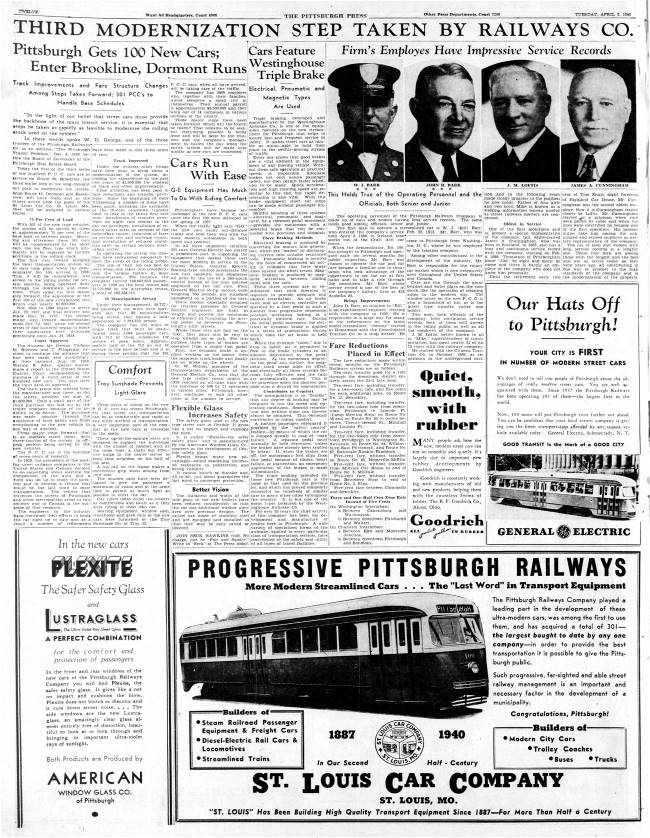 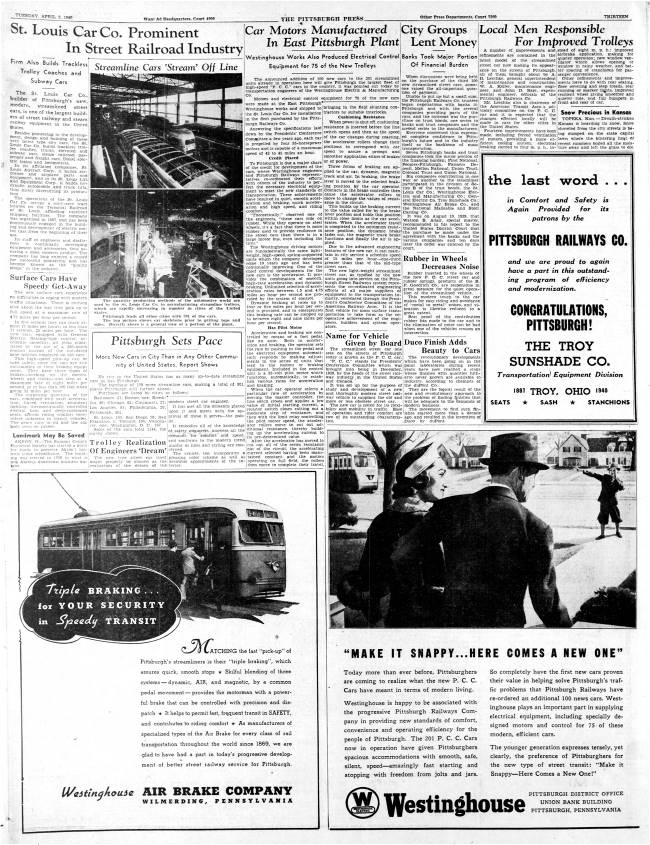
* Click on newspaper
images for larger readable version *
Riding The Streetcar To
South Hills High School
The Pittsburgh Public School
Board opened South Hills High School, in 1917. Located along Ruth Street in Mount
Washington, the high school served students from Mount Washington,
Banksville, Beechview and Brookline for sixty years, until
1977.
Conveniently located on the hill
above the Pittsburgh Railways' South Hills Junction, a set of city steps
led to Paul Street, and from there it was a short walk to the school
along Ruth Street.
Public transportation was the best
alternative to transport students from Brookline and Beechview to and from
school, but the company was unwilling to give school discounts. Students
who rode the streetcar always paid a full fair.

A Pittsburgh Press clipping from October 29,
1934, touting new transportation arrangement for Brookline students.
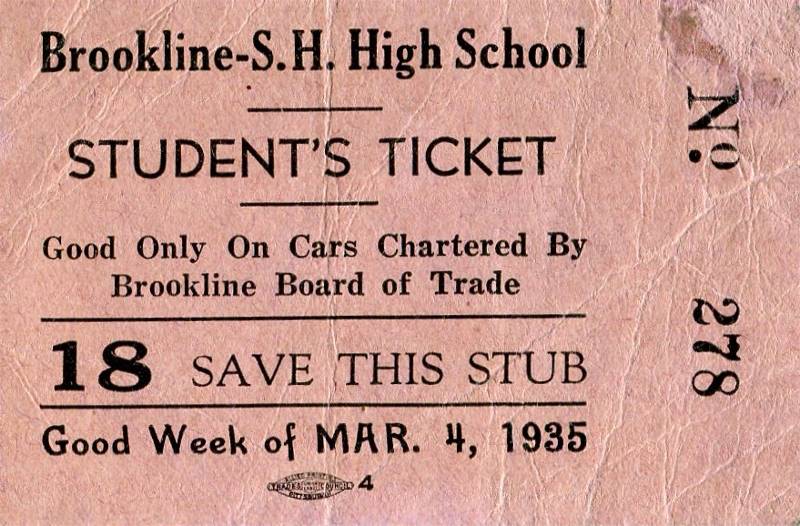
An interesting solution was found.
The Brookline Board of Trade and the Beechview Democratic Workers each
began renting streetcars at $5/hour. Students were sold tickets each month
at a rate of five cents each.
So many students became riders that
Brookline was renting four buses. But, in the end, the plan worked so well
that it actually lowered the per-student fare to only four cents per trip,
less than the predicted five cents and a far cry from the standard ten cent
fare.

A Pittsburgh Sun Telegraph clipping from
March 21, 1935.
 
Streetcars line up at the South Hills
Junction in 1935 to transport South Hills High School students home to
Brookline and Beechview (left); A gathering of students boarding a streetcar
at the Junction in 1963.
In later years, the Board of Trade
and the Pittsburgh School Board came to aggreement and the streetcars became
basic school-day transport. Starting in 1966, Brookline students began taking
buses rather than the streetcars, still subsidized by the Chamber of Commerce,
as the local rail route was discontinued.
For the generations of Brookline
teenagers who attended South Hills High School, their school days were filled
with many memories. One remembrance that most look back on with fondness was their
daily ride on the 39-Brookline, especially the trip home from school.

A Brookline trolley stands second in line
ready to pick up students from South Hills High School circa 1961.
Brookline Streetcar Route
Discontinued
The last run of the 39-Brookline
streetcar took place on September 3, 1966. Trolley enthusiasts gathered
for one final trip on a chartered PCC car that made a ceremonial run
along the sixty-one year old Brookline route. When the trip was completed,
John Damerson, Director of the Port Authority, signed the final transfer
slip to mark the occasion.
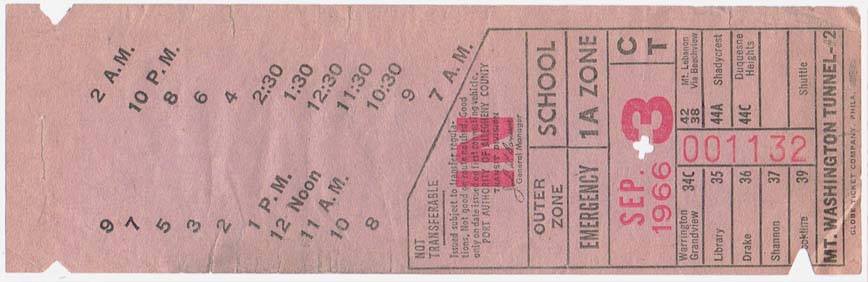

The following day, Port Authority
bus service replaced
the old trolley service and the local route was given a new designation,
41-Brookline. Within a few months, the old tracks that ran down the center
of Brookline Boulevard were paved over. The divided section of the road
from Edgebrook Avenue to Breining Street was widened to a broad,
four-lane avenue.
 
Red and cream colored PCC trolley cars travel
along Brookline Boulevard in 1966.
The era of rail traffic through
the heart of the Brookline community had come to an end. Many Brookliners
lamented the loss of the vintage streetcar service. However, as time went
on, they embraced the new Port Authority bus service as a reliable and
convenient public transportation alternative.

Reminders Of Yesteryear
The trolleys may have disappeared
from the Brookline landscape, but the old rails remained buried under the
asphalt. They occasionally made themselves a visible reminder of the
the community's streetcar past when a deep pothole emerged.

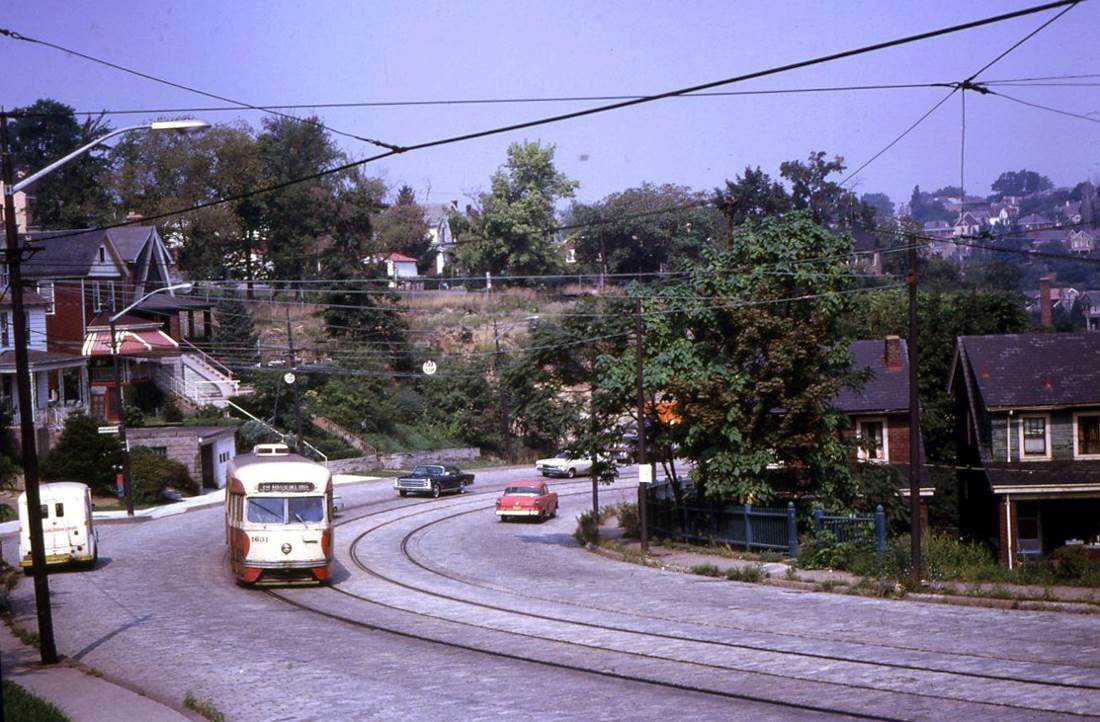
An inbound 39-Brookline approaching Flatbush
Avenue on Brookline Boulevard in the Summer of 1966.
The old tracks were briefly exposed,
in their entirity, during the reconstruction of Brookline Boulevard in 2014. When the aging asphalt was milled
down to the base, the four lines of steel tracks once again stretched down
the center of the boulevard.
For a brief time, Brookliners could
once again gaze at these historic remnants of the community's railway heritage.
After just two days above ground, the tracks were again hidden under eight
inches of black top.
An outbound 39-Brookline passes Kenilworth Avenue
in August 1966.
Another throwback to yesteryear came
in 2011. During a reorganization of the Port Authority bus service here in
Pittsburgh, Brookline's route designation was changed back to number thirty-nine,
a number not scene in the neighborhood since 1966. When a bus now makes the local
run, the marquee is emblazened with the vintage 39-Brookline.

One final reminder of the era of Pittsburgh
Railways and the trolleys that played a part in the birth of Brookline are located
here and there, mostly in collector albums or attic drawers. These are the various
fare tokens issued by Pittsburgh Railways over the years. The most common are the
1922 variety, a 3/4 inch brass token emblazened with an image of a Jones Car and
distinguishable by the triangle cut in the center.

A 39-Brookline streetcar at the trolley loop
along the 1400 block of Brookline Boulevard.
A Slice Of Americana
Brookline's trolleys may be gone,
but they will never be forgotten. The four-wheel box cars, the yellowish
Jones Cars, the red and cream PCC Cars, and the steel rails will forever
be a part of Brookline's transportation heritage that evoke nostalgic
memories.

An outbound Brookline trolley at the Queensboro
Avenue crosswalk in 1965.
Urban rail car enthusiasts still yearn
for the thrill of riding the rails through the city landscape. Photos of the
39-Brookline trolleys, making their way past the Boulevard shops, are like a
classic Norman Rockwell slice of Americana.
 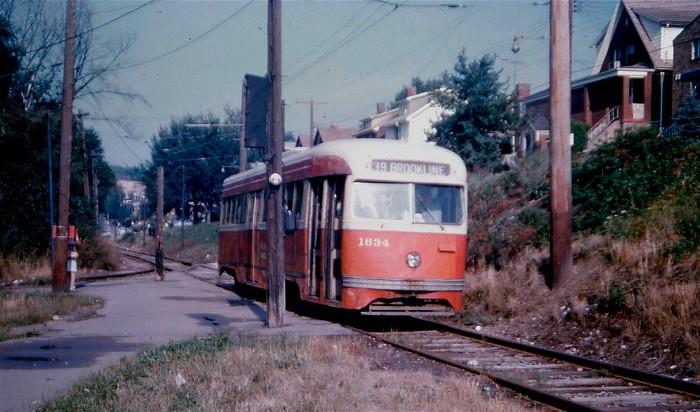
39-Brookline trolleys at the turn-around
loop at the end of the Brookline route.
A final historical note on the PCC cars of the
old Pittsburgh fleet. A few are scattered about in Trolley Museums around the country.
Others were sent to the San Francisco Bay area, where they provided much-needed
replacement parts for vintage PCC cars that remain in operation, ferrying
passengers through the Old Town to the harbor.


Take A Ride On The "T"
For those who still have an itch
to ride the rails, the Port Authority's "T", a modern light rail
system, still operates
along the old Shannon-Drake, Shannon-Library, Beechview and Mount Lebanon routes.
The Potomac Station in Dormont is just a short drive or a brisk walk for
most Brookliners, making the "T" a viable alternative for local commuters.

Light rail cars pass the Station
Square stop at Carson and Smithfield Streets.
The Port Authority's subway system
connects these southern light rail routes with locations throughout downtown
Pittsburgh and the North Shore. A quiet ride to South Hills Village or a run
to the Library suburbs is reminiscent of the old days.
<><><><> <><><><>
<><><><> <><><><>
<><><><> <><><><>
Light-Rail Service Comes To
Brookline
Although Brookline lost it's direct
streetcar route in September 1966, residents of East Brookline could still
walk down the Jacob Street Steps and through the Overbrook Tunnel to a car
stop along the Shannon-Drake line. This was the only streetcar stop located
within the confines of the Brookline community.
The Port Authority's Shannon-Drake
line ran along the route of the old Pittsburgh and Castle Shannon Railroad.
In the Saw Mill Run valley it passed through Bon Air and Carrick on the
northern side, then crossed over to the southern side of Saw Mill Run at
Whited Street.
The line then passed through a small
section of Brookline, where the local Car Stop stood near Overbrook Elementary
School. This long-serving streetcar line, one of the oldest in the South
Hills, was discontinued in 1993.
 
South Bank Station is a light-rail
transit stop located within the Brookline community.
After the turn of the century, the
Port Authority began a reconstruction project along the length of the
Shannon-Drake route to convert it to the modern light-rail system. Due to
elevation changes in the new line, the Overbrook station was
eliminated.
When the refurbished rail line
opened in 2004, a passenger platform was installed near Jacob Street.
between Whited Street and the lower end of Brookline Boulevard. It is
located the portion of the route that is shared by the rail line and the
South Busway.
Known as South Bank Station, the
bus stop had been in existence since 1977, when the South Busway opened.
Now doubling as a bus and light-rail station, South Bank has become a popular
car stop for residents living in the East Brookline part of the
neighborhood.

Brookline Streetcar Photo Gallery
(Downtown Pittsburgh to the Brookline Loop)
♦ Downtown Pittsburgh ♦
♦ South Hills Junction ♦
♦ West Liberty Avenue to the Brookline Junction ♦
♦ Brookline Boulevard from West Liberty to Pioneer ♦
♦ Brookline Boulevard Commercial District ♦
♦ Brookline Boulevard from Edgebrook to Breining ♦
♦ Breining Street to the Brookline Loop ♦

♦ Pittsburgh Light Rail Transportation
History ♦
(including video of the Brookline Route)
<><><><> <><><><>
<><><><> <><><><>
<><><><> <><><><>
Downtown Pittsburgh

Inbound 39-Brookline crosses East Carson
Street onto the Smithfield Street Bridge.
 
An inbound 39-Brookline on the Smithfield Street
Bridge (left) and another heading outbound at Carson Street.

Outbound 39-Brookline on the Smithfield
Street Bridge heading towards Carson Street and the transit tunnel.

39-Brookline passes the First English Evangelical
Lutheran Church along Grant Street - June 27, 1965.
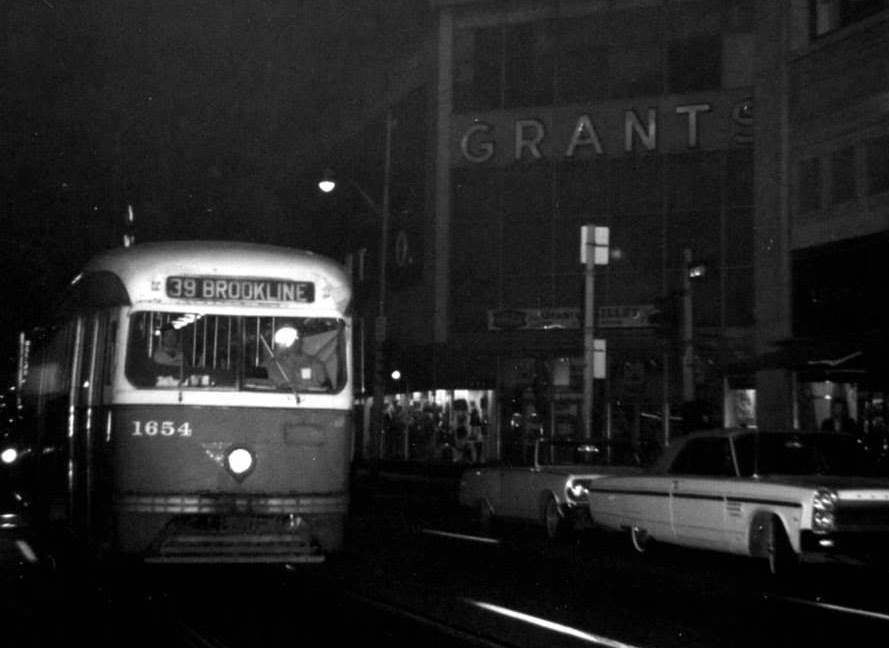 
39-Brookline at Mellon Plaza on Smithfield
Street (left) and another passing the City County Building on Grant Street.

Outbound 39-Brookline makes the turn off
the First Street ramp onto the Smithfield Street Bridge.
<><><><> <><><><>
<><><><> <><><><>
<><><><> <><><><>
South Hills Junction

Looking down upon the Pittsburgh Railways
South Hills Junction in the spring of 1905 from the P&CSRR tracks
above.

Looking from atop South Hills High School
along Ruth Street down at the southern approaches to the South Hills
Junction in 1918. The Shannon and Charleroi lines come in from the left and the
Brookline, Beechview, Dormont
and Mt. Lebanon lines to the right. Homes along Warrington Avenue can be seen to
the left.

A 39-Brookline PCC passes an old Jones Car as
it approaches the South Hills Junction.
 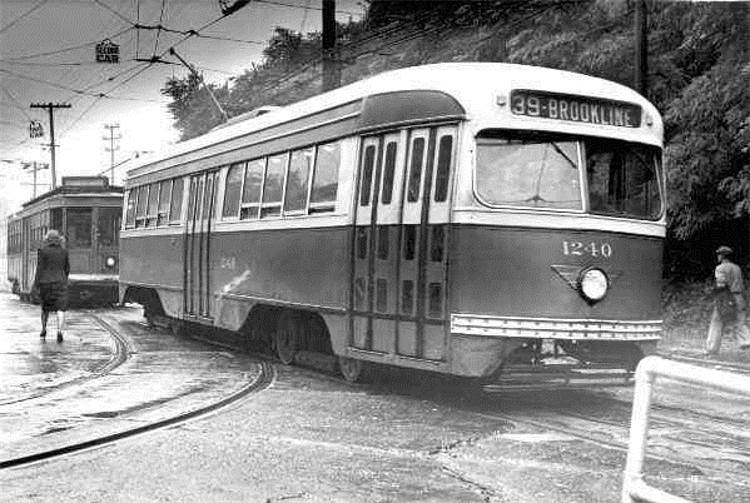
An outbound 39-Brookline at the Junction Car
Stop (left) and an inbound approaches the transit tunnel entrance.
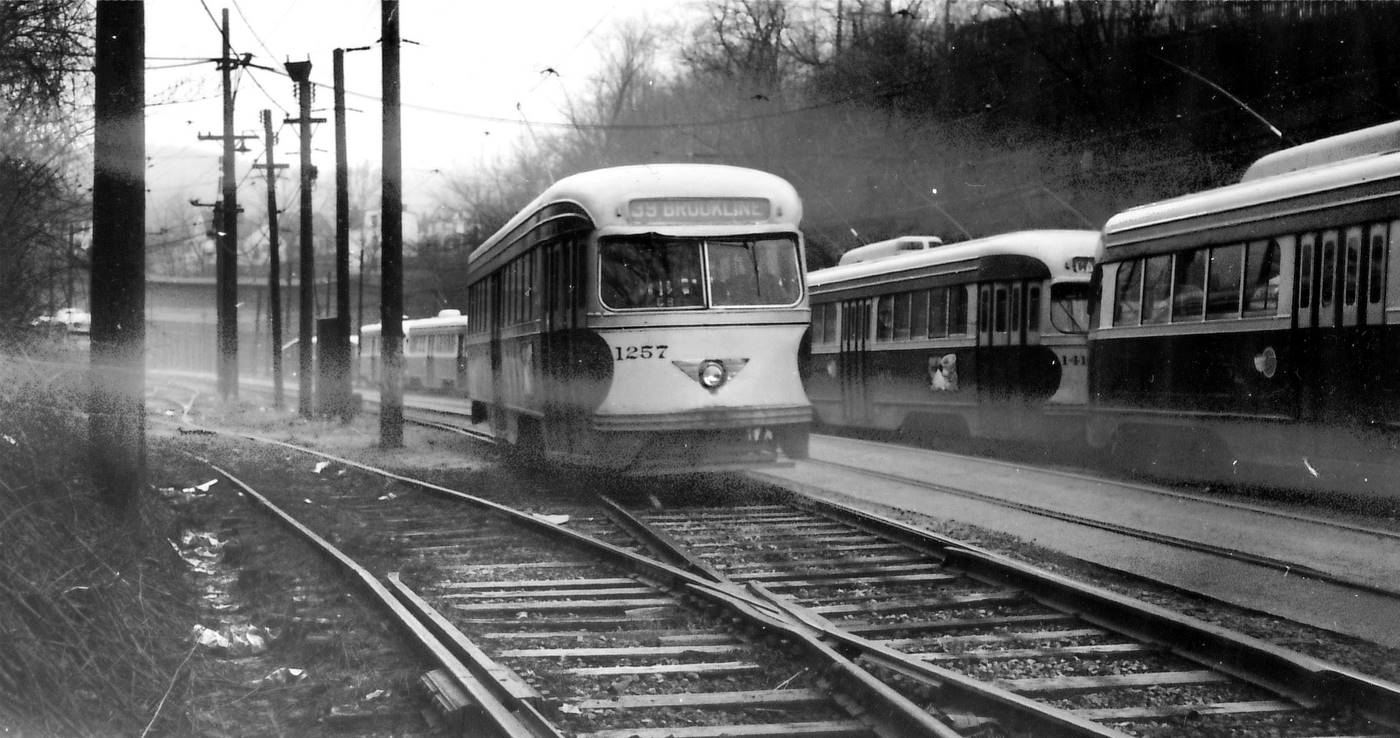
An inbound 39-Brookline passes through
the South Hills Junction.
 
39-Brookline trolleys crossing the Palm
Garden trestle on their way toward the South Hills Junction.

A 39-Brookline trolley passing through
the South Hills Junction yard in 1959.
 
An outbound 39-Brookline exits the transit
tunnel (left) and another passes the car barn at the Junction.

A 39-Brookline PCC passes through the
South Hills Junction.

1960s-era overhead view of the South Hills Junction
rail yard complex.
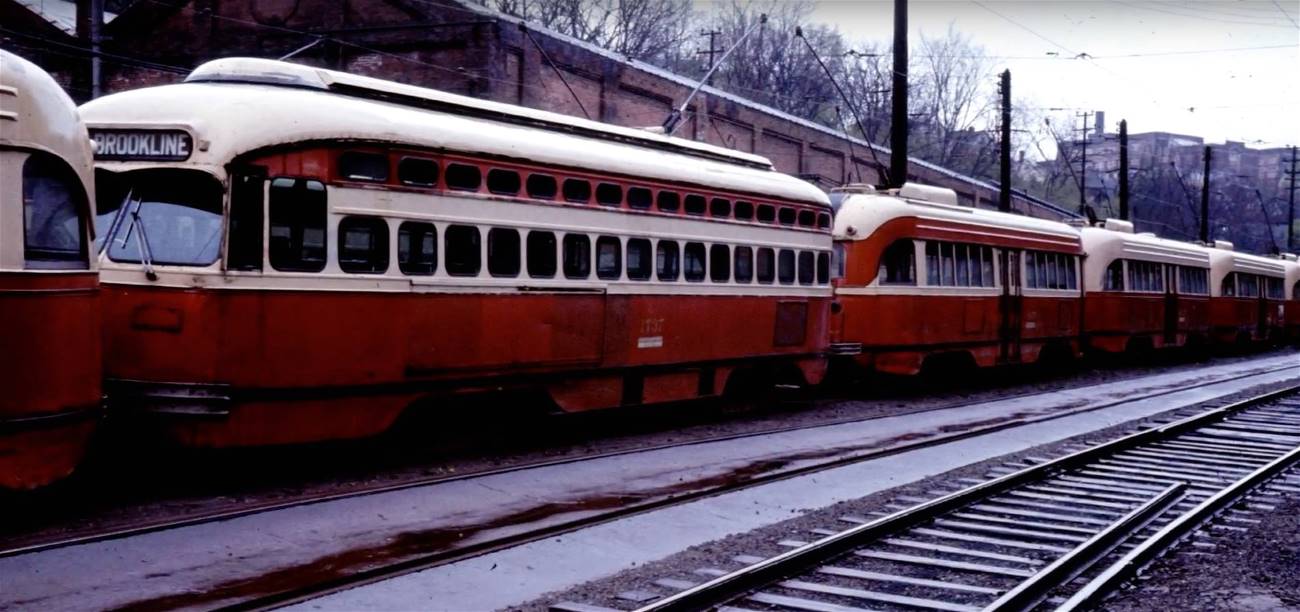
A 39-Brookline PCC stands in line waiting to take
to the tracks South Hills Junction.
 
Inbound 39-Brookline trolleys pass the outbound
Junction loading platform on the way to the transit tunnel.

A 39-Brookline PCC passes through the
South Hills Junction.
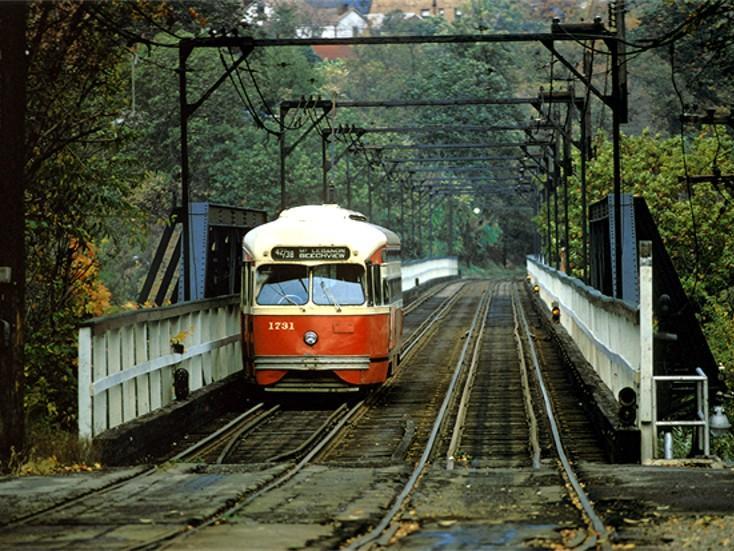 
A 42/38-Mt Lebanon/Beechview on the
Parm Garden Trestle (left). The 39-Brookline streetcar used the bridge
from 1940 to 1966. To the right, a 39-Brookline enters the
trolley ramp heading towards West Liberty.
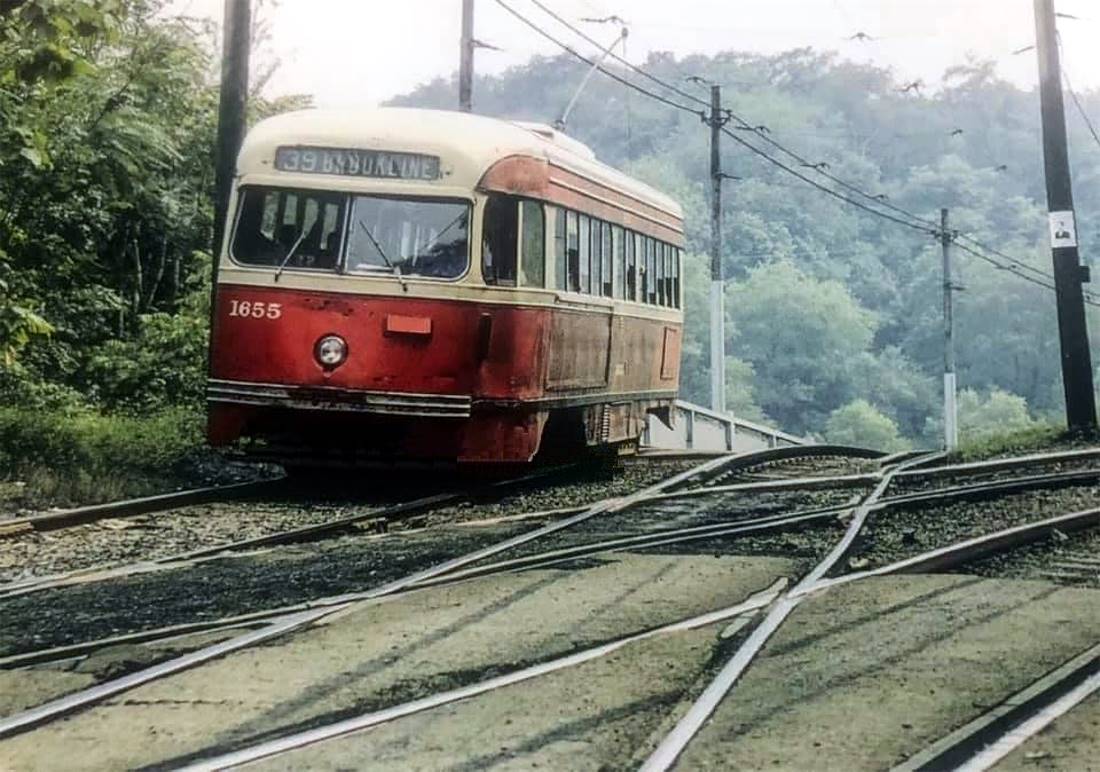
An inbound 39-Brookline merges onto the Beechview
line at the top of the West Liberty Avenue ramp.
<><><><> <><><><>
<><><><> <><><><>
<><><><> <><><><>
West Liberty Avenue

A trolley car passes homes along West Liberty
Avenue, north of Brookside Avenue (circa 1904).
By the end of 1905 the streetcar line along West Liberty Avenue would be
double-tracked.
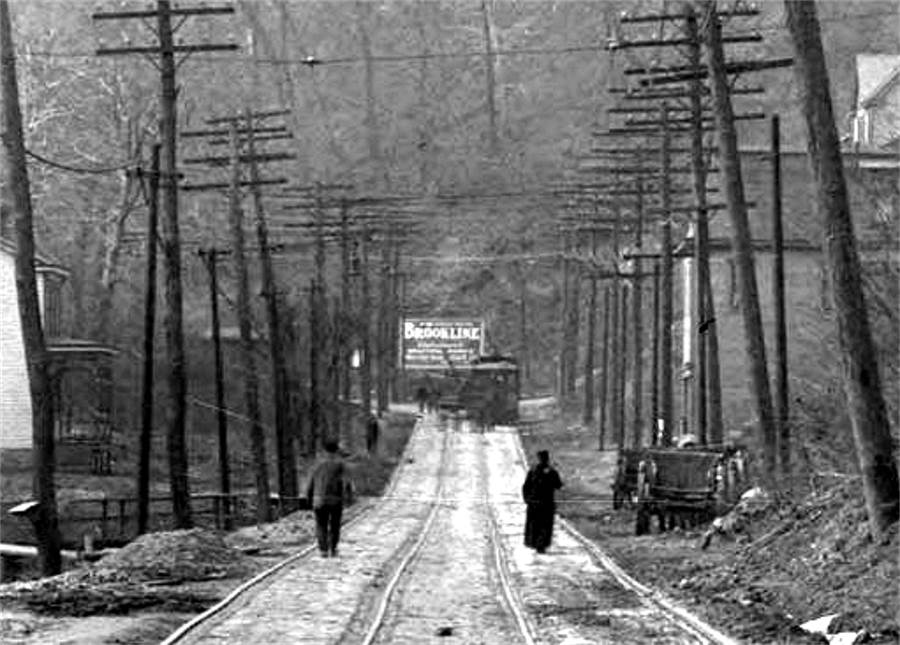 
An outbound streetcar approaches Brookside
Avenue and a billboard advertising lots in Brookline (left),
and an inbound streetcar passing Stetson Street heading north towards
Cape May in March 1915.
 
An outbound streetcar approaches Belle Isle
Avenue in March 1915 (left) and another at Belle Isle in August 1915.
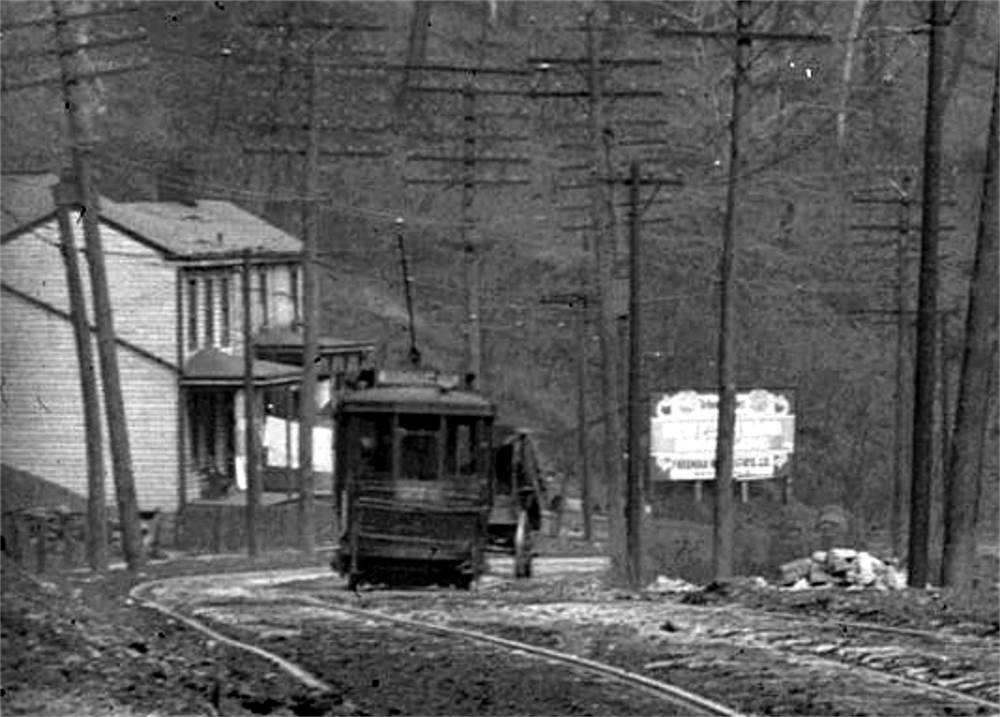
An inbound 39-Brookline streetcar heads
north towards Cape May Avenue in March 1912.
 
Two inbound 39-Brookline streetcars approach
the Capital Avenue on West Liberty Avenue (left), and a
well-dressed family wait for a streetcar at the Capital Avenue
Car Stop in September 1915.
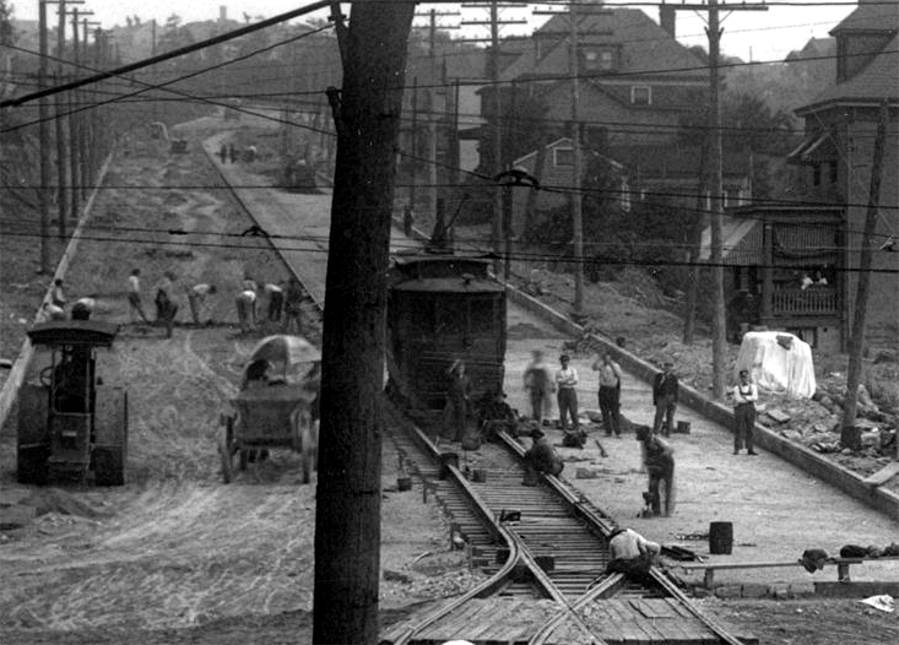 
Construction work at the Brookline Junction in
May (left) and in August 1915, looking south towards the city line.

A man and three boys pass Stetson Street as
they ride the rails south towards Capital in August 1915. The young
lad standing on the edge of the wagon is looking back at a streetcar coming
up behind the wagon.
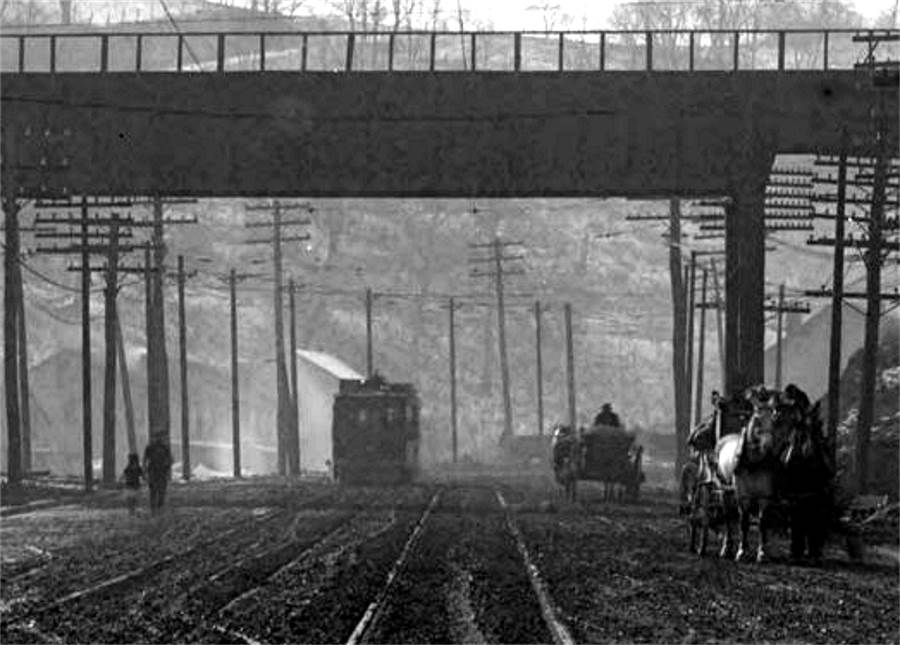 
An inbound streetcar passes Pioneer Avenue
approaching the intersection with Warrington (left)
and another heading outbound past Cape May Avenue in December 1915.
 
West Liberty Avenue in 1916, looking north from
the Brookline Junction (left) and the intersection of Ray Avenue.
The year-long reconstruction project is finished. The roadway was widened
to four lanes and paved in Belgian
block. New sewers and electric has been installed as well as a complete upgrade of
the streetcar line.

An outbound streetcar passes the Brookline
Junction heading uphill towards the city line in June 1916.
 
A trolley car heading inbound approaches
the Pioneer Avenue Car Stop (left) in 1918; An inbound
trolley on Warrington Avenue after turning off West Liberty Avenue in
1921.

The intersection of West Liberty Avenue and
Warrington Avenue in 1918.
 
Prior to 1940 and the construction of the
trolley ramp, the Brookline route ran the length of West Liberty Avenue
to Saw Mill Run Boulevard. From there it turned onto Warrington
Avenue, then entered the South Hills Junction.
The trolley ramp was built to ease traffic congestion at the Liberty Tunnels
intersection. The ramp led to
a junction with the Beechview line and proceeded over the Palm Garden trestle
to The Junction.
The two photos above show the busy intersection in 1930 (left) and again in
1936.

A 1940s-era long view showing the lower end
of West Liberty Avenue,
including the trolley ramp and the Liberty Tunnels.
 
A 39-Brookline PCC comes off the newly
constructed West Liberty Avenue streetcar ramp in 1940 (left) and in
1965.

An outbound 39-Brookline comes down the West Liberty
Avenue trolley ramp.
 
A 39-Brookline heading outbound along the West
Liberty Avenue trolley ramp (left) and another
making the inbound trip, entering the ramp in 1966.
 
A 39-Brookline enters the West Liberty trolley
ramp (left) and an outbound car passes Cape May Avenue.
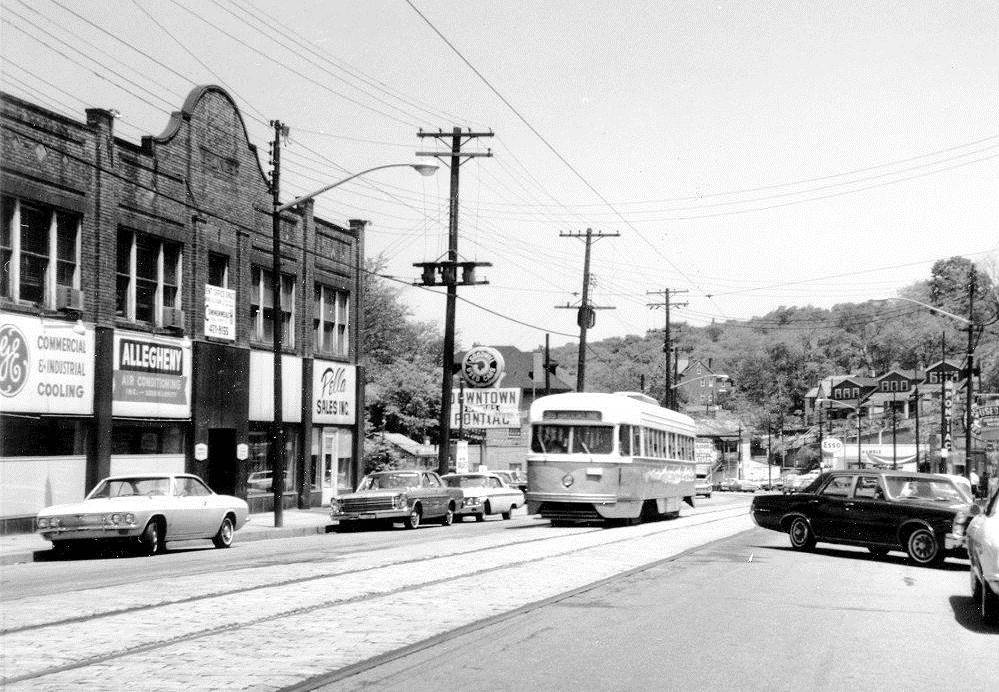
A 39-Brookline passes Downtown Pontiac's Used Car
lot heading outbound towards the Ray Avenue Stop.
 
Inbound streetcars at the Capital Avenue Car
Stop, on January 22, 1959 (left) and February 4, 1960.

An inbound 39-Brookline pulls onto West Liberty
Avenue from Brookline Boulevard on May 22, 1962.
 
Inbound 39-Brookline streetcars approaching
the Pauline Avenue (left) and Capital Avenue car stops.
 
An outbound 39-Brookline passes Brookside
Avenue (left) and another outbound approaches Capital Avenue.
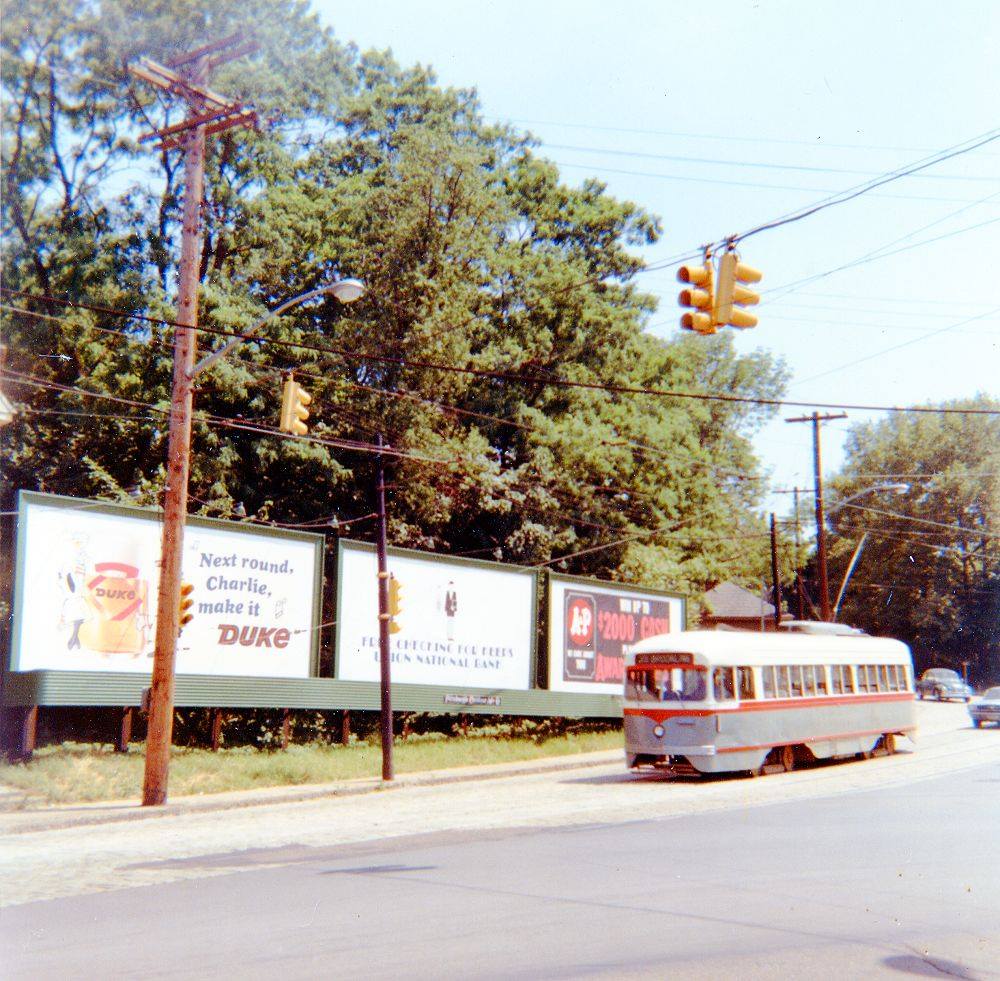
An inbound 39-Brookline passes billboards at the
Brookline Junction as it merges onto West Liberty Avenue.
<><><><> <><><><>
<><><><> <><><><>
<><><><> <><><><>
Brookline Boulevard
(West Liberty Avenue to Pioneer Avenue)

A 1909 view taken from Brookline Boulevard (Bodkin
Street) and Pioneer Avenue showing the Pittsburgh Railways
streetcar right-of-way that would one day become part of
the Boulevard Loop. At that time the Brookline
route was only a single-track line. The homes in the
distance are on Espy Avenue in Dormont.
 
The Brookline Junction (left) at West Liberty
Avenue in 1909, and the 39-Brookline tracks passing the front
of Harley's Express Moving and General Hauling, located at the
Brookline Junction, in 1915.
 
West Liberty Avenue at the intersection
with Brookline Boulevard, called the Brookline Junction, in March 1915.
The narrow dirt roadway was paved only along the trolley line, which
doubled as a pedestrian walkway.

A vintage Jones Car passing Brookline's
Fleming Car Stop in 1928.
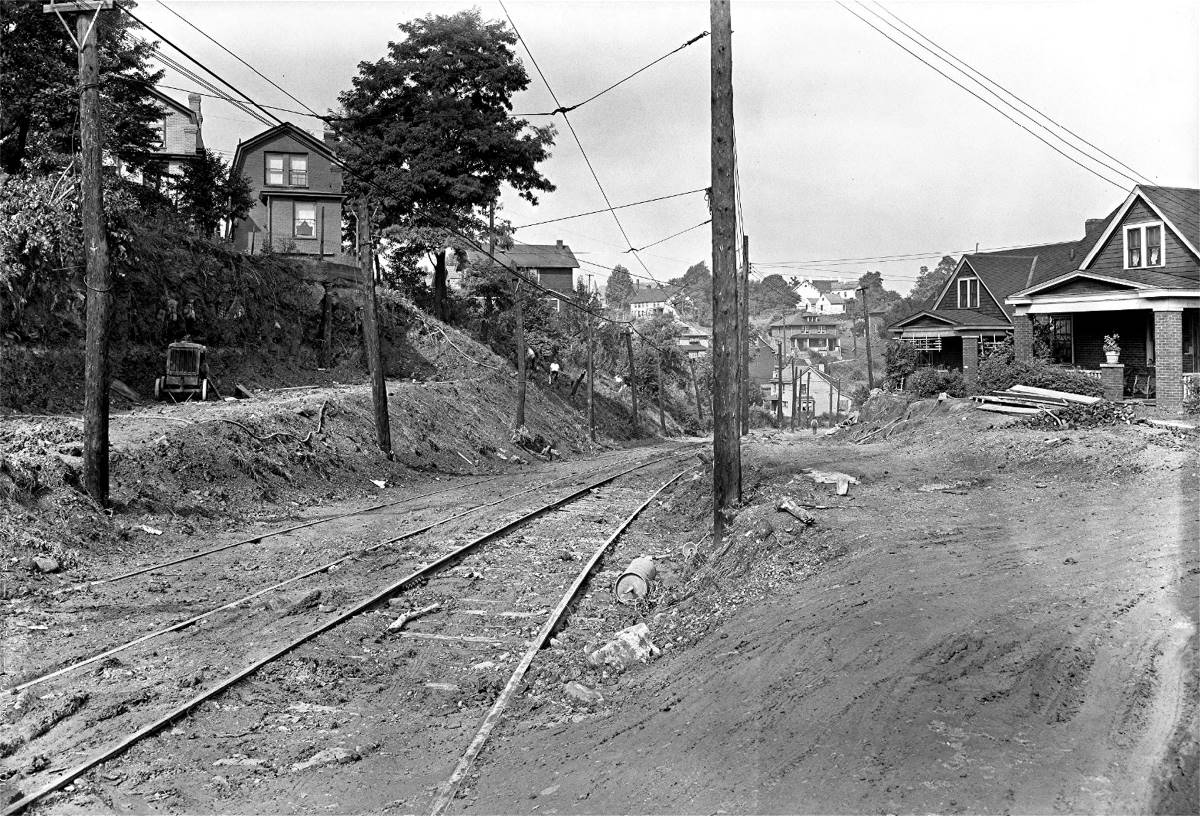
The old trolley right-of-way at Shawhan Avenue
in July 1935, before the reconstruction of Brookline Boulevard.
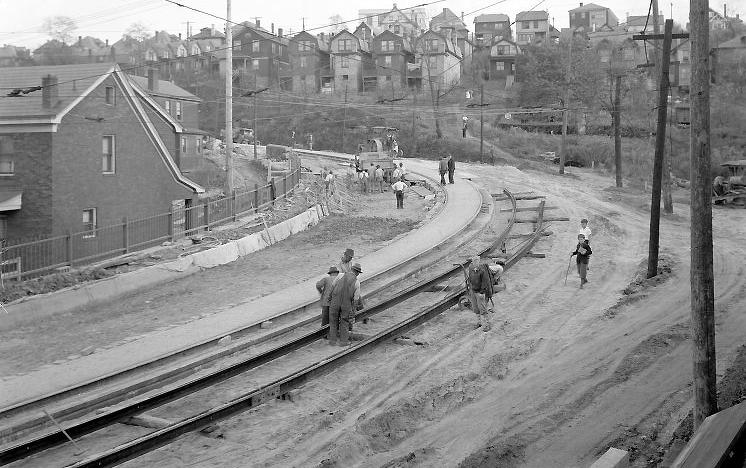 
Two 1935 views showing the construction
of the Boulevard Loop from Pioneer Avenue to West Liberty Avenue.
The boulevard was rerouted off of present-day Bodkin Street onto the
streetcar right-of-way.
To the left is a view of the Fleming Car Stop and to the right
a view towards Pioneer.

A web of overhead wires and the Car Stop
sign that hung at the Fleming Place stop.
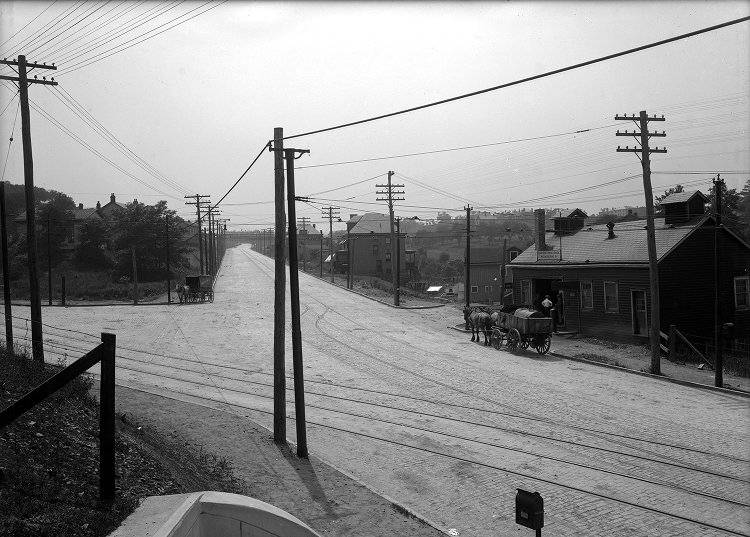 
West Liberty Avenue, at the intersection
with Brookline Boulevard and Wenzel Avenue, in June 1916 (left) and
an inbound trolley, a Jones Car, on Brookline Boulevard at the
Fleming Car Stop, near Kenilworth, in 1935.
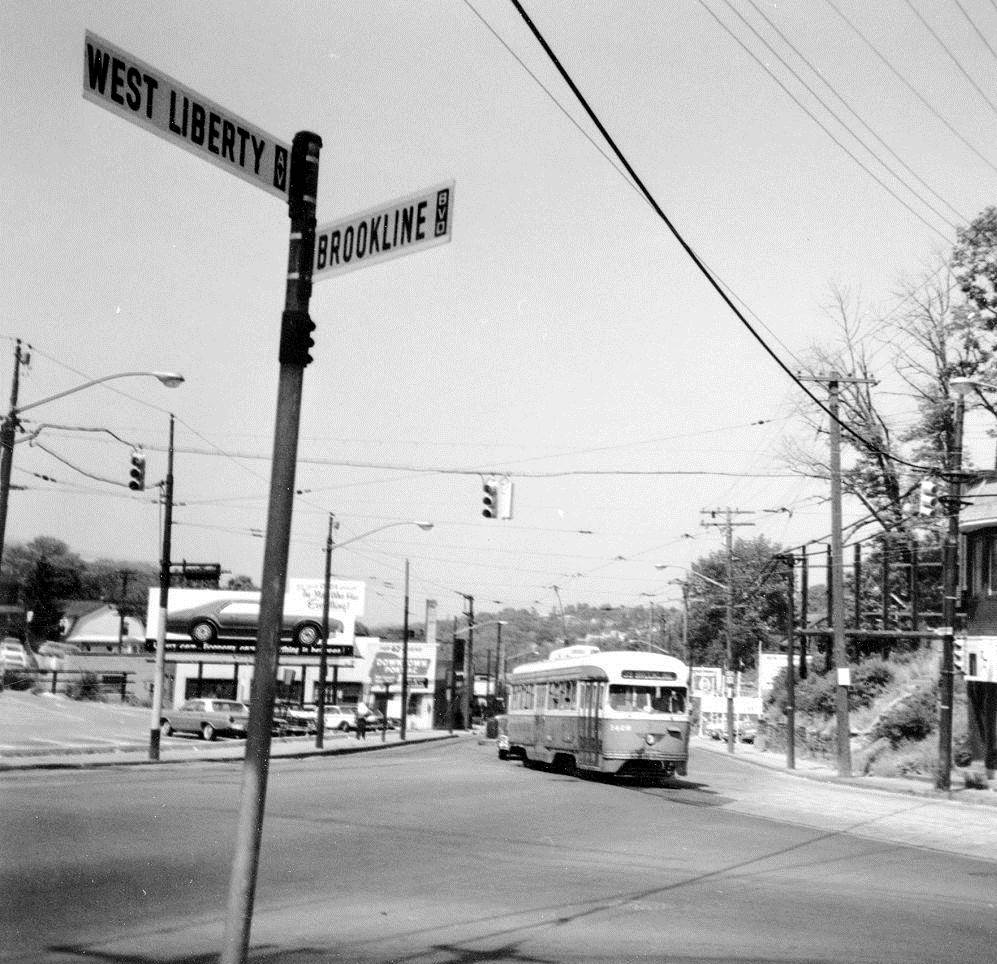
An outbound 39-Brookline makes the turn
from West Liberty Avenue onto Brookline Boulevard.
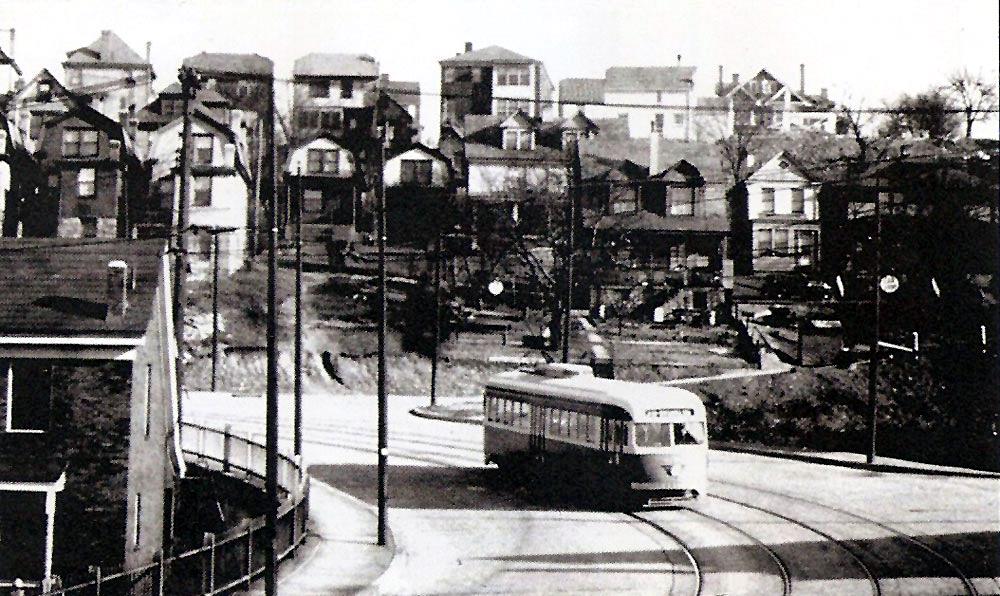 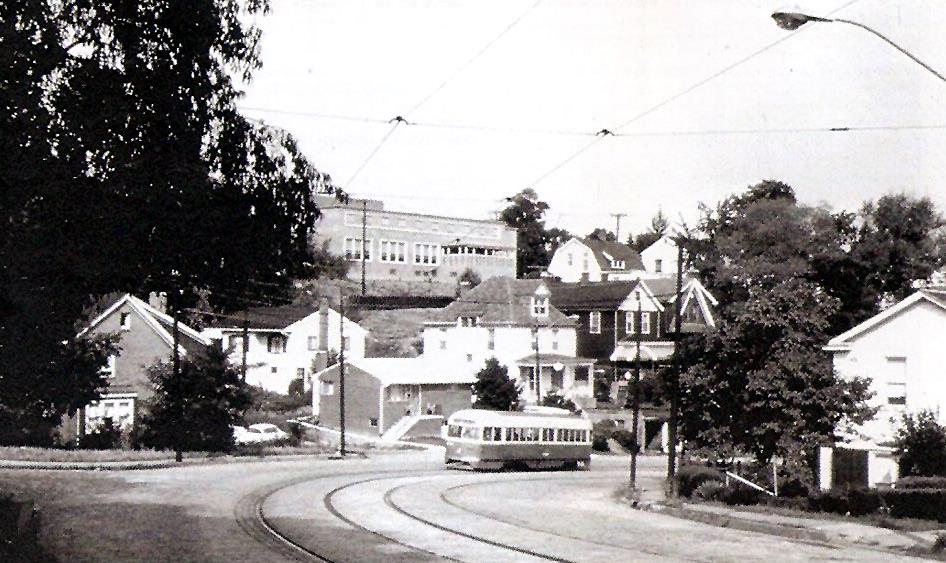
A new PCC car passes the Fleming
Car Stop (left) as it heads inbound towards West Liberty Avenue in 1940,
and an outbound trolley passes Kenilworth Avenue, heading towards Pioneer
Avenue in the late-1950s.
 
Outbound 39-Brookline trolley cars passing Kenilworth
Street on the way up hill towards Pioneer Avenue.

An outbound 39-Brookline passes Jillson Street heading
towards West Liberty Avenue on on May 19, 1963.
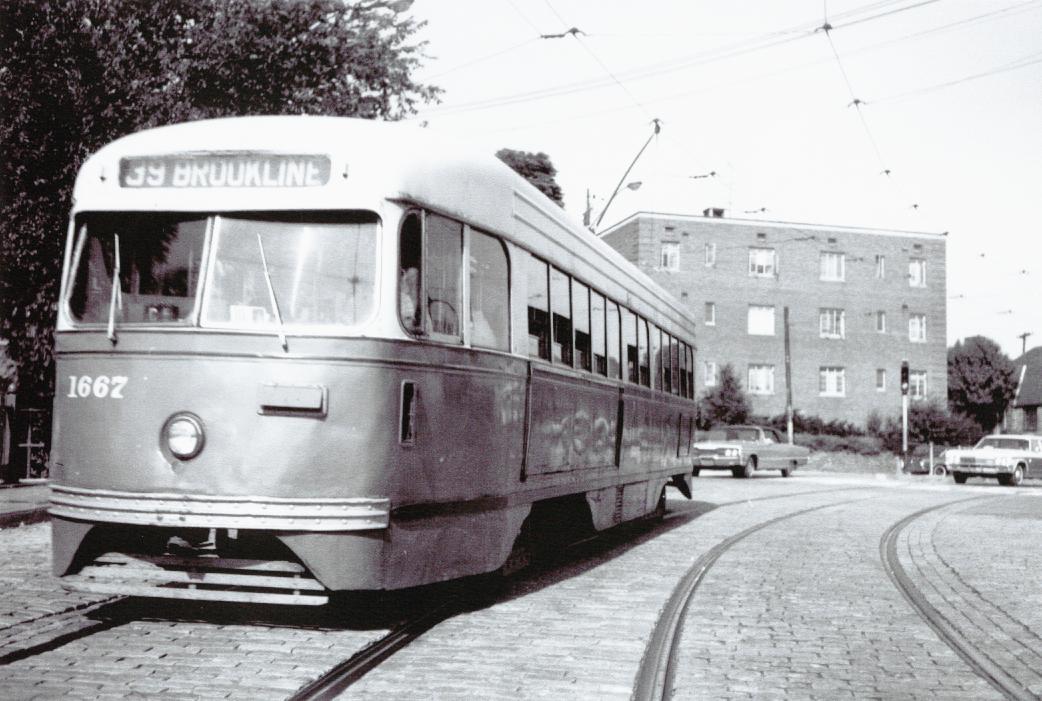 
Inbound 39-Brookline streetcars pass Pioneer
Avenue (left) and Kenilworth Avenue (right) enroute to West Liberty.
 
Outbound 39-Brookline streetcars head up Brookline
Boulevard after turning off of West Liberty Avenue in 1966.

A chartered outbound trolley passes Kenilworth
Avenue enroute to Brookline Boulevard in 1966.
<><><><> <><><><>
<><><><> <><><><>
<><><><> <><><><>
Brookline Boulevard - The Commercial District
(Pioneer Avenue to Edgebrook Avenue)

Brookline Boulevard in 1910, at the
corner of Chelton Avenue. The Freehold Real Estate office is located on
the corner island where present-day Triangle Park and the Veteran's Memorial
stand. A vintage
39-Brookline four-wheel box car can be seen to the left
passing Queensboro Avenue.
 
A 1916 view of Brookline Boulevard, looking
towards Stebbins Avenue (left) and Brookline Boulevard, in 1926,
looking along the streetcar rails in the direction of Creedmoor
Avenue.
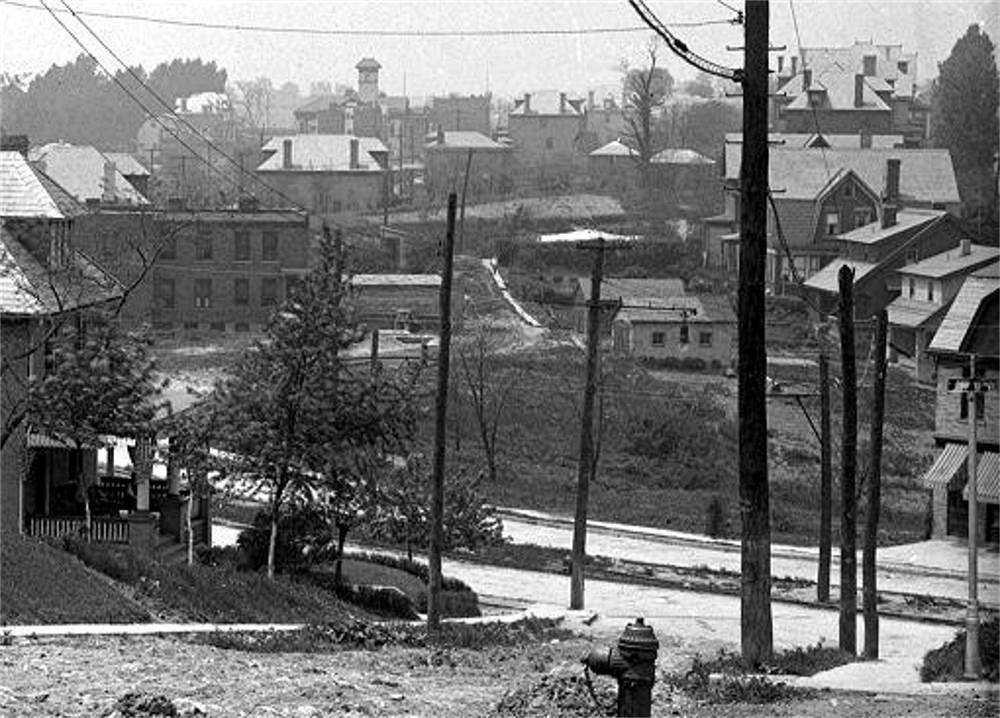
Looking down Creedmoor Avenue, from Clippert
to Brookline Boulevard and the streetcar tracks in 1919.
 
A view of the rails along Brookline Boulevard,
taken from Pioneer Avenue (left) and a 39-Brookline Jones Car
approaches the Stebbins Avenue Car Stop along Brookline Boulevard in
1933.

Inbound and outbound trolley rails cut a
path along Brookline Boulevard, near Castlegate Avenue, in 1926.
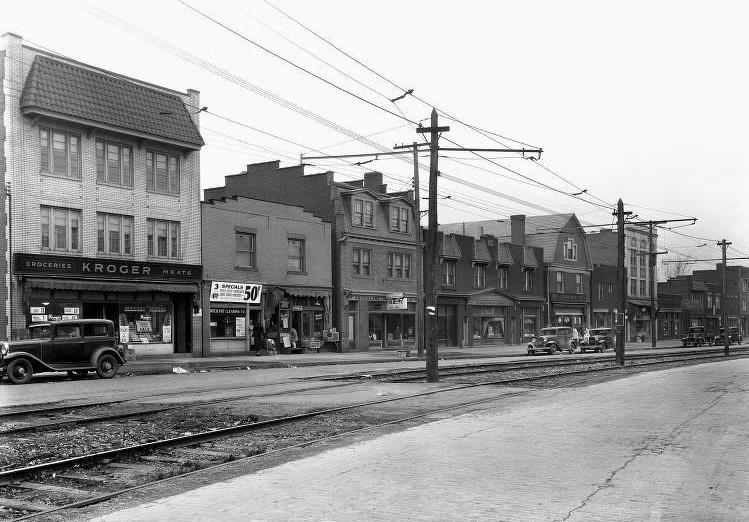 
Two views of Brookline Boulevard in 1933,
near Glenarm Avenue (left) and Flatbush Avenue.
 
The Brookline Boulevard Commercial
District (left), looking west from Chelton Avenue and Veteran's Memorial Park.
Two streetcars are passing near Stebbins Avenue. To the right
is the passenger island at Pioneer Avenue in 1936.

Two trolley cars, one inbound and one outbound,
pass near Flatbush Avenue along Brookline Boulevard in 1965.
 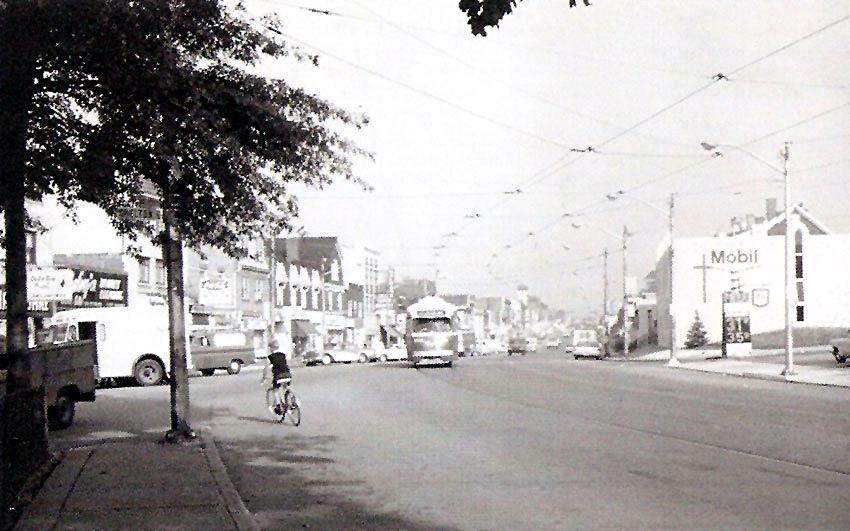
An inbound 39-Brookline trolley approaches
the intersection with Flatbush Avenue (left) and an
outbound car passes the intersection of Glenarm Avenue in 1965.

An outbound 39-Brookline passing the Texaco station
at the corner of Pioneer Avenue and Brookline Boulevard on June 28, 1965.
 
Outbound and inbound streetcars approaching
Castlegate Avenue (left) and two inbound cars near Stebbins Avenue.

An inbound trolley moves with traffic along
Brookline Boulevard on June 26, 1965.
 
An inbound 39-Brookline trolley passes
the intersection with Flatbush Avenue (left) and an
outbound car at the intersection of Pioneer Avenue in 1965.

An inbound trolley approaching a passenger
waiting on the island at Pioneer Avenue in 1965.
<><><><> <><><><>
<><><><> <><><><>
<><><><> <><><><>
Brookline Boulevard
(Edgebrook Avenue To Breining Street)

An inbound 39-Brookline approaches a passenger
waiting to board at Whited Street on May 19, 1963.
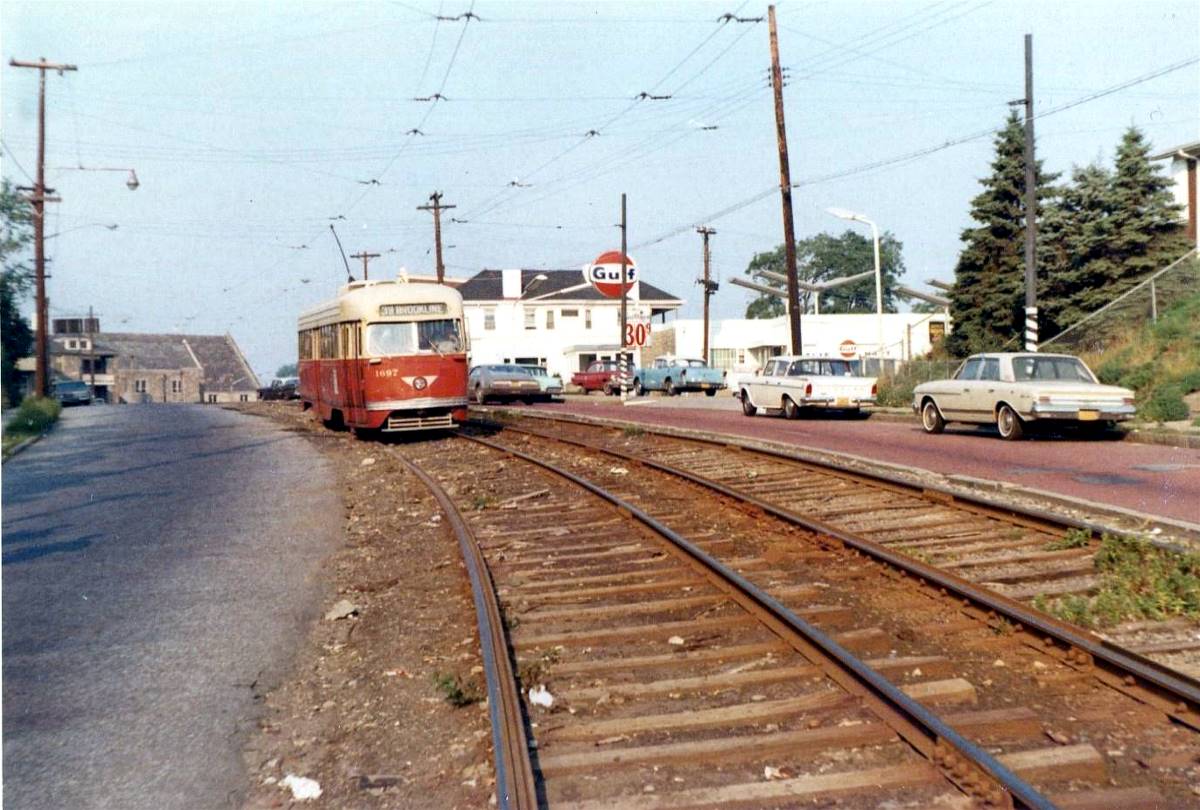
An outbound 39-Brookline passes Edgebrook
Avenue heading downhill towards the Whited Street Car Stop.
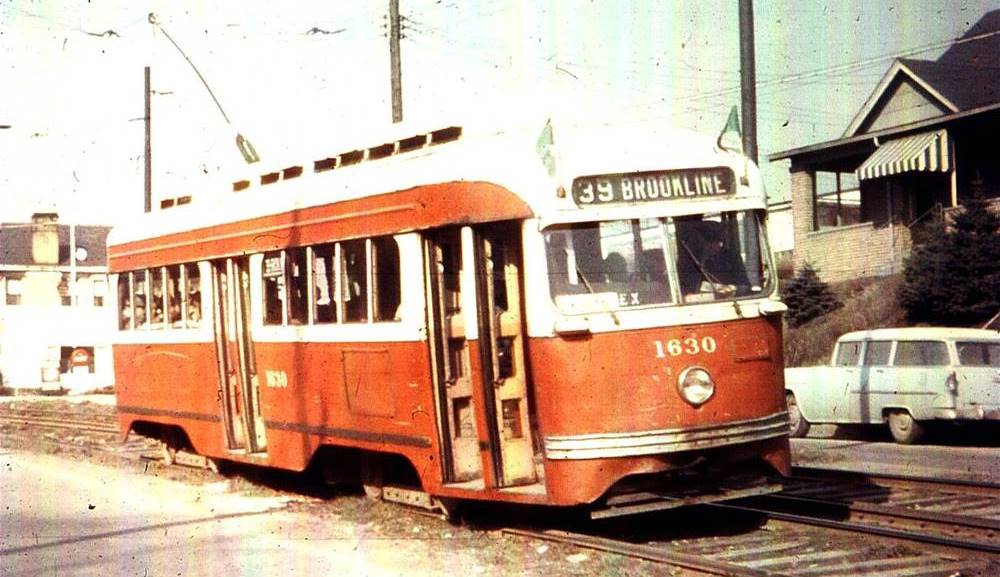 
Outbound cars approach Whited Street (left)
and Breining Street.

An outbound 39-Brookline passes Whited Street
heading downhill towards the Breining Street Car Stop.
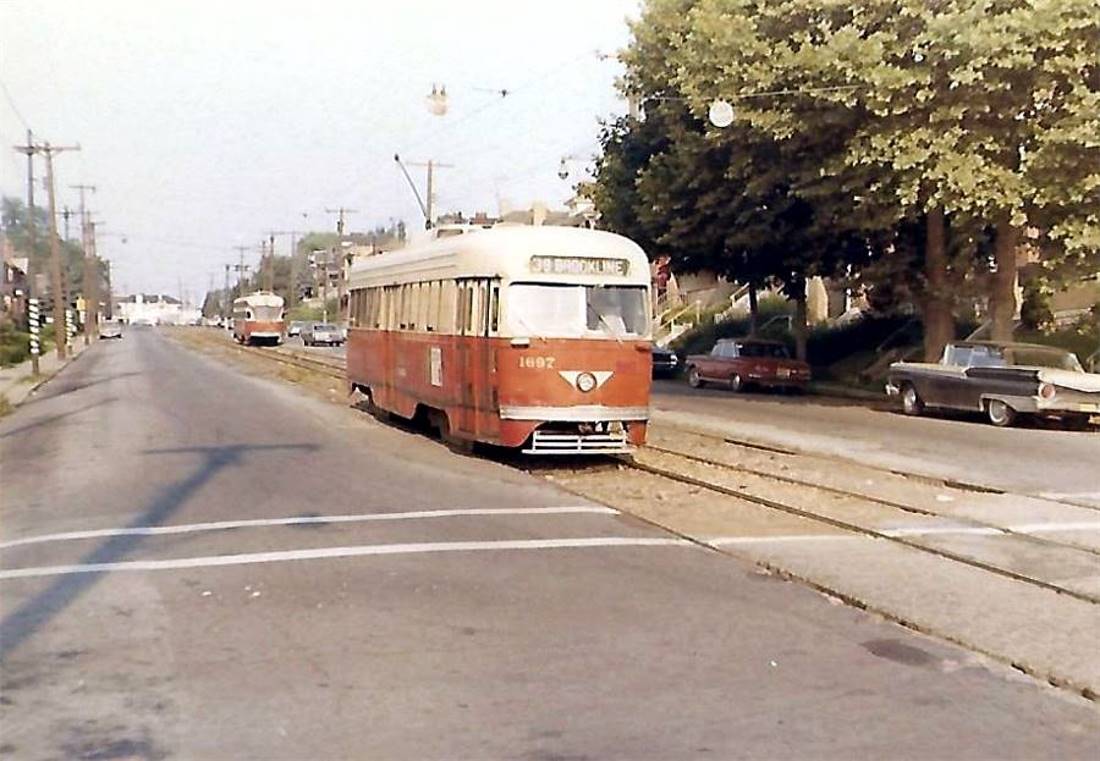
An outbound 39-Brookline approaches Breining Street
while an inbound heads uphill towards Whited Street in 1966.
<><><><> <><><><>
<><><><> <><><><>
<><><><> <><><><>
Brookline Boulevard
(Breining Street To The Trolley Loop)
A 39-Brookline streetcar at the trolley loop
preparing for the return trip up Brookline Boulevard.
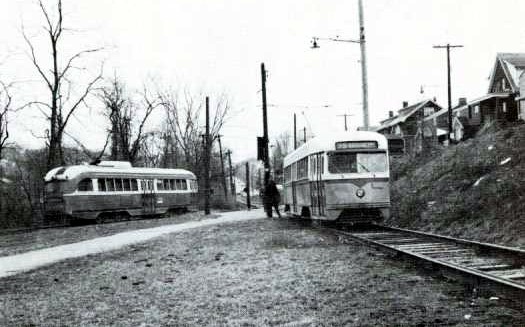 
Two trolleys at the Brookline Loop (left)
and another beginning the inbound trip back along Brookline Boulevard.
 
Two outbound 39-Brookline trolleys approaching
Breining Street on September 4, 1953 (left) and September 1, 1966.

A 39-Brookline waits for automobile traffic
to pass at the intersection of Breining Street in January 1958.
 
Conductor checking in at the Brookline Loop (left) and
an outbound car approaching the loop.
 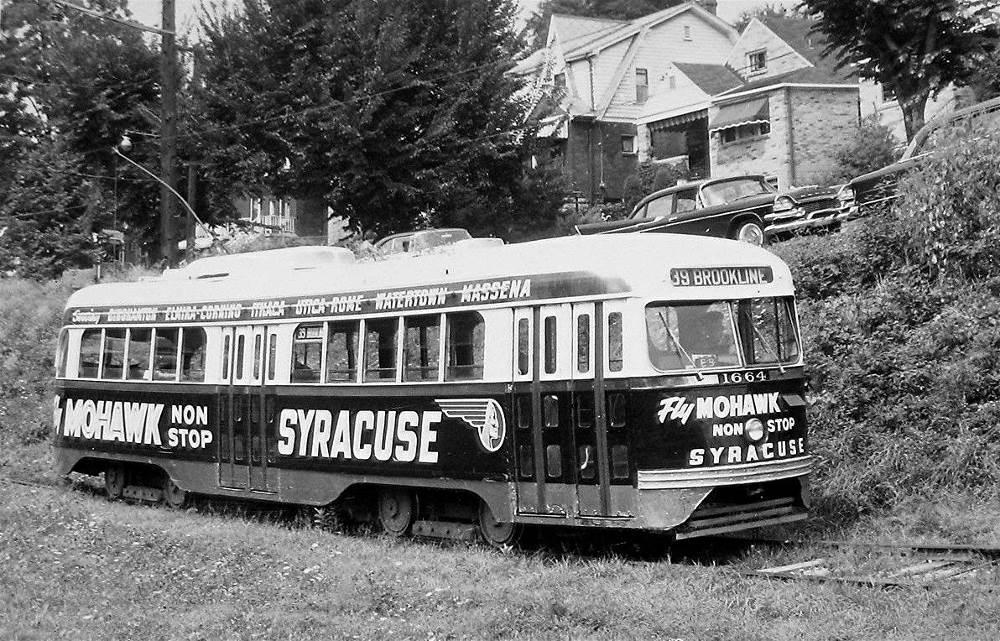
An outbound streetcar passes the intersection
with Birchland Street (left) and another approaches the trolley loop.
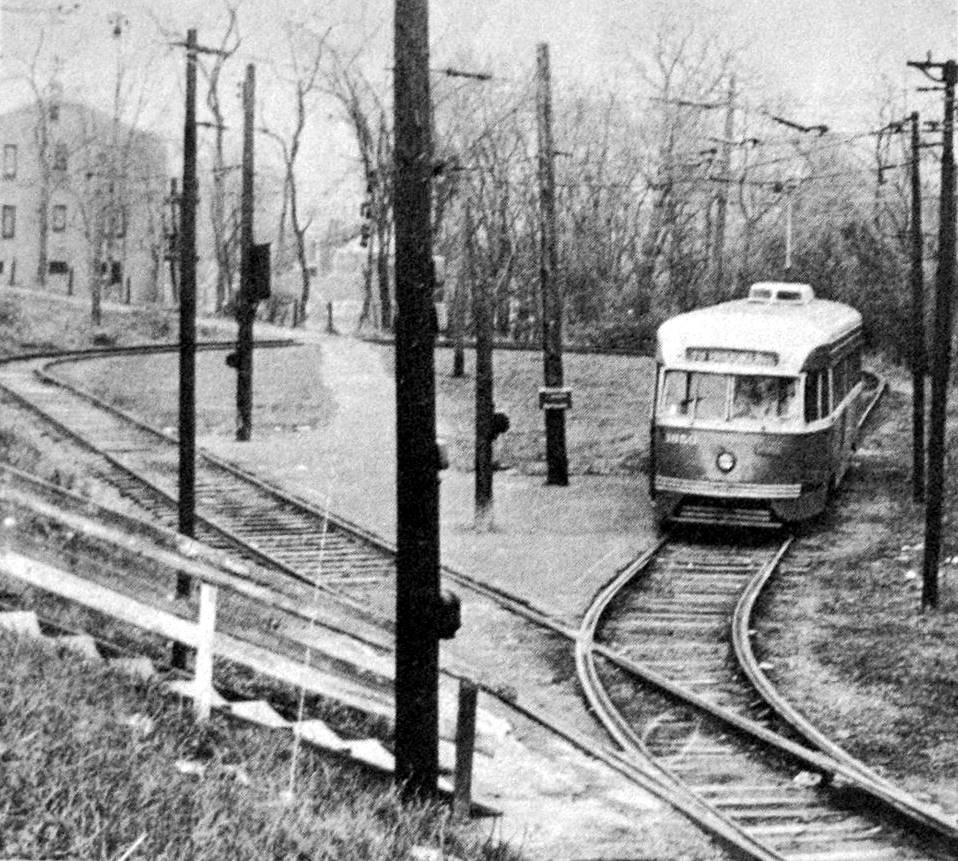
A 39-Brookline waits at the Brookline Loop
to begin its inbound run.

A 39-Brookline waits at the Brookline Loop
to begin its inbound run.
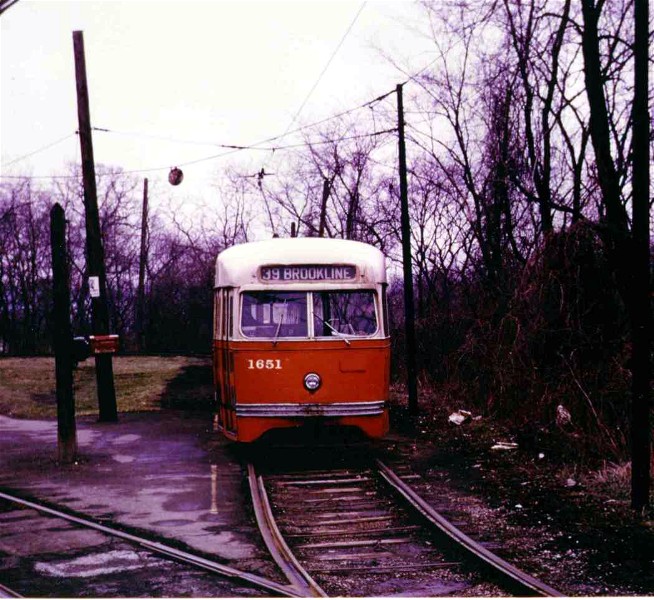 
Trolley cars at the Brookline Loop along the
1400 block of Brookline Boulevard. This was the end of the local route.
 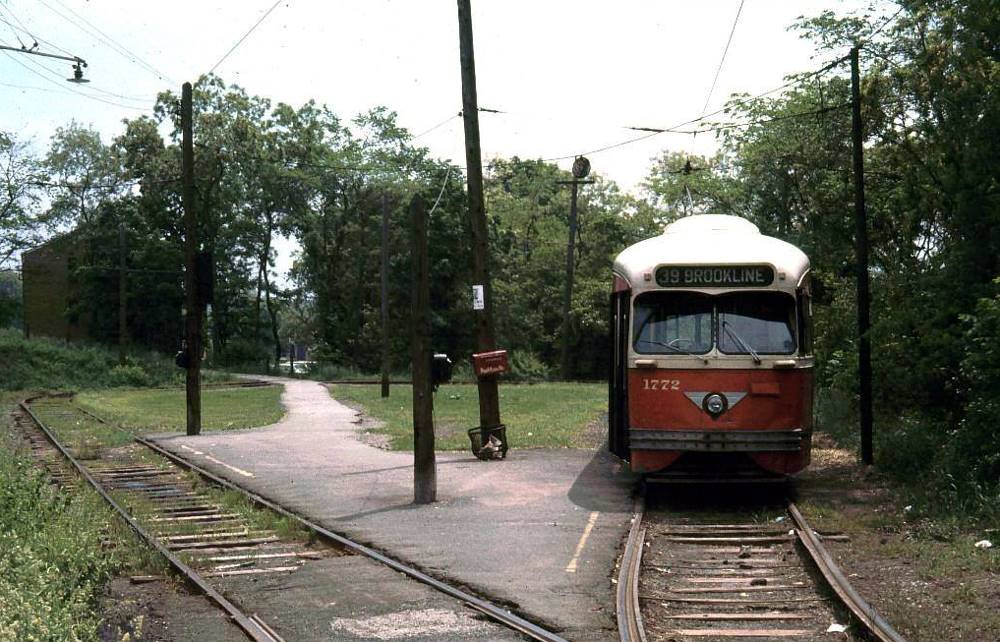
Two images showing the 39-Brookline trolley cars
at the Brookline Loop in 1965.

A 39-Brookline makes the turn at the Brookline Loop
in January 1965.
 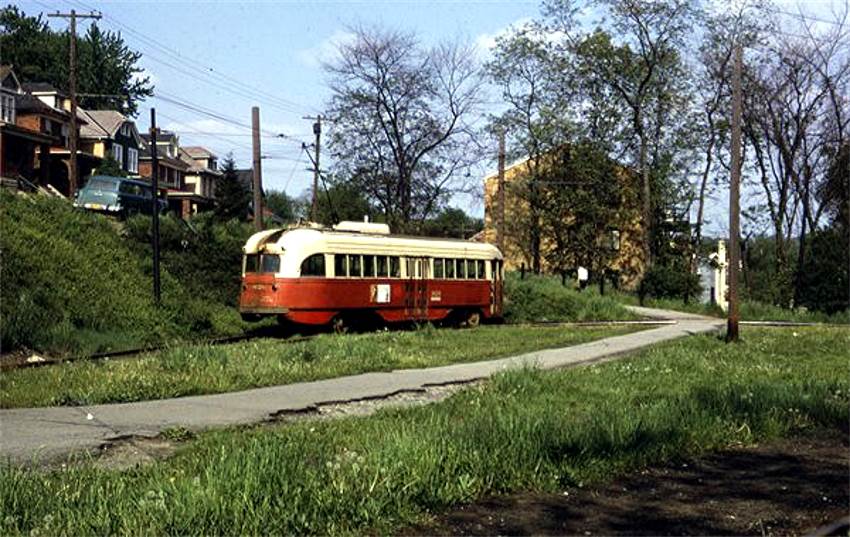
Two images showing the 39-Brookline trolley cars
at the Brookline Loop in 1966.
 
The Brookline Loop was built in 1910 when the
local route was double-tracked. Prior to that, the Brookline route
ran into the Overbrook Valley to Saw Mill Run, where it intersected
with the Shannon and Charleroi lines.
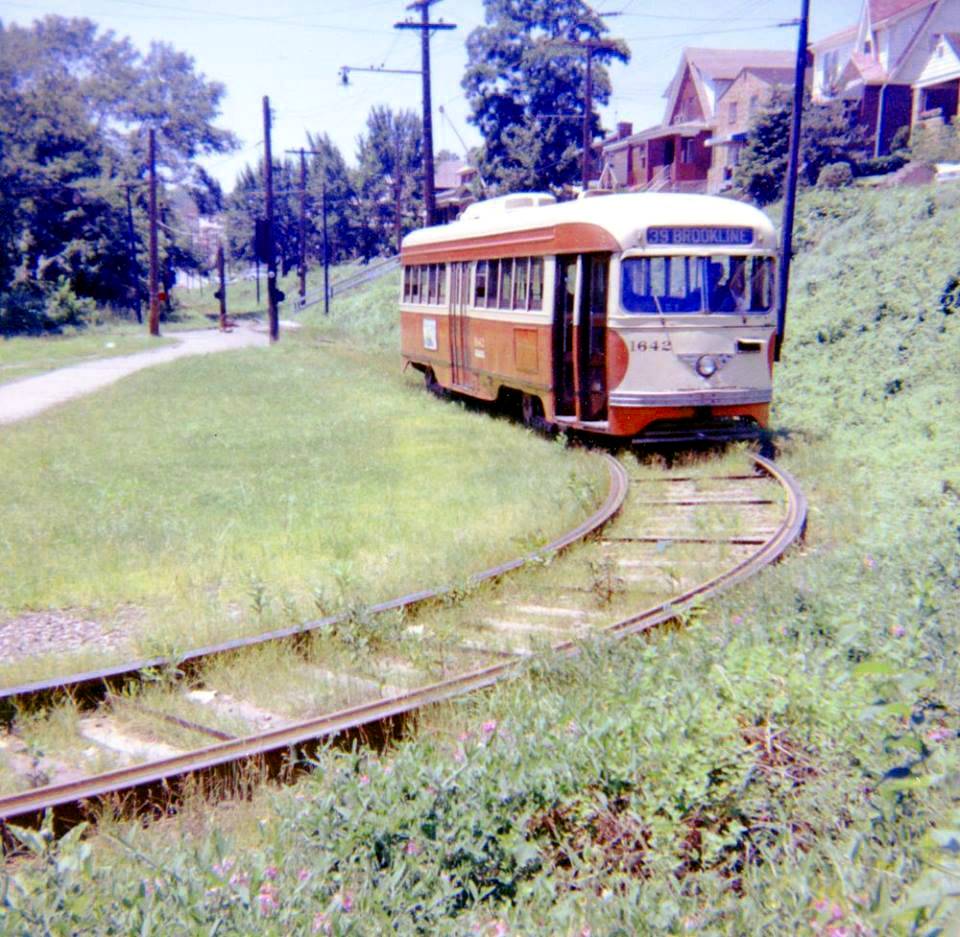
A 39-Brookline at the Brookline Trolley Loop.

Related Links
♦ The Pittsburgh & Castle Shannon Railroad (1871-1915) ♦
♦ The Pittsburgh Railways South Hills Junction - 1904 ♦
♦ South Hills Junction to Brookline Boulevard - 1912 ♦
♦ The Mount Washington Streetcar Tunnel - 1904 ♦
♦ Reconstruction of West Liberty Avenue in 1915 ♦
♦ Reconstruction of Brookline Boulevard in 1935 ♦
♦ Reconstruction of Brookline Boulevard in 2013 ♦
♦ Brookline Junction Trolley Accident - 1930 ♦
♦ West Liberty Avenue Trolley Ramp - 1939 ♦
♦ A Short History of Trolleys in Pittsburgh ♦
♦ A Tragic Bus/Trolley Collision - 1978 ♦
♦ Pittsburgh Railways Company Records ♦
♦ Photos of Trolleys Around Pittsburgh ♦
♦ Pittsburgh Light Rail Photo Gallery ♦
♦ The "T" Light Rail Transit System ♦
♦ The Skybus Project in the 1960s ♦
♦ Pittsburgh Motor Coach Company ♦
♦ PAT Bus Service in Brookline ♦
♦ Trolley Parks in Pittsburgh ♦
♦ Pittsburgh's Old Inclines ♦
♦ Pennsylvania Trolley Museum ♦
♦ Wikipedia: Pittsburgh Light Rail ♦
♦ Wikipedia: Pittsburgh Railways Company ♦
♦ Wikipedia: Port Authority of Allegheny County ♦

♦ Pittsburgh Light Rail Transportation
History ♦
(including video of the Brookline Route)
American Motor Coach Association
of Pittsburgh
Transit History Links
♦ The Formation of PAT (1956-1964) ♦
♦ The Early Years At PAT (1964-1972) ♦
♦ Pittsburgh Area Transit History Index ♦
Transit Companies
That Made Up Pittsburgh Railways
♦ Pittsburgh Railways Company Books ♦
♦ History of the Southern Traction and Underlying Companies ♦
♦ History of the Suburban Rapid Transit and Underlying Companies ♦
♦ County Railway Companies Incorporated Under Focht-Emery Bills - Vol I ♦
♦ County Railway Companies Incorporated Under Focht-Emery Bills - Vol II ♦
♦ County Railway Companies Incorporated Under Focht-Emery Bills - Vol III ♦
♦ Allegheny County Street Railways Extending Service (6/8/01-10/1/03) ♦
♦ History of the Consolidated Traction and Underlying Companies - Vol I ♦
♦ History of the Consolidated Traction and Underlying Companies - Vol II ♦
♦ History of the United Traction and Underlying Companies - Vol I ♦
♦ History of the United Traction and Underlying Companies - Vol II ♦
♦ History Street Railway Companies (6/8/01-2/25/02) ♦
♦ History of Pittsburg Railways and Underlying Companies ♦
♦ List of the 280 Companies That Made Up Pittsburgh Railways ♦
(as of October 25, 1906)
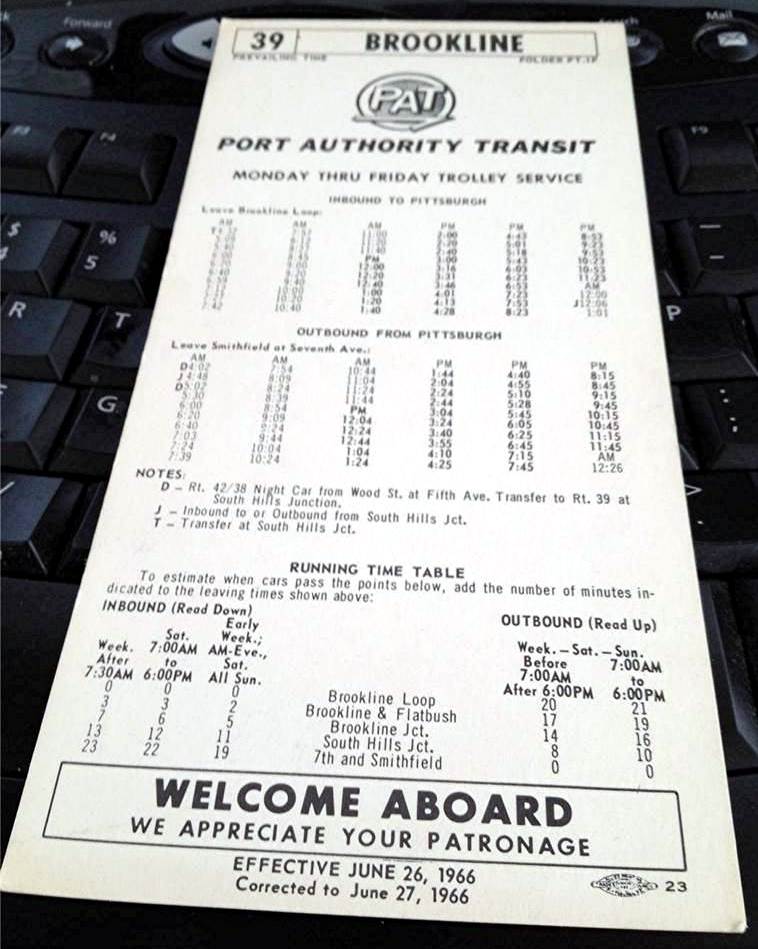
Are They Called
Streetcars Or Trolleys?

There is some debate over whether the
proper term for the vehicles that ran the rails on Pittsburgh streets were
called "Streetcars" or "Trolleys."
The answer is ... both!
The official
terminology might sound a bit strange:
A TRAM (also known as a tramcar; a
streetcar or street car; and a trolley, trolleycar, or trolley car) is a rail
vehicle which runs on tracks along public urban streets (called street running),
and also sometimes on separate rights of way. Trams powered by electricity,
which were the most common type historically, were once called electric street
railways. Trams also included horsecar railways which were widely used in urban
areas before electrification.
For a more detailed history
of trams, visit Wikipedia (Trams).

One of the old-time Car Stop signs that hung
along overhead wires around Pittsburgh.
Just to throw a further element into the
"streetcar" or "trolley" debate, many of the old turn-of-the-century advertisements
for Brookline speak of the Transit Line and the fine "transit cars" that helped link
the neighborhood to the city of Pittsburgh. So, when in doubt, the best and most
correct answer is "Tram." However, depending upon the present company one could
choose "transit car," "trolley" or "streetcar" and fit right in with the
crowd.

An inbound 39-Brookline streetcar approaches
Carson Street in 1963.
Original Brookline Souvenirs
In 1907, during the initial residential
building boom in Brookline, the Freehold Real Estate Company offered solid sterling
silver commemorative spoons to homebuyers. With respect to the Pittsburgh
Railways streetcar line that brought this new prosperity to the emerging community,
the ornate spoons featured an image of a trolley along with the name
"Brookline."
A few of these spoons, now over a century
old, have survived the test of time, like the one shown here. These spoons were
the very first commemorative Brookline souvenirs ever offered, and a prized piece
of our community's streetcar heritage.

The Brookline Herald was a Pittsburgh Press
insert that ran for a few weeks in October 1907. The Herald ran a small contest in
the October 20 issue, and some of the prizes offered were commemorative spoons
like the one shown above.
The contest winners were published in the
October 27 issue. Both editions are shown below. Could the spoon shown above have
been one of those lucky spoons?
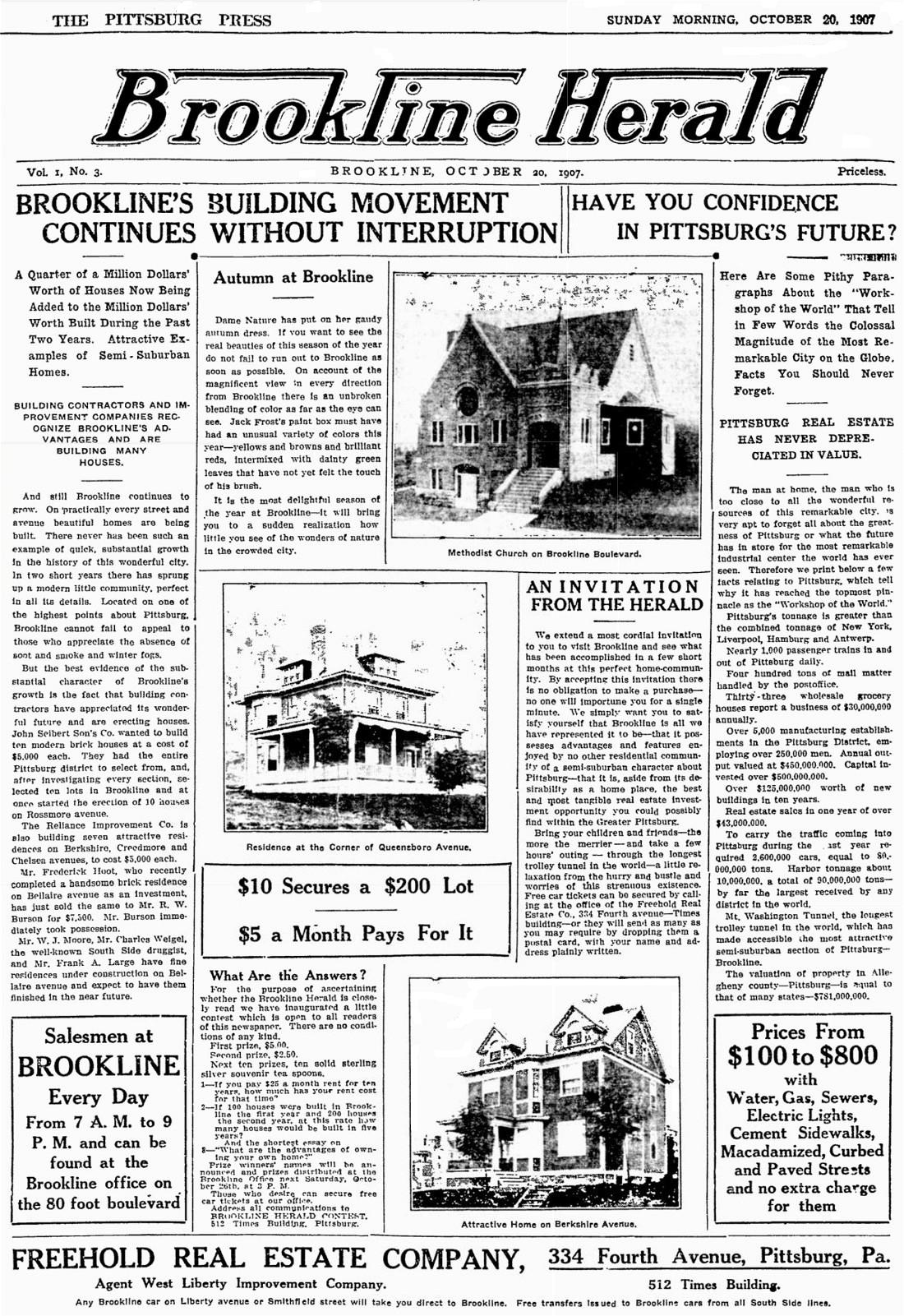 
The October 27 issue of the Herald also reminds
readers that Brookline is only fifteen minutes from downtown Pittsburgh via the
transit tunnel, and the new high-speed electric railway will cut that time in
half. What an excellent reason to invest in Brookline!
Digging Up The
Past - 2014
Beginning in February 2013, Brookline
Boulevard was the site of a seventeen month reconstruction and renovation effort. The project included infrastructure improvements
like new sidewalks, overhead lighting and signage. The highlight of the project
was the repaving of Brookline Boulevard from Starkamp Avenue to Pioneer
Avenue.
Although, in the end, the reconstruction
effort unveiled a picturesque new boulevard, the process of getting to that point
was a difficult and frustrating experience for the merchants and
motorists.
Work was halted in November due to the
onset of winter, and by the spring of 2014 the cold months had taken quite a
destructive toll on the boulevard. Enormous potholes turned the road surface
into a veritable moonscape. Mastery in the Art of Pothole Dodging has become
a pre-requisite to anyone brave enough to run the gauntlet.
In the midst of this urban chaos
came one award-winning pothole. The old-school strut-shocker was
spotted on April 7, 2014. It wasn't the size that made it stand out. Although
it was large, it paled in comparison to some of the truly abyss-like crevices
nearby.
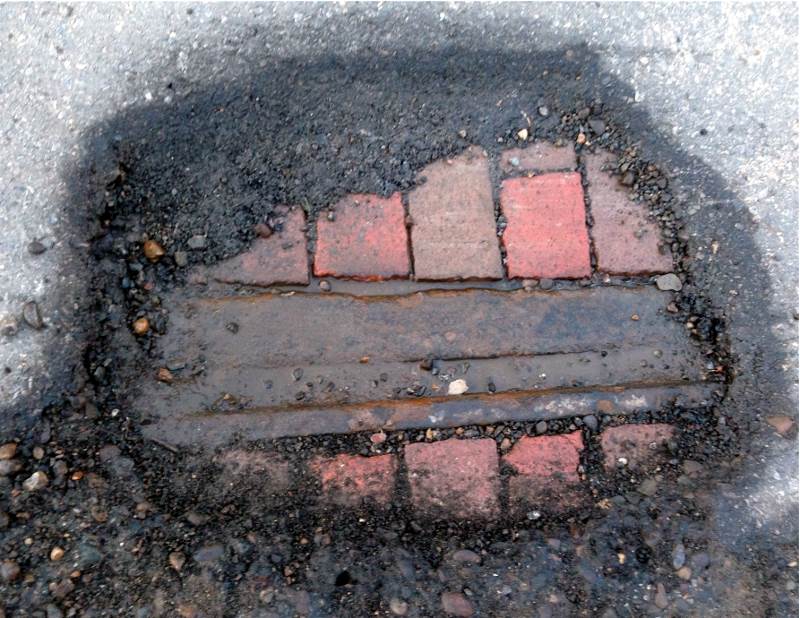
Brookline Boulevard's Pothole to the
Past.
What gave this pothole character was
the old red paving brick road surface and the trolley track. This historic
part of Brookline Boulevard has been in place since the early 1900s. In 1966,
when the trolley line was discontinued, it was paved over in asphalt.
Forty-seven years and five inches of
asphalt later, the forces of nature, accompanied by liberal amounts of rock
salt, brought this bygone part of Brookline Boulevard back into the light of
day, if only for a few days. The following day it was paved over with cold
patch.

The old bricks and tracks were
brought back to the surface in June 2014.
In June of 2014 the reconstruction
project reached it's final phase, and the roadway was completely milled down
to the bricks, exposing the complete length of the trolley tracks that ran down
the center of the boulevard. Once again, the old red bricks and tracks were
exposed.
After this brief glimpse back to the
glory days of Brookline's transit history, the paving company out a fresh layer
of asphalt on the boulevard and, just like that, the tracks were once again
buried. It may take another fifty years before they see the light of
day.
<><><><> <><><><>
<><><><> <><><><>
<><><><>
During the early 1900s, the U.S. Post Office
Department operated Railway Post Offices (RPOs) on streetcars in several cities,
including Pittsburgh, to carry mail between post office branches. Postal clerks were
stationed aboard the cars to sort the mail and speed processing at the post offices.
Some interurban routes also served as RPOs.
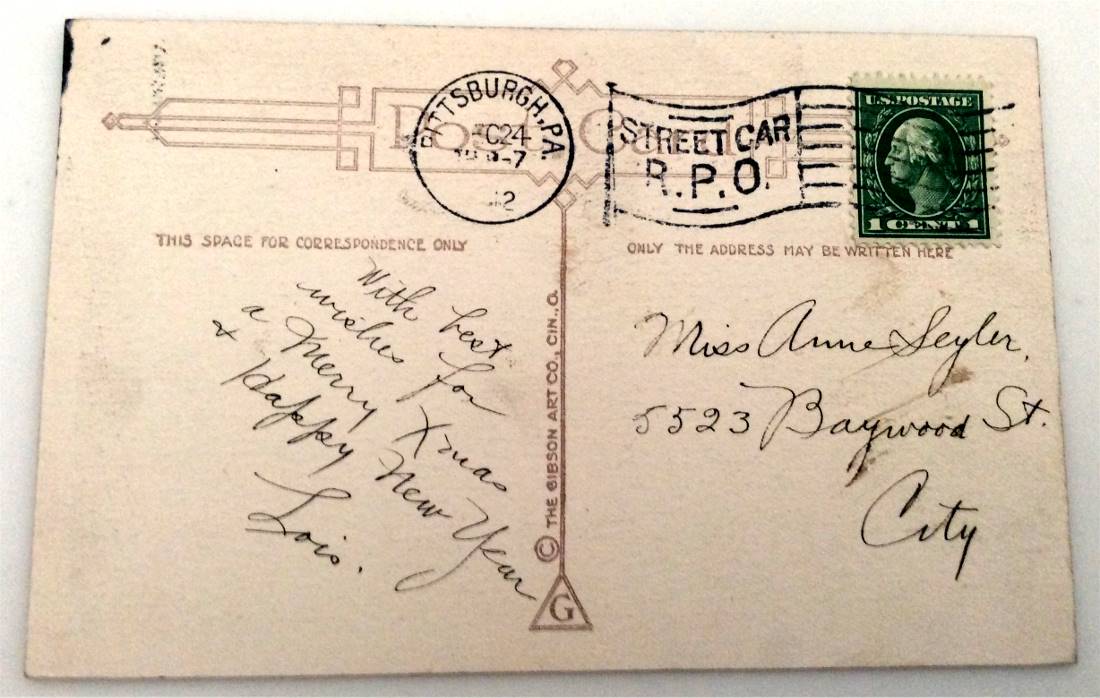
People could deposit mail on these cars,
sometimes via slots in their sides. The clerks would postmark that mail on the spot
while the car rolled. Shown here is an example of one such postcard with a Pittsburgh
Streetcar RPO cancellation stamp postmarked Dec 24, 1912, that was found in an old
scrapbook by former Brookline resident Bill Mullen.
It is unknown if a Railway Post Office
was ever attached to the 39-Brookline route, but the postcard above is an
interesting sliver of Pittsburgh Railways history.

There was a time when conductors would issue
change for fares. Streetcars were equipped with a standard coin dispenser and transfer
holder. The policy of conductor's carrying loose change ended in 1968.

A couple years ago, Jeff Wilinski called
to say he'd come across this streetcar passenger counter in an old box when preparing
to move. It still worked, and rather than throw it away he donated it to the
Brookline Historical Society. It's just another example of the many places where
we can find our hidden past. Let's dig it up, folks.

Models Of The 39-Brookline
And South Hills Junction
 
A replica of the 39-Brookline trolley made
by Dr. Michael Brendel.
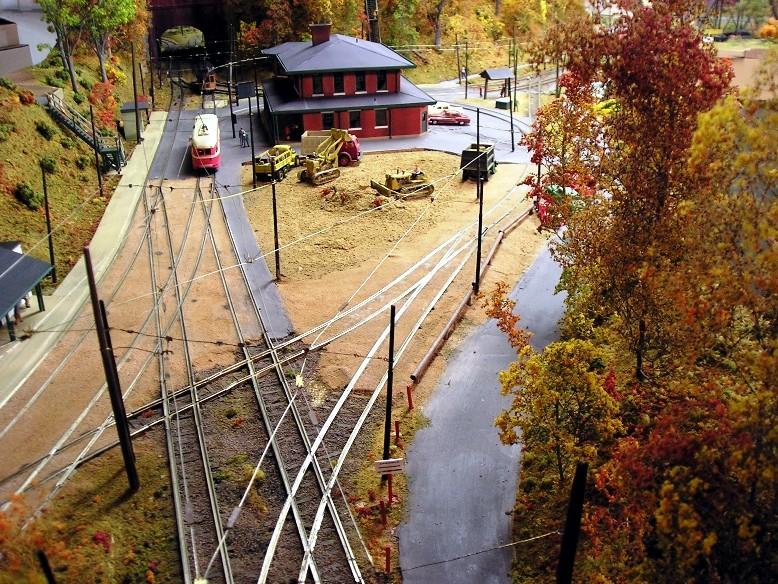
A model layout of the South Hills Junction
by Bob Dietrich. For more Junction model photos, click here.
We are always looking for old
photos and information on trolleys in Brookline.
If you have something to share, please contact us via our guestbook.
* Compiled from
various sources, including the Press and Post Gazette - Last Updated: April 20, 2015 *
* Several of the Brookline trolley photos are from the collections of Tom Castriodale
and George Gula *


A Short History
On Trolley Service In The City Of Pittsburgh
Pittsburgh's trolley history dates
to the 1850s when the State Legislature passed a law allowing "motor power
companies" to operate passenger railways by cable, electrical or other means.
The first passenger service was a horse-drawn trolley that operated in East
Liberty in 1859. Since then, the city has been at the forefront
of trolley transportation.
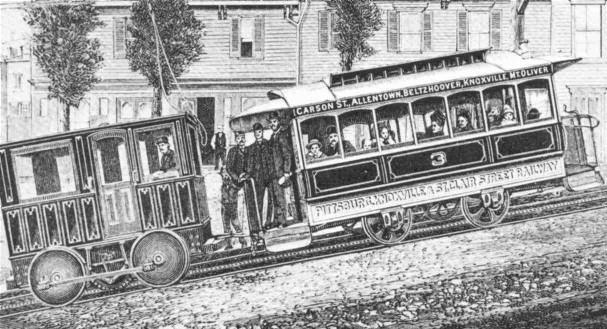 
A cable trolley in Allentown (left) and
a horse-drawn trolley on Warrington Avenue in 1859.
JUNE 1887: Pittsburgh Traction Company
constructs a cable line beginning at the foot of Fifth Avenue and running east
along Shady, Penn and Highland Avenues, a distance of 5.5 miles. The line
opens for passengers on September 12, 1889. Various cable lines operate in the
City of Pittsburgh until 1897.
THE LATE 1890's: The first
electric line is constructed from South 13th and Carson streets to
Knoxville Borough. That is followed by development of successful and
consistent electric trolley service on the North Side and the South Side.
In the ensuing years, competing lines are built by 190 trolley operators
in the city. The wooden trolley cars have four wheels.

A Pittsburgh Traction Company
cable line loop, located at
Fifth and Liberty Avenues in 1890.
"It was really a hodgepodge," says
Scott Becker, executive director of the Pennsylvania Trolley Museum in
Washington, near the Meadowlands.
JUNE 1901: Pennsylvania's Focht-Emery
Transit Bills are signed into law, opening a rush of investors wishing to
form new transit companies throughout the region to compete with the established
passenger railways. The sweeping domain and financial powers granted under the
new legislation fuel the expansion and modernization of Pittsburgh's public
transportation system. The bills also led to rampant stock fraud.
JANUARY 1, 1902: Pittsburgh Railways Company, a subsidiary of the Philadelphia Company, is
formed on June 8, 1901 as a result of the transit bills to consolidate the
increasing number of transit companies in Allegheny County. There are 1100
trolleys in operation along 400 miles of single track. Yearly ridership totals
178.7 million passengers with revenue of $6.7 million.
 
 
The first generation electrified traction
cars were wooden cars covered in steel-sheeting, sometimes referred to as "box cars."
They were built by the St. Louis Car Company at a cost of $6000 each and introduced
in Pittsburgh during the winter of 1902.
The eight-wheelers were forty-seven feet long
and powered by four fifty-horse power motors. The cars had high floors, narrow doors
and sat forty-four passengers on wooden seats. They could be driven from either side
of the vehicle by moving directional controls and electrical guide wire from one end
to the other.

DECEMBER 1, 1904: The Mount Washington Transit Tunnel a 3,500 foot bore through Mount Washington, opens
to traffic. The tunnel, from the South Hills Junction to Carson Street, was built
at a cost of $875,000. The inner walls were lined with 12,000,000 bricks. This
tunnel, along with the Corliss Tunnel (1914) on the West End, led to real estate
booms in both the South Hills and Sheridan areas, respectively.
A Philadelphia Company executive called it
"one of the greatest works ever undertaken in the street railway business. The
project will be the making of the South Hills." He was correct. In a span of just
one year, three farms in Brookline increased in valuation from $68,000 to $1.3
million.
The standard turn-of-the-century
streetcar has eight wheels, high steps and narrow doors. This makes traveling
slow and cumbersome, particularly for women whose clothes don't allow them
to negotiate the cars.

A 1905 Freehold Real Estate advertisement
that shows the new trolley line running to Brookline.
OCTOBER 1906: Company records indicate
that there are over 280 subsidiary companies either owned or leased by Pittsburgh
Railways.
1912: Pittsburgh's trolley network
is growing fast and the number of passengers increasing. Because of the
over-crowded conditions during peak times, P. N. Jones, head of Pittsburgh
Railways, leads the effort to produce a standard car. The city tries out
double-decker cars. About a dozen were built between 1912 and 1924, but
they never really catch on in Pittsburgh.

1915: Pittsburgh Railways decides
that the new, low-floor Jones Car, built in McKees Rocks, with its sloping
floor is going to be its standard car. The company purchases 1000 of them
between 1915 and 1927. The steel cars run on 600 volts of direct current
and feature rattan seats, beautiful woodwork, windows that open and shaded
light bulbs. The cars are well-received by the public.
The trolleys are painted orange
but their color fades to yellow, prompting most people to call them
yellow trolleys. They are used in Pittsburgh until the mid-1950s, when
many trolleys are phased out in favor of buses.
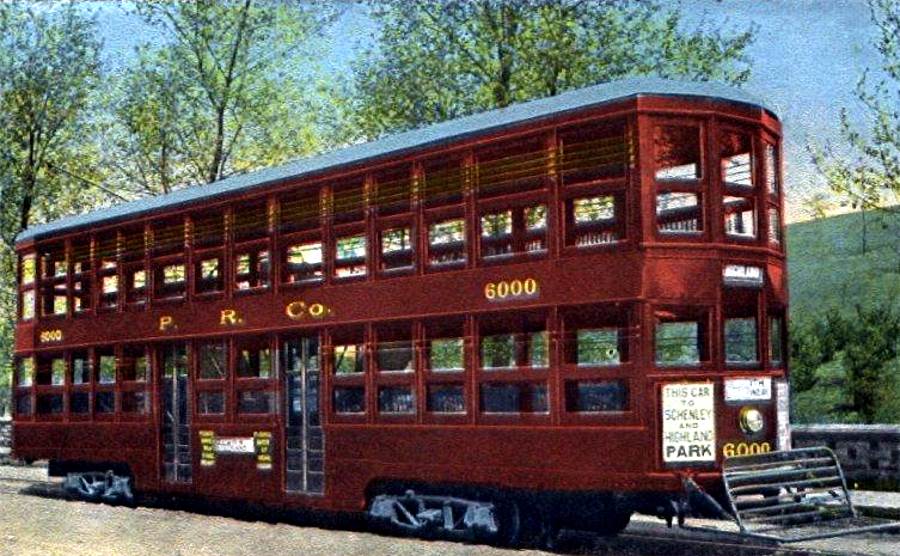
Pittsburgh Railways
Double-Decker.
In the ensuing years, Pittsburgh
Railways experimented readily with a variety of cars, testing aluminum,
fiddling with control systems and trying a number of options with
wheels.
1918 - The Pittsburgh Railways Company
files for bankruptcy. Negotiations with the City of Pittsburgh drag on for
six years. Valued at $62.5 million, the companies credit obligations are
settled and a city Board of Advisors appointed to oversea the company
management. The Pittsburgh Railways Agreement goes into effect in April
1924 to keep the streetcars rolling.

An outbound Dormont streetcar on West Liberty
Avenue, passing the southern end of Pioneer Avenue in 1918.
 
Long-time Pittsburgh Railways conductor
Owen Richard McCaffrey Sr. of Overbrook, pictured in the early 1920s.
1926: Pittsburgh
Railways operates 590 miles of single track; carries 396,679,675
passengers a year and has revenue of $21.7 million.
1928: Pittsburgh Railways begins
producing high speed trolleys for its interurban lines that run to Washington
and Charleroi. The company makes fifteen cars that are painted red and feature
bucket seats.
Portions of the Charleroi Short Line remained
in service until September 4, 1999 as the Port Authority's "Library" Light Rail
Transit line. A portion of the Washington line survived as the "Drake" or Overbrook
line, service that ended in the late-80s and began again in 2004.

THE 1930s: Pittsburgh, like the
country, is in the depths of the Depression. Pittsburgh Railway is losing
ridership, but the company does not lose its tradition of supporting
innovation. The company is enthusiastic about the ideas for a new car
being developed at the request of the American Electric Railway
Association Advisory Council.
The plan for the car's development is
overseen by the Electric Railway Presidents Conference Committee, which
turns to Pittsburgh's Westinghouse Company for help designing the
revolutionary new car.

JULY 26, 1936: The first
Presidential Conference Committee car, # 100, goes into service in the
city. Pittsburgh Railways, trying to lure Depression-weary riders back to
the trolleys, promotes the car in newspaper advertisements and on
sandwich boards and with demonstration rides. Car #100 becomes the first PCC
car to carry passengers for a fare on September 26, 1936, when it covered
the 50-Carson Street Route.
FEBRUARY 4, 1937: The first 100 PCC
enter the Pittsburgh fleet. The new cars were used on the 38-Mt. Lebanon
route.
 
The inside of a PCC car, looking
towards both the front and rear.
Over the next twelve years, Pittsburgh
Railways orders 666 of the cars, at a cost of $28,000 apiece, from the St. Louis
Car Company to replace the oldest trolleys in the fleet, which still included
several of the original 1902 model high-floor trolleys. The new PCC streetcars
were painted in a red and cream color scheme.
1938: The financially struggling
Pittsburgh Railways Company files for bankruptcy. The reorganization effort
between the transit agency and the City of Pittsburgh drags on for thirteen
long years.

The first inbound trolley to use the
West Liberty Avenue trolley ramp was photographed on August 15, 1939.
1939: Due to the growing vehicular
congestion at the busy intersection of West Liberty Avenue and Saw
Mill Run Boulevard, a new trolley ramp was constructed along the lower end of West
Liberty Avenue. This diverted the 39-Brookline and 38-Mount Lebanon trolleys
from the crowded junction and on to the line used by Dormont and Beechview
trolleys.
The cost of the new ramp was $347,000.
It opened to traffic in August 1939. The Brookline and Mount Lebanon trolleys
now used the West Liberty ramp to connect to the Palm Garden Trestle on their
way towards the South Hills Junction.
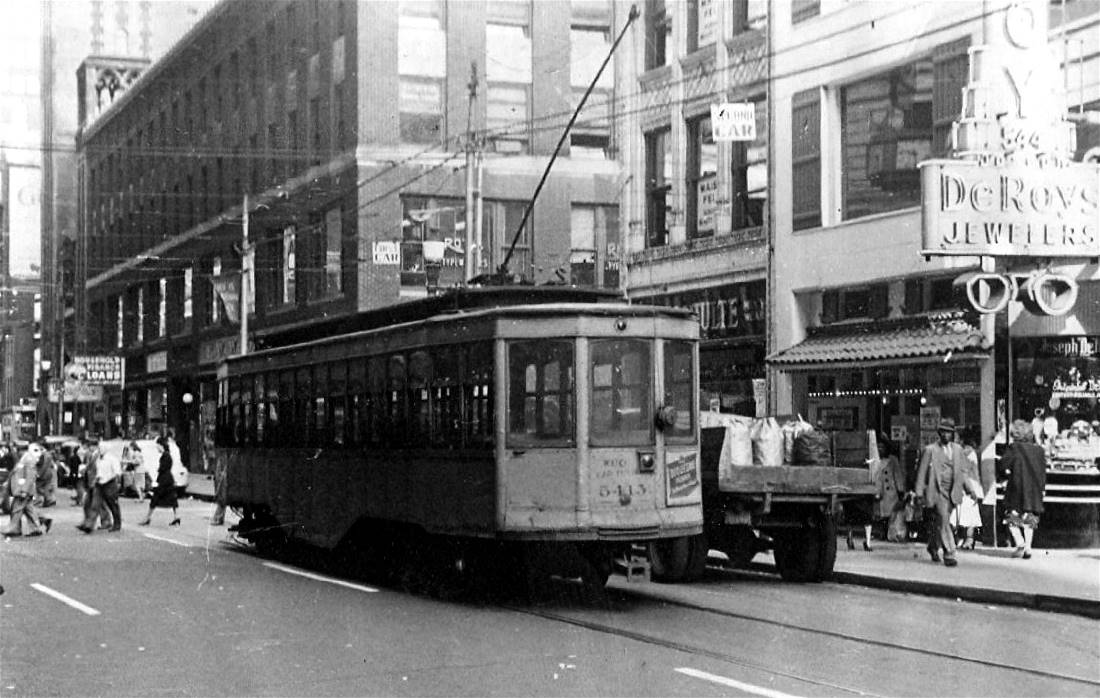
One of Pittsburgh Railways "Jones Cars"
downtown on Smithfield Street (circa 1945).
APRIL 2, 1940 - Pittsburgh Railways
receives a shipment of 100 new cars from the St. Louis Car Company, bringing
the fleet total to 301, the largest single fleet in the nation. Seventy-two
of the new cars were equipped with the latest Westinghouse motor and braking
systems. The cars enter continual service for the first time on the 39-Brookline
and 42-Dormont/Beechview routes.
1949: The Pittsburgh Railways PCC trolley
fleet is the 2nd largest in the country. Only Chicago, which operates 683 cars,
is bigger.

JANUARY 1951: Pittsburgh Railways, the
City of Pittsburgh and Allegheny County reach an agreement to end the thirteen
year company reorganization. The cars keep rolling, but changes in public
transportation will soon threaten the existence of the mighty
rail network.
SUMMER, 1953: Interurban trolley service,
which had boomed during the World War II and Korean War years, is scaled back to
the border of Allegheny County.

Map of South Hills Trolley
Lines.
MARCH, 1964: The Port Authority of
Allegheny County is formed to unify all public transit services. Despite the
declining trolley use, the authority inherits the Pittsburgh Railways fleet
of 283 PCC trolley cars and 219 buses.
1964 to 1967: Many rail routes are
converted to bus routes, including the 38-Mount Lebanon and the 39-Brookline
route, which made its final run on September 3, 1966.
1968: The Port Authority is
operating fifty-eight miles of track, only ten percent of the
Pittsburgh Railways network that was in operation forty years
earlier.
 
Many South Hills lines were replaced with
bus service, including 38-Mt.Lebanon and 39-Brookline.
The rails and passenger kiosks along West Liberty Avenue were
removed.
1972: The ninety-five remaining
PCC cars servicing the South Hills get new paint jobs, including one with
a psychedelic look.
LATE-1970s: An attractive feature that
was introduced at the time was a new advertising scheme. Trolleys could be
corporate sponsored and decorated at will. Soon, many of Pittsburgh's trolleys
took on a new look. Some of the memorable designs that stood out were
the Pittsburgh Steeler's Terrible Trolley, the Bicentennial Spirit of America,
the Clark Bar and the Gateway Clipper Triple Treat.
 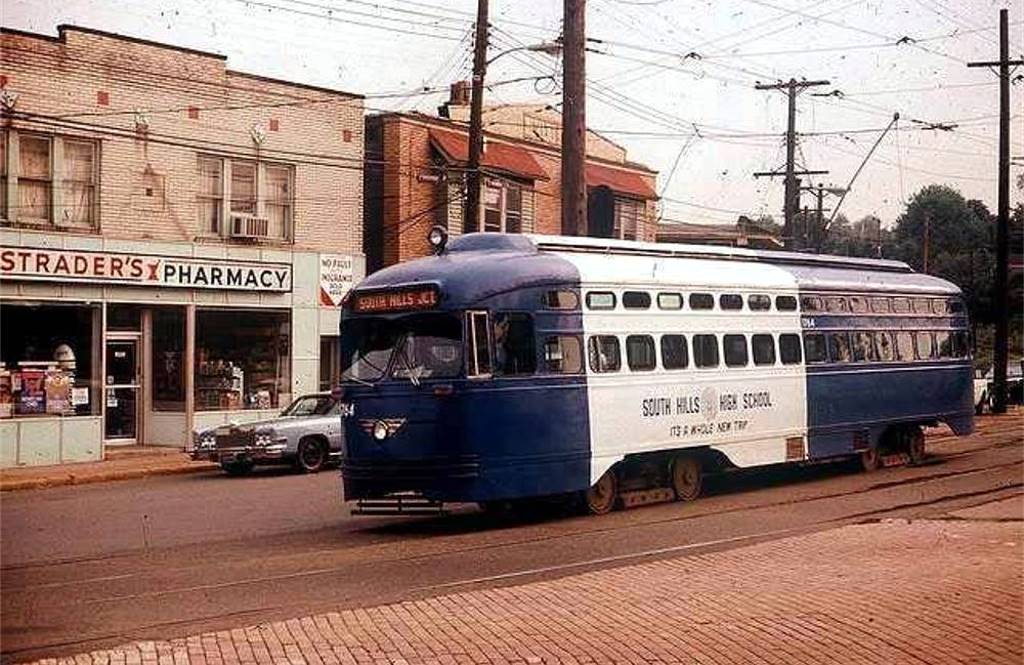
1981: The Port Authority plans to
refurbish forty-five PCC trolleys for use on the city's new "T" Light Rail
System. The $763,000 cost is prohibitive and only twelve are completed
before the program is abandoned in 1987.
JULY 3, 1985: Trolley street
operations in the Golden Triangle cease when the downtown subway, part of
the Light Rail "T" System, is opened. All above ground tracks in
downtown Pittsburgh are eventually removed or paved over.
The only rail routes that remain
in operation are part of the new Light Rail System. They are the
Beechview/South Hills Village line, the Warrington/Arlington line and the
Library extension. Soon, the only route still using the aging PCC trolley
cars was the Library line.
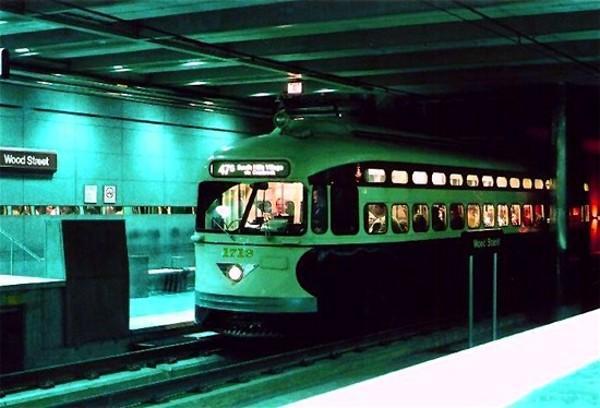
A PCC trolley at the Wood Street
Subway Station in 1985.
AUGUST 1, 1988: thirty-six PCC cars
are removed from operation because of deteriorated electrical wires.
Twenty-seven of those are retired and used to supply parts for the few
that remained in operation along the Library line.
SEPTEMBER 4, 1999: The final PCC
car makes the 4.4 mile Library extension run before the route was retired
forever, being replaced by a shuttle bus. The three remaining functional
PCC cars, all having logged well over 2,000,000 miles, were donated to
trolley museums.

A PCC car stands outside
the trolley museum in 2007.
JANUARY 2000: Pittsburgh no longer has
hundreds of miles of trolley track lining the streets, but the city still boasts
a state-of-the-art Light Rail system servicing the downtown area and South
Hills, including Beechview, Dormont, Warrington Avenue/Arlington Heights,
Castle Shannon, Bethel Park and Library.
JUNE 2004: The Port Authority
completes the four-year reconstruction the old Shannon Drake line, bringing
light-rail service back to Bon Air, Overbrook, Brookline and along Library Road
in Castle Shannon. Three bridges along the route were completely
rebuilt.
MARCH 2012: The downtown subway's
North Shore Connector, beginning at Gateway Station and including a twin tunnel
bore under the Allegheny River, opens to traffic. Passenger stations are
located near PNC Park, Heinz Field and the Rivers Casino.
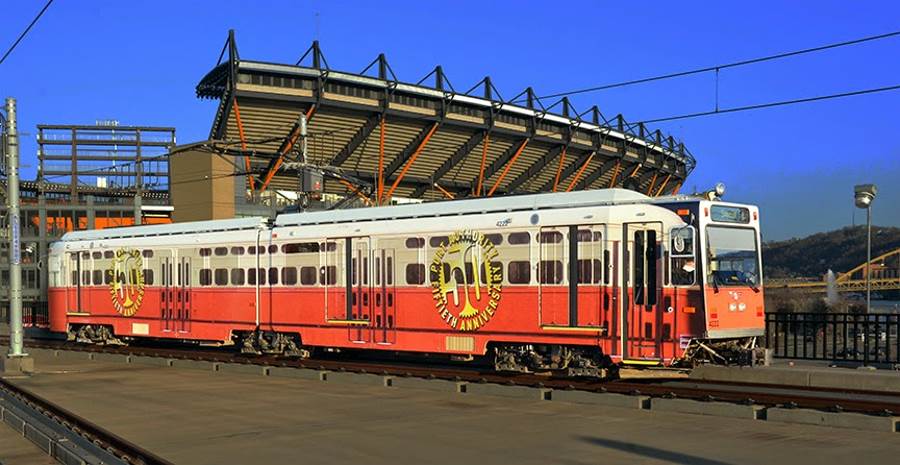
In 2014, a few of the modern light-rail
cars were painted to resemble the old PCC streetcars
as part of the Port Authority's 50th Anniversary celebration.
Pittsburghers love their trolleys.
From the horse-drawn carriages of the 1800s to the new "T" Light Rail
cars that carry us into the 21st Century, our proud city will
always have a rail system to ferry passengers to and from the downtown
area.
For more information on the history of
trolley service in Pittsburgh, visit the Pennsylvania Trolley Museum at the Meadowlands.
The number to call for information is 877-PA-Trolley or 724-228-9256.

An inbound 39-Brookline streetcar crosses the
intersection at Breining Street headed for the trolley loop in 1966.
A Tragic Day For Brookline
Transit Riders

On the morning of February 10, 1978, one
of Pittsburgh's most horrific public transit accidents occurred near the Palm
Garden Bridge along the Port Authority's recently completed South
Busway.
A near head-on collision between an
inbound 41D-East Brookline bus and an outbound Mt.Lebanon/Beechview streetcar
resulted in the tragic toll of four dead and twenty-eight injured, most of whom
lived in Brookline.
These photos were taken by Post-Gazette
photographer James Klingensmith, who arrived on the scene as paramedics were
busy removing victims from the wreckage. The newspaper reported the accident
on the Post-Gazette front page the following day.

The probable cause of the violent
collision was a faulty switch along the rail line leading out of the South
Hills Junction car yard. The outbound streetcar reached the switch, which
suddenly flipped to the left turn position leading to a loop off of
the main line. The trolley veered directly into the path of the oncoming
bus.
Upon impact, the bus, which was filled
to capacity with over fifty rush hour commuters, veered to the right off of
the busway. It sheered off a utility pole and came to rest partially atop a
parked car. The incident happened so suddenly that there was no time for
either the bus or trolley driver to react.
The bus driver and three passengers
seated near the front of the vehicle suffered fatal blunt trauma injuries.
The driver died at the hospital and the three passengers were pronounced
dead on arrival. The trolley car was empty except for the motorman
who suffered only minor injuries.
Although a moment of panic ensued
among the stunned and injured passengers on the bus, the calm and quick
thinking of several male passengers aided in an orderly evacuation of the
vehicle.
"Blood was everywhere," reported Michael
Robbins, a passenger treated at Mercy Hospital. "There was no screaming.
Most everyone kept their cool. It was just a lot of moaning and
groaning."
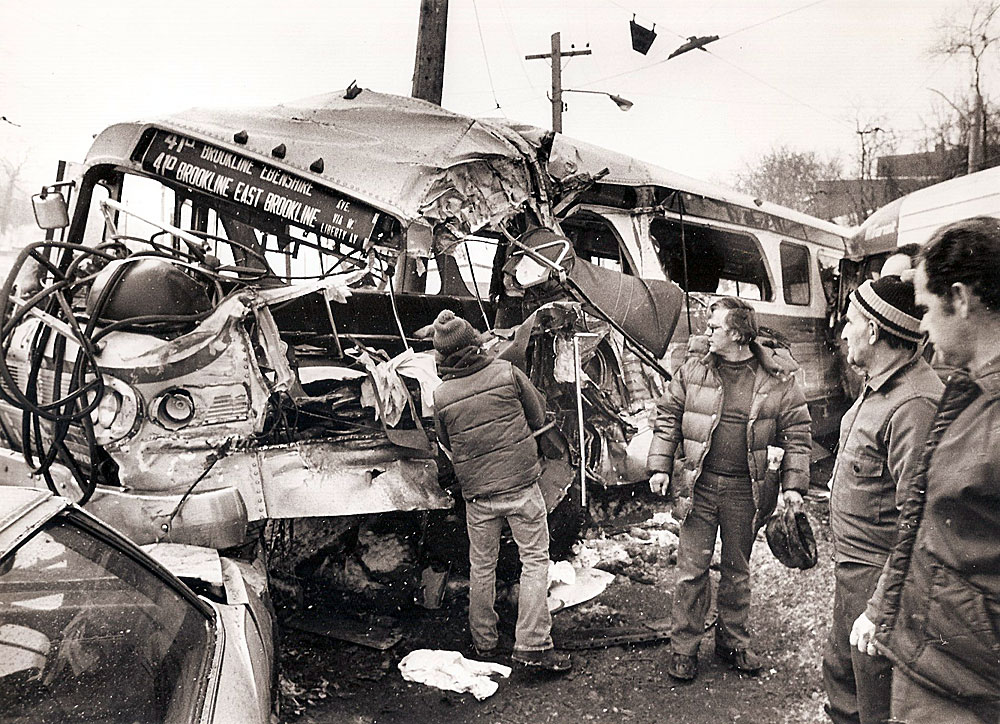
The driver of the bus was Brookline
resident and long-time PAT employee Anthony Petrusky, 55, of 1621 Fiat Street.
Others who suffered fatal injuries were Brookline's Elva Semon, 54, of 2136
Plainview Avenue, Donna Louise Harmon, 21, of 5870 Irishtown Road, Bethel Park,
and Monica Ewansik, 40, of 2447 Saranac Avenue in Beechview.
Brookline travelers with severe to mild
injuries that were transported to local hospitals included Marie Schafer,
Patricia Burgess, Ruth Ann Fabrizio, Mary Pilarski, Linda March, Marjorie
Mitchell, Carla Arpgaus, Aileen Brown, Robert Dunlap, Bernadette Harris,
Sandra Horne, Patricia McDonald, Carol Rosipal, Francis Schell, Lynetta Talak,
William Zwick, Patty Diven, Mila Coccimiglio, Alice Skiba, Michael Robbins,
Mary Ellen Glandville, Frank Lanzetta, James Budd and John Raymond.
Others injured in the crash were
Tracy Lappert and Patricia Goedert of Beechview, Frank Dixon of St. Clair
Village and trolley driver Robert Ray of Bethel Park.
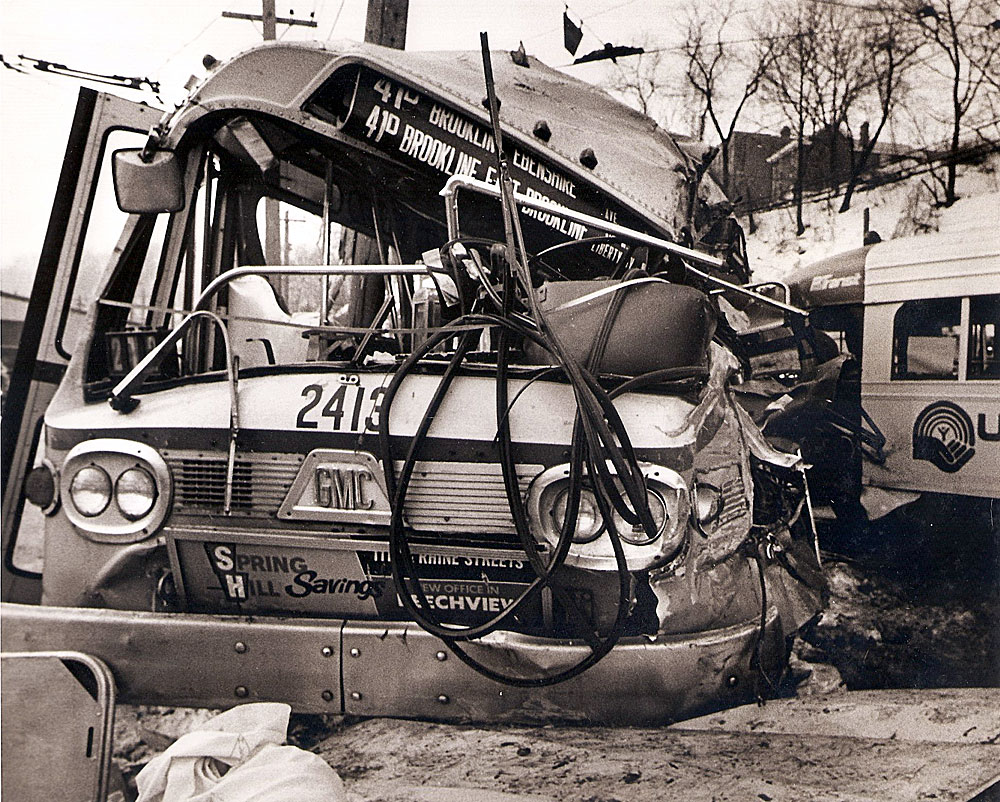
The South Busway had been opened
in December of 1977. At that time concerns were raised about the safety
of having both buses and trolleys passing with such frequency along the
same narrow roadway.
With this accident happening so
soon after the opening, transit safety along the busway was once again
a major concern. Bus traffic was suspended until a thorough investigation
was conducted.
In the aftermath of the investigation,
which yielded inconclusive results, additional safety devices were installed
to prevent any sudden switch malfunctions. Also, procedures were put in place
to eliminate the possibility of vehicles passing so close together in the
vicinity of a switch.

Third Worst Crash In
Pittsburgh Transit History
The fatal bus/trolley collision
on February 20, 1978 was the third worst commuter transit tragedy on
record in the City of Pittsburgh.
The worst accident in Pittsburgh's
mass transit history came on Christmas Eve, 1917, when a runaway Knoxville
streetcar roared through the Mount Washington Trolley tunnel and overturned
at Carson Street. Twenty-one people were killed and scores of others were
injured.

Pittsburgh Railways streetcar lies overturned
at Carson and Smithfield Street - December 24, 1917.
On November 14, 1944, five people
were killed and thirty-five injured when two Pittsburgh Railways streetcars
collided in a heavy fog near the old Munhall Junction.
The outbound Homestead/East Pittsburgh streetcar,
one of the old-style Jones Cars, slammed into the back of a East Liberty/Homestead
PCC car. The impact came with such force that the older trolley, which was loaded
with war workers, telescoped itself over the rear of the PCC car.
 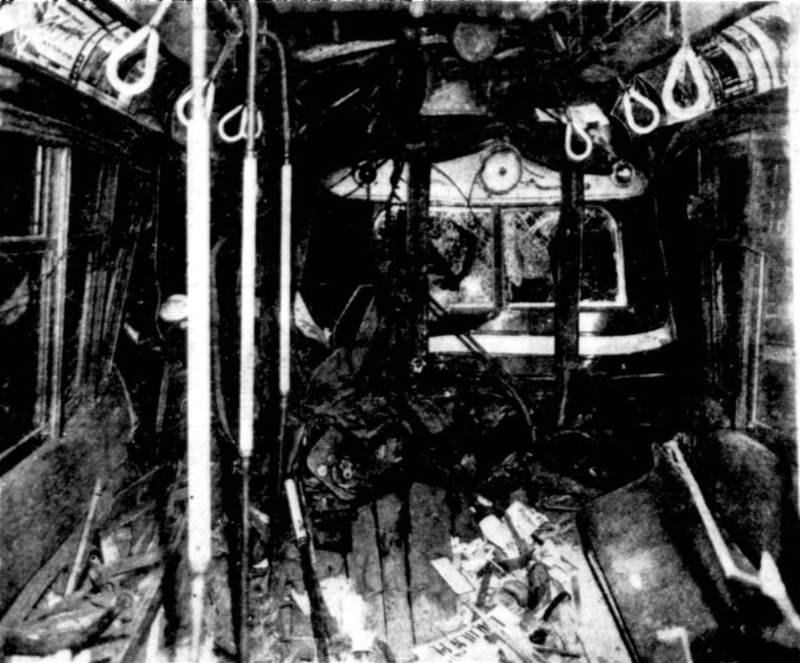
The wreckage of two Pittsburgh Railways trolleys
that collided near Munhall Junction - November 14, 1944.
Another fatal crash that fell to
fourth in terms of human tragedy occurred on March 10, 1959, when a Brentwood Motor Coach bus careened into a
rush hour crowd at Forbes Avenue and Smithfield Street after brake failure. Two
pedestrians were killed and sixteen injured in the accident.
Other Mass Transit Accidents Since
1978
On September 12, 1980, the South Hills
Junction was the scene of another collision, this time between two trolleys.
An outbound Dormont trolley suddenly veered off the main line towards a storage
barn. The car began to rocking and nearly tipped over.
It swayed into another trolley coming
in the other direction. The two cars made sideswiped each other. The second car,
which had no passengers, actually righted the teetering car and prevented it
from falling. Four people were injured in the second switching mishap at the
busy junction.
On Friday, June 26, 1986, the Washington
Observer-Reporter covered a head on collision between two trolleys along West
Carson Street near McKees Rocks. Along a single-track section of line, the
trolleys were traveling slowly in opposite directions around a siding when
the crash occurred.
As the cars approached the siding, an
obstruction blocked the view of the motormen. This led to the collision
slow-speed collision where the drivers and twelve passengers
were taken to local hospitals after suffering minor injuries.
The following year, almost a decade
after the deadly February 1978 bus/trolley collision noted above, another
potentially disastrous trolley accident occurred near downtown. The incredible
crash occurred in almost the same location as the Christmas Eve 1917
disaster.

A runaway streetcar came to a halt along
Smithfield Street after crashing into the P&LERR terminal building.
On October 28, 1987, during the morning rush hour, an inbound streetcar
suffered brake failure as it entered the Mount Washington Transit Tunnel. After
emerging from the lower tunnel portal, the speeding car jumped the tracks.
The streetcar skid across the crowded
Carson Street intersection, sideswiping a bus and a PAT Transit truck before
slamming into the landmark P&LERR terminal building along Smithfield
Street.
Although thirty-three passengers were
injured in the crash, no lives were lost due to the quick thinking of the
motorman, John Stromple, who calmly moved everyone to the rear of the car
and shielded them. Stromple, along with seven other PAT employees, also
suffered injuries in the accident.
Brookline Trolley Jumps Tracks
On Smithfield Street Bridge

On October 4, 1943, the Pittsburgh
Press reported an inbound 39-Brookline trolley's rear tracks split a switch
at Smithfield and Water Streets and spun the car around. Ten persons were
hospitalized while forty others were shaken up when the car spon and struck
a small safety island. The spinning car struck Julia Lacko, of Library, who
was standing on the safety island. She was taken to Mercy Hospital for
treatment of lacerations of the left leg. Passengers taken to the hospital
were not injured seriously.

|