|
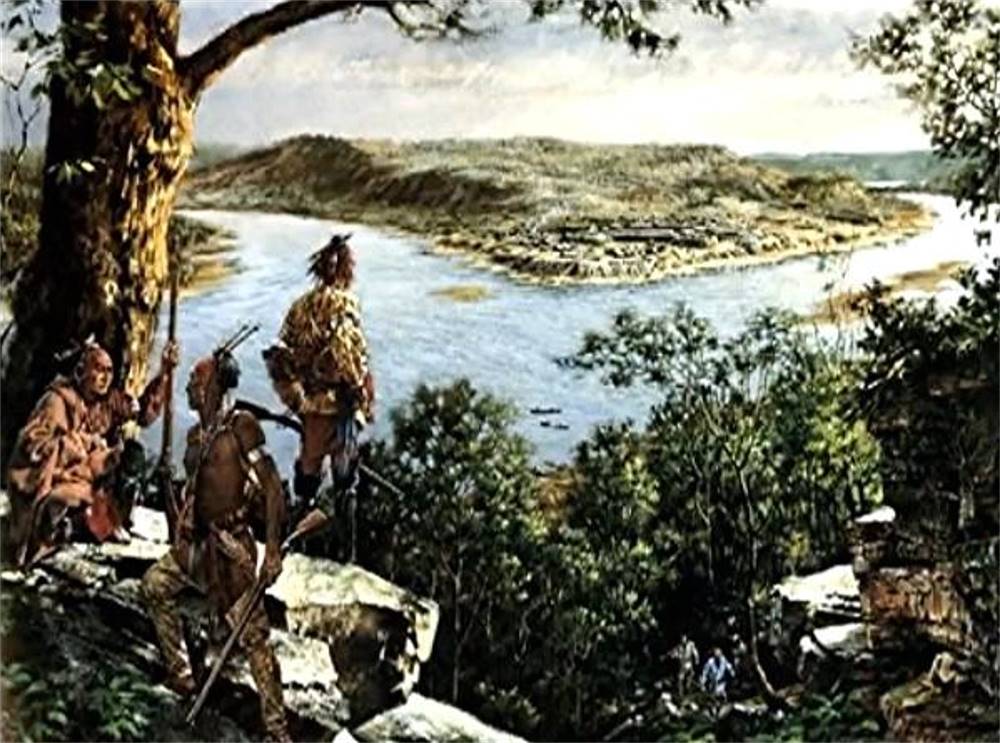
When the French and Indian War ended in February 1763, the British assumed control of vast territories in the Great Lakes region and the Ohio territory. British policies towards the Native Americans in these areas were very strict. This caused much dissent among the various tribes. Soon, the tribal leaders rallied around the Ottawa Chief Pontiac and began an open rebellion against the British. Pontiac's War began in May 1763 when the Native Americans attacked a number of British forts and settlements. Eight forts were captured, the large bastion of Fort Detroit was besieged, and Fort Niagara was threatened. Thousands of colonists were killed or captured, and many more fled the region. From May 27 to August 20, 1763, as the conflict swept across the Old Northwest, 600 frightened settlers and a garrison of 125 determined British soldiers, led by Captain Simon Ecuyer, a professional Swiss soldier of the Royal American Regiment, were under siege at Fort Pitt.
The Indian attacks began near Pittsborough on May 27 along the Youghiogheny River, near West Newton, when a family and most of its servants were killed. Two soldiers were killed near Fort Pitt two days later. Refugees began fleeing to the fort. By the end of May, in addition to the 125 Royal American regulars in the garrison, there were 305 women and children, and another 205 men buttoned up in the fort. More refugees appeared from time to time, telling frightful stories of what they had seen and suffered. Captain Ecuyer worked hard to prepare Fort Pitt for a siege. He burned some two hundred houses and huts between the fort and Grant's Hill to clear the field of fire, and dismantled many more for use to build shelters for the refugees within the fort. He shored up the Ohio bastion, damaged by a recent flood, using barrels filled with earth, bales of deerskins and sharp-pointed poles facing outward.
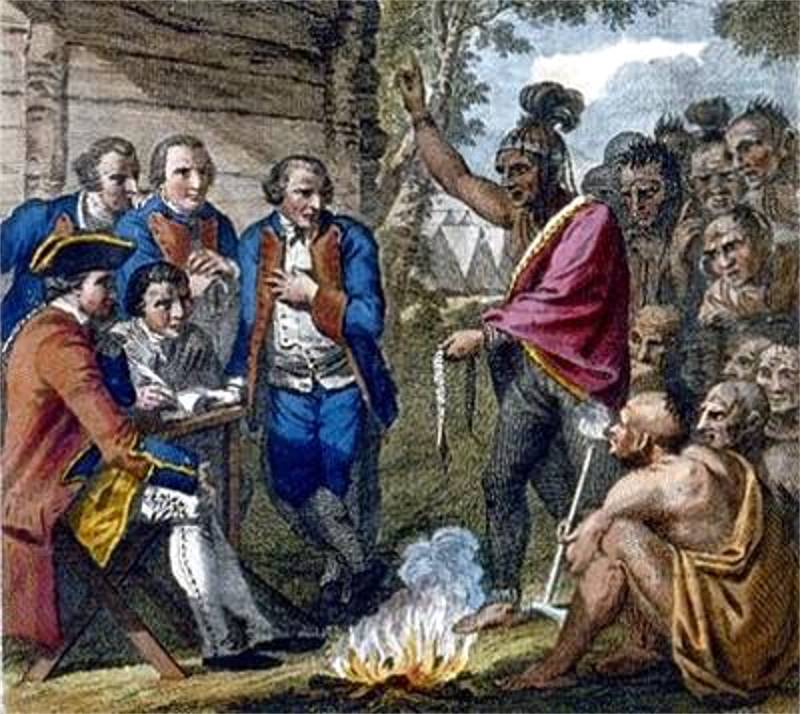
Ecuyer set up a smallpox isolation hospital under the protection of the drawbridge, built a forge and two bake ovens in the fort, placed beaver traps and spiked "crow-feet" in the ditch, and fenced the cattle and horses in an enclosure under one of the walls. He also built a fire engine, placed casks of water about the fort, and trained the women and older children to use the fire buckets to extinguish fire arrows. To the men he distributed tomahawks. Everyone within the walls of the fort were placed on half rations. In a sign of defiance, drums beat reveilli every day at an early hour. The diary of William Trent reports that first heavy attack came on June 22 and was beaten off. Two days later two chiefs appeared before the fort, ceremoniously laid down their weapons, advanced, and "made a speech." The diary of William Trent, trader and militiaman, reported that the braves began by saying that all of the other English forts had fallen and that a great number of warriers were coming to capture Fort Pitt. Out of friendship and regard, the chiefs had persuaded the warriors to delay their attack long enough for everyone in the fort to leave and retire safely to the English settlements.
Captain Ecuyer thanked them, then told them that there would be no retirement and that his soldiers would defend the fort against all of the Indians in the woods, and furthermore that three large British armies (a fabrication) were marching westward to repulse the Indian invasion. The chiefs reported the Captain's refusal and the hostilities continued. The fort was under intermittent siege throughout June and July by Delawares, Shawnees, Wyandots, Huron and Mingoes. Smoke rising in the distance told of houses and barns fired under the rampaging Indians. At times when no Indians appeared near the fort, foraging parties ventured out under guard to gather hay, wheat, corn, and greens.
On July 27, at another such parley, Captain Ecuyer again refused to accept the chief's terms, and answered them in blunt terms. "Brothers," Ecuyer said, "I will advise you to go home to your towns and take care of your wives and children. Moreover I tell you that if any of you appear again about this fort I will throw bombshells, which will burst and blow you to atoms, and fire cannon among you, loaded with a whole bag of bullets. Therefore, take care, for I don't want to hurt you." After this dismissal, the fort was under continuous siege from July 28 through August 3. Indian women and children appeared on the far shores, ready to help carry away the spoils after the fort was defeated. During the attacks, warriors reached the outskirts of the fort several times. Seven people in the fort were killed in the fighting. Captain Ecuyer himself was wounded in the leg by an arrow. Fires on the roofs caused by blazing arrows were successfully extinguished. The defenders most effective weapons were their howitzers and hand grenades, thrown onto the attackers crouching behind the river banks.
The fort was vigorously assailed on several ocassions. The fort was completely surrounded and harrassed repeatedly with fire arrows. A direct assault was not attempted. The Indians hoped to overcome the garrison either by famine, fire or fatigue. The plan was working. After nearly three months, the inhabitants of Fort Pitt were weakening and they were running desperately short of ammunition and supplies. The capture of Fort Pitt would be a devastating blow to the already reeling British. Information about the rebellion filtered slowly east to the British High Command. Once the true scope of the situation was realized, the British acted swiftly. The only hope for rescuing the trapped settlers and soldiers was a relief column, consisting of elements of the 77th and 42nd Highland Regiments, along with the 60th Royal Americans. This force was led by the redoubtable Colonel Henry Bouquet, a Swiss-born professional soldier. His orders were to march west to Fort Pitt, then proceed north and west to reacquire the fallen forts.
The expedition left Carlisle, Pennsylvania, on July 18, 1763. The Indians were aware of Bouquet's force marching west along the Forbes Road and dispatched a strong contingent of warriors to intercept them. On August 5, the advancing column was ambushed near Bushy Run Station, a small stronghold just southeast of Pittsborough. The location where the British put up their defense was known as Edge Hill. On the same day three couriers managed to reach the fort, bringing news that Colonel Bouquet was leading a 400 man relief force to raise the siege. They explained that the column was now less than forty miles away. The Indians around Fort Pitt disappeared, and for four days there was an ominous silence. When the troops did not arrive according to expectations fears arose they have been attacked on their march. In an ominous sign, Indians began appearing on the river banks, shaking bloody scalps and calling triumphantly that they had destroyed the British army.
Meanwhile, at the Battle of Bushy Run, the Indians clashed with Bouquet's column. The battle at first went well for the Indians. On the second day, the British feigned a retreat and drew the attackers into an ambush, where the force was routed. On the tenth of August, another courier reached Fort Pitt, bringing the comforting news that although Colonel Bouquet had been under heavy attack at Bushy Run for two days and a night, the battle was a decisive victory for the British, and a great many warriors were dead on the spot, including two prominent chiefs.
Bouquet buried his dead - 115 men and eight officers, more than one-fourth of his force, and resumed the march to Fort Pitt. In one of the great dramatic scenes of early American history, the red-coated Royal Americans and the Highlanders wearing kilts and tartans came into sight in the early afternoon of August 20. They marched to the fort with drums beating and bagpipes skirling. Colonel Bouquet and Captain Ecuyer, two Swiss mercenaries fighting in the wilds of America, embraced each other. The relief column was surrounded by more than six hundred haggard but jublilant men, women, and children. They had been penned up in the fort for ten weeks and now for the first time were freed of the fear of death or captivity. Colonel Bouquet's triumph, and the lifting of the Siege of Pittsborough, was celebrated throughout the British colonies. Church bells rang all through the night in Philadelphia, and the occasion was praised by King George III. Hostilities in the Northwest continued until October, 1764 when a force of 1150 Pennsylvania militiamen under Colonel Bouquet, now the commander of Fort Pitt, cornered the remaining rebellious tribes in the Ohio Country. After meeting with leaders of the Delaware, Seneca and Shawnee tribes, a peace treaty was signed.
Further west, in the Illinois country, the rebellion continued to a lesser degree. Not until July 25, 1766, when Chief Pontiac traveled to New York, was a formal treaty signed to officially end the war. Chief Pontiac's rebellion and the Native American's attempt to take their country back from the British had failed. The uprising did, however, lead to better relations between the occupying nation and the Northwestern tribes.
To learn more about the
Battle of Bushy Run, |